
AI-Powered Clinical Trial Recruitment Market Report Scope & Overview:
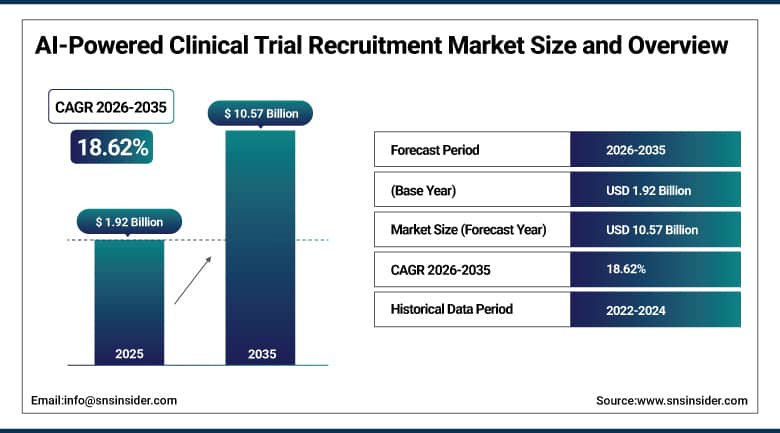
The AI-Powered Clinical Trial Recruitment Market was valued at USD 1.92 billion in 2025 and is expected to reach USD 10.57 billion by 2035, growing at a CAGR of 18.62% from 2026–2035.
The AI-powered clinical trial recruitment market is witnessing strong growth in the global market owing to increasing demand for faster patient enrollment and reduced clinical trial timelines. Rising adoption of artificial intelligence driven patient matching systems is improving recruitment efficiency. Pharmaceutical companies and CROs are increasingly deploying AI tools to reduce dropout rates and optimize site selection processes. Growth in decentralized clinical trials is further supporting digital recruitment platforms. Integration of machine learning and natural language processing is enhancing patient data analysis capabilities. Increasing clinical trial complexity and rising R&D investments are accelerating AI adoption across healthcare research ecosystems.
According to the U.S. Food and Drug Administration Clinical Trial Diversity Action Plans guidance and NIH clinical research enrollment, fewer than 5% of U.S. adults participate in clinical trials, with minority populations often underrepresented at significantly lower proportional enrollment rates.
As per the World Health Organization International Clinical Trials Registry Platform, over 460,000 registered clinical studies are actively tracked globally, with increasing adoption of digital recruitment and AI-enabled patient matching tools across research networks. Additionally, NIH reports indicate that decentralized and digitally enabled trials now represent over 30% of ongoing U.S.-based studies, reflecting measurable growth in AI-supported recruitment systems.
To Get More Information On AI-Powered Clinical Trial Recruitment Market - Request Free Sample Report
AI-Powered Clinical Trial Recruitment Market Trends:
-
Increasing adoption of AI driven patient matching platforms improving recruitment speed, accuracy, and reducing clinical trial enrollment delays globally.
-
Rising integration of real-world data and electronic health records enhancing precision in patient identification across clinical studies.
-
Growing use of machine learning and natural language processing improving eligibility screening and automated patient selection processes efficiently.
-
Expansion of precision medicine and genomic research increasing demand for highly targeted and specialized patient recruitment solutions.
-
Increasing pharmaceutical investment in predictive analytics improving trial planning, site selection, and overall recruitment efficiency globally.
-
Rising digital transformation of healthcare systems enabling scalable, data driven, and AI enabled clinical trial recruitment ecosystems worldwide.
U.S. AI-Powered Clinical Trial Recruitment Market Outlook:
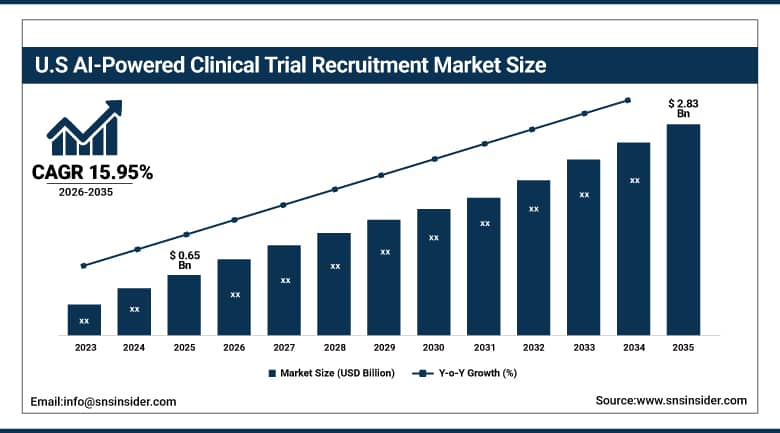
The U.S. AI-Powered Clinical Trial Recruitment Market was valued at USD 0.65 billion in 2025 and is expected to reach around USD 2.83 billion by 2035, growing at a CAGR of 15.95% from 2026–2035.
The U.S. AI-powered clinical trial recruitment market is growing strongly owing to rising demand for faster patient recruitment in clinical trials. Strong presence of pharmaceutical companies and CROs is supporting rapid AI adoption nationwide. Increasing use of electronic health records is improving patient matching accuracy across studies. Deployment of AI driven platforms is reducing recruitment timelines and operational costs significantly. Growth in decentralized clinical trials is further accelerating digital recruitment solutions. Advancements in natural language processing and machine learning are improving patient data analysis. Expanding clinical research infrastructure is further driving continuous market expansion.
As per the FDA’s Digital Health Center of Excellence, more than 80% of U.S. clinical trials now incorporate at least one digital technology such as electronic consent, remote monitoring, or AI-assisted data analysis. Additionally, National Institutes of Health reporting indicates that patient recruitment delays affect up to 85% of clinical trials, supporting increased adoption of AI-driven recruitment optimization systems in 2025.
AI-Powered Clinical Trial Recruitment Market Segment Analysis:
-
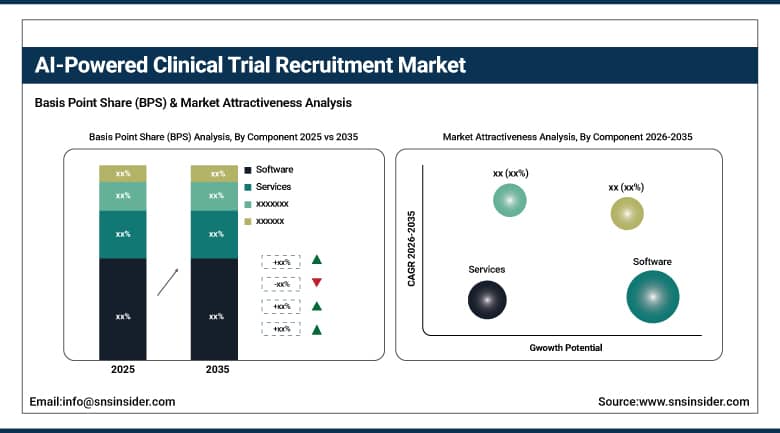
By Component, software dominated the market with 70.20% share in 2025; while services are the fastest growing segment with CAGR of 20.82% during 2026 to 2035.
-
By Deployment Mode, cloud-based dominated the market with 55.40% share in 2025; while software-as-a-service (SaaS) are the fastest growing segment with CAGR of 29.11% during 2026 to 2035.
-
By Technology, artificial intelligence (AI) dominated the market with 60.50% share in 2025; while natural language processing (NLP) is the fastest growing segment with CAGR of 23.76% during 2026 to 2035.
-
By Application, oncology trials dominated the market with 38.60% share in 2025; while rare disease trials are the fastest growing segment with CAGR of 23.17% during 2026 to 2035.
-
By End User, pharmaceutical & biotechnology companies dominated the market with 58.70% share in 2025; while contract research organizations (CROs) are the fastest growing segment with CAGR of 22.34% during 2026 to 2035.
By Component, software dominated the AI-powered clinical trial recruitment market, while services are the fastest growing segment.
Software Segment held the dominated market share in terms of revenue for AI-powered clinical trial recruitment market in 2025. This can be attributed to the wide adoption of AI-based recruitment platforms and predictive analytics solutions. Pharmaceutical companies depend on software to match patients, select sites and screening of eligibility. Electronic health record and clinical database integrations also increase efficiencies. High demand for automation and real-time processing also favors the leadership of the software segment in global clinical trial research markets.
Services segment is expected to register the fastest CAGR during 2026–2035 owing to growing need for implementation, consulting and managed services. Lack of in-house AI capabilities forces companies to outsource their needs to service providers. There is a high demand for continuous support services due to the complexity of clinical trials. Contract Research Organizations and pharmaceutical companies are moving towards a service-based model for scaling their processes. Decentralized and AI based trials further drive the need for managed services.
By Deployment Mode, cloud-based dominated the AI-powered clinical trial recruitment market, while software-as-a-service (SaaS) is the fastest growing segment.
Cloud Based segment holds the dominated revenue share in the AI Powered Clinical Trial Recruitment Market in 2025 owing to the attributes of scalability, real-time data access and integrability with the clinical trials platform. The companies working in the pharmaceutical industry as well as CROs are inclined towards cloud solutions for patient data management. Cybersecurity advancements along with decreased cost of infrastructure have added to its wide adoption in global clinical research settings and multihospital trial operations.
Software as a Service (SaaS) segment will exhibit the fastest growth during the period 2026-2035 on account of its subscription-based payment structure and lesser initial costs. Its adoption is rising owing to its ability to be quickly implemented and integrated with the existing clinical systems. The growing need for remote clinical trial management as well as decentralized clinical trials is also boosting its market.
By Technology, artificial intelligence (AI) dominated the AI-powered clinical trial recruitment market, while natural language processing (NLP) is the fastest growing segment.
Artificial Intelligence (AI) segment held the dominated revenue share in the AI-powered clinical trial recruitment market in 2025. This is due to its key functions related to patient identification, eligibility check, and analysis of predictive insights. AI is commonly used by pharmaceutical companies for faster patient recruitment as well as fewer failed trials. Inclusion of EHRs and RWDs increases accuracy. The enterprise level usage along with automation makes AI an absolute leader in this market.
Natural Language Processing (NLP) segment is predicted to exhibit the fastest CAGR between 2026–2035. This is attributed to the growing need for analyzing unstructured clinical information like physicians' notes, patient files, and trial documents. NLP facilitates improved matching precision and decreases manual screening efforts. The use of EHRs and digital health solutions contributes to this trend as well. Development of better language models and AI-powered text analytics increases the efficiency of clinical trials significantly.
By Application, oncology trials dominated the AI-powered clinical trial recruitment market, while rare disease trials are the fastest growing segment.
Oncology Trials segment held a leading position in the AI-powered clinical trial recruitment market with the maximum revenue share in 2025 due to the increasing burden of cancer and rising number of oncology trials worldwide. There are large patient pools and regular trials that help in driving recruitment. Complex inclusion criteria involved in oncology clinical trials lead to higher use of AI-based patient matching. Large investments made by the pharmaceutical companies in oncology R&D drive the market dominance.
Rare Disease Trials segment is projected to register the fastest CAGR from 2026 to 2035 due to the increasing importance and development of orphan drugs and unmet medical need. There are limited patients for such clinical trials and hence the use of AI-based patient matching becomes essential. There are many incentives provided by the regulatory authorities for such drugs along with fast-track approvals. Real-world evidence helps in precise matching.
By End User, pharmaceutical & biotechnology companies dominated the AI-powered clinical trial recruitment market, while contract research organizations (CROs) are the fastest growing segment.
Pharmaceuticals & Biotechnology Companies segment held the dominated revenue share of the AI-powered clinical trial recruitment market in 2025, due to the high volume of clinical trial pipelines and R&D investments made by them. This segment is a heavy user of AI technology in patient matching and recruitment processes. They also leverage their advanced data system and analytics abilities. The increasing emphasis on drug development efficiency also reinforces their dominance in the clinical research environment worldwide.
Contract Research Organizations (CROs) segment is anticipated to register the fastest CAGR during the forecast period, 2026-2035. The increasing trend of outsourcing clinical trial activities by pharmaceutical companies is driving the growth in this segment. There is a rapid adaptation of AI-based recruitment platforms among CROs to increase efficiencies and minimize the trial period. Their flexibility and cost-effectiveness have made them major service providers in the market.
Regional Analysis:
|
Region |
Major Country |
Share within Region, 2025(%) |
|---|---|---|
|
North America |
United States |
78.56% |
|
Europe |
Germany |
29.40% |
|
Asia Pacific |
China |
43.20% |
|
Middle East & Africa |
UAE |
18.70% |
|
Latin America |
Brazil |
47.80% |
North America AI-Powered Clinical Trial Recruitment Market Insights.
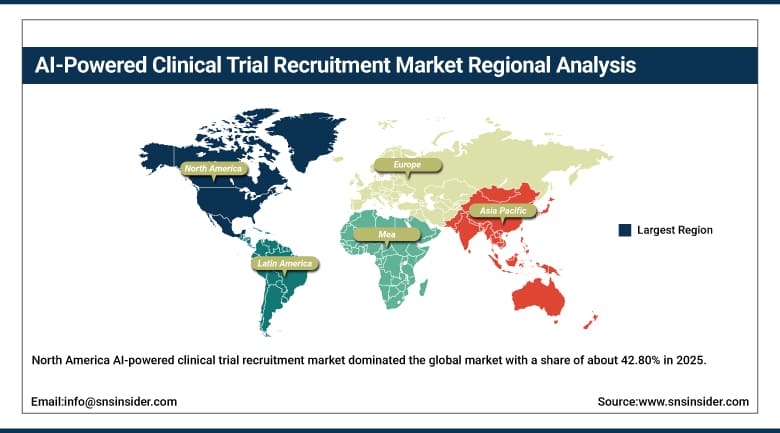
North America AI-powered clinical trial recruitment market dominated the global market with a share of about 42.80% in 2025 owing to high adoption of digital clinical trial technologies. The region benefits from strong pharmaceutical presence and advanced healthcare infrastructure. Increasing use of electronic health records and real-world data is improving patient recruitment efficiency. Growing deployment of AI driven platforms is reducing trial timelines significantly. Rising investment in decentralized clinical trials is further supporting market expansion. Strong regulatory support and innovation ecosystem are accelerating adoption across United States and Canada.
According to the U.S. Food and Drug Administration 2025 Digital Health Center of Excellence and National Institutes of Health clinical trial modernization initiatives, over 80% of U.S. clinical trials now use electronic data capture systems, enabling structured patient recruitment and screening workflows.
According to FDA’s Drug Trials Snapshots initiative, over 75% of pivotal clinical trials that have been submitted for regulatory approval have at least one element of a decentralized or hybrid trial. Furthermore, according to NIH data, around 60 percent of active federally sponsored trials use artificial intelligence for matching, screening, or recruitment.
Get Customized Report as Per Your Business Requirement - Enquiry Now
Europe AI-Powered Clinical Trial Recruitment Market Insights.
Europe AI-powered clinical trial recruitment market is growing steadily in 2025 owing to strong regulatory frameworks and rising clinical research activity. Key countries include Germany, France, United Kingdom, and Italy with high adoption of digital health technologies. Increasing use of AI for patient matching and trial optimization is supporting market expansion. Growth in personalized medicine and rare disease research is further driving adoption. Strong healthcare infrastructure and cross border research collaboration are boosting demand for recruitment platforms.
As per the European Medicines Agency Clinical Trials Information System 2025 update via Regulation, all the clinical trials should be registered and managed using the centralized digital system in the EU, accounting for 100% of all interventional studies commenced. As per the Digital Health and AI Act Implementation Framework in the European Commission 2025, more than 60% of the healthcare systems in the EU have implemented AI-powered clinical decision support solutions, whereas over 85% of the hospitals in the region use electronic health records systems that allow structured patient data access for patient recruitment and trial matching using AI.
Asia Pacific AI-Powered Clinical Trial Recruitment Market Insights.
Asia Pacific AI-powered clinical trial recruitment market is positioned to register the fastest CAGR of about 21.84% during 2026–2035 owing to rapid expansion of pharmaceutical research and increasing clinical trial outsourcing. The region benefits from strong demand across China, India, Japan, South Korea, and Southeast Asia. Growing adoption of AI based patient matching platforms is improving recruitment speed and accuracy. Rising healthcare investments and large patient pools are supporting strong market growth. Expansion of digital health infrastructure is further accelerating regional adoption.
According to the OECD digital health indicators 2025, above 70% of member and partner countries in the region have deployed electronic health records that facilitate clinical data interoperability. Furthermore, the WHO reveals above 55% of large hospitals in high-income economies in Asia Pacific have used AI-based diagnostic or stratification tools facilitating AI-enabled clinical trials recruitment potential.
Middle East & Africa and Latin America AI-Powered Clinical Trial Recruitment Market Insights.
The Middle East & Africa and Latin America AI-powered clinical trial recruitment market are experiencing steady growth in 2025 owing to increasing healthcare investments and clinical research expansion. Key countries include Brazil, Mexico, Saudi Arabia, United Arab Emirates, and South Africa. Growing adoption of digital health platforms is improving patient recruitment efficiency. Rising focus on rare disease and oncology trials is supporting market expansion. Increasing collaboration with global pharmaceutical companies is accelerating technology adoption. Expanding healthcare infrastructure is further strengthening regional market growth.
According to World Health Organization Global Observatory on Health Research & Development and Pan American Health Organization clinical research indicators, there are over 1,200 clinical trial sites registered in Latin America with more than 60% trial activity in Brazil and Argentina. According to WHO Africa Health Statistics 2025, Africa has over 24% of world’s disease burden but has less than 5% of world’s clinical trials.
Market Dynamics:
Growth Drivers: Growing adoption of artificial intelligence and real-world data in clinical research processes
The expansion of AI technology is leading to changes in the process of recruiting participants in clinical trials. With the aid of machine learning and natural language processing, the accuracy of patient selection is improved. The real-world data obtained from the hospitals and healthcare organizations contributes to the improvement of recruitment accuracy in a significant way. Predictive analytics are becoming more popular among pharmaceutical firms because of the need for proper planning of the trials.
According to the U.S. Food and Drug Administration and National Institutes of Health clinical research modernization initiatives, more than 90% of clinical trials in the United States now incorporate electronic data capture systems, enabling structured patient recruitment workflows.
In terms of the updates of the 2025 Digital Health and AI guidelines by the FDA, there are more than 100 approved AI-powered medical software applications that can be employed for trial screenings and matching patients. Moreover, according to studies funded by the NIH, real world data is used in more than 60% of clinical trials in their later stages.
Restraints: Data privacy concerns and regulatory complexities restricting adoption of AI based recruitment solutions globally
The use of patient information in AI-based recruitment processes is associated with substantial challenges of data security and privacy. The legislation differs from one jurisdiction to another, and usually prevents data sharing between health care facilities. There are also issues of patients’ consent and transparency of algorithm functioning that influence the use of AI for recruitment purposes. Adequate data protection is crucial for the effective and successful implementation of AI recruitment processes.
Opportunities:Rising adoption of precision medicine and rare disease research driving advanced AI recruitment solutions
Increased interest in precision medicine is driving the need for highly tailored approaches to recruiting patients. There is a need for advanced AI techniques to recruit patients for rare disease clinical trials. Machine learning can enhance patient selection for highly specialized requirements. Pharmaceutical firms have increased investment in the development of personalized medicines. Increased number of genomic and biomarker studies is improving the precision requirements of patient recruitment.
According to the U.S. Food and Drug Administration 2025 clinical trial modernization framework and NIH rare disease research statistics, rare diseases collectively affect approximately 300 million people globally, with over 7,000 identified conditions, and about 95% still lacking approved treatments. The European Medicines Agency reports that over 40% of newly authorized trials include adaptive or AI-supported recruitment components, reflecting increasing integration of AI-driven patient matching in clinical research systems.
Recent Developments:
-
2026: IQVIA Holdings Inc. no publicly verified AI powered clinical trial recruitment development disclosed in available industry announcements.
-
2025: Medable Inc. strengthened decentralized clinical trial platform incorporating AI tools for patient recruitment, engagement, and retention optimization.
-
2025: Oracle Corporation advanced cloud-based clinical research workflows and AI driven health data platforms supporting trial recruitment optimization.
-
2024: Veeva Systems Inc. enhanced Clinical Cloud platform with AI capabilities for study recruitment and site selection automation features.
AI-Powered Clinical Trial Recruitment Market Key Players are:
-
IQVIA Holdings Inc.
-
Oracle Corporation
-
Veeva Systems Inc.
-
Dassault Systèmes (Medidata Solutions)
-
Medable Inc.
-
Antidote Technologies
-
Clariness GmbH
-
Trialbee AB
-
TrialX Inc.
-
ConcertAI
-
Parexel International
-
ICON plc
-
Syneos Health
-
Fortrea Holdings Inc.
-
Labcorp
-
Medpace Holdings Inc.
-
Cognizant Technology Solutions Corporation
-
Accenture plc
-
Tata Consultancy Services Limited
-
Infosys Limited
AI-Powered Clinical Trial Recruitment Market Report Scope:
| Report Attributes | Details |
|---|---|
| Market Size in 2025 | USD 1.92 Billion |
| Market Size by 2035 | USD 10.57 Billion |
| CAGR | CAGR of 18.62% From 2026 to 2035 |
| Base Year | 2025 |
| Forecast Period | 2026-2035 |
| Historical Data | 2022-2024 |
| Report Scope & Coverage | Market Size, Segments Analysis, Competitive Landscape, Regional Analysis, DROC & SWOT Analysis, Forecast Outlook |
| Key Segments | • By Component (Software, Services) • By Deployment Mode (Cloud-Based, On-Premises, Hybrid, Software-as-a-Service (SaaS)) • By Technology (Artificial Intelligence (AI), Machine Learning (ML), Natural Language Processing (NLP), Robotic Process Automation (RPA), Others) • By Application (Oncology Trials, Rare Disease Trials, Cardiovascular Trials, Neurology Trials, Infectious Disease Trials, General Clinical Studies, Others) • By End User (Pharmaceutical & Biotechnology Companies, Contract Research Organizations (CROs), Hospitals & Clinics, Others) |
| Regional Analysis/Coverage | North America (US, Canada), Europe (Germany, UK, France, Italy, Spain, Russia, Poland, Rest of Europe), Asia Pacific (China, India, Japan, South Korea, Australia, ASEAN Countries, Rest of Asia Pacific), Middle East & Africa (UAE, Saudi Arabia, Qatar, South Africa, Rest of Middle East & Africa), Latin America (Brazil, Argentina, Mexico, Colombia, Rest of Latin America). |
| Company Profiles | IQVIA Holdings Inc., Oracle Corporation, Veeva Systems Inc., Dassault Systèmes (Medidata Solutions), Medable Inc., Antidote Technologies, Clariness GmbH, Trialbee AB, TrialX Inc., ConcertAI, Parexel International, ICON plc, Syneos Health, Fortrea Holdings Inc., Labcorp, Medpace Holdings Inc., Cognizant Technology Solutions Corporation, Accenture plc, Tata Consultancy Services Limited, Infosys Limited |
Frequently Asked Questions
The AI-powered clinical trial recruitment market was valued at USD 1.92 billion in 2025.
The AI-powered clinical trial recruitment market is expected to grow at a CAGR of 18.62% from 2026 to 2035.
North America dominated the AI-powered clinical trial recruitment market in 2025 due to strong pharma presence, advanced healthcare infrastructure, and AI adoption.
The Oncology Trials segment dominated the market in 2025 due to high cancer burden, complex trials, and strong pharmaceutical R&D investment.
Major growth factors include demand for faster enrollment, AI driven patient matching, decentralized trials, machine learning integration, rising R&D investments, reduced dropout rates, and improved site selection efficiency globally.
