
AI Evaluation Platform Market Report Scope & Overview:
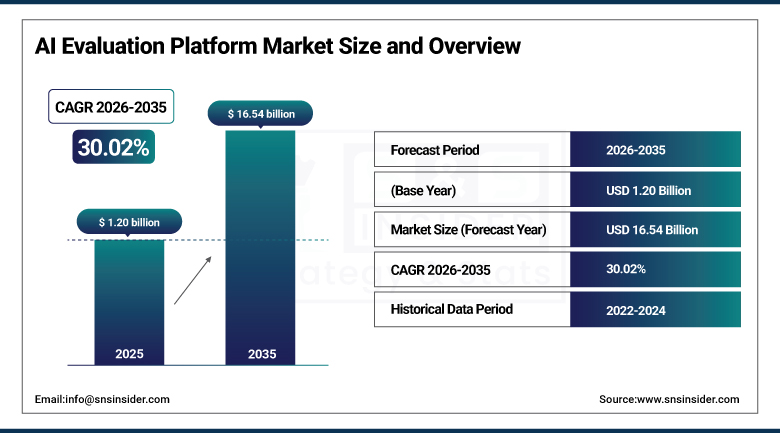
The AI Evaluation Platform Market was valued at USD 1.20 Billion in 2025 and is expected to reach USD 16.54 Billion by 2035, growing at a CAGR of 30.02% from 2026–2035.
Amongst some of the main drivers contributing to the growth of the global AI evaluation platform market are the fast adoption of AI and generative AI in enterprises and the growing implementation of large language models (LLMs) and AI agents in enterprises. The increasing need for assessing the performance, detecting the bias, ensuring explainability, testing the security, and regulatory compliance is propelling the demand for AI evaluation platforms. Since enterprises are incorporating more and more AI into their operations, decision making, engaging customers, and software development, the need for continuously testing, validating, benchmarking, and governing the AI models is growing. Additionally, growing investments in enterprise AI infrastructure, responsible AI, and AI governance solutions are fueling market growth.
In addition, the market offers many growth opportunities due to the growing implementation of AI evaluation platforms for validation, bias detection, explainability, compliance testing, security assessment, and continuous performance optimization. Enterprises are implementing AI evaluation and governance solutions to increase the reliability, transparency, fairness, and scalability of the AI applications. Moreover, continuous improvements in large language models (LLMs), multimodal AI, synthetic data generation, AI evaluation techniques, and responsible AI solutions are boosting the capabilities of the AI evaluation platforms.
In July 2026, the National Institute of Standards and Technology (NIST) launched the AI Technology Evaluation (AITE) platform, providing a secure environment for evaluating AI models using standardized benchmark datasets and rigorous testing methodologies.
To Get more information AI Evaluation Platform Market - Request Free Sample Report
AI Evaluation Platform Market Trends:
-
Increasing adoption of artificial intelligence (AI), generative AI, and AI agents is driving the AI evaluation platform market.
-
Growing demand for AI model validation, performance benchmarking, bias detection, and explainability is accelerating market growth.
-
Expanding adoption of AI evaluation platforms for compliance monitoring, security testing, and responsible AI governance is enhancing market demand.
-
Rising investments in enterprise AI infrastructure, cloud-based AI platforms, and responsible AI frameworks are supporting market innovation.
-
Increasing deployment of AI evaluation solutions across IT & telecommunications, BFSI, healthcare, manufacturing, retail, and government sectors is strengthening market growth.
U.S. AI Evaluation Platform Market Outlook:
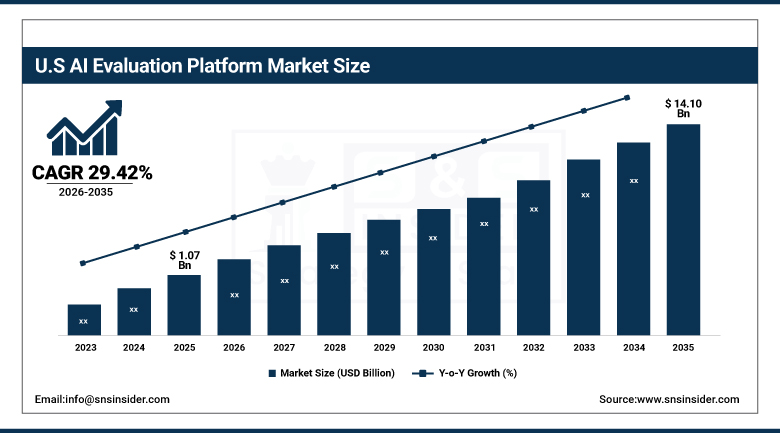
The U.S. AI Evaluation Platform Market was valued at USD 1.07 Billion in 2025 and is expected to reach around USD 14.10 Billion by 2035, growing at a CAGR of 29.42% from 2026–2035.
The increasing use of AI, machine learning, generative AI, and AI agents is projected to boost the AI evaluation platform market in the United States during the forecast period. Companies are increasingly relying on AI evaluation platforms to verify model performance, assess accuracy, analyze bias, improve explainability, identify security risks, and maintain compliance with AI regulations. Market growth is further being driven by the presence of top AI technology providers, cloud service providers, and enterprise software providers along with the rising focus on digital transformation and enterprise AI infrastructure. AI evaluation platforms are increasingly being leveraged by industries including IT & telecom, healthcare, BFSI, manufacturing, retail, and government.
In addition to this, continuous developments in LLMs, multimodal AI, automated evaluation systems, synthetic data generation, and responsible AI technologies are improving the offerings of AI evaluation platforms. Increasing investments in cloud AI platforms, AI governance frameworks, and enterprise model lifecycle management are expected to further boost the adoption of platforms. With the regulatory pressure surrounding AI solutions rising continuously, companies are looking at robust solutions for evaluation and monitoring to make sure that the AI solutions deployed by them are trustworthy and compliant.
In June 2026, Microsoft introduced an expanded AI evaluation and optimization stack in Microsoft Foundry at Build 2026, including open evaluation frameworks, trace-based evaluations, runtime monitoring, and governance capabilities to help enterprises evaluate, optimize, and securely deploy AI models and agents at scale.
AI Evaluation Platform Market Segment Analysis:
-
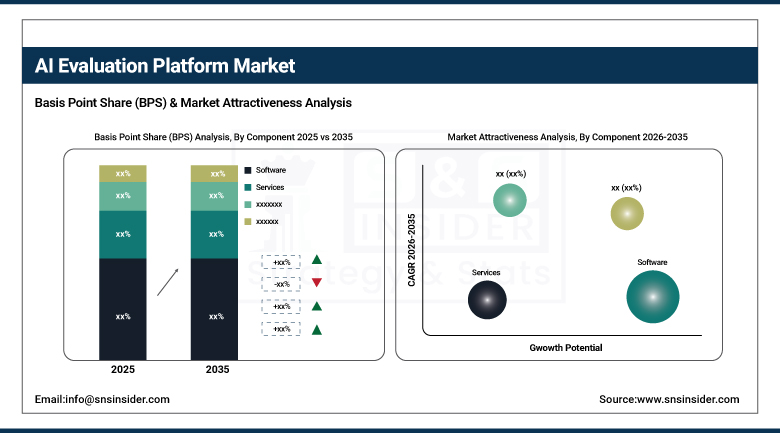
By Component, software dominated the AI evaluation platform market with an 81.64% share in 2025, while services are projected to be the fastest-growing segment, registering a 34.86% CAGR during 2026–2035.
-
By Deployment Mode, cloud deployment dominated the AI evaluation platform market with a 72.84% share in 2025, while on-premises deployment is projected to be the fastest-growing segment, registering a 30.95% CAGR during 2026–2035.
-
By Enterprise Size, large enterprises dominated the AI evaluation platform market with a 74.63% share in 2025, while small & medium enterprises (SMEs) are projected to be the fastest-growing segment, registering a 33.78% CAGR during 2026–2035.
-
By Application, model performance assessment dominated the AI evaluation platform market with a 31.82% share in 2025, while compliance monitoring is projected to be the fastest-growing segment, registering a 35.54% CAGR during 2026–2035.
-
By Industry Vertical, BFSI dominated the AI evaluation platform market with a 26.74% share in 2025, while healthcare is projected to be the fastest-growing segment, registering a 34.33% CAGR during 2026–2035.
By Component, software dominated the AI evaluation platform market, while services are expected to grow fastest
Software was the major contributor in terms of the market share in the AI Evaluation Platform market in 2025 as platforms capable of assessing the validation, benchmarking, detecting bias, explainability, compliance, and security of AI models are increasingly adopted. The software is used by enterprises to ensure that AI models are reliable, fair, robust, and accurate at all stages of their life cycle. The growing adoption of generative AI, large language models (LLM), and AI agents is driving the demand for AI evaluation software that can be integrated into the enterprise's AI development pipeline. Moreover, the focus on responsible AI, regulatory compliance, and continuous model monitoring is helping in the growth of the software segment.
The fastest-growing segment is that of services as the demand for consultation, implementation, integration, validation, and management of services is expected to rise. Companies require expertise to develop AI governance framework, customize evaluation methodology, comply with regulations, and continuously monitor AI model performance.
By Deployment Mode, cloud deployment dominated the AI evaluation platform market, while on-premises deployment is expected to grow fastest
Market share of cloud deployment is the largest among others as it is scalable, flexible, and capable of offering continuous assessment of the AI models within distributed enterprise environments. Cloud deployment allows businesses to evaluate their model performance effectively, monitor the production models, automate testing processes, and connect with cloud-native AI development platforms. Higher usage of SaaS solutions, cloud migrations by enterprises, and investment in AI infrastructure have also contributed towards the increased usage of cloud deployment.
On-premises segment is estimated to grow at the fastest pace during the forecast period as highly regulated industry enterprises give importance to privacy, security, and compliance of AI models. Organizations dealing with sensitive information related to finance, healthcare, government, and defense sectors use on-premises AI model evaluation platforms.
By Application, model performance assessment dominated the AI evaluation platform market, while compliance monitoring is expected to grow fastest
The evaluation of model performance had the highest share in the AI evaluation platform market in 2025 because of the increasing requirement for the constant evaluation of AI model performance in terms of accuracy, robustness, consistency, and reliability. Companies evaluate AI models before and after their deployment to guarantee maximum performance on various data sets and under operating conditions. The fast adoption of generative AI, predictive analytics, and enterprise AI applications has driven the demand for performance evaluation tools that help detect model deterioration and improve decision making.
The fastest-growing segment in the AI evaluation platform market in the forecasted period would be the compliance monitoring segment because of the increasing number of regulations related to artificial intelligence and responsible AI deployment. Compliance monitoring solutions help companies to guarantee compliance with constantly developing AI regulation, standards, and corporate policy in relation to AI. The increasing focus on transparency, accountability, and ethical deployment of AI will drive strong demand for compliance monitoring solutions in enterprise AI environments.
Regional Insights:
|
Region |
Major Country |
Share within Region, 2025(%) |
|---|---|---|
|
North America |
United States |
89.16% |
|
Europe |
Germany |
28.85% |
|
Asia Pacific |
China |
43.92% |
|
Middle East & Africa |
Saudi Arabia |
28.24% |
|
Latin America |
Brazil |
47.58% |
North America AI Evaluation Platform Market Insights
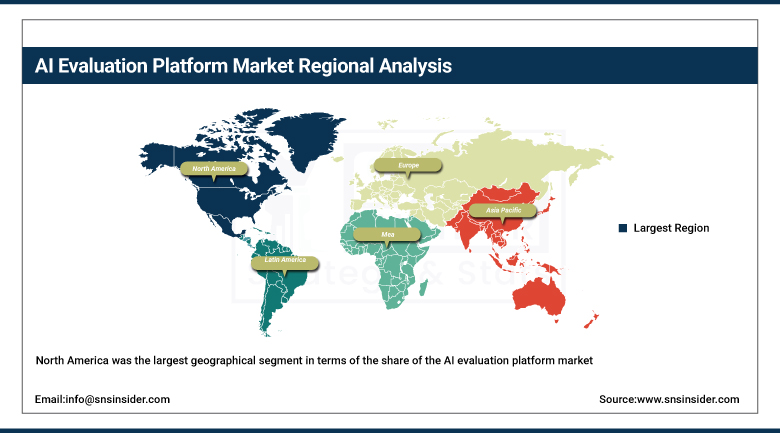
North America was the largest geographical segment in terms of the share of the AI evaluation platform market in the year 2025 due to the dominance of top-notch artificial intelligence technology vendors, cloud services, and enterprise software companies. Investments in artificial intelligence, responsible AI, cloud services, and enterprise digital transformation have been substantial in the region.
The growing deployment of AI evaluation platforms by enterprises to evaluate model performance, bias, explainability, security, and compliance is driving demand for these solutions. With the adoption of generative AI, LLMs, and AI agents becoming more prevalent, there is increasing demand for continuous AI evaluation and governance solutions. In North America, the U.S. has emerged as the largest regional market in 2025 on account of an advanced AI landscape and adoption of enterprise AI solutions.
Get Customized Report as per Your Business Requirement - Enquiry Now
Europe AI Evaluation Platform Market Insights
The market for AI evaluation platforms in Europe is seeing fastest growth due to the growing focus on responsible AI, regulation compliance, and trust-worthy implementation of AI systems. The implementation of the new and evolving regulations and data protection needs is motivating companies to implement AI evaluation solutions. Companies from various sectors, such as healthcare, manufacturing, automotive, BFSI, retail, and public sector companies, are adopting AI evaluation platforms to enhance transparency, fairness, explainability, and robustness. Increased investments in enterprise AI, cloud computing, and digital transformation projects are also facilitating market growth. In 2025, Germany accounted for the largest share of the European market on account of its industrial and manufacturing prowess and increased use of AI-based enterprise applications.
Asia Pacific AI Evaluation Platform Market Insights
The Asia Pacific region is projected to show the steady growth in the AI evaluation platform market during the forecast period due to rapid adoption of AI, increasing cloud infrastructure, and rising investments by enterprises in digital transformation. Various organizations in countries such as China, India, Japan, and South Korea are implementing generative AI, machine learning, and AI-based enterprise applications; hence, there is a growing demand for AI model evaluation, monitoring of performance of AI, detection of biases, and management of compliance of AI solutions.
Governments and enterprises are making investments in responsible AI models to deploy AI solutions securely and reliably. The Asia Pacific region was dominated by China in terms of market share in 2025 due to its wide AI ecosystem and supportive government for AI innovations.
Middle East & Africa and Latin America AI Evaluation Platform Market Insights
The AI evaluation platform market in Middle East & Africa is growing steadily because of growing investments in artificial intelligence, cloud computing, smart city, and enterprise digital transformation in the region. Organizations in sectors such as government, BFSI, healthcare, telecommunications, and energy are utilizing AI evaluation platforms to improve AI governance and compliance with regulations. The leading player in the regional market in 2025 was Saudi Arabia due to its national AI strategies, digital transformation efforts, and growing investments in cloud and AI.
The AI evaluation platform market in Latin America is witnessing steady growth because of growing adoption of AI-driven business solutions, cloud computing, and enterprise automation among organizations. Investments in digital transformation, responsible AI, and AI governance are driving the adoption of AI evaluation platforms. Brazil is the largest contributor to the market share in Latin America in 2025 because of its large number of enterprises, developing AI ecosystem, and adoption of AI technologies in BFSI, healthcare, manufacturing, and retail.
Growth Driver: Rising adoption of generative AI and responsible AI driving AI evaluation platform market growth
The swift adoption of artificial intelligence (AI), generative AI, large language models (LLMs), and AI-enabled enterprise applications is one of the key drivers of the AI evaluation platform market. Companies are using AI models to automate business operations, enhance customer interaction, and make decisions based on analytics, thereby necessitating the need for evaluation of the accuracy, reliability, fairness, and security of the models. Through AI evaluation platforms, companies can check for bias in AI models and improve their explainability and drift management while complying with emerging AI regulations. Besides, the rising investment in enterprise AI infrastructure, AI platforms, MLOps, and AI governance practices is fueling the use of AI evaluation platforms.
Restraints: Model complexity and evolving regulatory requirements may restrict AI evaluation platform market growth
While there are many possibilities for growth within the AI evaluation platform industry, the industry does have some barriers when it comes to increased AI model complexity, unavailability of standards for evaluations, and changes in regulations. Businesses find it difficult to test language AI and multimodal AI models in diverse settings. Also, the integration of the evaluation platform into the process of development of an AI system and existing frameworks requires a great deal of expertise and investment. Data privacy regulations, regulatory requirements, and the scarcity of AI governance professionals are also restraining factors in the industry.
Opportunities: Growing focus on AI governance and regulatory compliance creating new growth opportunities
There are significant opportunities emerging for the AI evaluation platform industry due to rising awareness regarding responsible AI, enterprise AI governance, and regulatory compliance. Companies are looking at deploying platforms that will continuously evaluate the performance, explainability, robustness, fairness, and security of their AI models. The emergence of new AI regulations, industry standards, and internal governance frameworks is pushing companies to adopt automated tools for AI evaluation and monitoring compliance. In addition, advancements in technology such as generative AI, AI safety, explainable AI, automated testing, and continuous model monitoring are anticipated to contribute to the evolution of AI evaluation platforms.
Recent Developments:
-
2026: Anthropic advanced enterprise AI capabilities through improvements in AI agent frameworks, model development, and secure AI application workflows. These advancements are expected to support the adoption of AI evaluation platforms by increasing the need for reliable model testing, performance monitoring, and responsible AI governance.
-
2026: Microsoft expanded its enterprise AI ecosystem through enhancements in Azure AI services, AI development tools, and governance capabilities. These developments are expected to strengthen demand for AI evaluation platforms by helping organizations assess, monitor, and manage AI model performance across enterprise environments.
-
2026: Amazon Web Services (AWS) continued expanding its enterprise AI infrastructure and generative AI services through cloud-based AI development, deployment, and management capabilities. These advancements are expected to drive the adoption of AI evaluation platforms by enabling scalable AI application testing, monitoring, and governance.
-
2026: Google strengthened its enterprise AI ecosystem through advancements in generative AI, cloud AI services, and AI development platforms. These innovations are expected to increase demand for AI evaluation platforms as organizations require improved model validation, explainability, safety assessment, and compliance monitoring for AI applications.
AI Evaluation Platform Market Key Players:
-
OpenAI
-
Google
-
Microsoft
-
Amazon Web Services (AWS)
-
IBM
-
Meta Platforms
-
NVIDIA
-
Anthropic
-
Databricks
-
Hugging Face
-
Scale AI
-
DataRobot
-
SAS Institute
-
Fiddler AI
-
Arize AI
-
WhyLabs
-
TruEra
-
Weights & Biases
-
MLflow
-
Arthur AI
AI Evaluation Platform Market Report Scope:
| Report Attributes | Details |
|---|---|
| Market Size in 2025 | USD 1.20 Billion |
| Market Size by 2035 | USD 16.54 Billion |
| CAGR | CAGR of 30.02% From 2026 to 2035 |
| Base Year | 2025 |
| Forecast Period | 2026-2035 |
| Historical Data | 2022-2024 |
| Report Scope & Coverage | Market Size, Segments Analysis, Competitive Landscape, Regional Analysis, DROC & SWOT Analysis, Forecast Outlook |
| Key Segments | • By Component (Software, Services) • By Deployment Mode (Cloud, On-Premises, Hybrid Cloud) • By Application (Model Performance Assessment, Bias Detection, Explainability, Compliance Monitoring, Security Testing, Others) • By Enterprise Size (Large Enterprises, Small & Medium Enterprises (SMEs)) • By Industry Vertical (BFSI, Healthcare, IT & Telecommunications, Retail, Manufacturing, Government & Public Sector, Others) |
| Regional Analysis/Coverage | North America (US, Canada, Mexico), Europe (Eastern Europe [Poland, Romania, Hungary, Turkey, Rest of Eastern Europe] Western Europe] Germany, France, UK, Italy, Spain, Netherlands, Switzerland, Austria, Rest of Western Europe]), Asia Pacific (China, India, Japan, South Korea, Vietnam, Singapore, Australia, Rest of Asia Pacific), Middle East & Africa (Middle East [UAE, Egypt, Saudi Arabia, Qatar, Rest of Middle East], Africa [Nigeria, South Africa, Rest of Africa], Latin America (Brazil, Argentina, Colombia, Rest of Latin America) |
| Company Profiles | OpenAI, Google, Microsoft, Amazon Web Services (AWS), IBM, Meta Platforms, NVIDIA, Anthropic, Databricks, Hugging Face, Scale AI, DataRobot, SAS Institute, Fiddler AI, Arize AI, WhyLabs, TruEra, Weights & Biases, MLflow, Arthur AI. |
Frequently Asked Questions
The AI evaluation platform market is expected to grow at a CAGR of 30.02% from 2026 to 2035.
The AI evaluation platform market was valued at USD 1.20 billion in 2025.
The market is driven by the increasing adoption of AI, generative AI, large language models (LLMs), and the growing demand for continuous AI model evaluation, monitoring, explainability, and responsible AI governance.
Software dominated the AI evaluation platform market in 2025 with an 81.64% share.
North America dominated the AI evaluation platform market in 2025 with a 40.82% share.
