
AI Server Market Report Scope & Overview:
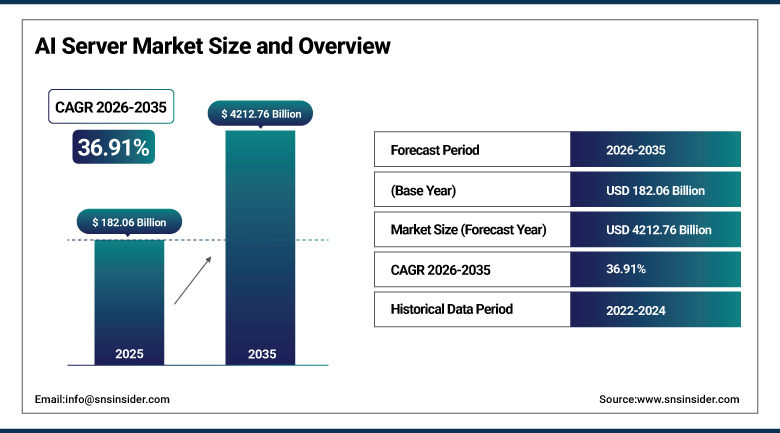
The AI Server Market was valued at USD 182.06 Billion in 2025 and is expected to reach USD 4,212.76 Billion by 2035, growing at a CAGR of 36.91% from 2026–2035.
AI servers are purpose-built computing systems optimized for the extraordinary computational demands of training and running large artificial intelligence models. A modern AI training cluster built around NVIDIA H100 or Blackwell GPUs consumes megawatts of power, requires liquid cooling infrastructure, and connects thousands of GPUs through ultra-high-bandwidth networking fabric that has no precedent in conventional data center design. These infrastructure requirements reflect the novelty of AI workloads, where training a single large language model may require months of continuous computation across thousands of specialized chips running simultaneously. The market is being driven by a fundamental shift in what computing infrastructure is for. Conventional enterprise servers supported business application processing, database queries, and web serving. AI servers support training and inference of models whose capabilities are reshaping how every industry creates value. Generative AI has moved from research novelty to commercial deployment at a pace that has shocked the infrastructure industry. Every major cloud provider, every major enterprise, and an expanding array of sovereign governments are investing in AI server infrastructure to avoid falling behind in a technology transition that shows every sign of being as commercially decisive as the internet or the smartphone. The demand shock this has created for AI-optimized server hardware is unlike anything the server industry has previously experienced.
NVIDIA reported that its data center GPU revenue exceeded USD 47 billion in fiscal year 2025, a figure that represents a market created almost entirely within three years and that would have seemed implausible to even the most optimistic industry analysts in 2022. This growth rate defines the commercial context in which the AI server market operates.
To Get more information AI Server Market - Request Free Sample Report
AI Server Market Trends
-
Liquid cooling has become a commercial necessity rather than a premium option in dense AI server deployments, as GPU power densities exceeding 700 watts per chip make air cooling thermally inadequate for full-performance AI training clusters at data center scale.
-
Custom AI silicon from Amazon (Trainium), Google (TPU), Microsoft (Maia), and Meta (MTIA) is creating an alternative procurement pathway for hyperscale cloud providers seeking to reduce GPU dependency.
-
Sovereign AI data centers funded by national governments in the UAE, France, India, Japan, and Singapore are creating a new category of AI server demand outside the hyperscale commercial cloud sector.
-
AI inference workload scale is growing faster than training as commercially deployed AI applications reach hundreds of millions of daily users.
-
Rack-level integration is replacing individual server procurement as the standard AI infrastructure unit, with NVIDIA DGX SuperPOD, HPE Cray XD, and Dell AI Factory providing complete integrated computer, networking, storage, and cooling systems.
The U.S. AI Server Market Outlook
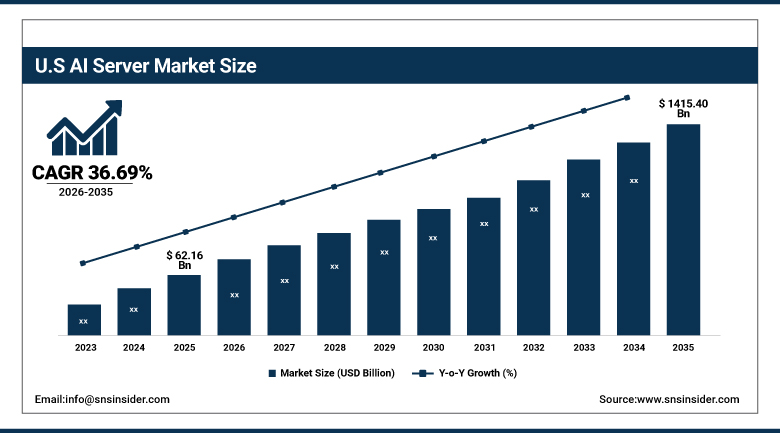
The U.S. AI Server Market was valued at approximately USD 62.16 Billion in 2025 and is expected to reach approximately USD 1,415.40 Billion by 2035, growing at a CAGR of 36.69%.
The United States is the world's largest AI server market by a wide margin, anchored by the hyperscale cloud investments of Amazon Web Services, Microsoft Azure, Google Cloud, and Meta whose combined AI infrastructure capital expenditure reached historic levels in 2025. Microsoft's partnership with OpenAI, Google's Gemini development, Meta's Llama programme, and Amazon's investment in Anthropic are each sustained by the AI server infrastructure that the U.S. data center industry is expanding at unprecedented speed. The U.S. government investment in AI computing infrastructure has added a second major demand vector beyond commercial cloud. The CHIPS and Science Act's AI investment provisions, Department of Energy national laboratory AI computing programmes, Department of Defence AI infrastructure investments, and the National Science Foundation's National AI Research Resource programme collectively represent billions of dollars in publicly funded AI server demand that is independent of commercial market dynamics. Export control restrictions on advanced GPU exports to China have simultaneously increased domestic U.S. AI server investment while creating complex geopolitical supply chain considerations for the global AI infrastructure market.
Microsoft announced plans to invest USD 80 billion in AI data center infrastructure in fiscal year 2025, with the majority of spending in the United States. This single capital commitment exceeds the total revenues of the global AI server market just two years earlier, illustrating the extraordinary investment velocity of the AI infrastructure buildout.
AI Server Market Segment Analysis
-
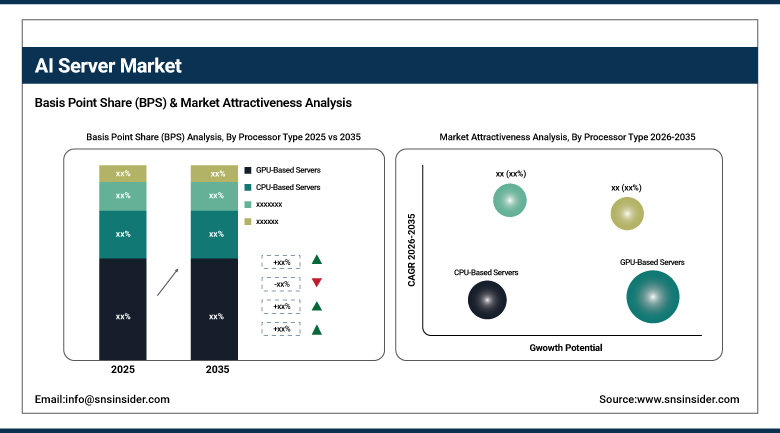
By Processor Type, GPU-based servers dominated the AI server market with approximately 72% share in 2025 and ASIC-based servers are also the fastest-growing segment.
-
By Cooling Technology, air cooling dominated with approximately 53% share in 2025; liquid cooling is the fastest-growing segment.
-
By Form Factor, rack-mounted servers dominated with approximately 81% share in 2025; rack-mounted servers are also the fastest-growing form factor.
-
By End User, IT and telecom dominated with approximately 34% share in 2025; automotive is the fastest-growing end user.
By Processor Type, GPU-based servers dominate and ASIC-based servers grow fastest
GPU-based servers held approximately 72% of the AI server market in 2025 and are simultaneously the fastest-growing processor type. NVIDIA's H100, H200, and Blackwell B100 GPUs have become the defining components of modern AI training infrastructure, providing the massive parallel processing throughput that deep learning workloads require. A single DGX H100 server containing eight H100 GPUs delivers roughly 32 petaflops of AI training performance, an amount of computing power that would have ranked among the world's fastest supercomputers fewer than ten years ago. The GPU's architecture, originally designed for graphics rendering whose parallel pixel computation maps naturally to neural network matrix operations, has proven extraordinarily suited to the training and inference of deep learning models.
ASIC-based servers are the fastest-growing processor segment by CAGR as custom silicon designed specifically for AI inference workloads offers significantly better performance per watt than general-purpose GPUs for specific model types. Google's TPU, Amazon's Inferentia and Trainium, and Microsoft's Maia chip are each ASIC-based accelerators designed to run specific AI frameworks with greater efficiency than NVIDIA GPUs at inference scale. These custom chips reduce the per-inference cost that makes large-scale AI application deployment commercially viable at consumer internet scale, where hundreds of millions of daily user interactions must be processed at low latency and acceptable cost per query.
By Cooling Technology, air cooling dominates, liquid cooling grows fastest
Air cooling held approximately 53% of cooling technology revenues in 2025. The dominance of air cooling reflects the enormous installed base of data centers built with conventional forced air-cooling infrastructure whose physical design and mechanical systems were engineered for the heat density of conventional CPU servers. Upgrading these facilities to liquid cooling requires civil engineering modifications, specialized pipe systems, and cooling distribution units that represent significant additional capital expenditure. Organizations deploying AI servers in existing conventional data centers often manage heat density challenges through careful rack placement, hot aisle containment, and enhanced air handling before committing to liquid cooling infrastructure investment.
Liquid cooling is the fastest-growing cooling technology segment as the AI server market's physics make air cooling increasingly inadequate for full-performance deployments. NVIDIA's H100 GPU has a thermal design power of 700 watts per chip. A single DGX H100 system containing eight H100 GPUs produces 10 kilowatts of heat in a single 6U rack unit. High-density AI training clusters create heat loads that exceed the rated capacity of most conventionally designed data center floor space. Liquid cooling through direct-to-chip water blocks, rear-door heat exchangers, and immersion cooling removes heat several times more efficiently than air, enabling the power density that AI training demands while keeping facility energy efficiency at commercially acceptable levels.
Regional Analysis
|
Region |
Major Country |
Share within Region, 2025 (%) |
|---|---|---|
|
North America |
United States |
81.3% |
|
Europe |
Germany |
26.4% |
|
Asia Pacific |
China |
52.8% |
|
Middle East & Africa |
UAE |
28.6% |
|
Latin America |
Brazil |
41.4% |
North America AI Server Market Insights
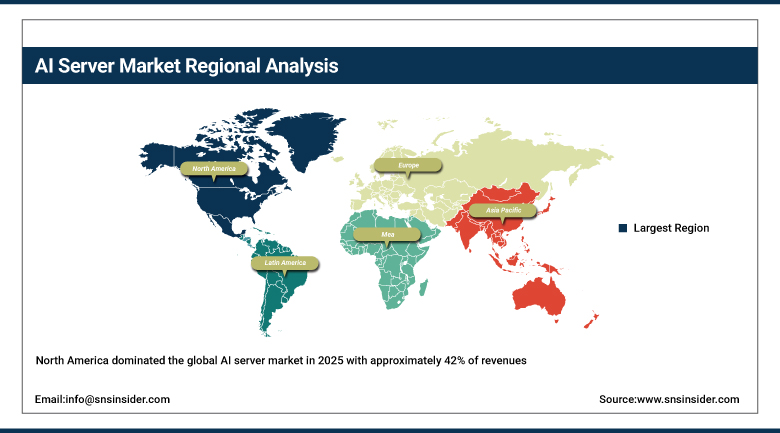
North America dominated the global AI server market in 2025 with approximately 42% of revenues. The United States accounts for approximately 81.3% of North American revenues as the home of the world's largest cloud providers and the dominant AI model developers whose infrastructure requirements are driving the AI server market's extraordinary growth. AWS, Microsoft Azure, Google Cloud, and Meta's internal AI infrastructure collectively represent the largest concentration of AI computing investment globally. The Chandler, Arizona; Northern Virginia; Dallas-Fort Worth; and Pacific Northwest data center corridors are expanding at rates driven by AI infrastructure demand that have exhausted available power capacity in several established data center markets. Canada is growing as an AI server market through both commercial cloud expansion by hyperscale’s establishing Canadian data centers for data residency compliance and the Canadian data centers benefit from abundant hydroelectric power and cold climate natural air-cooling opportunities that make them competitive AI infrastructure locations despite higher labor costs than U.S. alternatives.
Get Customized Report as per Your Business Requirement - Enquiry Now
Europe AI Server Market Insights
Europe is a large and rapidly growing AI server market shaped by GDPR data residency requirements that mandate European data processing, the EU AI Act's regulatory framework creating compliance incentives for European AI infrastructure investment, and the major European cloud regions operated by AWS, Microsoft, Google, and domestic providers. Germany accounts for approximately 26.4% of European revenues as the EU's largest data center market and the location of Frankfurt's continental internet exchange that makes German data centers geographically optimal for European AI workload deployment. European sovereign AI computing programmes, most prominently EuroHPC's expansion of its supercomputing network, are adding publicly funded AI server capacity complementing commercial cloud investment. European industrial companies including Siemens, BASF, and Airbus are investing in on-premise AI server infrastructure for sensitive industrial AI applications whose data sovereignty requirements make external cloud AI processing commercially or legally impractical.
Asia Pacific AI Server Market Insights
Asia Pacific is the fastest-growing AI server region at a CAGR of approximately 39.06% through 2035. China accounts for approximately 52.8% of Asia Pacific revenues through its combination of domestic hyperscale cloud providers including Alibaba Cloud, Tencent Cloud, and Huawei Cloud, an active sovereign AI infrastructure investment programme whose scale rivals U.S. hyperscale investment, and the largest manufacturing demand for AI-enabled industrial automation requiring edge and on-premise AI computing. U.S. export controls restricting advanced GPU sales to China have accelerated domestic Chinese GPU development through Biren Technology, Moore Threads, and Huawei Ascend, creating a domestic supply alternative that reduces but does not eliminate the competitive disadvantage created by GPU access restrictions.
MEA & Latin America AI Server Market Insights
The Middle East and Africa and Latin America are rapidly growing AI server markets where sovereign AI investment and commercial cloud expansion are driving infrastructure deployment. The UAE leads MEA revenues at approximately 28.6% of the regional share through its G42 AI computing infrastructure, Cerebras partnership, and the Abu Dhabi government's ambition to establish the UAE as a global AI hub that requires world-class AI computing infrastructure to attract international AI development activity. Saudi Arabia, Qatar, and Kenya are each investing in national AI computing infrastructure. Brazil leads Latin American revenues at approximately 41.4% through AWS, Google, and Microsoft's Brazilian cloud region operations and growing domestic enterprise AI adoption across its large financial services and agribusiness sectors.
Market Dynamics
Growth Drivers: Generative AI workload explosion and hyperscale cloud provider capital expenditure commitments are the primary AI server market growth drivers.
Generative AI has created a demand shock for AI server infrastructure that no historical analogy fully captures. ChatGPT reached 100 million users in two months. Every major enterprise is now investing in generative AI capabilities. The inference compute required to serve hundreds of millions of daily AI application users at acceptable latency continuously requires AI server capacity that grows with user adoption. Each percentage point of global population that engages daily with AI applications adds material AI server demand. The market's growth rate reflects this structural demand expansion rather than cyclical technology investment.
Hyperscale cloud providers have made public capital expenditure commitments totaling hundreds of billions of dollars annually across AWS, Microsoft, Google, and Meta's AI infrastructure programmes. These commitments provide multi-year demand visibility for AI server manufacturers including Dell, HPE, Supermicro, and the custom direct design procurement operations of cloud giants. The sovereign AI investment programmes of UAE, France, India, Japan, and Singapore add government-funded demand that is explicitly geopolitically motivated and therefore less cyclically sensitive than commercial cloud investment.
Restraints: GPU supply constraints from TSMC and CoWoS advanced packaging capacity limitations are restraining AI Server Market growth.
GPU supply has been the most commercially significant constraint on AI server market growth. TSMC's CoWoS advanced packaging technology, required to connect GPU dies to their high-bandwidth memory in the stacked configuration that delivers AI performance, has been in severe shortage. The supply constraint is not a demand problem. It is a manufacturing capacity problem that TSMC, NVIDIA, and packaging partners are investing to resolve over a multi-year timeline. Power consumption is creating physical infrastructure bottlenecks that constrain AI server deployment velocity independently of hardware availability. A 1-megawatt AI training cluster requires specialized power delivery, transformer capacity, and cooling infrastructure. Several U.S. data center markets including Northern Virginia and Silicon Valley have reached the limits of their utility power allocation capacity. New data center projects are being approved in markets with available power including Texas, Ohio, and Wyoming based on power availability rather than optimal geography for cloud service delivery.
Opportunities: Edge AI server deployment for real-time industrial and autonomous applications, energy-efficient AI inference chip architectures, and private cloud AI infrastructure for regulated enterprises represent the growth opportunities.
Edge AI server deployment is a growing opportunity as AI inference moves closer to the data sources and physical systems it serves. Autonomous vehicle AI processing must happen in the vehicle, not in a cloud data center. Industrial quality inspection AI must process images at the production line, not across a WAN connection. Medical imaging AI in remote clinics needs local processing capability. Each of these edge AI applications requires ruggedized, power-efficient AI server hardware deployed in environments far from the controlled conditions of enterprise data centers. The edge AI server market is currently smaller than the cloud AI server market but is growing from a larger number of deployment locations.
Private cloud AI infrastructure for regulated enterprises represents a substantial and commercially underserved opportunity. Banks, healthcare providers, insurance companies, and government agencies face data residency, privacy, and security requirements that complicate or prevent using public cloud AI infrastructure for sensitive workloads. These Organizations need on-premise or co-location AI server infrastructure with the same GPU performance as public cloud while maintaining the data control their compliance obligations require. HPE, Dell, and Lenovo are competing for these private cloud AI infrastructure contracts whose deal sizes rival hyperscale cloud procurement.
Recent Developments:
-
2025: NVIDIA launched its Blackwell B100 and B200 GPU architecture, delivering approximately 5x AI training performance improvement over the previous H100 generation and establishing NVIDIA's technology leadership for the next AI server upgrade cycle.
-
2025: Microsoft announced USD 80 billion in AI data center capital expenditure for fiscal year 2025, the largest single-year AI infrastructure investment commitment by any company globally, primarily directed toward U.S. facilities.
-
2025: Dell Technologies reported AI server revenues exceeding USD 10 billion in fiscal year 2025, driven by PowerEdge XE9680 GPU server demand from enterprise customers deploying private AI infrastructure and government AI programmes.
-
2025: Supermicro introduced its liquid-cooled AI server rack systems capable of handling 200-kilowatt per rack power densities, addressing the thermal management challenge that high-density Blackwell GPU deployments create for existing data center infrastructure.
AI Server Market key players are:
-
NVIDIA Corporation
-
Dell Technologies Inc.
-
Hewlett Packard Enterprise Company
-
Supermicro (Super Micro Computer Inc.)
-
Lenovo Group Limited
-
IBM Corporation
-
Intel Corporation
-
AMD (Advanced Micro Devices Inc.)
-
Inspur Group
-
Gigabyte Technology Co. Ltd.
-
Asus
-
Quanta Computer Inc.
-
Wiwynn Corporation
-
Google LLC
-
Amazon Web Services
-
Microsoft Corporation
-
Fujitsu Limited
-
NEC Corporation
-
Penguin Computing
-
Liqid Inc.
AI Server Market Report Scope:
| Report Attributes | Details |
|---|---|
| Market Size in 2025 | USD 182.06 Million |
| Market Size by 2035 | USD 4,212.76 Million |
| CAGR | CAGR of 36.91% From 2026 to 2035 |
| Base Year | 2025 |
| Forecast Period | 2026-2035 |
| Historical Data | 2022-2024 |
| Report Scope & Coverage | Market Size, Segments Analysis, Competitive Landscape, Regional Analysis, DROC & SWOT Analysis, Forecast Outlook |
| Key Segments | • By Processor Type (GPU-Based Servers, CPU-Based Servers, ASIC-Based Servers, FPGA-Based Servers) • By Cooling Technology (Air Cooling, Liquid Cooling) • By Form Factor (Rack-Mounted Servers, Tower Servers, Blade Servers) • By End User (IT & Telecom, Healthcare, BFSI, Automotive, Government, Others) |
| Regional Analysis/Coverage | North America (US, Canada), Europe (Germany, UK, France, Italy, Spain, Russia, Poland, Rest of Europe), Asia Pacific (China, India, Japan, South Korea, Australia, ASEAN Countries, Rest of Asia Pacific), Middle East & Africa (UAE, Saudi Arabia, Qatar, South Africa, Rest of Middle East & Africa), Latin America (Brazil, Argentina, Mexico, Colombia, Rest of Latin America). |
| Company Profiles | NVIDIA Corporation, Dell Technologies Inc., Hewlett Packard Enterprise Company, Supermicro (Super Micro Computer Inc.), Lenovo Group Limited, IBM Corporation, Intel Corporation, AMD (Advanced Micro Devices Inc.), Inspur Group, Gigabyte Technology Co. Ltd., Asus, Quanta Computer Inc., Wiwynn Corporation, Google LLC, Amazon Web Services, Microsoft Corporation, Fujitsu Limited, NEC Corporation, Penguin Computing, Liqid Inc. |
Frequently Asked Questions
North America dominated the market in 2025, holding approximately 42% of global revenues.
GPU-Based Servers dominated with approximately 72% of revenues in 2025.
The generative AI workload explosion driving hyperscale cloud investment and sovereign AI infrastructure programmes is the primary growth driver.
The AI server market was valued at USD 182.06 Billion in 2025.
The AI server market is expected to grow at a CAGR of 36.91% from 2026 to 2035.
