
Aircraft Cabin Disinfection System Market Report Scope & Overview:
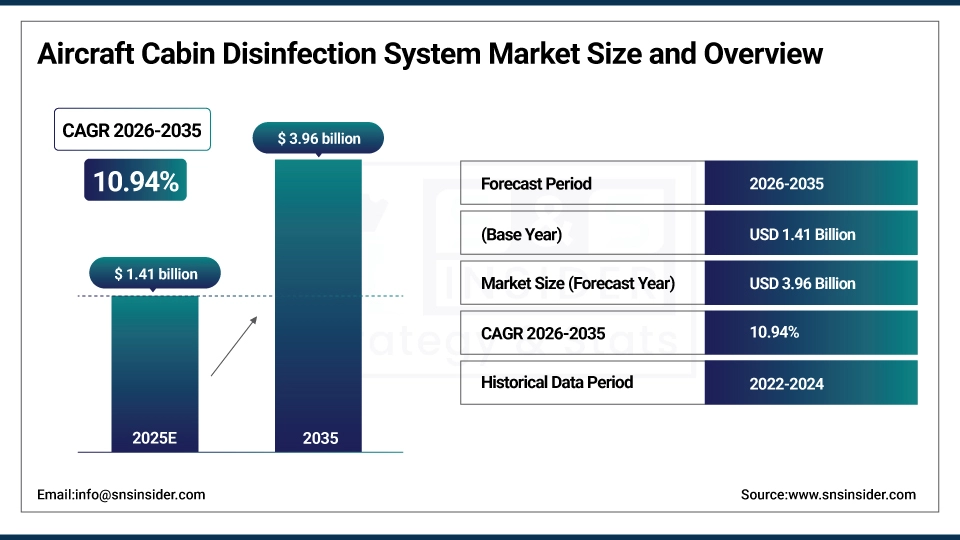
The Aircraft Cabin Disinfection System Market size is valued at USD 1.41 Billion in 2025 and is expected to reach USD 3.96 Billion by 2035 and grow at a CAGR of 10.94% over the forecast period 2026-2035.
The Aircraft Cabin Disinfection System market is anticipated to witness remarkable growth on account of growing passenger health and safety concerns in view of the mounting concern for both air-borne as well as surface borne pathogen transmission in commercial, business & cargo aircraft. Strict aviation hygiene requirements and the need to regain passenger trust are driving airlines and OEMs to implement high-end disinfection technologies, including UV-C systems, HEPA filters, automated robotic solutions. New real-time monitoring technology, automation and integration with cabin environmental systems are contributing to more efficient turnaround, enabling improved reliability.
According to industry studies, over 60% of Aircraft Cabin Disinfection System demand is driven by commercial airlines, fueled by increasing passenger health awareness, stringent aviation hygiene regulations, and the need for rapid and effective cabin disinfection solutions.
To Get more information on Aircraft Cabin Disinfection System Market - Request Free Sample Report
Aircraft Cabin Disinfection System Market Trends:
-
UV-C and robotic disinfection adoption is increasing for faster, effective cabin sanitization.
-
Integration with smart cabin and ECS systems enables real-time air quality monitoring.
-
Retrofit and portable solutions drive fleet modernization without major modifications.
-
Automation improves efficiency by reducing labor and turnaround times.
-
Passenger safety and confidence remain key drivers post-pandemic.
U.S. Specialty Aircraft Cabin Disinfection System Market Insights:
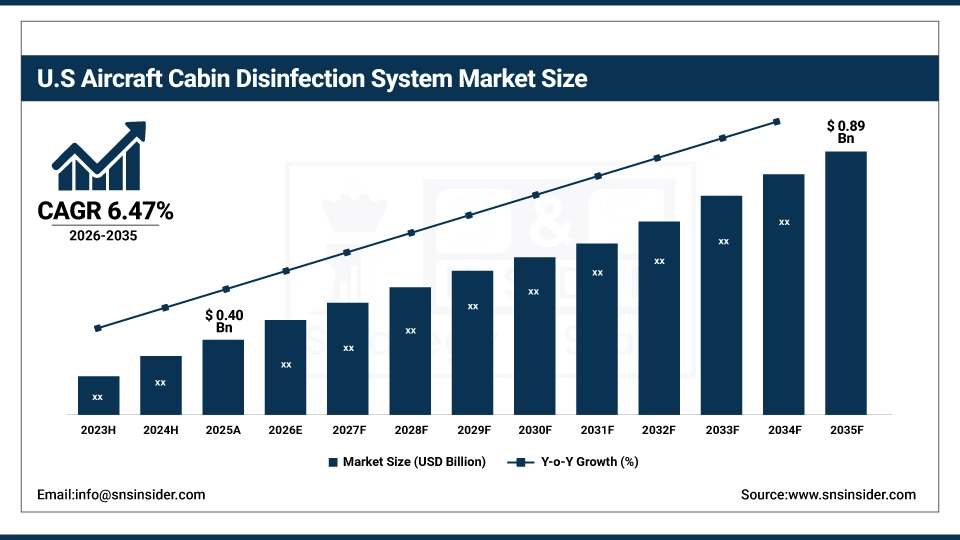
The U.S. Aircraft Cabin Disinfection System Market size is USD 0.40 Billion in 2025 and is expected to reach USD 0.89 Billion by 2035, growing at a CAGR of 6.47% over the forecast period of 2026-2035.
The Aircraft Cabin Disinfection System market in the U.S. is primarily influenced by rising passenger health and safety concerns, strict aviation hygiene regulations, and increasing airline emphasis on operational efficiency. Advancements in UV-C, HEPA filtration, and automated robotic disinfection services improve turn-around speeds and reliability, with fleet modernization programs, retrofit solutions, and regulatory mandates driving adoption on commercial, business and cargo aircraft.
Aircraft Cabin Disinfection System Market Growth Drivers:
-
Rising Demand for Enhanced Passenger Health and Safety
Growth in the Aircraft Cabin Disinfection System market is pressured by the developing knowledge of air and surface-borne pathogens in commercial, business, and cargo planes. The likes of airlines and OEMs are investing in new disinfection systems using UV-C, HEPA filtration and robotics to protect passengers against the virus and promote confidence in air travel returning. Commercial airlines account for more than 60% of market demand, which underscores the importance of health and cleanliness in adoption. Operation efficiency and quick aircraft turnaround times also drive the market.
Aircraft Cabin Disinfection System Market Growth Restraints:
-
High Costs and Retrofit Challenges
Market expansion is limited by expensive initial investment of sophisticated disinfection equipment and difficulties to upgrade available planes with them. It is estimated by some research that about 40% of airlines post-pone implementation of such e-Enabled services at least in their published schedules as not to bother with capital expenditure costs and integration problems, especially if the aircraft are aging. Moreover, the lack of standardization between aircraft types and regulation barriers like UV exposure and use of chemical disinfectants delay faster deployment and wider acceptance.
Aircraft Cabin Disinfection System Market Growth Opportunities:
-
Fleet Modernization, Automation, and Smart Cabin Integration
Fleet modernization programs, automated disinfection robots and integration with smart cabin environmental control systems are just some of the opportunities. In the era of IOT, sensors and air quality monitoring in real time, what used to be optimization for operations, reduced labor and meet dot healthcare standards are now all achieved when using this kit. According to industry studies, demand for automated and sensor-powered disinfection solutions is growing at a rate of more than 15% per year. The high investment in Retrofit programs & state-of-the-art cabin sanitation technologies is the long term growth trend shaping up both in commercial as well as business aviation globally.
Aircraft Cabin Disinfection System Market Segment:
-
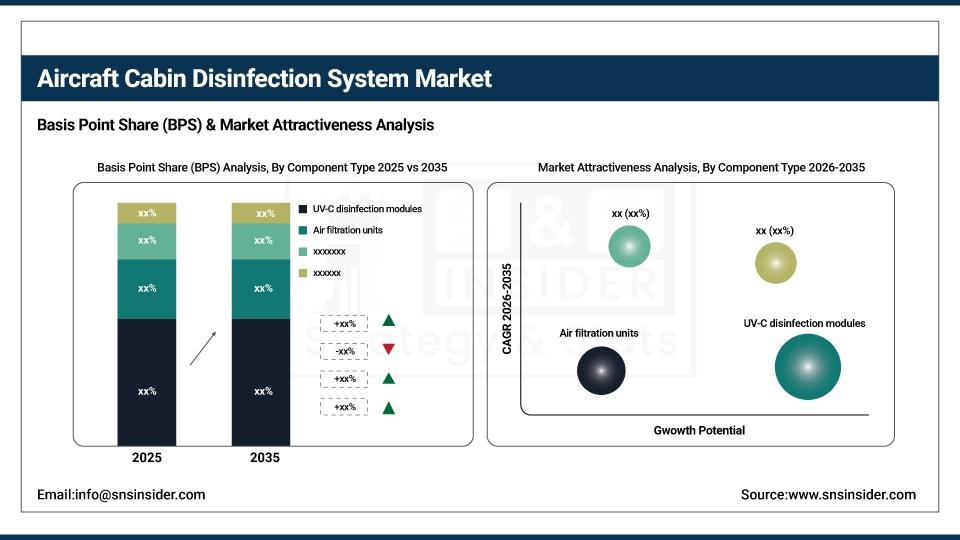
By Component Type: In 2025, UV-C disinfection modules dominated with 45% share; electrostatic spray systems are the fastest-growing segment during 2026–2035.
-
By Technology: In 2025, UV-C light disinfection dominated with 50% share; electrostatic & chemical-based disinfection is the fastest-growing segment during 2026–2035.
-
By Application: In 2025, commercial aircraft cabins dominated with 55% share; cargo & special-mission aircraft is the fastest-growing segment during 2026–2035.
-
By End-user Industry: In 2025, airlines dominated with 60% share; MRO service providers are the fastest-growing segment during 2026–2035.
Aircraft Cabin Disinfection System Market Segment Analysis:
By Component Type: UV-C Disinfection Modules Lead as Electrostatic Spray Systems Expand Rapidly.
UV-C disinfection modules are leading the aircraft cabin disinfection system market, as they have been proven to be effective for inactivating pathogens and offer faster disinfection cycles than Hydrogen Peroxide/ Silver ion fogging system, with higher penetration on commercial and business airplanes. These systems are the choice of airline and OEM customers for new build and retrofit programmes, introducing consistent performance and compatibility with cabin environmental control systems.
Electrostatic spray systems are seeing rapid expansion due to increased demand for surface disinfection, retrofittable capability for existing fleets, and increasing uptake on cargo and specialty aircraft. Advances in electrostatic technology and adaptions for automation are driving efficiency gains, spreading adoption throughout commercial, private and cargo aviation types
By Technology: UV-C Light Disinfection Leads as Electrostatic & Chemical-Based Disinfection Gains Momentum.
UV-C exposure is the preferred disinfection approach as it can inactivate airborne and surface pathogens with high efficacy, ease of integration into cabin air systems, while having strong regulatory backing for improving aviation hygiene. Due to its tested effectiveness in reducing the microbial burden, HF is now the most used technology internationally.
Electrostatic & chemical disinfection is becoming popular as airlines and MROs look for multi-purpose approaches to surface, air and allergen control. Advancements in chemical mixtures and automatic spraying mechanisms are enhancing safety and speed of operation, leading to stronger growth in the retrofitting and special-purpose segment.
By Application: Commercial Aircraft Cabins Lead as Cargo & Special-Mission Aircraft Expand.
Commercial aircraft cabin are the dominant in terms of market share on account of high number of passengers, long flying hours and strict wash protocols maintained in aircraft. Disinfection systems have been widely adopted in this category, to ensure that passenger confidence is preserved, and aviation regulation compliance is observed while minimizing turnaround times.
Freighters & special mission aircraft are growing at a rapid pace on account of the rise of the pathogen free logistics, air ambulance and customized transport solutions. Rising investments in disinfection and sanitation solutions for non-passenger vehicles is promoting the growth of this high-growth segment.
By End-User Industry: Airlines Lead as MRO Service Providers Expand.
The market is heavily dominated by airlines, with provision of fleet-wide disinfection systems being essential to satisfy passenger safety requirements, maintain airline brand reputation and comply with regulations. Major airlines are asking for advanced UV-C and filtration systems on new and retrofit aircraft.
All top MRO service providers are growing, providing retrofit solutions, maintenance and installation for disinfection systems within the airline and business jet segments. The demand for fleet renewal, automation and effective disinfection performance is increasing in this segment.
Aircraft Cabin Disinfection System Market Regional Analysis:
North America Aircraft Cabin Disinfection System Market Insights:
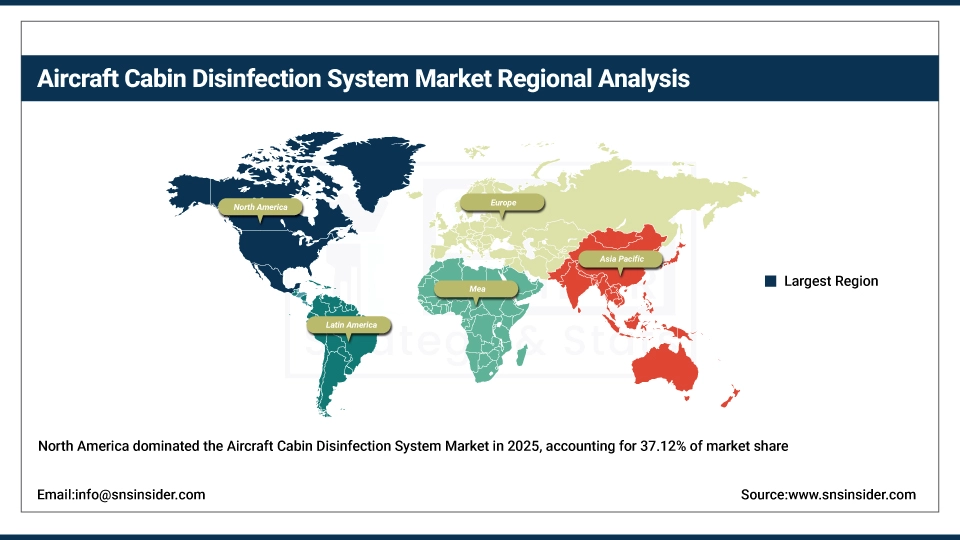
In 2025, North America’s Aircraft Cabin Disinfection System Market accounting for the highest regional revenue share of approximately 37.12% in 2025. The market for Aircraft Cabin Disinfection System in North America is driven by the presence of a large number of airlines with high passenger capacities, stringent regulatory norms pertaining to aircraft antibacterial system coupled with increasing demand from commercial fleet. The deployment of advanced technology from UV-C systems, to HEPA filtration, and automated disinfection offer the capability to adapt into hundreds of airline fleets and MRO’s. Market growth has also been driven by fleet modernization programmes, retrofit projects and pro-active attitudes to regulatory compliance that have propelled the region’s dominant position in total revenue share.
Get Customized Report as per Your Business Requirement - Enquiry Now
Asia Pacific Aircraft Cabin Disinfection System Market Insights:
Asia Pacific represents a high-growth region for the Aircraft Cabin Disinfection System market, registering a CAGR of 14.26% during 2026–2035. The robust growth is attributed to the surge in air travels, growing fleet modernization and implementation of technologies based on advanced cabin hygiene and disinfection. Rise in the number of passengers and burgeoning commercial & cargo airlines in the region, coupled with increasing health concerns radios of people has bolstered market demand for efficient cabin disinfection systems. Further, investments in UV-C, HEPA filters and robotics & automated technologies along with favourable regulatory net present value positive initiatives have helped drive adoption and market growth during 2026-2035.
Europe Aircraft Cabin Disinfection System Market Insights:
The growth is spurred by increasing levels of passenger health awareness, extensive regulations on cabin hygiene, and growing airline emphasis on the operational efficiency. Strong need for mature European aviation market, good volume of air travel and progressive regulation, to grow demand for superior disinfection systems. Investment in UV-C, HEPA filtration, and automatic robotic solutions, together with fleet renewal and retrofit programs has also driven uptake and supported market growth across key Western European markets in 2026–2035.
Latin America Aircraft Cabin Disinfection System Market Insights:
This Latin America Aircraft Cabin Disinfection System Market growth is mainly attributed to the increasing commercial aircraft orders, rising number of air passengers and growing passenger and cargo traffic and circulation. With growing aviation industry in the region, transportation via urban air mobility and new fleets being inducted have opened up good potential for such disinfection products. Automated UV-C systems, electrostatic disinfection investment and retrofit programs supplemented by the government will drive adoption and market growth throughout Brazil, Mexico and other emerging markets between 2026-2035.
Middle East and Africa Aircraft Cabin Disinfection System Market Insights:
This growth is attributed to increasing demand of air travel, fleet expansion and emphasizing on passenger safety & operational efficiency. Urbanization, the expansion of commercial and cargo airlines and an increased focus on cabin hygiene has made a strong case for high-tech disinfection systems. Furthermore, UV-C, HEPA filtration and automated disinfection investments as well the retrofit programs and supportive aviation regulations are driving adoption and resulting in a substantial market growth across the region during 2026–2035.
Aircraft Cabin Disinfection System Market Competitive Landscape:
Honeywell International Inc. is a leading Aircraft Cabin Disinfection System company known for its advanced cabin air quality solutions, including UV-C disinfection, HEPA filtration, and integrated environmental control systems. Honeywell serves commercial, business, and cargo aircraft globally, focusing on improving passenger safety, operational efficiency, and regulatory compliance. The company is recognized for its innovation in automated cabin hygiene technologies and strong collaborations with OEMs and airlines.
-
In 2024, Honeywell launched its next-generation UV-C cabin disinfection system for retrofit and new aircraft, expanding adoption across North America, Europe, and Asia Pacific.
Collins Aerospace (Raytheon Technologies) is a leading Aircraft Cabin Disinfection System company specializing in integrated cabin environmental systems, air filtration, and UV-C-based disinfection technologies. Collins Aerospace provides solutions for commercial, business, and defense aviation, focusing on reliability, operational efficiency, and regulatory compliance. The company is recognized for its engineering expertise, system integration capabilities, and partnerships with major airline fleets worldwide.
-
In 2025, Collins Aerospace introduced automated UV-C disinfection modules compatible with wide-body and narrow-body aircraft, targeting retrofits in North America and Europe.
GermFalcon (Dimer UVC Innovations) is a prominent Aircraft Cabin Disinfection System company known for its autonomous UV-C robotic disinfection solutions for aircraft cabins. GermFalcon focuses on high-efficiency pathogen elimination, reduced turnaround times, and integration with airline operational workflows. The company is recognized for its innovative robotics, rapid deployment capability, and partnerships with major commercial airlines.
-
In 2025, GermFalcon deployed its autonomous cabin UV-C robots across several U.S. and European airline fleets, reducing manual cleaning time by over 50% and expanding adoption in business and cargo aircraft.
Aircraft Cabin Disinfection System Market Key Players:
-
Honeywell International Inc.
-
Collins Aerospace
-
GermFalcon
-
Aero HygenX
-
UVD Robots
-
Blue Ocean Robotics
-
Xenex Disinfection Services Inc.
-
UVC Cleaning Systems Inc.
-
AeroClave LLC
-
Aviation Clean Air LLC
-
Diehl Aviation
-
Panasonic Avionics Corporation
-
Parker Hannifin Corporation
-
Safran Group
-
Lufthansa Technik AG
-
Airbus S.A.S.
-
The Boeing Company
-
CleanAir Engineering Inc.
-
Aero Specialties Inc.
-
Fogging Technologies Ltd.
| Report Attributes | Details |
|---|---|
| Market Size in 2025 | USD 1.41 Billion |
| Market Size by 2035 | USD 3.96 Billion |
| CAGR | CAGR of 10.94% From 2026 to 2035 |
| Base Year | 2025 |
| Forecast Period | 2026-2035 |
| Historical Data | 2022-2024 |
| Report Scope & Coverage | Market Size, Segments Analysis, Competitive Landscape, Regional Analysis, DROC & SWOT Analysis, Forecast Outlook |
| Key Segments | • By Component Type: (Air filtration units, UV-C disinfection modules, Electrostatic spray systems) • By Technology: (UV-C light disinfection, HEPA & advanced filtration, Electrostatic & chemical-based disinfection) • By Application: (Commercial aircraft cabins, Business & private jet cabins, Cargo & special-mission aircraft) • By End User: (Airlines, Aircraft OEMs, MRO service providers) |
| Regional Analysis/Coverage | North America (US, Canada), Europe (Germany, UK, France, Italy, Spain, Russia, Poland, Rest of Europe), Asia Pacific (China, India, Japan, South Korea, Australia, ASEAN Countries, Rest of Asia Pacific), Middle East & Africa (UAE, Saudi Arabia, Qatar, South Africa, Rest of Middle East & Africa), Latin America (Brazil, Argentina, Mexico, Colombia, Rest of Latin America). |
| Company Profiles | Honeywell International Inc., Collins Aerospace (RTX), GermFalcon (Dimer UVC Innovations), Aero HygenX, UVD Robots, Blue Ocean Robotics, Xenex Disinfection Services Inc., UVC Cleaning Systems Inc., AeroClave LLC, Aviation Clean Air LLC, Diehl Aviation, Panasonic Avionics Corporation, Parker Hannifin Corporation, Safran Group, Lufthansa Technik AG, Airbus S.A.S., The Boeing Company, CleanAir Engineering Inc., Aero Specialties Inc., Fogging Technologies Ltd. |
Frequently Asked Questions
The Aircraft Cabin Disinfection System market is expected to grow at a CAGR of 10.94% during 2026-2035.
The key drivers of the Aircraft Cabin Disinfection System market include rising passenger health and safety awareness, stringent aviation hygiene regulations, adoption of advanced UV-based and automated disinfection technologies.
The market was valued at USD 1.41 Billion in 2025 and is projected to reach USD 3.96 Billion by 2035.
The Technology segment, led by UV-C disinfection systems, dominated the Aircraft Cabin Disinfection System market due to their high effectiveness, fast disinfection capability, and wide adoption across commercial aircraft fleets.
North America dominated the Aircraft Cabin Disinfection System market in 2025.
