
Aircraft De-Icing Market Report Scope & Overview:
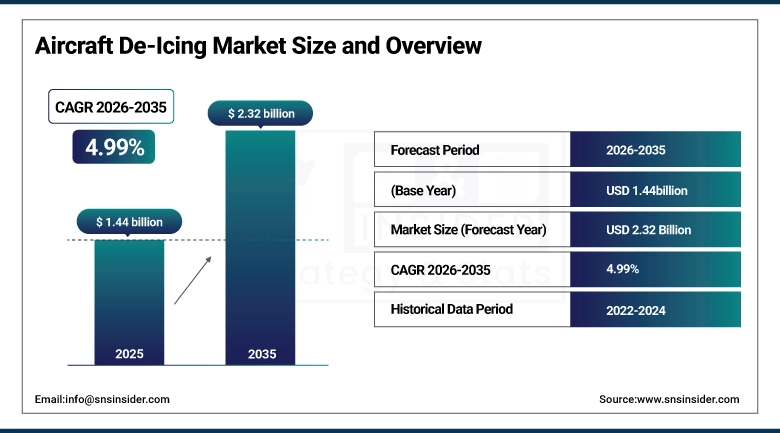
The Aircraft De-Icing Market size is valued at USD 1.44 Billion in 2025 and is projected to reach USD 2.32 Billion by 2035, growing at a CAGR of 4.99% during the forecast period 2026–2035.
The Aircraft De-Icing Market Analysis report gives a thorough evaluation of market dynamics, technology development, and application uses. The increase in air traffic, frequent winter disruption events, increased focus on aircraft safety regulations, and airport expansion are contributing to the stable growth in the market from 2026 to 2035.
More than 8.6 Billion de-icing processes took place in 2025 due to increased flights in cold weather regions and stringent safety regulations in the aviation industry.
Market Size and Forecast:
-
Market Size in 2025: USD 1.44 Billion
-
Market Size by 2035: USD 2.32 Billion
-
CAGR: 4.99% from 2026 to 2035
-
Base Year: 2025
-
Forecast Period: 2026–2035
-
Historical Data: 2022–2024
To Get more information on Aircraft De-Icing Market - Request Free Sample Report
Aircraft De-Icing Market Trends:
-
Increasing air traffic and rising fleet expansion are driving higher frequency of aircraft operations in winter-prone regions, boosting demand for de-icing services.
-
Growing emphasis on aviation safety regulations and ICAO compliance standards is increasing mandatory adoption of standardized de-icing procedures across airports and airlines.
-
Rising occurrence of extreme weather conditions and unpredictable icing events is significantly increasing operational dependency on de-icing systems.
-
Expansion of airport infrastructure and modernization of ground support equipment is improving efficiency and scalability of de-icing operations.
-
Advancements in eco-friendly de-icing fluids and low-toxicity chemical formulations are supporting environmental compliance and sustainable aviation goals.
-
Increasing deployment of automated, sensor-based, and high-efficiency de-icing systems is enhancing turnaround time and reducing flight delays.
-
Growing outsourcing of de-icing services to specialized ground handling providers is improving cost efficiency and operational reliability for airlines.
U.S. Aircraft De-Icing Market Insights:
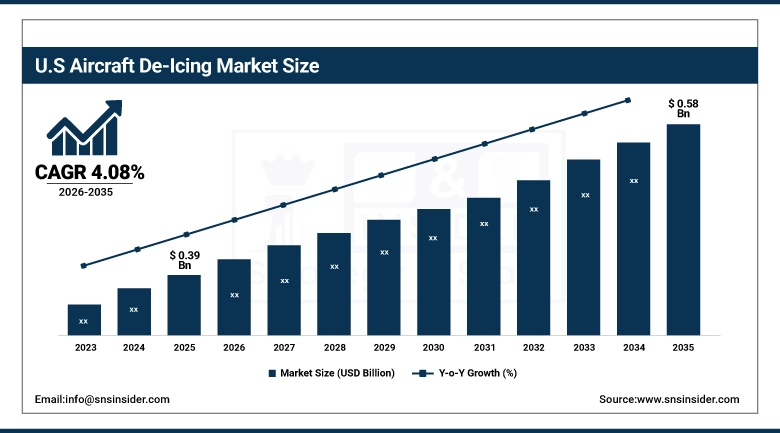
The U.S. Aircraft De-Icing Market is projected to grow from USD 0.39 Billion in 2025 to USD 0.58 Billion by 2035, at a CAGR of 4.08%. The growth in the industry is attributed to dense air traffic, seasonal weather interruptions, prominent presence of aviation centers, stringent safety standards of the FAA, and growing demand for state-of-the-art de-icing fluids and automated equipment for airport ground handling.
Aircraft De-Icing Market Growth Drivers:
-
Rising air traffic volume and increasing frequency of winter weather disruptions are driving strong demand for aircraft de-icing operations.
The increase in flight traffic and icing seasons are major factors fueling the Aircraft De-Icing Market. Modern de-icing solutions for aircraft, including fluid, systems, and automated machines, are being adopted by airports, airlines, and handling services companies in order to maintain safe flights without delays due to weather. With the increase in airport capacity along with enhanced safety rules in aviation and compliance with ICAO standards, the demand for efficient de-icing systems is increasing at a rapid pace.
Over 60% of all airports and airlines applied the standard system of aircraft de-icing in 2025 to avoid any weather-based issues while taking off.
Aircraft De-Icing Market Restraints:
-
High operational costs and weather-dependent inefficiencies are restraining the widespread adoption of advanced aircraft de-icing systems in cost-sensitive aviation markets.
Expensive de-icing fluid, costly equipment, costly infrastructure development, and expensive system maintenance have been restraining growth in the Aircraft De-Icing Market. In addition to that, airlines and small airports do not always have sufficient budgets for the implementation of advanced technology in de-icing processes due to they mostly operate in emerging or regional regions. Moreover, the difficulty and unpredictability of winter conditions, along with environmental norms, limit the implementation of eco-friendly de-icing chemicals, which require highly-qualified staff for their effective utilization.
Aircraft De-Icing Market Opportunities:
-
Growing adoption of sustainable, eco-friendly de-icing fluids and next-generation ice protection systems presents significant market expansion opportunities.
The increase in environmental compliance and carbon reductions in the aviation industry is providing many openings for the Aircraft De-Icing Market. Various organizations such as airports, airlines, and ground handlers have been moving toward the use of eco-friendly and energy-saving de-icing equipment. The incorporation of various automated de-icing processes, predictive weather analytics, and advanced AI-driven ground-handling processes is increasing efficiency. Service providers that offer economic and efficient services for de-icing will find good openings in growing airports across the world.
Over 27% of all the international airports started implementing eco-friendly de-icing programs during 2025.
Aircraft De-Icing Market Segmentation Analysis:
-
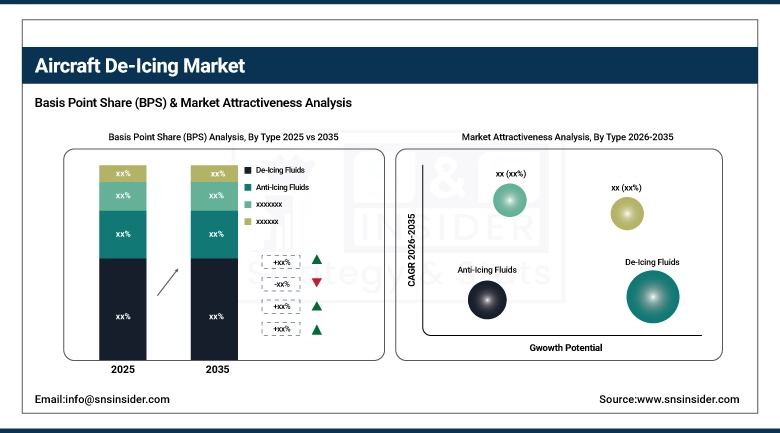
By Type, De-Icing Fluids held the largest market share of 55.75% in 2025, while De-Icing Equipment & Systems are expected to grow at the fastest CAGR of 6.01% during 2026–2035.
-
By Technology, Fluid-Based De-Icing Systems dominated with 60.05% market share in 2025, whereas Infrared De-Icing Systems are projected to record the fastest CAGR of 7.39% through 2026–2035.
-
By Application, Commercial Aviation dominated with 60.85% share in 2025, while Cargo Aviation is expected to expand at the fastest CAGR of 5.45% during the forecast period.
-
By End User, Airports held the largest share of 45.12% in 2025, while MRO Service Providers are expected to grow at the fastest CAGR of 5.86% during 2026–2035.
-
By Aircraft Type, Narrow-Body Aircraft accounted for 40.23% share in 2025, while UAVs / Drones are expected to grow at the fastest CAGR of 6.23% during the forecast period.
-
By De-Icing Method, Ground-Based De-Icing dominated with 70.54% share in 2025, while In-Flight De-Icing is expected to grow at the fastest CAGR of 5.36% through 2026–2035.
By Type, De-Icing Fluids Dominate While De-Icing Equipment & Systems Grow Rapidly:
The De-Icing Fluids segment dominated the market due to their extensive use in commercial airports and heavy dependence in removing and preventing ice buildup on airplanes. The segment continues to be the preferred option by airports and airline companies due to its high efficiency and importance in making flights safe during winter conditions.
De-Icing Equipment & Systems are the fastest growing segment as It is fuelled by rising modernization efforts at airports, increasing automation in ground handling operations, and investments in spray systems and heating equipment.
By Technology, Fluid-Based De-Icing Systems Dominate While Infrared De-Icing Systems Grow Rapidly:
Fluid-Based De-Icing Systems segment dominated the market share owing to its extensive use over airports in the past and effective capability in tackling icing problems in severe climatic conditions. Efficient integration into the routine functioning of airports and compatibility with airport ground equipment are other key factors contributing to its dominant market position.
The fastest growing segment was the Infrared De-Icing Systems. This was mainly due to the growing preference for green aircraft de-icing technology and decreased dependence on chemicals.
By Application, Commercial Aviation Dominates While Cargo Aviation Grows Rapidly:
Commercial Aviation segment dominated the market owing to consistent passenger volumes and safety standards that made flights mandatory during winters. The Commercial Aviation category still benefits from strong regulatory mechanisms and reliance on de-icing techniques.
Cargo Aviation is the fastest-growing segment, attributed to the fast-paced development of logistics systems and the rise of operations in cold climates.
By End User, Airports Dominate While MRO Service Providers Grow Rapidly:
Airports segment dominated the market, as the primary site for conducting de-icing activities due to the presence of large-scale ground facilities, dedicated de-icing areas, and constant movement of planes from different regions. The need to ensure safe flying in winter seasons and handling of high volumes of operations ensures their dominance in the market.
MRO Service Providers is the fastest-growing segment due to the rise in outsourcing of aircraft maintenance and handling services, the increase in demand for efficient de-icing operations, and increased collaboration of service providers with airlines.
By Aircraft Type, Narrow-Body Aircraft Dominate While UAVs / Drones Grow Rapidly:
Narrow-Body Aircraft segment dominated owing to wide application in short-haul and medium-haul services, causing higher utilization and more opportunities for winter de-icing operations. Air carriers depend greatly on this aircraft type in transporting passengers, thus emphasizing its significant share in driving demand.
UAVs / Drones are the fastest-growing segment, owing to growing use in surveillance, logistics, defense, and advanced autonomous aviation. The growth was attributed to growing activities in cold regions, innovations in lighter protection solutions, and higher penetration in aviation ecosystems.
By De-Icing Method, Ground-Based De-Icing Dominates While In-Flight De-Icing Grows Rapidly:
Ground-Based De-Icing segment dominated the market due to its widespread adoption across airports and strong reliance on standardized procedures for removing and preventing ice formation before takeoff.
In-Flight De-Icing is the fastest-growing segment, driven by increasing demand for advanced aircraft safety systems, rising adoption of embedded ice protection technologies, and growing focus on operational efficiency during extreme weather conditions.
Aircraft De-Icing Market Regional Analysis:
North America Aircraft De-Icing Market Insights:
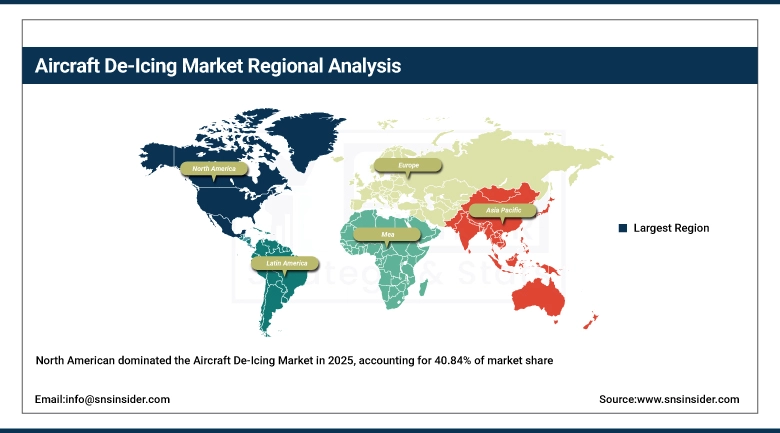
The North America Aircraft De-Icing Market is dominated, holding a 40.84% share in 2025, due to a number of factors such as high level of air traffic, winter disruptions, and the existence of an efficient network of major hubs throughout the United States and Canada. Increased adoption of various de-icing technologies including sophisticated fluids, de-icing gear, and automatic de-icing equipment has played a significant role in the market’s development. Tight FAA regulations, highly developed airport infrastructure, and a large number of key aviation companies in the area ensure North America’s market supremacy. Additional factors include investment in airport modernization, sustainable de-icing systems, and improved digital weather tracking facilities.
Get Customized Report as per Your Business Requirement - Enquiry Now
U.S. Aircraft De-Icing Market Insights:
U.S region is driven by a high number of flights, intensive operations in winter conditions across various states, and standardized de-icing procedures employed by the country’s major domestic and international airports, the U.S. Aircraft De-Icing Market has achieved high operational efficiency due to the widespread utilization of advanced de-icing equipment, fluids, and outsourced airport services. In addition, effective regulation, constant airport modernization efforts, and a large number of airline companies contribute significantly to the country’s market supremacy.
Asia-Pacific Aircraft De-Icing Market Insights:
The Asia-Pacific Aircraft De-Icing Market is the fastest-growing region, projected to expand at a CAGR of 6.89% during 2026–2035. Growth will be fueled by the rise in air passenger traffic, expansion of airport infrastructure, and flights at high altitude and winter conditions in countries such as China, Japan, and South Korea. The rising usage of innovative de-icing systems, enhanced aviation safety regulations, and investments in modernized ground infrastructure will boost market growth in the region. The fast-paced increase in aircraft fleets, rise in low-cost airlines, and innovations in smart airport systems are boosting the growth opportunities within the region.
China Aircraft De-Icing Market Insights:
The China Aircraft De-Icing Market is driven by rapid aviation infrastructure development, an increase in air passenger traffic, and an increase in flights in high-altitude and northern areas. The adoption of advanced de-icing fluids, ground support infrastructure, and automated de-icing systems is significantly enhancing operational efficiency. Ongoing developments in airports, increased focus on aviation safety standards, and the expansion of the airline network in the country are driving market growth, making China a significant contributor to Asia-Pacific aircraft de-icing market growth.
Europe Aircraft De-Icing Market Insights:
Factors fueling the Europe Aircraft De-Icing market include recurring winter weather, stringent aviation safety standards, and the presence of an extensive international airport network in leading economies. Significant dependence on standard de-icing methods, efficient ground handling equipment, and environmentally friendly aircraft de-icing fluids contributes to the steady demand in the market. Growing focus on environmental regulations, usage of non-toxic chemicals, and improved airport infrastructure are providing further impetus to the market.
Germany Aircraft De-Icing Market Insights:
Germany is an important part of the Europe Aircraft De-Icing market, supported by robust aircraft traffic, advanced airport infrastructure, and recurring winter conditions. Extensive usage of standard aircraft de-icing methods, improved ground handling facilities, and stringent regulatory framework contribute to the safety of operations. Ongoing developments in airport infrastructures, along with other sustainable practices, provide further impetus to the country’s importance in the market.
Latin America Aircraft De-Icing Market Insights:
Growing demand for de-icing solutions from aircraft operators owing to the increase in infrastructure at airports, international connectivity, and the operation of flights through selected high altitude and seasonal cold areas in Brazil, Mexico, and Argentina is fueling growth of the Latin America Aircraft De-Icing Market. The market will continue to grow on the back of gradual improvement in aviation safety standards and advancements in ground handling services.
Middle East & Africa Aircraft De-Icing Market Overview:
The growth of the Middle East & Africa Aircraft De-Icing Market is driven by the rise in connectivity through air transport, ongoing airport developments, and the rise in safety compliance in the region. Increasing aircraft fleet size, advancement in ground handling, and adoption of advanced operational services in selected colder and high-altitude areas will also contribute toward market expansion.
Aircraft De-Icing Market Competitive Landscape:
BASF SE is one of the world's top chemical companies that also features prominently within the aircraft de-icing segment owing to its effective de-icing and anti-icing fluid products. BASF is an innovator of glycol-based de-icers that provide for effective ice removal, better environmental compatibility, and operational safety for commercial airports. With robust research and development operations, extensive manufacturing facilities, and extensive distribution channels, BASF produces de-icing chemicals of consistent quality that can be delivered to leading airports throughout the world.
-
In September 2025, BASF expanded its aviation chemicals portfolio with next-generation low-environmental-impact de-icing fluid formulations aimed at improving performance efficiency while reducing chemical runoff in major European and North American airports.
Clariant AG is one of the prominent companies in the production of performance and environment-friendly fluid used for de-icing aircraft. In addition, it is one of the major players in the market with emphasis placed on sustainable chemicals. It produces various additives that enhance the performance of its glycol products, especially in ice prevention under very harsh weather conditions. Given its major strength in sustainable chemistry, regulations, and partnership with airport authorities, it continues to gain prominence in winter operation markets in both Europe and North America.
-
In August 2025, Clariant AG introduced an upgraded line of sustainable de-icing additives designed to reduce toxicity levels and improve operational efficiency in airport ground handling applications across key international hubs.
Kilfrost Limited is an aviation de-icing solution company with an excellent reputation when it comes to manufacturing de-icing and anti-icing fluids designed for the specific purpose of air crafts safety. The company produces aviation specific fluids that offer efficient performance under harsh winter climatic conditions, while at the same time fulfilling international standards required by aviation safety regulations. Kilfrost has a wealth of experience dealing with glycols and has established business relationships with different airlines, airports, and ground services companies, thus enhancing its market competitiveness.
-
In July 2025, Kilfrost Ltd. launched an upgraded eco-efficient Type I and Type IV de-icing fluid range aimed at improving aircraft protection performance while reducing environmental impact and supporting airport sustainability initiatives.
Aircraft De-Icing Market Key Players:
Some of the Aircraft De-Icing Market Companies are:
-
BASF SE
-
Clariant AG
-
Kilfrost Ltd.
-
Textron Ground Support Equipment Inc.
-
JBT Corporation (Oshkosh Aerotech)
-
Vestergaard Company A/S
-
Global Ground Support LLC
-
Cryotech Deicing Technology (General Atomics)
-
The Dow Chemical Company
-
DuPont de Nemours Inc.
-
Tronair Inc.
-
Collins Aerospace (RTX Corporation)
-
Menzies Aviation
-
Integrated Deicing Services (IDS)
-
Air BP (BP plc)
-
Honeywell International Inc.
-
LyondellBasell Industries
-
Zurich Airport Services AG
-
Aero Mag 2000
-
Inland Technologies International Limited
| Report Attributes | Details |
|---|---|
| Market Size in 2025 | USD 1.44 Billion |
| Market Size by 2035 | USD 2.32 Billion |
| CAGR | CAGR of 4.99% From 2026 to 2035 |
| Base Year | 2025 |
| Forecast Period | 2026-2035 |
| Historical Data | 2022-2024 |
| Report Scope & Coverage | Market Size, Segments Analysis, Competitive Landscape, Regional Analysis, DROC & SWOT Analysis, Forecast Outlook |
| Key Segments | • By Type (De-Icing Fluids, Anti-Icing Fluids, De-Icing Equipment & Systems, Others) • By Technology (Fluid-Based De-Icing Systems, Electric/Heating-Based Systems, Infrared De-Icing Systems, Electro-Mechanical Ice Protection Systems, Hybrid Systems, Others) • By Application (Commercial Aviation, Military Aviation, Business & General Aviation, Cargo Aviation, Others) • By End User (Airports, Airlines, Defense Forces, MRO Service Providers, Others) • By Aircraft Type (Narrow-Body Aircraft, Wide-Body Aircraft, Regional Jets, Helicopters, UAVs / Drones, Others) • By De-Icing Method (Ground-Based De-Icing, In-Flight De-Icing, Others) |
| Regional Analysis/Coverage | North America (US, Canada), Europe (Germany, UK, France, Italy, Spain, Russia, Poland, Rest of Europe), Asia Pacific (China, India, Japan, South Korea, Australia, ASEAN Countries, Rest of Asia Pacific), Middle East & Africa (UAE, Saudi Arabia, Qatar, South Africa, Rest of Middle East & Africa), Latin America (Brazil, Argentina, Mexico, Colombia, Rest of Latin America). |
| Company Profiles | BASF SE, Clariant AG, Kilfrost Ltd., Textron Ground Support Equipment Inc., JBT Corporation (Oshkosh Aerotech), Vestergaard Company A/S, Global Ground Support LLC, Cryotech Deicing Technology (General Atomics), The Dow Chemical Company, DuPont de Nemours Inc., Tronair Inc., UTC Aerospace Systems (Collins Aerospace), Menzies Aviation, Integrated Deicing Services (IDS), Air BP (BP plc), Honeywell International Inc., LyondellBasell Industries, Zurich Airport Services AG, Aero Mag 2000, Inland Technologies International Limited |
Frequently Asked Questions
North America dominated with a 40.84% share in 2025, while Asia-Pacific is the fastest-growing region, expected to expand at a CAGR of 6.89% during 2026–2035.
Fluid-Based De-Icing Systems dominated with a 60.05% share in 2025, while Infrared De-Icing Systems are projected to grow at the fastest CAGR of 7.39% during 2026–2035.
Growth is driven by rising air traffic, increasing winter weather disruptions, strict aviation safety regulations, and expanding airport infrastructure.
The market is valued at USD 1.44 Billion in 2025 and is projected to reach USD 2.32 Billion by 2035.
Ans: The Aircraft De-Icing Market is projected to grow at a CAGR of 4.99% during 2026–2035.
