
Aircraft Electrification Market Report Scope & Overview:
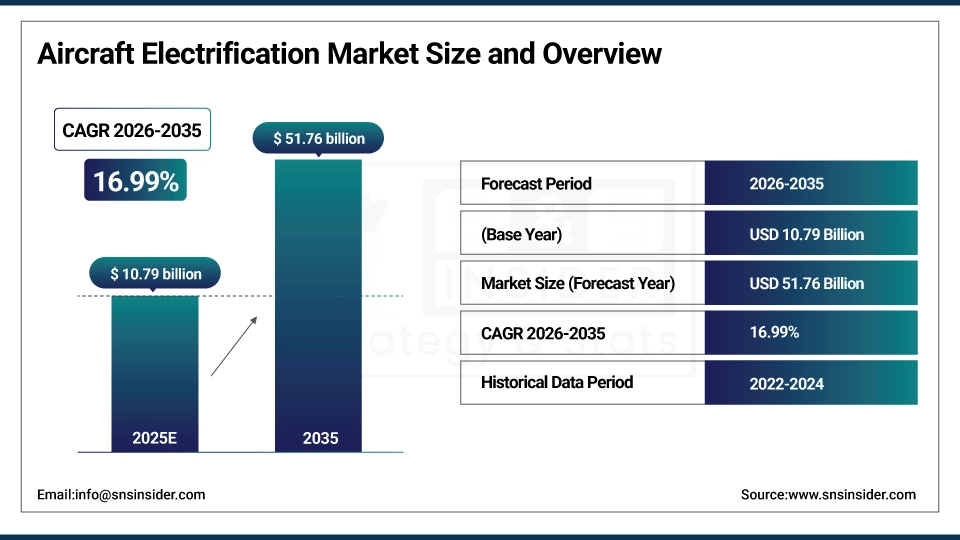
The Aircraft Electrification Market was valued at USD 10.79 Billion in 2025 and is expected to reach USD 51.76 Billion by 2035, growing at a CAGR 16.99% of from 2026-2035.
The Aircraft Electrification Market is revolutionizing the aviation sector by replacing traditional hydraulic and pneumatic systems with new electric techniques to enhance performance, efficiency, and environmental footprint. Electric propulsion allows an airplane to be lighter, which means it can use less fuel and require less maintenance and emit fewer pollutants. Driven by electric propulsion, power electronics, energy storage and advanced technologies, this market will foster development of more-electric aircraft and hybrid STOLs as a new era in cleaner air transportation is opened.
To Get more information on Aircraft Electrification Market - Request Free Sample Report
Key Trends in the Aircraft Electrification Market
-
More Electric Aircraft (MEA) adoption is increasing, replacing hydraulic and pneumatic systems.
-
Hybrid-electric and eVTOL platforms are driving next-generation aircraft development.
-
Advances in lithium-ion, solid-state batteries, and fuel cells improve range and reliability.
-
High-efficiency motors, converters, and electric actuators enhance performance and reduce weight.
-
Aviation electrification focuses on reducing carbon emissions and improving sustainability.
U.S. Aircraft Electrification Market Insights:
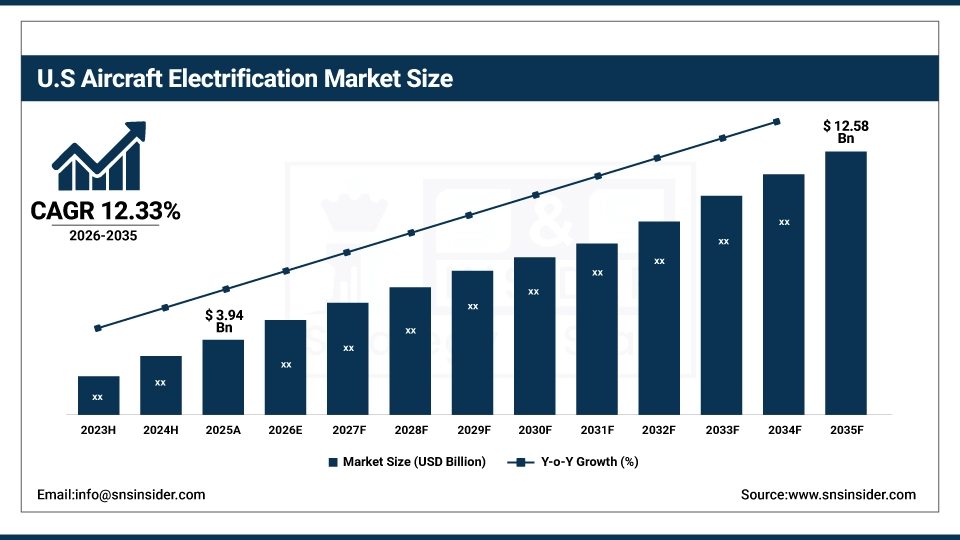
The U.S. Aircraft Electrification Market is projected to grow from USD 3.94 Billion in 2025 to USD 12.58 Billion by 2035, at a CAGR of 12.33%. Growth is influenced by increasing MEA uptake, significant defense and commercial aviation expenditure, fast development of eVTOLs, electric propulsion development and power electronics improvements as well as strict U.S. emission policies and sustainability regulations.
Aircraft Electrification Market Growth Drivers:
-
Stringent Emission Regulations and Shift Toward Sustainable Aviation
The market is growing on account of the global decarbonization targets, stringent aviation emission standards and airline service contracts for net-zero goals. Electrification is claimed to lower fuel burn, emissions and maintenance costs, as well as boosting efficiency of aircraft. Breakthrough in electric propulsion, power electronics and energy storage technologies as well as significant government and defense investments are driving adoption across commercial, military, and advanced air mobility aircraft.
Aircraft Electrification Market Restraints:
-
High Development Costs, Battery Limitations, and Certification Challenges
Growth is limited by the high R&D and integration cost of new electric propulsion systems, power management and advanced batteries. Shortcomings with battery energy density, thermal management difficulties and rigorous airline safety and certification demands add to the pace of development and there is a lag in commercialization on a large scale and near-term use.
Aircraft Electrification Market Opportunities:
-
Growth of eVTOL, Hybrid-Electric Aircraft, and Advanced Power Technologies
Fast-paced evolvement of eVTOL’s and hybrid-electric aircraft provides a golden opportunity for GSE solutions. These efforts, alongside the latest commercial developments in solid-state batteries, fuel cells, light-weight materials and high-voltage architectures for power electronics systems, as well as public-private partnerships and growing R&D investments will facilitate the emergence of new applications on the market and accelerate longer-term market growth.
Aircraft Electrification Market Segment:
-
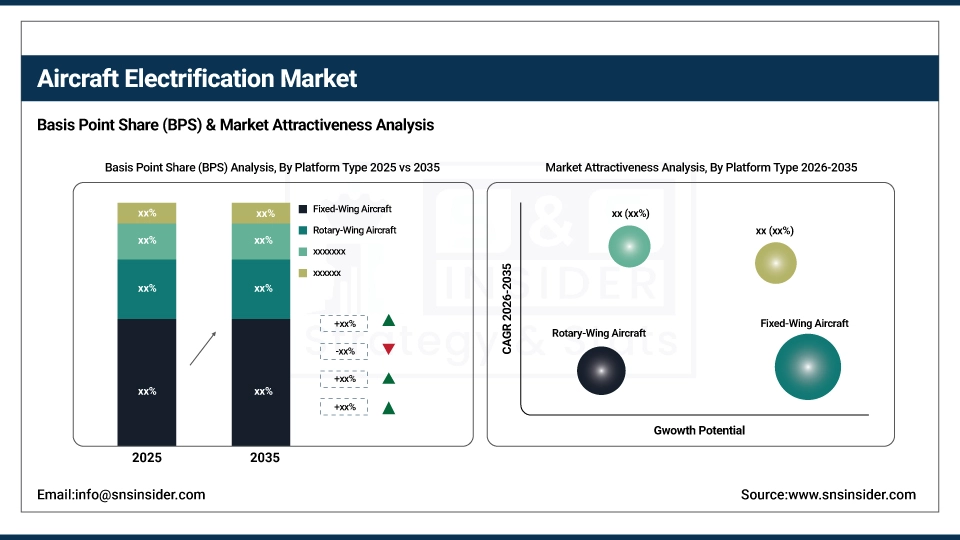
By Platform Type: In 2025, Fixed-Wing Aircraft dominated with 58% share; eVTOL / Advanced Air Mobility fastest growing segment during 2026-2035
-
By Technology: In 2025, Electric Power Generation & Distribution dominated with 46% share; Electric Propulsion Systems fastest growing segment during 2026-2035
-
By Application: In 2025, Flight Control Systems dominated with 39% share; Environmental Control Systems fastest growing segment during 2026-2035
-
By Energy Storage: In 2025, Lithium-Ion Batteries dominated with 67% share; Solid-State Batteries fastest growing segment during 2026-2035
Aircraft Electrification Market Segment Analysis:
By Platform Type: Fixed-Wing Aircraft Dominate, eVTOL / Advanced Air Mobility Fastest-Growing
Fixed-Wing Aircraft segment captures larger market share as they are heavily utilized with both commercial and military aircraft globally, and the trend of increased adoption of More Electric Architecture. Airbus has already developed and implemented electric flight controls, braking systems, environmental control systems and power distribution for fixed-wing vehicles that are helping to enable more fuel-efficient yet lighter-weight and lower-maintenance aircraft.
eVTOL / Advanced Air Mobility is the fastest-growing platform type, driven by fully electric propulsion requirements, urban air mobility programs, and strong investments in next-generation short-range aircraft designed for sustainable transportation.
By Technology: Electric Power Generation & Distribution Dominate, Electric Propulsion Systems Fastest-Growing
Electric Power Generation & Distribution dominates the technology segment as it forms the backbone of aircraft electrification across all platforms. High voltage power architectures, converters, generators and wiring systems are vital for the integration of electrified subsystems along with facilitating efficient power management on modern aircraft.
Electric Propulsion Systems are fastest growing segment as development of hybrid-electric and fully electric aircraft is increasing in regional aviation and eVTOL platforms which are reinforced by evolution of motors and power electronics.
By Application: Flight Control Systems Dominate, Environmental Control Systems Fastest-Growing
Flight Control Systems dominate the application segment owing to the rapid replacement of hydraulic systems with electric actuators for primary and secondary flight controls. They enhance reliability, reduce the aircraft weight and reduce the long-term maintenance costs, as such are key areas for aircraft electrifications.
Environmental Control Systems are the fastest-growing application segment as aircraft manufacturers increasingly electrify cabin pressurization, cooling, and air management systems to enhance efficiency and eliminate bleed-air dependence.
Aircraft Electrification Market - Regional Analysis
North America Aircraft Electrification Market Insights:
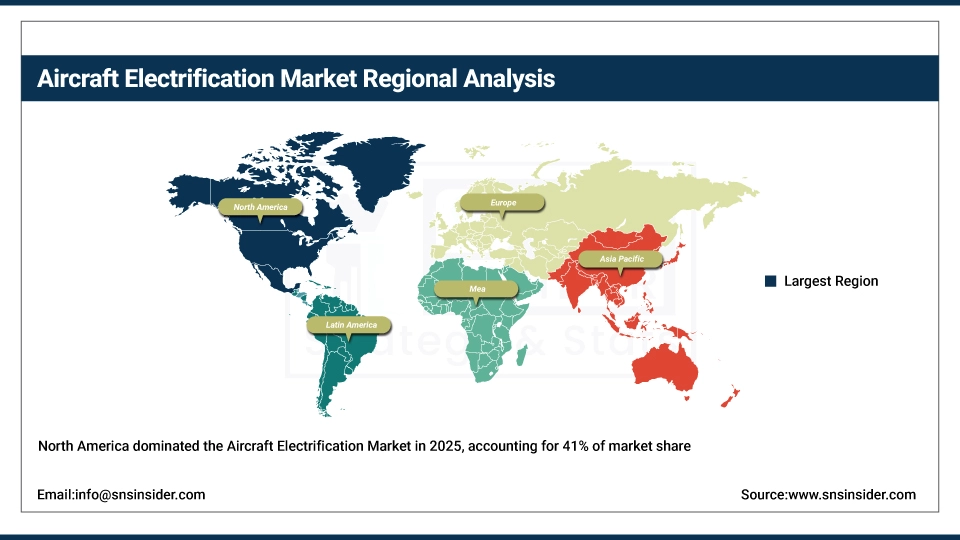
North America dominates the Aircraft Electrification Market, accounting for approximately 41% of the global market share. Such dominance is attributed to robust presence of key aerospace OEMs and system integrators, high defense & commercial aviation budgets, early uptake of More Electric Aircraft (MEA) architectures, and huge spending on electric propulsion and advanced air mobility programs.
Get Customized Report as per Your Business Requirement - Enquiry Now
Europe Aircraft Electrification Market Insights:
Europe plays a pivotal role in the Aircraft Electrification Market, driven by strong sustainability mandates and a mature aerospace ecosystem. The region hosts active involvement of major aircraft manufacturers, tier-1 suppliers, and research institutions in more electric and hybrid-electric air vehicle development. Clean aviation initiatives supported by EU, leading edge power electronics research, and early adoption of electrified systems across commercial and regional aircraft platforms are driving innovation and laying a strong foundation for sustained market growth.
Asia-Pacific Aircraft Electrification Market Insights:
Asia-Pacific is the fastest-growing region in the Aircraft Electrification Market, projected to expand at a CAGR of approximately 24.77% during 2026-2035. Market expansion is facilitated by a growing commercial aircraft fleet, rising air passenger numbers and strong investment in electric and hybrid-electric aircraft programmes. Government efforts to promote sustainable aviation, increased urban air mobility (UAM) projects and the development of aerospace manufacturing in China, Japan, South Korea and India are also driving interest in aircraft electrification technologies across the region.
Latin America Aircraft Electrification Market Insights:
Latin America as a market in awakening of aircraft electrification is the result of aging fleets and growing attention to fuel efficiency and sustainability. There is a developing market demand for electric systems such as, on regional and business airplanes, as well as an early development adoption for hybrid-electric technologies. Increasing regional air connectivity, growing spend on aerospace maintenance & manufacturing and in line with the global carbon reduction targets are likely to support steady growth of aircraft electrification in Latin America over the upcoming years.
Middle East & Africa Aircraft Electrification Market Insights:
The Middle East & Africa region is gradually adopting aircraft electrification, driven by fleet renewal programs and increasing emphasis on operational efficiency and sustainability. Airlines and defense operators are exploring electrified systems to reduce fuel consumption, maintenance costs, and emissions. Growing investments in aerospace infrastructure, rising interest in advanced air mobility, and collaborations with global aerospace OEMs and technology providers are expected to support long-term adoption of aircraft electrification technologies across the region.
Aircraft Electrification Market Competitive Landscape:
Honeywell International Inc., headquartered in Charlotte, North Carolina, USA, is a leading global aerospace technology provider and a key player in the aircraft electrification market. The company focuses on advanced electric power generation, power management, avionics, and electric actuation systems that support More Electric Aircraft and hybrid-electric platforms. Honeywell’s expertise in high-voltage power electronics, thermal management, and energy storage integration enables improved aircraft efficiency, reduced emissions, and enhanced system reliability across commercial, military, and advanced air mobility aircraft.
-
In April 2025: Honeywell expanded its aircraft electrification portfolio by advancing high-voltage power management and electric propulsion support technologies for hybrid-electric and eVTOL aircraft programs.
GE Aerospace, headquartered in Evendale, Ohio, USA, is a major global aerospace propulsion and systems manufacturer and a prominent contributor to aircraft electrification. The company emphasizes hybrid-electric propulsion, electric power generation, and advanced electrical systems to support next-generation commercial and military aircraft. Through extensive R&D in electric motors, power electronics, and sustainable propulsion technologies, GE Aerospace plays a critical role in enabling more electric and low-emission aviation platforms.
-
In May 2025: GE Aerospace strengthened its hybrid-electric aviation roadmap by progressing electric propulsion and power generation technologies aimed at improving fuel efficiency and reducing emissions in future aircraft platforms.
Aircraft Electrification Market Key Players
-
Honeywell International Inc.
-
GE Aerospace
-
Safran Group
-
RTX Corporation (Collins Aerospace)
-
Thales Group
-
Rolls-Royce plc
-
BAE Systems
-
Meggitt plc (Parker Meggitt)
-
Parker Hannifin Corporation
-
Moog Inc.
-
Eaton Corporation plc
-
Liebherr-Aerospace
-
Leonardo S.p.A.
-
Magellan Aerospace
-
AMETEK Inc.
-
Crane Aerospace & Electronics
-
Astronics Corporation
-
Joby Aviation
-
Lilium GmbH
-
Heart Aerospace
| Report Attributes | Details |
|---|---|
| Market Size in 2025 | USD 10.79 Billion |
| Market Size by 2035 | USD 51.76 Billion |
| CAGR | CAGR of 16.99% From 2026 to 2035 |
| Base Year | 2025 |
| Forecast Period | 2026-2035 |
| Historical Data | 2022-2024 |
| Report Scope & Coverage | Market Size, Segments Analysis, Competitive Landscape, Regional Analysis, DROC & SWOT Analysis, Forecast Outlook |
| Key Segments | • By Platform Type: (Fixed-Wing Aircraft, Rotary-Wing Aircraft, eVTOL / Advanced Air Mobility) • By Technology: (Electric Propulsion Systems, Electric Power Generation & Distribution, Electric Actuation Systems) • By Application: (Flight Control Systems, Environmental Control Systems, Landing & Braking Systems) • By Energy Storage: (Lithium-Ion Batteries, Solid-State Batteries, Fuel Cells) |
| Regional Analysis/Coverage | North America (US, Canada), Europe (Germany, UK, France, Italy, Spain, Russia, Poland, Rest of Europe), Asia Pacific (China, India, Japan, South Korea, Australia, ASEAN Countries, Rest of Asia Pacific), Middle East & Africa (UAE, Saudi Arabia, Qatar, South Africa, Rest of Middle East & Africa), Latin America (Brazil, Argentina, Mexico, Colombia, Rest of Latin America). |
| Company Profiles | Honeywell International Inc., GE Aerospace, Safran Group, RTX Corporation (Collins Aerospace), Thales Group, Rolls-Royce plc, BAE Systems, Meggitt plc (Parker Meggitt), Parker Hannifin Corporation, Moog Inc., Eaton Corporation plc, Liebherr-Aerospace, Leonardo S.p.A., Magellan Aerospace, AMETEK Inc., Crane Aerospace & Electronics, Astronics Corporation, Joby Aviation, Lilium GmbH, Heart Aerospace |
Frequently Asked Questions
The Aircraft Electrification Market is expected to grow at a CAGR of 16.99% during 2026–2035.
The market was valued at USD 10.79 Billion in 2025 and is projected to reach USD 51.76 Billion by 2035.
The key drivers of the Aircraft Electrification Market include stringent emission regulations, rising MEA adoption, advancements in batteries and power electronics, growing eVTOL demand, lower operating costs, and strong government and defense funding driving aircraft electrification.
The Electric Power Generation & Distribution segment dominated during the projected period.
North America dominated the Aircraft Electrification Market in 2025.
