
Airport Shuttle Buses Market Report Scope & Overview:
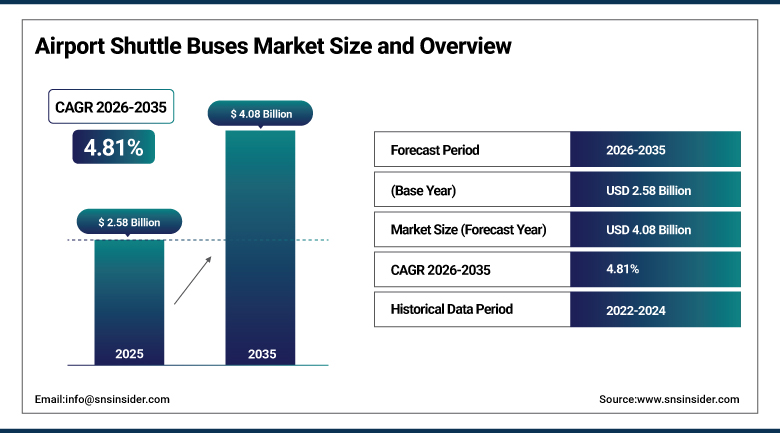
The Airport Shuttle Buses Market was valued at USD 2.58 billion in 2025 and is projected to reach around USD 4.08 billion by 2035, growing at a CAGR of 4.81% from 2026–2035.
The Airport Shuttle Buses Market is experiencing sustained growth due to the consistent increase in international air travel, the fast-paced upgrading of airport infrastructure, and the rising demand for effective means of intra-airport transportation. The growing emergence of mega airports featuring several terminals and remote parking locations is leading to an enhanced requirement for frequent shuttle bus services. Furthermore, the increasing inclination towards green aviation infrastructure around the world is paving the way for the adoption of electric and eco-friendly airport shuttle buses.
BYD, and COBUS Industries are actively expanding their electric airport bus portfolios, with multiple deployments in major international airports across Asia-Pacific, Europe, and the Middle East. Several airports, including those in Dubai, Singapore, and Europe’s major aviation hubs, are increasingly investing in zero-emission apron bus fleets as part of long-term carbon neutrality goals.
Airport Shuttle Buses Market Size and Forecast
-
Market Size in 2025: USD 2.58 Billion
-
Market Size by 2035: USD 4.08 Billion
-
CAGR: 4.81% from 2026 to 2035
-
Base Year: 2025
-
Forecast Period: 2026–2035
-
Historical Data: 2022–2024
To Get more information Airport Shuttle Buses Market - Request Free Sample Report
Airport Shuttle Buses Market Trends
-
Rising air passenger traffic and airport expansion is driving shuttle bus demand.
-
Increasing adoption of electric and zero-emission buses is accelerating sustainability transition.
-
Growing deployment of smart fleet management and IoT tracking is improving efficiency.
-
Rising development of autonomous shuttle buses is enabling next-gen airport mobility.
-
Expansion of mega airports is boosting inter-terminal and airside transport needs.
-
Increasing outsourcing of shuttle operations is improving cost efficiency and utilization.
-
Growing use of AI-based predictive maintenance is enhancing fleet performance.
-
Rising focus on passenger experience is driving modernization of airport transport systems.
U.S. Airport Shuttle Buses Market Size Outlook:
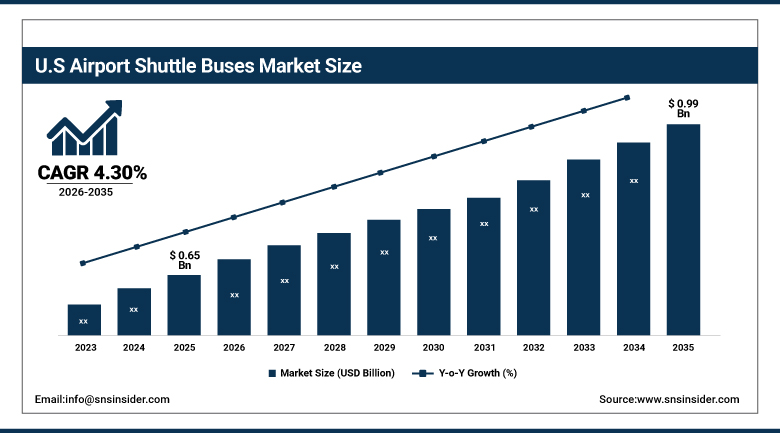
The U.S. Airport Shuttle Buses Market was valued at USD 0.65 billion in 2025 and is projected to reach around USD 0.99 billion by 2035, growing at a CAGR of 4.30% from 2026–2035.
The United States represents a vital market for airport shuttle buses because of the country's numerous international and domestic airports, significant levels of air travel traffic, and ongoing improvements in infrastructure at airports. The need for airport shuttles is fueled by a number of factors, including the necessity to ensure inter-terminal connections in large hub airports, increasing replacement of old diesel models, and the use of electric shuttles to support airports' environmental efforts. Besides, an upsurge in investment in smart airport transport systems is expected to help drive market growth in the country.
Recent developments highlight accelerating electrification of airport ground transport fleets, with several major U.S. airports such as Los Angeles International Airport (LAX) and San Francisco International Airport expanding electric apron and shuttle bus deployments in collaboration with OEMs like BYD and Proterra.
Additionally, airport authorities are increasingly integrating AI-based fleet scheduling and predictive maintenance systems to improve turnaround efficiency and reduce operational delays in high-traffic terminals.
Airport Shuttle Buses Market Segment Highlights
• By Bus Type, Diesel Airport Shuttle Buses dominated the market with 44.34% share in 2025, while Autonomous / Driverless Shuttle Buses are the fastest growing segment CAGR.
• By Application, Airside Passenger Transport dominated the market with 36.15% share in 2025, while Inter-Terminal Connectivity is the fastest growing segment CAGR.
• By Seating Capacity, Below 20 Seats (Mini Shuttle Buses) dominated the market with 46.81% share in 2025, while High-Capacity segment also shows strong growth driven by hub airport expansion CAGR.
• By Propulsion Type Internal Combustion Engine (ICE) dominated the market with 36.24% share in 2025, while Electric (Battery Electric Vehicles – BEV) is the fastest growing segment CAGR.
• By End User, International Airports dominated the market with 48.75% share in 2025, while Airport Ground Handling Service Providers are the fastest growing segment CAGR.
By Bus Type, Diesel Airport Shuttle Buses segment dominates the Airport Shuttle Buses Market, Electric Airport Shuttle Buses expected to grow fastest
In 2025, the Diesel Airport Shuttle Buses segment maintained its dominant position in the Airport Shuttle Buses Market, accounting for 44.34% of total revenue. The primary reasons for this are because there are already many existing fleets of airport buses, their initial cost is relatively cheap, and they are highly reliable when operating on high frequency transport services at airports. The use of diesel buses will continue to be prevalent in advanced and developing airports because of their availability and reliability when maintained.
From 2026 to 2035, the Electric Airport Shuttle Buses segment is projected to record the highest CAGR. This rapid growth is driven by increasing airport decarbonization mandates, rising investments in zero-emission ground support equipment, and strong government regulations targeting aviation carbon neutrality.
By Application, Airside Passenger Transport segment dominates the Airport Shuttle Buses Market, Inter-Terminal Connectivity expected to grow fastest
In 2025, the Airside Passenger Transport segment held the largest share of 36.15% in the Airport Shuttle Buses Market, driven by the critical need for efficient passenger movement between remote aircraft stands and terminal buildings. This segment remains essential in large hub airports with high flight volumes, where operational efficiency, turnaround time optimization, and passenger handling capacity are key priorities.
From 2026 to 2035, the Inter-Terminal Connectivity segment is expected to register the highest CAGR. Growth is attributed to increased developments of mega airports with several terminals, an increase in passengers transiting between the international and domestic terminals, and an increasing need for efficient airport transportation options.
By Seating Capacity, below 20 Seats (Mini Shuttle Buses) segment dominates the Airport Shuttle Buses Market, above 40 Seats segment expected to grow fastest
In 2025, the Below 20 Seats (Mini Shuttle Buses) segment dominated the Airport Shuttle Buses Market with a 46.81% share, this is mainly due to their extensive use in airport shuttle services over short distances, personnel transportations, and small-scale passenger movements. Such buses have been utilized extensively in regional and national airports because of their versatility, cost-effectiveness, and suitability for short-haul operations
From 2026 to 2035, the Above 40 Seats (High-Capacity Airport Buses) segment is expected to record the highest growth momentum, driven by increasing passenger traffic at international hub airports and the need for efficient mass passenger movement from remote stands to terminals.
By Propulsion Type, Internal Combustion Engine (ICE) segment dominates the Airport Shuttle Buses Market, Electric (Battery Electric Vehicles – BEV) segment expected to grow fastest
In 2025, the Internal Combustion Engine (ICE) segment maintained its dominant position in the Airport Shuttle Buses Market, accounting for 36.24% of total revenue. Such domination is chiefly attributed to the significant presence of the system worldwide in different airports, its reliable operation in high-frequency shuttles, and the availability of fueling and maintenance facilities for the same. Shuttle buses that use ICE continue to be the most favored ones in several airports owing to lower purchase price, better distance covered, and ability to undertake continuous operations.
From 2026 to 2035, the Electric (Battery Electric Vehicles – BEV) segment is projected to record the highest CAGR.
By End User, International Airports segment dominates the Airport Shuttle Buses Market, Airport Ground Handling Service Providers segment expected to grow fastest
In 2025, the International Airports segment held the largest share of 48.75% in the Airport Shuttle Buses Market, Fuelled by high passenger throughput, intricate multi-terminal activities, and constant growth of international airports around the world. International airports need huge shuttle fleets with high frequency to connect the airside terminals as well as other terminals within the airport, and hence they emerge as the major customers for diesel buses as well as upcoming electric shuttle bus models.
From 2026 to 2035, the Airport Ground Handling Service Providers segment is expected to record the highest CAGR.
Airport Shuttle Buses Market Regional Analysis
|
Region |
Major Country |
Share within Region (%) |
|---|---|---|
|
North America |
United States |
84.24% |
|
Europe |
Germany |
30.44% |
|
Asia Pacific |
China |
36.29% |
|
Middle East & Africa |
UAE |
24.19% |
|
Latin America |
Brazil |
37.59% |
North America Airport Shuttle Buses Market Insights
The North American continent features a well-established system of aviation infrastructure, facilitated by efficient airport infrastructure and advanced systems of ground handling coupled with considerable investments in upgrading airports. The North American continent enjoys the advantage of being characterized by a high volume of air passengers, especially within the USA, whereby large airports in cities such as Atlanta, Dallas, Chicago, and Los Angeles create a constant need for effective airport shuttle buses to serve these airports.
Supporting this dominance, airports across the U.S. and Canada are increasingly prioritizing fleet electrification, operational efficiency, and digital fleet management systems. Growing procurement of low-emission shuttle buses, integration of real-time tracking systems, and modernization of aging diesel fleets are reshaping airport mobility infrastructure across the region.
Additionally, recent developments such as BYD expanding electric airport bus deployments across major U.S. airports and Cobus Industries strengthening its apron bus supply contracts with North American airport operators are reinforcing the shift toward sustainable and high-capacity airport transport solutions.
Asia Pacific Airport Shuttle Buses Market Insights
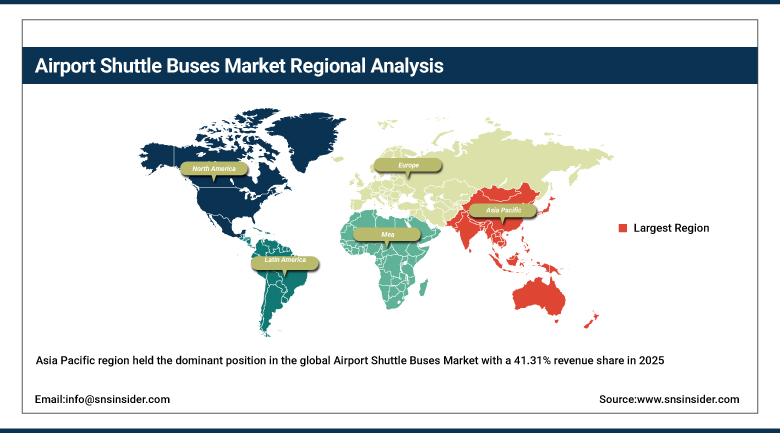
The Asia Pacific region held the dominant position in the global Airport Shuttle Buses Market with a 41.31% revenue share in 2025, and it is also projected to register the highest CAGR of 5.39% from 2026–2035, stimulated by the fast growth of airport infrastructure, growing volume of air traffic passengers, and development of new international aviation hub airports. Nations like China, India, Japan, South Korea, and Southeast Asia have invested highly in mega-airport constructions, terminal-to-terminal transportation networks, and smart airport transportation services, greatly increasing the need for shuttle buses, including electric shuttle buses.
Major Chinese and Southeast Asian airports are accelerating adoption of Yutong and BYD electric airport shuttle buses, driven by large-scale airport expansion programs and government-backed green aviation initiatives.
India and Southeast Asia are witnessing increasing public-private partnerships (PPP) in airport ground transport modernization, including smart shuttle tracking systems and high-capacity bus procurement for new terminal projects.
Get Customized Report as per Your Business Requirement - Enquiry Now
Europe Airport Shuttle Buses Market Insights
The continent of Europe continues to dominate the global Airport Shuttle Buses market due to its well-established aviation industry, high sustainability, and extensive modern airport projects. Some of the countries which continue to embrace sustainable airport transport services include Germany, UK, France, Spain, and Nordic countries due to their stringent environmental laws and zero-carbon emission aviation policies.
Recent developments such as Volvo Buses and Solaris expanding electric airport bus deliveries across major European airports and MAN Truck & Bus enhancing zero-emission airport mobility solutions under EU green mobility initiatives are further strengthening Europe’s transition toward sustainable airport transport ecosystems.
Latin America, Middle East & Africa (LAMEA) Airport Shuttle Buses Market Insights
LAMEA is registering continuous growth in its Airport Shuttle Buses market due to growing investments made in airport infrastructure, higher volumes of air passengers, and tourism/aviation industries. Some of the countries contributing to this include Brazil, Mexico, South Africa, UAE, Saudi Arabia, and Qatar. This is fueled by the construction of new airports and modernization of existing airports.
Middle Eastern aviation hubs, particularly in the UAE and Saudi Arabia, are investing in next-generation smart airport mobility systems, including high-capacity electric apron bus fleets and automated passenger transfer solutions.
Brazil and South Africa are expanding airport modernization programs with fleet renewal contracts for diesel-to-electric transition pilots, supported by partnerships with global OEMs and regional operators.
Airport Shuttle Buses Market Growth Drivers:
-
Rising global air passenger traffic, rapid airport expansion projects, and increasing demand for efficient intra-airport mobility systems are driving strong demand for airport shuttle buses across international aviation hubs.
The primary structural driving factor behind the Airport Shuttle Buses Market is the consistent modernization of airport facilities along with the rising demand for smooth transit of passengers from one terminal to another, from remote aircraft parking areas to terminals, and from remote parking facilities to terminals. With the development of airport facilities turning into mega multiple terminals, the dependency on frequent shuttle buses has been rising steadily.
COBUS Industries achieved a major global milestone in 2025 with the delivery of its 5,000th airport apron bus, including next-generation electric e.COBUS models deployed at major hubs such as British Airways operations in Europe, strengthening its leadership in high-capacity airside mobility solutions.
Airport Shuttle Buses Market Restraints:
-
Rising dependency on airport-wide shuttle operations, high capital costs for fleet electrification, and operational constraints in managing airside safety regulations are creating adoption challenges in the Airport Shuttle Buses Market
The major constraint on the Airport Shuttle Buses market can be related to the substantial expense of purchasing and maintenance of modern shuttle buses, which includes buying new equipment, installing infrastructure, and integrating them into the airport. The problem here is that airports, specifically in developing areas, have limited budgets, hindering the process of updating their fleets. Moreover, another constraint can be linked to rigorous airside safety requirements. This factor makes it difficult to introduce shuttles at the airports because the buses will need to meet some standards to operate within the airside territory.
Airport Shuttle Buses Market Opportunities:
-
Expansion of smart airports, electrified ground mobility systems, and rising focus on passenger experience are creating strong opportunities for connected and low-emission airport shuttle buses
Another key opportunity in the Airport Shuttle Buses market is the conversion of airports into a complete smart mobility ecosystem, wherein shuttle buses will be upgraded from mere transport carriers to sophisticated passengers’ movement platforms that leverage technology and data. As a result, there is growing demand for shuttle bus fleets that incorporate GPS tracking, artificial intelligence-based scheduling, and predictive maintenance systems. Furthermore, the rising trend of decarbonizing airports around the world and achieving net-zero emissions goals is fueling growth prospects for electric and hydrogen-based shuttle buses.
Recent Developments:
-
2026: Siemens Mobility partnered with European airport authorities to deploy integrated smart charging infrastructure for electric apron and shuttle buses, enabling real-time energy optimization and reducing turnaround charging time across high-traffic airport terminals.
-
2026: New Flyer Industries secured new contracts in North America for airport shuttle bus modernization programs, focusing on fleet replacement with low-emission and connected shuttle systems integrated with airport traffic management platforms.
-
2025: Alexander Dennis Limited (ADL) expanded its zero-emission airport bus deployment in the UK and European regional airports, introducing lightweight electric shuttle platforms designed for high-frequency inter-terminal operations.
-
2025: Ashok Leyland strengthened its airport mobility footprint in South Asia by supplying upgraded high-capacity diesel and hybrid airport shuttle buses for new terminal expansions, supporting growing domestic air traffic demand and regional airport upgrades.
Airport Shuttle Buses Market Key Players
-
Yutong Bus Co. Ltd.
-
BYD Company Limited
-
Cobus Industries GmbH
-
Volvo Group (Volvo Buses)
-
Daimler Truck AG (Mercedes-Benz Buses)
-
MAN Truck & Bus
-
Zhongtong Bus Holding Co. Ltd.
-
King Long United Automotive Industry Co. Ltd.
-
Zhengzhou Yutong Group (Yutong)
-
Solaris Bus & Coach
-
Tata Motors Limited
-
Ashok Leyland Limited
-
New Flyer Industries
-
Alexander Dennis Limited (ADL)
-
Proterra Inc.
-
MCV (Manufacturing Commercial Vehicles)
-
Temsa Global
-
Van Hool NV
-
Blue Bird Corporation
-
Gillig Corporation
Airport Shuttle Buses Market Report Scope:
| Report Attributes | Details |
|---|---|
| Market Size in 2025 | USD 2.58 Billion |
| Market Size by 2035 | USD 4.08 Billion |
| CAGR | CAGR of 4.81% From 2026 to 2035 |
| Base Year | 2025 |
| Forecast Period | 2026-2035 |
| Historical Data | 2022-2024 |
| Report Scope & Coverage | Market Size, Segments Analysis, Competitive Landscape, Regional Analysis, DROC & SWOT Analysis, Forecast Outlook |
| Key Segments | • By Bus Type (Diesel Airport Shuttle Buses, Electric Airport Shuttle Buses, Hybrid Airport Shuttle Buses, Autonomous / Driverless Shuttle Buses) • By Application (Airside Passenger Transport (Remote Stands to Terminal), Landside Passenger Transport (Parking to Terminal), Inter-Terminal Connectivity, Crew & Staff Transport) • By Seating Capacity (Below 20 Seats (Mini Shuttle Buses), 20–40 Seats (Mid-Size Shuttle Buses), Above 40 Seats (High-Capacity Airport Buses)) • By Propulsion Type (Internal Combustion Engine (ICE), Electric (Battery Electric Vehicles – BEV), Hybrid Electric Systems, Hydrogen Fuel Cell) • By End User (International Airports, Domestic Airports, Military & Private Airports, Airport Ground Handling Service Providers) |
| Regional Analysis/Coverage | North America (US, Canada), Europe (Germany, UK, France, Italy, Spain, Russia, Poland, Rest of Europe), Asia Pacific (China, India, Japan, South Korea, Australia, ASEAN Countries, Rest of Asia Pacific), Middle East & Africa (UAE, Saudi Arabia, Qatar, South Africa, Rest of Middle East & Africa), Latin America (Brazil, Argentina, Mexico, Colombia, Rest of Latin America). |
| Company Profiles | Yutong Bus Co. Ltd., BYD Company Limited, Cobus Industries GmbH, Volvo Group (Volvo Buses), Daimler Truck AG (Mercedes-Benz Buses), MAN Truck & Bus, Zhongtong Bus Holding Co. Ltd., King Long United Automotive Industry Co. Ltd., Zhengzhou Yutong Group (Yutong), Solaris Bus & Coach, Tata Motors Limited, Ashok Leyland Limited, New Flyer Industries, Alexander Dennis Limited (ADL), Proterra Inc., MCV (Manufacturing Commercial Vehicles), Temsa Global, Van Hool NV, Blue Bird Corporation, Gillig Corporation |
Frequently Asked Questions
The Airport Shuttle Buses Market is expected to grow at a CAGR of 4.81% from 2026 to 2035.
The Airport Shuttle Buses Market was valued at USD 2.58 billion in 2025.
Rapid expansion of smart airport infrastructure, rising air passenger traffic, and increasing demand for efficient intra-airport mobility systems is the primary growth driver of the Airport Shuttle Buses Market.
The Diesel Airport Shuttle Buses segment dominated the Airport Shuttle Buses Market in 2025.
Asia Pacific dominated the Airport Shuttle Buses Market in 2025.
