
Automotive Brake-by-Wire System Market Report Scope & Overview:
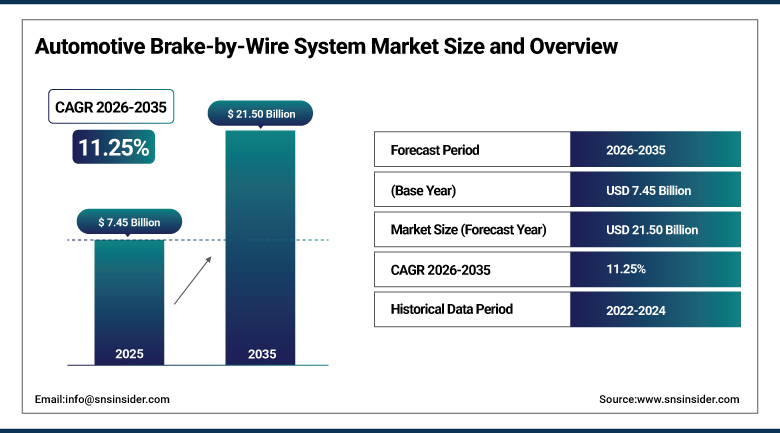
The Automotive Brake-by-Wire System Market was valued at USD 7.45 billion in 2025 and is expected to reach USD 21.50 billion by 2035, growing at a CAGR of 11.25% from 2026-2035.
The Automotive Brake-by-Wire System Market is witnessing strong growth due to the increasing electrification of vehicles, increase in the need for better braking systems, and the increased use of electronic systems in controlling vehicles. There is an increased trend among automobile manufacturers to incorporate brake-by-wire systems in order to increase responsiveness in braking and also electronic control of brakes. The increase in electric and hybrid vehicles has increased the need for lighter and electronically-controlled braking systems that could be able to work in coordination with regenerative braking systems. Furthermore, advances in autonomous driving, connected vehicles, sensor technology, and electronic control units have boosted the incorporation of brake-by-wire systems.
Global electric car sales exceeded 20 million in 2025, representing one-quarter of all new cars sold worldwide. Increasing EV penetration supports demand for braking systems capable of integrating with electric powertrains.
To Get more information Automotive Brake-by-Wire System Market - Request Free Sample Report
Automotive Brake-by-Wire System Market Trends
-
Growing adoption of electric vehicles is increasing demand for brake-by-wire systems supporting regenerative braking and improved energy efficiency.
-
Rising integration of ADAS and autonomous driving technologies is accelerating demand for precise electronic braking and faster response.
-
Increasing adoption of software-defined vehicles is supporting electronically controlled braking systems with advanced software and centralized vehicle architectures.
-
Advancements in sensors, actuators, and control units are improving braking precision, reliability, redundancy, and overall system performance.
U.S. Automotive Brake-by-Wire System Market Outlook
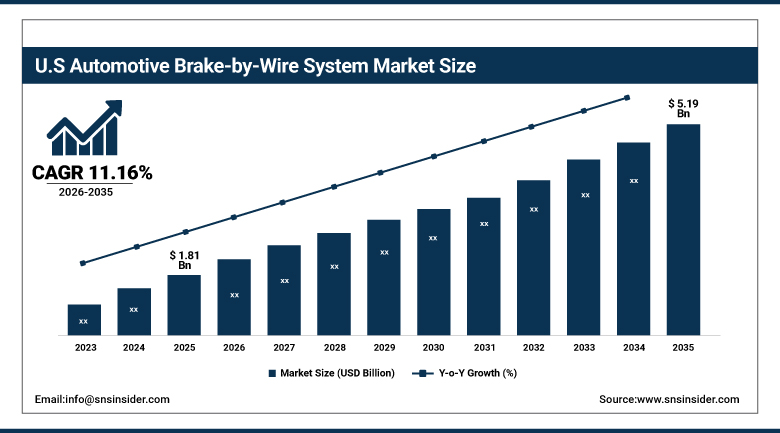
U.S. Automotive Brake-by-Wire System Market was valued at USD 1.81 billion in 2025 and is expected to reach USD 5.19 billion by 2035, growing at a CAGR of 11.16% from 2026-2035.
The U.S. Automotive Brake-by-Wire System Market is witnessing strong growth due to increased use of vehicles with electric engines, increasing use of high-end brake technology, and growing preference for electronically-controlled vehicle braking systems. Vehicle manufacturers are increasingly deploying brake-by-wire systems owing to their high responsiveness and better electronic control capabilities, while the adoption of hybrid vehicles is another factor contributing to the growth of brake-by-wire market. Other emerging factors that are aiding the deployment of brake-by-wire technology include advancements in autonomous vehicles, vehicle-to-vehicle communication, sensors, and electronic control units. The requirement of improved safety features in vehicles, reduced weight, efficient braking, and new-age vehicle architecture is fueling the demand for brake-by-wire systems in the United States.
NHTSA initiated rulemaking in 2026 concerning vehicles designed exclusively for automated driving systems, including requirements related to brake pedals while maintaining braking-performance requirements.
Automotive Brake-by-Wire System Market Segment Analysis
-
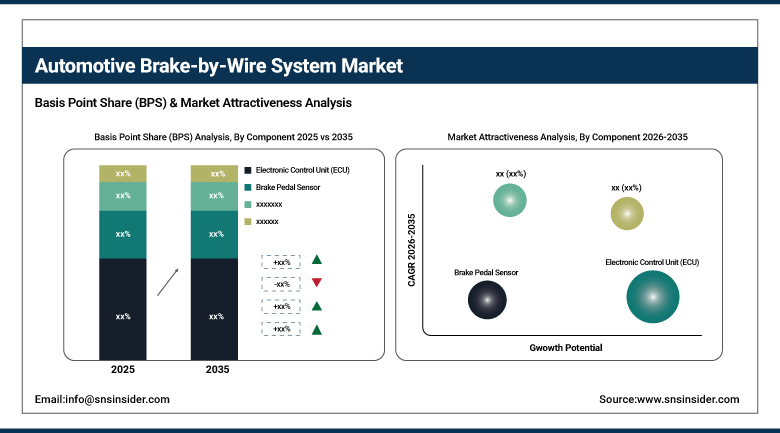
By Component, Electronic Control Unit (ECU) dominates the Automotive Brake-by-Wire System Market with 23% share in 2025; Electronic Control Unit (ECU) is expected to grow at the fastest CAGR of 14.20% from 2026–2035.
-
By Type, Electro-Hydraulic Brakes (EHB) dominate the Automotive Brake-by-Wire System Market with 50% share in 2025; Electro-Mechanical Brakes (EMB) are expected to grow at the fastest CAGR of 12.45% from 2026–2035.
-
By Vehicle Type, Passenger Cars dominate the Automotive Brake-by-Wire System Market with 72% share in 2025; Commercial Vehicles are expected to grow at the fastest CAGR of 12.65% from 2026–2035.
-
By Solution, One Box dominates the Automotive Brake-by-Wire System Market with 61% share in 2025; One Box is expected to grow at the fastest CAGR of 11.71% from 2026–2035.
-
By Vehicle Propulsion, ICE dominates the Automotive Brake-by-Wire System Market with 64% share in 2025; Electric Vehicles are expected to grow at the fastest CAGR of 11.68% from 2026–2035.
-
By Sales Channel, OEM dominates the Automotive Brake-by-Wire System Market with 92% share in 2025; Aftermarket is expected to grow at the fastest CAGR of 13.57% from 2026–2035.
By Component, Electronic Control Unit (ECU) dominates the Automotive Brake-by-Wire System Market, Electronic Control Unit (ECU) grows fastest.
Electronic Control Unit (ECU) dominated the Automotive Brake-by-Wire System Market with the highest revenue share of about 23% in 2025, powered by the important function it performs as part of brake input processing, actuator control, and overall management of electronic braking. Growing application of advanced brake systems and electronic architectures for automobiles is contributing to growing integration of ECUs.
Electronic Control Unit (ECU) is expected to grow at the fastest CAGR of 14.20% from 2026–2035, backed up by the growing trend of electrification in vehicles, advanced driver assistive systems, and the growing need for precision in electronic braking controls. With the increasing use of sensors, software, and vehicle control systems, there is a greater likelihood of more advanced ECUs being used.
By Type, Electro-Hydraulic Brakes (EHB) dominate the Automotive Brake-by-Wire System Market, Electro-Mechanical Brakes (EMB) grow fastest.
Electro-Hydraulic Brakes (EHB) dominated the Automotive Brake-by-Wire System Market with the highest revenue share of about 50% in 2025, backed by their technological expertise, reliable braking performance, and suitability for use with existing hydraulic brake systems. Successful implementation in hybrid and luxury cars, along with good integration with electronics and hydraulics, ensures continued demand for EHBs in the automobile industry.
Electro-Mechanical Brakes (EMB) are expected to grow at the fastest CAGR of 12.45% from 2026–2035, motivated by increased electrification of vehicles and the need for completely electronic braking system architecture. The electronic braking systems do not have any hydraulic parts, thereby making them simpler and electronically controllable. Their suitability for autonomous driving, sophisticated vehicle control systems, and regenerative braking makes them ideal for future use.
By Vehicle Type, Passenger Cars dominate the Automotive Brake-by-Wire System Market, Commercial Vehicles grow fastest.
Passenger Cars dominated the Automotive Brake-by-Wire System Market with the highest revenue share of about 72% in 2025, mainly because of their high production output and growing incorporation of brake technology. Consumer demands for safer cars with better comfort, electric features, and driver assist devices are motivating car manufacturers to install brake by wire systems widely in passenger cars.
Commercial Vehicles are expected to grow at the fastest CAGR of 12.65% from 2026–2035, Propelled by rising electrification of trucks, buses, and delivery vans. Higher needs for effective fleet management, safety braking, and driver assistance systems are driving this development. The brake-by-wire system also provides precise braking control and regeneration braking capability, thereby improving the suitability of the technology in future commercial vehicle designs.
By Solution, One Box dominates the Automotive Brake-by-Wire System Market, One Box grows fastest.
One Box dominated the Automotive Brake-by-Wire System Market with the highest revenue share of about 61% in 2025, due to its modular structure that integrates the braking control functions into one unit. Automotive manufacturers are gradually shifting to One Box technology for various reasons, including easier packaging of the car, simplicity in construction, and better integration with electronic stability control and regenerative braking technologies.
One Box is expected to grow at the fastest CAGR of 11.71% from 2026–2035, fueled by rising demands for small-size, integration, and electronic control of braking systems. The capability of integrating several braking functions in one device may contribute to less packaging space and reduced system complexity. Increasingly electrified vehicles and use of more advanced driver-assistance systems are helping in adopting the One Box system.
By Vehicle Propulsion, ICE dominates the Automotive Brake-by-Wire System Market, Electric Vehicles grow fastest.
ICE vehicles dominated the Automotive Brake-by-Wire System Market with the highest revenue share of about 64% in 2025, backed up by their large number of units installed around the world and ongoing production volume. The use of electronic braking technology is becoming more common in ICEs due to the increased focus on driver safety and better braking performance.
Electric Vehicles are expected to grow at the fastest CAGR of 11.68% from 2026–2035, Driven by the rapid electrification of vehicles and the increased use of regenerative braking systems. The brake-by-wire system allows for the accurate control of friction brakes and regenerative braking. Increased manufacture of electric vehicles and the use of electronic vehicle architecture is increasing demand for these systems.
By Sales Channel, OEM dominates the Automotive Brake-by-Wire System Market, Aftermarket grows fastest.
OEM dominated the Automotive Brake-by-Wire System Market with the highest revenue share of about 92% in 2025, mostly because of the increasing installation of brake-by-wire technology at the time of manufacture of automobiles. The automakers and manufacturers of the system can perfect their electronic braking system, software integration, and safety validation within the new platforms, thus creating strong OEM demand.
Aftermarket is expected to grow at the fastest CAGR of 13.57% from 2026–2035, backed up by the growing installed base of vehicles that use electronic braking technology. Rising vehicle maintenance requirements, replacement requirements, and availability of parts specific to braking systems will create new aftermarket opportunities. The growth in vehicles with electronically enabled systems will also generate replacement and servicing needs.
Regional Analysis
|
Region |
Major Country |
Share within Region, 2025 (%) |
|---|---|---|
|
North America |
United States |
89.0% |
|
Europe |
Germany |
27.5% |
|
Asia Pacific |
China |
41.0% |
|
Middle East & Africa |
UAE |
16.5% |
|
Latin America |
Brazil |
35.0% |
North America Automotive Brake-by-Wire System Market Insights
North America maintains strong demand for automotive brake-by-wire systems Due to sophisticated automobile technology, widespread use of electric vehicles, and the increasing use of ADAS. Automobile manufacturers are beginning to adopt electronic brakes for better response, safety, and regenerative braking systems compatibility. Investments in self-driving cars, software defined automobiles, and vehicle electronics provide additional support to the regional adoption and technological developments.
The U.S. Automotive Brake-by-Wire System Market accounted for a market share of 89.0%, Backed by advancements in automotive technology, high electric vehicle (EV) adoption rates, and ADAS. Increased focus on autonomous driving, electric vehicles, electronic braking, and software defined vehicles is boosting the demand for such systems even more.
Get Customized Report as per Your Business Requirement - Enquiry Now
Europe Automotive Brake-by-Wire System Market Insights
Europe is supported by stringent vehicle safety requirements, advanced automotive manufacturing, and strong adoption of premium, electric, and hybrid vehicles. Brake-by-wire technology is being used by the automakers for improved braking accuracy, regeneration, and ADAS/automated driving applications. Robust automotive R&D facilities, presence of established Tier 1 companies, and vehicle electrification add to the growth potential in the region.
The Germany Automotive Brake-by-Wire System Market accounted for a market share of 27.5%, powered by its robust automotive manufacturing infrastructure, sophisticated automobile engineering expertise, and the growing trend of electrified and hybridized automobiles. Development in vehicle safety, ADAS, self-driving technology, and electronically controlled braking systems helps in the growth of the market.
Asia Pacific Automotive Brake-by-Wire System Market Insights
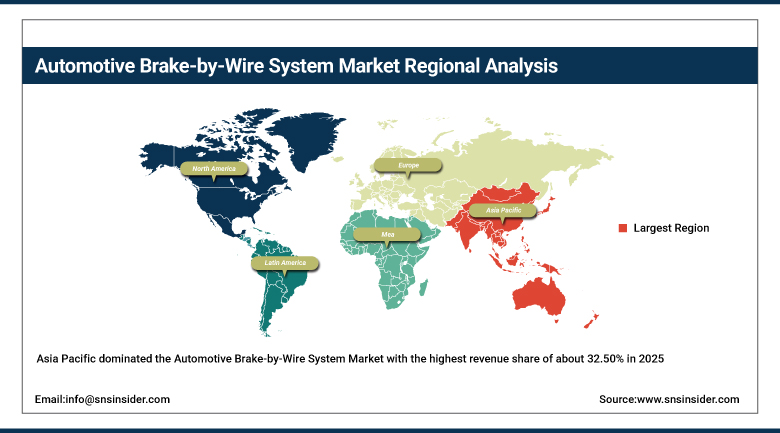
Asia Pacific dominated the Automotive Brake-by-Wire System Market with the highest revenue share of about 32.50% in 2025, supported by high volume of vehicle production, fast growth in adoption of electric and hybrid vehicles, robust production of automotive electronics, and increasing use of advanced safety features. This region is forecasted to witness the highest CAGR of around 12.22% during 2026-2035, attributed to fast-growing electrification, increasing vehicle production, ADAS adoption, technology investment, and automotive supply chain expansion.
The China Automotive Brake-by-Wire System Market accounted for a market share of 41.0%, underpinned by mass-production of vehicles, rapid penetration of electric vehicles, manufacturing of automotive electronics, and the use of ADAS. Vehicle electrification, development of smart vehicles, and domestic manufacturing of components of automobiles will add to the adoption of the system.
Middle East & Africa and Latin America Automotive Brake-by-Wire System Market Insights
Middle East & Africa and Latin America We can observe the growing implementation of electronically controlled braking systems in relation to safety requirements in the vehicle industry, modernization of the automotive industry, and increased electric cars. Higher purchases of advanced passenger cars, better development of the automotive industry, and the presence of EVs and hybrid cars is fueling growth. Growth of investments from automotive companies and suppliers, as well as ADAS integration, is anticipated to slowly support BbW implementation.
The UAE Automotive Brake-by-Wire System Market accounted for a market share of 16.5%, backed by the increased use of sophisticated cars, more widespread adoption of EVs, and the advancement in automotive technology. The increased need for safety of the vehicles, ADAS, luxurious cars, and electronically controlled braking system also helps the market grow.
Market Dynamics
Growth Drivers: Growing adoption of electric and software-defined vehicles is accelerating brake-by-wire integration by supporting electronic control, improved responsiveness, and advanced vehicle architectures.
The rapid expansion of electric vehicles and software-defined vehicles is increasing demand for electronically controlled braking technologies. The brake-by-wire system involves either a reduction or total replacement of mechanical/hydraulic control systems by electronic signals and actuators in order to provide faster and more precise control of the braking process. The compatibility of brake-by-wire with regenerative braking systems makes it especially useful in electric and hybrid cars due to its ability to improve energy efficiency. The rise in adoption of driver assistance systems and other advanced automated driving features is creating additional need for electronically-controlled braking systems.
Restraints: High system development costs and stringent safety requirements can limit adoption because brake-by-wire technologies require advanced electronics, redundant architectures, testing, and validation.
Brake-by-wire systems require sophisticated electronic control units, sensors, actuators, software, communication networks, and redundant safety mechanisms to maintain reliable braking performance. The creation and validation of these components can require significant engineering effort and testing in various driving scenarios. Automakers also have to guarantee that these technologies work even when there is a failure in electronics, power systems, sensors, or communication systems. There could be difficulties in meeting the functional safety and vehicle certification criteria, which could take more time and money. There would be difficulties in meeting these standards because they could make the technologies expensive to adopt.
Opportunities: Integration of brake-by-wire systems with regenerative braking and centralized vehicle control can improve energy recovery, braking precision, and overall electric vehicle performance.
The growing electric vehicle market presents significant opportunities for brake-by-wire technologies due to the ability of electronic brake systems to harmonize the functions of friction brakes and regenerative braking. Integrated controls will assist in achieving maximum efficiency through energy recovery while retaining optimal braking performance in varying driving environments. The use of centralized architecture for a vehicle will allow the connection of braking system with the powertrain system, stability control, ADAS, and other electrical systems of a vehicle, allowing for the coordination of vehicle dynamics management. With the adoption of software-based architectures in electric vehicles, the brake-by-wire system becomes integral to electronic vehicle controls.
Recent Developments:
-
2026 : Brembo S.p.A. began series production of its Sensify brake-by-wire system, with the intelligent braking platform expected to equip hundreds of thousands of vehicles annually.
-
2026 : Robert Bosch GmbH advanced its Brake-by-Wire and Vehicle Motion technologies, with series production planned from 2026 for Asian automakers and centralized software control integrating braking, steering, and chassis functions.
-
2026 : ZF Friedrichshafen AG expanded its passenger-car braking business in India, beginning local production of electric parking brake systems and planning further investment in electronic braking and chassis technologies.
-
2025 : Continental AG continued advancing its electronic brake system designed for electrified and automated vehicles, integrating electronic control, cybersecurity, and brake-system technologies for next-generation vehicle architectures.
Automotive Brake-by-Wire System Market key players are:
-
Robert Bosch GmbH
-
ZF Friedrichshafen AG
-
Continental AG
-
Hyundai Mobis Co., Ltd.
-
DENSO Corporation
-
Hitachi Astemo, Ltd.
-
Knorr-Bremse AG
-
HL Mando Corporation
-
Brembo S.p.A.
-
ADVICS Co., Ltd.
-
AISIN Corporation
-
Akebono Brake Industry Co., Ltd.
-
BWI Group
-
Haldex AB
-
Valeo SE
-
Nidec Corporation
-
JTEKT Corporation
-
Schaeffler AG
-
Tuopu Group
-
Zhejiang Wanan Technology Co., Ltd.
Automotive Brake-by-Wire System Market Report Scope:
| Report Attributes | Details |
|---|---|
| Market Size in 2025 | USD 7.45 Billion |
| Market Size by 2035 | USD 21.50 Billion |
| CAGR | CAGR of 11.25% From 2026 to 2035 |
| Base Year | 2025 |
| Forecast Period | 2026-2035 |
| Historical Data | 2022-2024 |
| Report Scope & Coverage | Market Size, Segments Analysis, Competitive Landscape, Regional Analysis, DROC & SWOT Analysis, Forecast Outlook |
| Key Segments | • By Component (Brake Pedal Sensor, Electronic Control Unit (ECU), Brake Actuators, Wheel Speed Sensors, Steering Wheel Angle Sensors, Yaw Sensor, Pressure Sensor, Others) • By Type (Electro-Hydraulic Brakes (EHB), Electro-Mechanical Brakes (EMB), Electric Parking Brakes (EPB)) • By Vehicle Type (Passenger Cars, Commercial Vehicles, Off-Highway Vehicles, Two-Wheelers) • By Solution (One Box, Two Box) • By Vehicle Propulsion (ICE, Electric Vehicles) • By Sales Channel (OEM, Aftermarket) |
| Regional Analysis/Coverage | North America (US, Canada), Europe (Germany, UK, France, Italy, Spain, Russia, Poland, Rest of Europe), Asia Pacific (China, India, Japan, South Korea, Australia, ASEAN Countries, Rest of Asia Pacific), Middle East & Africa (UAE, Saudi Arabia, Qatar, South Africa, Rest of Middle East & Africa), Latin America (Brazil, Argentina, Mexico, Colombia, Rest of Latin America). |
| Company Profiles | Robert Bosch GmbH, ZF Friedrichshafen AG, Continental AG, Brembo S.p.A., Hyundai Mobis Co., Ltd., DENSO Corporation, Hitachi Astemo Ltd., Knorr-Bremse AG, HL Mando Corporation, Akebono Brake Industry Co., Ltd., ADVICS Co., Ltd., Nissin Kogyo Co., Ltd., WABCO Holdings Inc., Valeo SA, JTEKT Corporation, Aisin Corporation, KSR International Inc., Haldex AB, BWI Group, Schaeffler AG. |
Frequently Asked Questions
Key players in the Automotive Brake-by-Wire System Market include Robert Bosch GmbH, ZF Friedrichshafen AG, Continental AG, Hyundai Mobis Co., Ltd., and DENSO Corporation, among others.
Key opportunities in the Automotive Brake-by-Wire System Market include increasing electric vehicle adoption, integration with ADAS and software-defined vehicles, and development of electro-mechanical and advanced electronic braking systems.
The market is driven by rapid electric vehicle adoption, increasing demand for advanced safety systems, and integration of electronic braking with ADAS and vehicle-control technologies.
The Asia Pacific region dominated the Automotive Brake-by-Wire System Market in 2025 with a 32.50% share, driven by increasing vehicle electrification, rising adoption of electric and hybrid vehicles, and growing demand for advanced automotive braking technologies.
