
Automotive AI Chipset Market Report Scope and Overview:
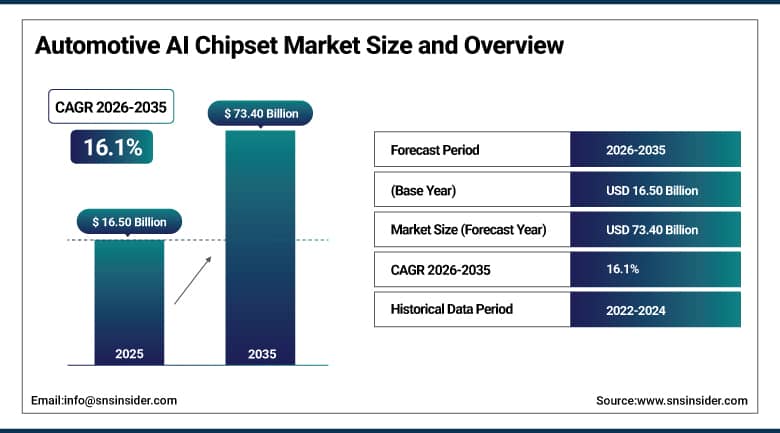
The Automotive AI Chipset Market size was valued at USD 16.50 Billion in 2025 and is projected to reach USD 73.40 Billion by 2035, registering a CAGR of 16.1% from 2026 to 2035.
The Automotive AI Chipset Market is revolutionizing the intelligence of vehicles through the use of chips that analyze the information in real-time inside the advanced driver assistance system, autonomous driving system, and in-car infotainment system. The Automotive AI Chipset Market is characterized by the growing deployment of advanced driver assistance system, growing investment in autonomous cars that can drive in difficult conditions even without any driver in it, and growing connectivity to enable V2X communication. Significant innovations in the field of electric vehicle battery management system, smart mobility solution, and predictive maintenance system have been observed due to the reason that automobile companies and semiconductor companies are investing heavily in chipsets that cater to the safety norms and automation norms.
In 2025, NVIDIA announced a collaboration with a leading automotive manufacturer to develop advanced AI algorithms for real-time vehicle data processing, reinforcing its position in autonomous driving technology development.
To Get More Information On Automotive AI Chipset Market - Request Free Sample Report
Automotive AI Chipset Market Trends
-
Growing integration of advanced driver-assistance systems continues embedding AI chipsets into mainstream vehicle platforms across price segments.
-
Rising investment in fully autonomous vehicle technology continues expanding demand for sophisticated data processing and decision-making chipsets.
-
Increasing focus on connectivity and IoT integration continues driving adoption of chipsets supporting vehicle-to-everything communication.
-
Expanding electric vehicle platform adoption continues requiring efficient AI chipsets for battery management and energy optimization.
-
Growing smart mobility solution deployment continues integrating AI technologies into urban traffic management and route optimization systems.
U.S. Automotive AI Chipset Market Size Outlook
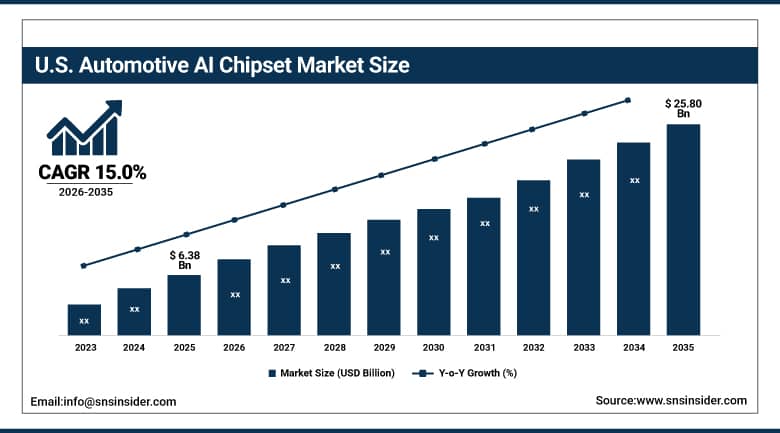
The U.S. Automotive AI Chipset Market was valued at approximately USD 6.38 Billion in 2025 and is projected to reach approximately USD 25.80 Billion by 2035, registering a CAGR of approximately 15.0% from 2026 to 2035.
U.S. demand was also impacted by continuing rapid innovations in self-driving car technology, higher electric vehicle demand, and favorable government policies that encourage the adoption of AI in automotive applications. These factors continued to be driven by the involvement of technology giants and automotive manufacturers, with major support coming from chipset vendors and helping make the country the biggest and most innovative market covered in this report. Adoption in fleet management predictive maintenance, automotive AI personal assistants, and future generation automotive infotainment systems helped add more drivers of domestic demand beyond the initial driver assistance application of AI.
In 2025, Intel unveiled its latest automotive AI chipset designed to support enhanced safety features and driver assistance systems, targeting partnerships with automotive OEMs seeking cutting-edge technology.
Automotive AI Chipset Market Segment Analysis
-
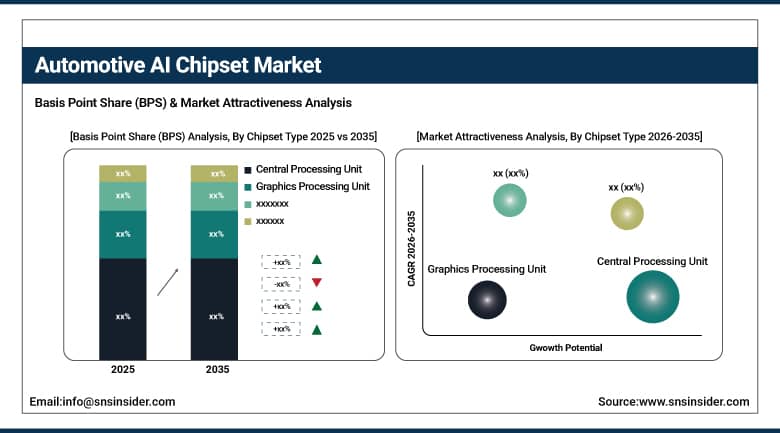
By Chipset Type, the Central Processing Unit segment dominated the Automotive AI Chipset Market with approximately 35.00% share in 2025, while the Graphics Processing Unit segment is the fastest growing with a CAGR of approximately 19.50%.
-
By Application, the Advanced Driver Assistance Systems segment dominated the Automotive AI Chipset Market with approximately 42.00% share in 2025, while the Autonomous Driving segment is the fastest growing with a CAGR of approximately 19.80%.
-
By Technology, the Artificial Neural Networks segment dominated the Automotive AI Chipset Market with approximately 38.00% share in 2025, while the Machine Learning segment is the fastest growing with a CAGR of approximately 19.20%.
-
By End Use, the Passenger Vehicles segment dominated the Automotive AI Chipset Market with approximately 40.00% share in 2025, while the Electric Vehicles segment is the fastest growing with a CAGR of approximately 21.00%.
By Chipset Type, CPU Leads While GPU Grows Fastest
Central Processing Unit was the key segment of Automotive AI Chipset Market in 2025 owing to its flexible nature and ability to carry out a wide range of functions at once, effectively managing all the calculations required for autonomous driving. This chip is still important for navigation and controlling the automobile, thereby making it the highest contributor to market revenues.
The Graphics Processing Unit segment is witnessing the highest growth in the Automotive AI Chipset Market due to its capability to process improved graphical operations that are important for ADAS and infotainment systems. The increasing digitization and connectivity of vehicles have driven the usage of GPUs in the development of new applications such as image processing and machine learning.
By Application, ADAS Leads While Autonomous Driving Grows Fastest
Advanced Driver Assistance Systems was the leading market segment in terms of revenue generation in 2025 as there was huge demand fueled by safety norms as well as awareness among consumers about the safety features of vehicles. ADAS comprises technology such as adaptive cruise control, lane keeping assistance, and automatic braking. Consumer demand for safety features in vehicles has helped ADAS maintain its position as the dominant market segment in the application area.
The Autonomous Driving segment is the fastest growing in the Automotive AI Chipset Market owing to rapid evolution fueled by significant investments in AI and machine learning from major automotive manufacturers pursuing fully automated vehicles. This technology aims to deliver vehicles capable of navigating complex environments without human intervention, generating excitement and substantial capital commitment across the automotive sector. Growing investment in autonomous driving development continues accelerating demand for this application segment.
By Technology, Artificial Neural Networks Dominate While Machine Learning Records Fastest Growth
The Artificial Neural Networks segment dominated the Automotive AI Chipset Market in 2025 due to its ability to process vast amounts of data and replicate human cognitive functions, enabling sophisticated applications such as real-time decision making in autonomous driving. This technology significantly influences the design and functionality of modern vehicles by optimizing applications including autonomous driving and predictive maintenance, keeping artificial neural networks the largest overall contributor to technology segment revenue.
The Machine Learning segment is the fastest growing in the Automotive AI Chipset Market owing to increasing investments in autonomous vehicle technology and enhanced data collection from connected cars. Machine learning is becoming increasingly vital for data processing and real-time decision-making in vehicles, with its potential for predictive analytics and continuous improvement through data-driven insights driving accelerated adoption across the industry.
By End Use, Passenger Vehicles Lead While Electric Vehicles Grow Fastest
Passenger Vehicles dominated the Automotive AI Chipset Market in 2025 because of the use of AI technology to offer features such as predictive maintenance, autonomous driving, and personalization in cars. This end-use segment is composed of many consumers and with the help of advancements in AI technology, they have been able to enhance the safety and convenience of vehicles.
The Electric Vehicles segment is the most rapidly growing segment in the Automotive AI Chipset market due to increasing demand for and support of sustainable transport options. The growth of the Electric Vehicle segment is attributed to the evolution of batteries and artificial intelligence-based energy management systems, signaling the shift toward sustainable means of transportation.
Regional Analysis
|
Region |
Major Country |
Share within Region, 2025 (%) |
|---|---|---|
|
North America |
United States |
85.00% |
|
Europe |
Germany |
35.00% |
|
Asia Pacific |
China |
45.00% |
|
Middle East and Africa |
South Africa |
55.00% |
|
Latin America |
Brazil |
50.00% |
North America Automotive AI Chipset Market Insights
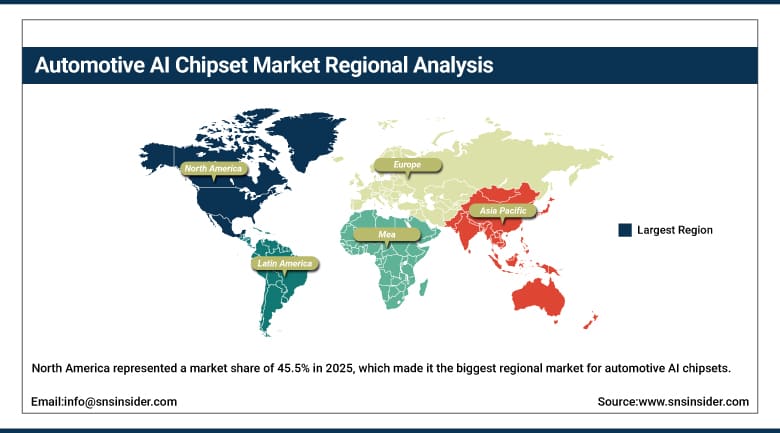
North America represented a market share of 45.5% in 2025, which made it the biggest regional market for automotive AI chipsets. The growth of the region is fueled by the fast development of self-driving technologies, the growing popularity of electric cars, as well as the government’s supportive regulations that favor the use of AI in automobiles. The presence of technology giants and automobile manufacturers contributes to this trend, thus positioning North America as the leading region.
The United States leads the market at roughly 85.00% of regional revenue, with significant contributions from leading chipset developers. Canada also plays a vital role, focusing on research and development in AI technologies, and that combined strength kept the continent the largest addressable market for automotive AI chipset vendors through the forecast period, characterized by continuous innovation and strategic partnerships among key players.
Get Customized Report as Per Your Business Requirement - Enquiry Now
Europe Automotive AI Chipset Market Insights
Europe is the second-largest market for automotive AI chipsets, accounting for around 30% of the global market share. The region’s growth is propelled by stringent regulations aimed at enhancing vehicle safety and environmental sustainability. The European Union’s Green Deal and initiatives to promote electric vehicles are significant catalysts for demand in this sector, driving innovation and investment in AI technologies.
Germany was leading the demand at about 35.00% of Europe revenue, while France and the Netherlands were having prominent car manufacturers and semiconductor firms as well. The market environment has competition among automotive and technology companies, and the continued investments by Europe in the AI chipsets that will be used for automotive will ensure steady demand growth throughout the forecast period.
Asia Pacific Automotive AI Chipset Market Insights
Asia Pacific is advancing at the fastest pace among all regions, registering a CAGR of 18.5% from 2026 to 2035, driven by increasing vehicle production, rising disposable incomes, and a growing focus on smart transportation solutions. Countries like China and Japan are at the forefront, with government initiatives supporting the development of AI technologies in the automotive sector, keeping the region’s growth trajectory well ahead of every other region.
The Chinese economy was the leading player as the largest market in the region, with considerable investments made in electric vehicles and technologies of self-driving cars. Following closely behind is Japan, with well-known firms at the forefront of developing semiconductors for the automotive industry. The competition is still intense among both domestic and foreign companies, which has contributed to innovations in this rapidly growing automotive AI chipset market.
MEA and Latin America Automotive AI Chipset Market Insights
The Middle East and Africa and Latin America both showed steady growth, driven by increasing urbanization, rising vehicle ownership, and government initiatives aimed at enhancing transportation infrastructure. As these markets continued building out modern automotive and smart mobility infrastructure, automotive AI chipset technology proved a genuinely valuable enabler of increasingly capable, locally supported vehicle safety and connectivity systems.
South Africa led Middle East and Africa demand, supported by a growing automotive manufacturing base. The UAE is also making strides, focusing on smart city initiatives and electric vehicle adoption. In Latin America, Brazil accounted for the largest share of regional revenue, with growing automotive manufacturing and smart mobility investment continuing to anchor regional demand for automotive AI chipset technology.
Market Dynamics
Growth Drivers: Rising Vehicle Electrification and Enhanced Safety Feature Demand
Factors influencing demand in the market include increased vehicle electrification where AI chipsets are needed to improve the performance and energy efficiency of batteries, increased deployment of smart mobility solutions where AI technology is incorporated in the transport system, increased use of advanced safety features including automatic emergency braking and lane keeping assist, and advancement in machine learning algorithms that optimize performance of the vehicles. The increasing focus by car manufacturers on safety standards and automation will keep the industry's demand strong.
Research and development activities in the industry will reinforce the above factor since competition will increase among automotive and technology companies who seek innovation in order to improve their AI capabilities. Increasing regulatory frameworks for safety and sustainability will define another layer of demand that makes up the growing demand in the industry.
Restraints: High Development Costs and Regulatory Compliance Complexity
The substantial research and development investment required to develop next-generation automotive AI chipsets continues posing a genuine restraint on faster market-wide expansion, as competition intensifies among automotive manufacturers and technology companies seeking to enhance AI capabilities. That capital intensity has kept advanced chipset development concentrated among a comparatively small number of well-resourced technology companies.
Ongoing regulatory complexity around safety certification and environmental compliance standards continues posing a further restraint, as governments worldwide implement stricter regulations regarding emissions and safety standards that manufacturers must navigate. Ensuring chipset technology meets diverse regional regulatory frameworks keeps some deployment scenarios more administratively complicated than standardized global rollout would otherwise require.
Opportunities: Predictive Maintenance Solutions and In-Car AI Personal Assistants
The development of AI-powered predictive maintenance technology for fleet management is a truly significant opportunity, as fleet managers look for ways to have technology that can predict maintenance issues even before they arise. Suppliers who are first movers in the area of predictive maintenance technology using chipsets will be able to gain market share as this becomes an increasing need in the area of fleet management.
Secondly, the integration of AI chipsets in electric vehicles to increase energy efficiency, along with collaboration with technology companies for the improvement of in-car AI personal assistants, is another significant opportunity. Companies with existing and energy-efficient chipset technology will be able to benefit from increasing global adoption of electric vehicles.
Recent Developments:
-
In 2026, Qualcomm Technologies expanded its automotive collaboration with Stellantis, supplying Snapdragon Digital Chassis platforms for next-generation ADAS, cockpit, and connectivity systems.
-
In 2026, NXP Semiconductors launched the S32N7 processor series, designed to centralize vehicle functions and support AI-powered software-defined vehicles.
-
In 2025, Mobileye expanded its EyeQ6 SoC family, providing scalable computing solutions for ADAS and autonomous-driving applications.
-
In 2025: Qualcomm expanded its automotive portfolio by acquiring a startup specializing in AI-driven vehicle-to-everything (V2X) communication technologies, strengthening its connected vehicle capabilities.
Automotive AI Chipset Companies are:
-
NVIDIA Corporation
-
Intel Corporation
-
Qualcomm Incorporated
-
Texas Instruments Incorporated
-
NXP Semiconductors N.V.
-
Renesas Electronics Corporation
-
Infineon Technologies AG
-
STMicroelectronics N.V.
-
Broadcom Inc.
-
Advanced Micro Devices, Inc. (AMD)
-
Samsung Electronics Co., Ltd.
-
MediaTek Inc.
-
onsemi (ON Semiconductor Corporation)
-
Marvell Technology, Inc.
-
Ambarella, Inc.
-
Horizon Robotics
-
Mobileye Global Inc.
-
Robert Bosch GmbH
-
Continental AG
-
Denso Corporation
Automotive AI Chipset Market Report Scope:
| Report Attributes | Details |
|---|---|
| Market Size in 2025 | USD 16.50 Billion |
| Market Size by 2035 | USD 73.40 Billion |
| CAGR | CAGR of 16.1% From 2026 to 2035 |
| Base Year | 2025 |
| Forecast Period | 2026-2035 |
| Historical Data | 2022-2024 |
| Report Scope & Coverage | Market Size, Segments Analysis, Competitive Landscape, Regional Analysis, DROC & SWOT Analysis, Forecast Outlook |
| Key Segments | • By Application (Advanced Driver Assistance Systems, Autonomous Driving, In-Vehicle Infotainment) • By Technology (Artificial Neural Networks, Machine Learning, Computer Vision, Natural Language Processing) • By Chipset Type (Central Processing Unit, Graphics Processing Unit, Field Programmable Gate Array, Application-Specific Integrated Circuit) • By End Use (Passenger Vehicles, Commercial Vehicles, Electric Vehicles) |
| Regional Analysis/Coverage | North America (US, Canada), Europe (Germany, UK, France, Italy, Spain, Russia, Poland, Rest of Europe), Asia Pacific (China, India, Japan, South Korea, Australia, ASEAN Countries, Rest of Asia Pacific), Middle East & Africa (UAE, Saudi Arabia, Qatar, South Africa, Rest of Middle East & Africa), Latin America (Brazil, Argentina, Mexico, Colombia, Rest of Latin America). |
| Company Profiles | NVIDIA Corporation, Intel Corporation, Qualcomm Incorporated, Texas Instruments Incorporated, NXP Semiconductors N.V., Renesas Electronics Corporation, Infineon Technologies AG, STMicroelectronics N.V., Broadcom Inc., Advanced Micro Devices, Inc. (AMD), Samsung Electronics Co., Ltd., MediaTek Inc., onsemi (ON Semiconductor Corporation), Marvell Technology, Inc., Ambarella, Inc., Horizon Robotics, Mobileye Global Inc., Robert Bosch GmbH, Continental AG, Denso Corporation. |
Frequently Asked Questions
Key players include NVIDIA, Qualcomm Technologies, Mobileye, NXP Semiconductors, and Renesas Electronics, among others.
Key opportunities include software-defined vehicles, centralized vehicle computing, advanced ADAS, autonomous driving, and AI-enabled cockpit applications.
Rising ADAS adoption, autonomous driving development, AI-enabled vehicle functions, and demand for real-time edge processing are driving market growth.
The hardware segment dominated the market, supported by increasing integration of AI processors, accelerators, and automotive-grade SoCs.
North America dominated the market, supported by strong AI semiconductor capabilities, autonomous-driving development, and major automotive technology investments.
