
Aliphatic Hydrocarbon Solvents and Thinners Market Report Scope & Overview:
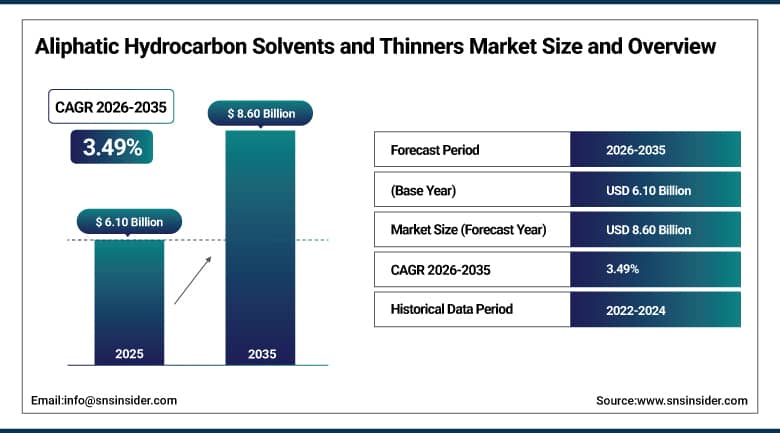
The Aliphatic Hydrocarbon Solvents and Thinners Market was valued at USD 6.10 Billion in 2025 and is expected to reach USD 8.60 Billion by 2035, growing at a CAGR of 3.49% from 2026 to 2035.
Aliphatic hydrocarbon solvents and thinners are a commercially essential class of petroleum-derived organic solvents characterized by their carbon chain composition of straight-chain or branched saturated hydrocarbons that contain no aromatic ring structures. This chemical distinction from aromatic solvents including toluene, xylene, and benzene derivatives is commercially significant because aliphatic solvents offer substantially lower acute toxicity, reduced occupational health risk, lower vapor pressure at equivalent volatility grades, and better regulatory compliance profiles in jurisdictions where aromatic solvent content in consumer and industrial products is restricted. The aliphatic hydrocarbon family spans a range of volatility grades from the lightest naphtha fractions boiling below 60 degrees Celsius through the medium-range mineral spirits fraction used in paint thinning and cleaning applications to the heavier Stoddard solvent.
TotalEnergies launched a new line of bio-based aliphatic solvents in September 2025, derived from renewable vegetable feedstocks through hydrotreatment and isomerization processing routes that produce aliphatic hydrocarbon fractions chemically equivalent to petroleum-derived mineral spirits but with a reduced lifecycle carbon footprint traceable to renewable feedstock origin. The bio-based solvent line was certified to ISCC PLUS mass balance standards, enabling paint and coatings formulators to substantiate bio-attributed carbon content claims in environmental product declarations whose relevance to green building certification submissions, corporate sustainability reporting, and Scope 3 emissions disclosure is growing with mandatory sustainability reporting framework implementation. The launch positioned TotalEnergies to serve the growing segment of industrial solvent buyers whose procurement specifications are incorporating bio-based material content criteria alongside traditional performance and regulatory compliance requirements.
To Get More Information On Aliphatic Hydrocarbon Solvents and Thinners Market - Request Free Sample Report
Aliphatic Hydrocarbon Solvents and Thinners Market Trends
-
Low-VOC and ultra-low-aromatic solvent grades are gaining adoption as industries comply with stricter environmental regulations and workplace safety standards.
-
Bio-based aliphatic hydrocarbon solvents are emerging as sustainable alternatives, supported by growing investments in renewable refinery technologies and green formulations.
-
Expanding edible oil extraction activities are driving demand for hexane-based solvents used in large-scale agricultural processing and oilseed crushing operations.
-
High-purity odorless mineral spirits and specialty aliphatic blends are witnessing increased demand in precision cleaning, personal care, and specialty industrial applications.
-
Solvent recovery and recycling technologies are being increasingly adopted to improve sustainability, reduce operating costs, and support circular economy initiatives across industrial manufacturing.
The U.S. Aliphatic Hydrocarbon Solvents and Thinners Market Outlook
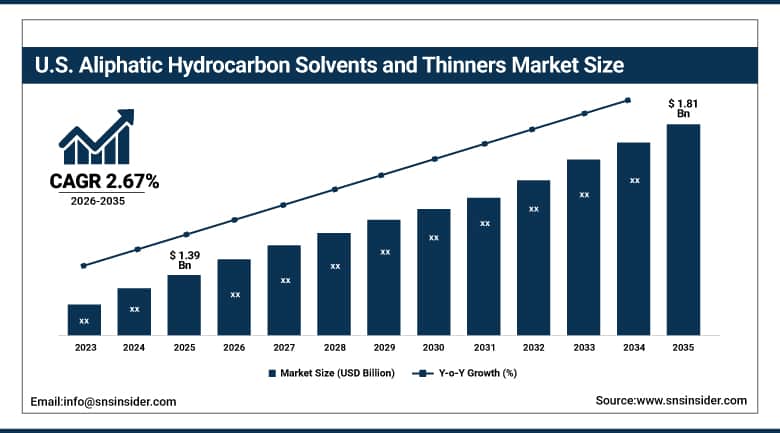
The U.S. Aliphatic Hydrocarbon Solvents and Thinners Market was valued at approximately USD 1.39 Billion in 2025 and is expected to reach approximately USD 1.81 Billion by 2035, growing at a CAGR of approximately 2.67%.
The United States is the world's largest national aliphatic hydrocarbon solvents market within the dominant North American region, anchored by the domestic presence of ExxonMobil Chemical's Isopar and Soltrol branded aliphatic product lines, Shell Chemical's Shellsol range, and Chevron Phillips Chemical's solvents portfolio whose combined production capacity serves the North American paints, coatings, adhesives, and industrial cleaning markets from domestic refinery-integrated solvent fractionation units. U.S. mineral spirit consumption is sustained primarily by the architectural and industrial maintenance coatings market whose professional painter brush-cleaning, equipment flushing, and solvent-borne specialty coating formulation volumes create steady recurring demand from industrial distributors and paint manufacturers. The U.S. hexane market is supported by the domestic soybean crushing sector whose annual processing volumes of approximately 60 million metric tonnes of soybeans.
BP expanded its production capacity for aliphatic hydrocarbon solvents in July 2025 in response to rising global demand from the construction and automotive refinishing sectors, increasing output at its European and North American refinery-integrated solvent fractionation units to reduce supply lead times and improve inventory availability for industrial distributors serving the professional paints and coatings trade. The capacity expansion addressed a recurring challenge for major solvent buyers in the paints industry whose supply security concerns had driven specification of dual-source procurement programmes that allocated purchases across multiple producers rather than concentrating on the lowest-cost single supplier, creating demand for reliable supply commitment from each qualified producer in the professional coatings distribution channel.
Aliphatic Hydrocarbon Solvents and Thinners Market Segment Analysis
-
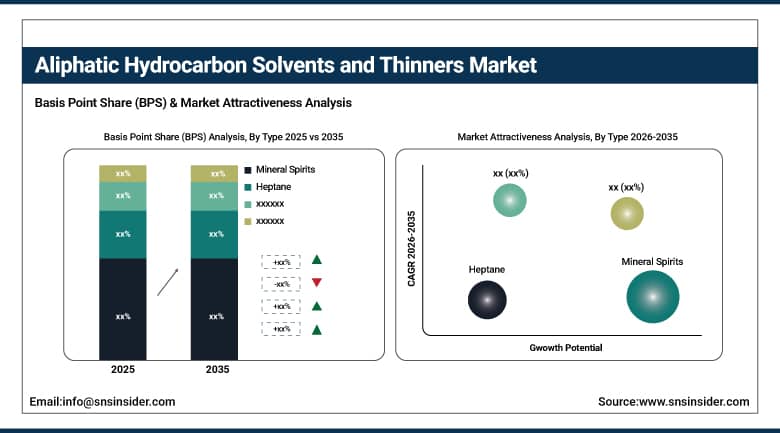
By Type, the mineral spirits segment dominated the aliphatic hydrocarbon solvents and thinners market with approximately 34.00% share in 2025, while the heptane segment is the fastest growing type at a CAGR of 4.38% during 2026 to 2035.
-
By Application, the paints & coatings segment dominated the aliphatic hydrocarbon solvents and thinners market with 44.14% share in 2025, while the rubber & polymers segment is the fastest growing application at a CAGR of 4.02% during 2026 to 2035.
-
By Formulation, the solvent-based formulation segment dominated the aliphatic hydrocarbon solvents and thinners market in 2025, while the water-based blends segment is growing with regulatory pressure.
-
By End Use Industry, the automotive segment is a significant end user, while the construction segment is among the fastest growing during 2026 to 2035.
By Type, mineral spirits dominate, heptane grows fastest
Mineral spirits retained the dominant type position with approximately 34.00% of Aliphatic Hydrocarbon Solvents and Thinners market share in 2025, reflecting their commercial role as the workhorse solvent of the global paints, coatings, and industrial maintenance markets whose broad application suitability at modest cost positions mineral spirits as the default specification for solvent-borne coating thinning, brush cleaning, and general-purpose industrial degreasing across the widest range of professional and industrial end users. The commercial versatility of mineral spirits across aromatic content levels from standard grade through low-aromatic and odorless grades enables a single product family to serve the full range of end-user performance and regulatory requirements from standard industrial maintenance coatings through the most VOC-sensitive consumer applications.
Heptane is growing fastest at a CAGR of 4.38% driven by its growing adoption in pharmaceutical synthesis applications where its higher flash point and lower toxicity relative to hexane create a regulatory compliance advantage in pharmaceutical manufacturing facility solvent safety classifications, and by its use as a hexane alternative in precision cleaning applications requiring residue-free evaporation.
By Application, paints & coatings dominate, rubber grows fastest
Paints and coatings retained the dominant application position with 44.14% of Aliphatic Hydrocarbon Solvents and Thinners market volume in 2025, sustained by industrial maintenance coatings whose single-coat 40 to 60 micrometre film thickness performance requirements create solvent-borne formulation demand that water-borne products cannot duplicate across the full range of application conditions including low-temperature, high-humidity, and immersion-resistant service environments.
Rubber and polymers is growing fastest at a CAGR of 4.02% as global tire production exceeding 2.1 billion units annually in Asia Pacific creates sustained hexane demand for solution styrene-butadiene rubber polymerization whose production process uses hexane as both the polymerization medium and the product washing solvent whose consumption is proportional to production throughput. Adhesives and sealants contribute meaningful and growing demand from flexible packaging, automotive interior assembly, and footwear manufacturing applications whose solvent-based adhesive formulations retain performance advantages over water-based alternatives in bond strength, open time control, and substrate compatibility.
Regional Analysis
|
Region |
Major Country |
Share within Region, 2025 (%) |
|---|---|---|
|
North America |
United States |
84.73% |
|
Europe |
Germany |
24.73% |
|
Asia Pacific |
China |
42.84% |
|
Middle East & Africa |
Saudi Arabia |
22.84% |
|
Latin America |
Brazil |
43.84% |
North America Aliphatic Hydrocarbon Solvents and Thinners Market Insights
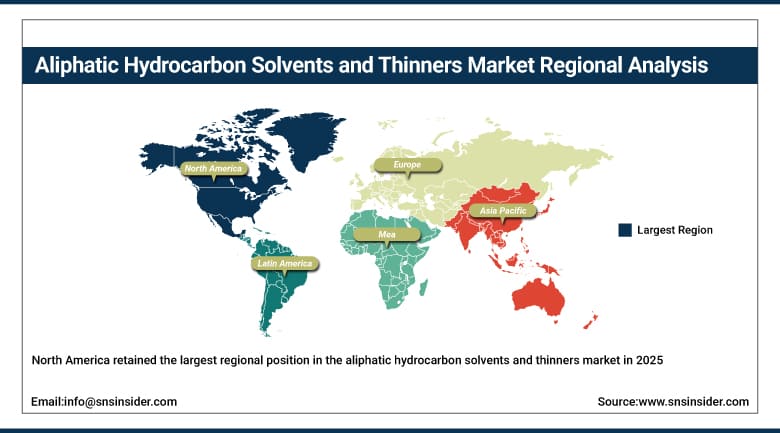
North America retained the largest regional position in the aliphatic hydrocarbon solvents and thinners market in 2025, holding approximately 27.00% of global revenues. The United States accounts for approximately 84.73% of regional revenue through the domestic presence of ExxonMobil, Shell, and Chevron Phillips Chemical whose refinery-integrated solvent production capacity serves the national paints, coatings, automotive refinishing, and industrial cleaning markets. North American demand is moderating relative to Asia Pacific growth rates as progressive VOC regulation tightening and water-borne reformulation trends in the architectural coatings market reduce per-unit solvent intensity.
Europe Aliphatic Hydrocarbon Solvents and Thinners Market Insights
Europe held approximately 20.00% of global aliphatic hydrocarbon solvents and thinners revenues in 2025. Germany accounts for approximately 24.73% of European revenues through its automotive and chemicals industries whose solvent-borne industrial coating, adhesive, and printing ink consumption sustains meaningful demand despite progressive VOC regulation. The EU's solvent emissions directive and REACH regulation's progressive restriction of specific aliphatic solvent uses including hexane in consumer products are driving European solvent demand toward higher-purity, lower-toxicity grades and bio-based alternatives. France, the United Kingdom, Italy, and the Netherlands each contribute meaningful European demand through their paints, printing, and industrial maintenance sectors.
Get Customized Report as Per Your Business Requirement - Enquiry Now
Asia Pacific Aliphatic Hydrocarbon Solvents and Thinners Market Insights
Asia Pacific is the fastest-growing regional aliphatic hydrocarbon solvents and thinners market, projected to expand at a CAGR of approximately 4.32% through the forecast period. China accounts for approximately 42.84% of Asia Pacific revenues through its world-leading urban infrastructure construction creating large architectural coating demand, its automotive production of 5.9 million vehicles in India and massive Chinese volumes creating automotive refinishing solvent consumption, and its textile and rubber manufacturing whose solvent processing requirements create substantial hexane and mineral spirit demand. India is among the fastest-growing national markets through expanding vehicle production, infrastructure investment, and growing paints and coatings sector investment.
MEA & Latin America Aliphatic Hydrocarbon Solvents and Thinners Market Insights
Middle East and Latin America are growing aliphatic hydrocarbon solvents and thinners markets where infrastructure investment, oil and gas sector activity, and manufacturing development sustain solvent demand. Saudi Arabia leads MEA revenues at approximately 22.84% of the regional total through its petrochemical industry's solvent production capability, construction sector creating architectural coating demand, and oil and gas equipment maintenance requiring cleaning and corrosion protection solvents. Brazil leads Latin American revenues at approximately 43.84% of the regional total through its soybean crushing industry's hexane demand, automotive sector refinishing market, and construction activity sustaining mineral spirits consumption.
Market Dynamics
Growth Drivers: Global paints and coatings production growth sustaining core aliphatic solvent demand and rubber manufacturing expansion in Asia Pacific driving hexane consumption are the primary structural market demand drivers.
Global paints and coatings market growth toward 55 to 60 million tonnes by 2035 creates proportional solvent demand even as water-borne reformulation reduces solvent intensity per tonne produced. Industrial maintenance and automotive coatings are relatively solvent-intensive categories whose demand growth is proportional to global manufacturing output. Asia Pacific tire production expansion across the 4.5 billion population consumer base creates sustained hexane demand for solution SBR rubber polymerization that cannot be replaced by water-based alternatives at equivalent performance.
Restraints: Progressive VOC regulation tightening in major markets driving water-borne reformulation that reduces per-unit aliphatic solvent consumption and environmental, health, and safety concerns creating substitution pressure in consumer product applications.
The European Solvents Directive, U.S. EPA's National Emission Standards for Hazardous Air Pollutants, and equivalent regulatory frameworks across China, Japan, South Korea, and Canada each define progressively lower acceptable VOC emission limits from industrial coating, printing, and adhesive operations that drive formulators to reduce solvent-borne formulation intensity or substitute water-borne alternatives where coating performance requirements permit. Each percentage point reduction in solvent-borne coatings market share, driven by regulatory reformulation pressure, translates directly into reduced aliphatic solvent consumption per tonne of paint produced, creating a structural market share headwind that partially offsets the volume growth from expanding global construction and manufacturing activity. Hexane's occupational exposure classification as a peripheral nervous system toxin at chronic exposure levels above 50 parts per million creates both regulatory substitution pressure toward heptane and other less toxic alternatives.
Opportunities: Bio-based aliphatic solvent development meeting green procurement requirements and specialty high-purity grade development for pharmaceutical and electronics applications represent premium market growth opportunities.
The market for bio-based aliphatic solvents certified to ISCC PLUS or REDcert mass balance standards is developing as a premium product tier whose pricing above conventional petroleum-derived equivalents is justified by the regulatory and procurement value of bio-attributed carbon content claims in sustainability reporting, environmental product declarations, and green building certification submissions. As major paint brands including AkzoNobel, Sherwin-Williams, and BASF Coatings commit to specific renewable material content targets in their product sustainability strategies, their upstream solvent procurement specifications are increasingly incorporating bio-based content criteria that create demand for certified bio-attributed aliphatic solvents from producers willing to invest in bio-refinery feedstock integration. High-purity pharmaceutical grade hexane and heptane specifications whose low benzene, aromatic, and sulphur impurity requirements exceed standard industrial grades.
Recent Developments:
-
2025: TotalEnergies launched a new line of bio-based aliphatic solvents derived from renewable vegetable feedstocks, certified to ISCC PLUS mass balance standards, enabling paint and coatings formulators to substantiate bio-attributed carbon content claims in environmental product declarations and green building certification submissions.
-
2025: BP expanded production capacity for aliphatic hydrocarbon solvents at European and North American refinery-integrated fractionation units in response to rising demand from construction and automotive refinishing sectors, reducing supply lead times for industrial distributors serving the professional paints and coatings trade.
-
2024: ExxonMobil Chemical introduced new Isopar-grade specialty aliphatic blends with ultra-low aromatic content below 0.05 percent targeting aerosol propellant, personal care, and precision electronics cleaning applications where residue-free evaporation and minimal aromatics exposure create premium demand for highly refined specialty grades above standard mineral spirits specification.
Aliphatic Hydrocarbon Solvents and Thinners Market Key Players are:
-
ExxonMobil Corporation
-
Shell PLC
-
Chevron Corporation
-
TotalEnergies SE
-
BP PLC
-
Saudi Basic Industries Corporation (SABIC)
-
LyondellBasell Industries Holdings BV
-
Maruzen Petrochemical Co. Ltd.
-
Hindustan Petroleum Corporation Ltd.
-
Reliance Industries Ltd.
-
PJSC Lukoil Oil Company
-
Valero Energy Corporation
-
Honeywell International Inc. (UOP)
-
Calumet Specialty Products Partners LP
-
Neste Corporation
-
Royal Dutch Shell PLC
-
Idemitsu Kosan Co. Ltd.
-
Kuwait Petroleum Corporation
-
Indian Oil Corporation Ltd.
-
Repsol SA
Aliphatic Hydrocarbon Solvents and Thinners Market Report Scope:
| Report Attributes | Details |
|---|---|
| Market Size in 2025 | USD 6.10 Billion |
| Market Size by 2035 | USD 8.60 Billion |
| CAGR | CAGR of 3.49% From 2026 to 2035 |
| Base Year | 2025 |
| Forecast Period | 2026-2035 |
| Historical Data | 2022-2024 |
| Report Scope & Coverage | Market Size, Segments Analysis, Competitive Landscape, Regional Analysis, DROC & SWOT Analysis, Forecast Outlook |
| Key Segments | • By Type (Mineral Spirits, Varnish Makers' & Painters' (VM&P) Naphtha, Hexane, Heptane, Gasoline, Other Specialty Blends) • By Application (Paints & Coatings, Adhesives & Sealants, Cleaning & Degreasing, Rubber & Polymers, Printing Inks, Aerosols, Others) • By Formulation (Solvent-Based, Water-Based Blends) • By End Use Industry (Automotive, Construction, Printing & Packaging, Oil & Gas, Industrial Cleaning, Pharmaceutical, Others) |
| Regional Analysis/Coverage | North America (US, Canada), Europe (Germany, UK, France, Italy, Spain, Russia, Poland, Rest of Europe), Asia Pacific (China, India, Japan, South Korea, Australia, ASEAN Countries, Rest of Asia Pacific), Middle East & Africa (UAE, Saudi Arabia, Qatar, South Africa, Rest of Middle East & Africa), Latin America (Brazil, Argentina, Mexico, Colombia, Rest of Latin America). |
| Company Profiles | ExxonMobil Corporation, Shell PLC, Chevron Corporation, TotalEnergies SE, BP PLC, Saudi Basic Industries Corporation (SABIC), LyondellBasell Industries Holdings BV, Maruzen Petrochemical Co. Ltd., Hindustan Petroleum Corporation Ltd., Reliance Industries Ltd., PJSC Lukoil Oil Company, Valero Energy Corporation, Honeywell International Inc. (UOP), Calumet Specialty Products Partners LP, Neste Corporation, Royal Dutch Shell PLC, Idemitsu Kosan Co. Ltd., Kuwait Petroleum Corporation, Indian Oil Corporation Ltd., and Repsol SA |
Frequently Asked Questions
The primary growth factors are global paints and coatings production growth sustaining mineral spirit and VM&P naphtha demand, Asia Pacific rubber and tire manufacturing expansion driving hexane consumption, infrastructure construction activity creating architectural coating solvent demand.
North America dominated the Aliphatic Hydrocarbon Solvents and Thinners Market in 2025, holding approximately 27.00% of global revenues.
The mineral spirits segment dominated the Aliphatic Hydrocarbon Solvents and Thinners Market with approximately 34.00% share in 2025.
The Aliphatic Hydrocarbon Solvents and Thinners Market was valued at USD 6.10 Billion in 2025.
The Aliphatic Hydrocarbon Solvents and Thinners Market is expected to grow at a CAGR of 3.49% from 2026 to 2035.
