
Honeycomb Sandwich Material Market Report Scope and Overview
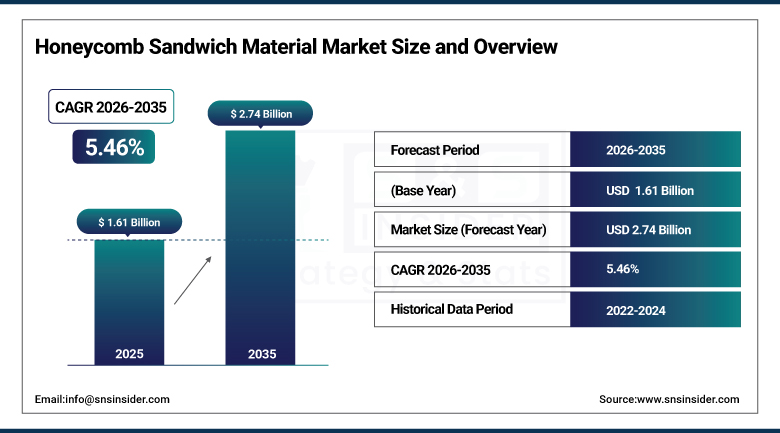
The Honeycomb Sandwich Material Market was valued at USD 1.61 Billion in 2025 and is estimated at USD 1.70 Billion in 2026. The market is forecast to reach USD 2.74 Billion by 2035, registering a CAGR of 5.46% from 2026 to 2035. Growth reflects the high stiffness to weight ratio of honeycomb cores bonded between thin skins, which lets aircraft, vehicles, ships, trains, and buildings cut weight without losing strength, along with rising output of commercial aircraft and wider use of panels in transport and construction. North America accounted for the largest regional share at 35.14% in 2025, while Asia Pacific is expected to register the fastest regional growth as aircraft, rail, and building programs expand in China, India, Japan, and South Korea.
To Get more information Honeycomb Sandwich Material Market - Request Free Sample Report
Key Market Trends & Insights
-
By material type: Aluminum held the largest market share of 33.46% in 2025.
-
By technology: Expansion held the largest market share of 27.38% in 2025.
-
By application: Aerospace held the largest market share of 27.84% in 2025.
-
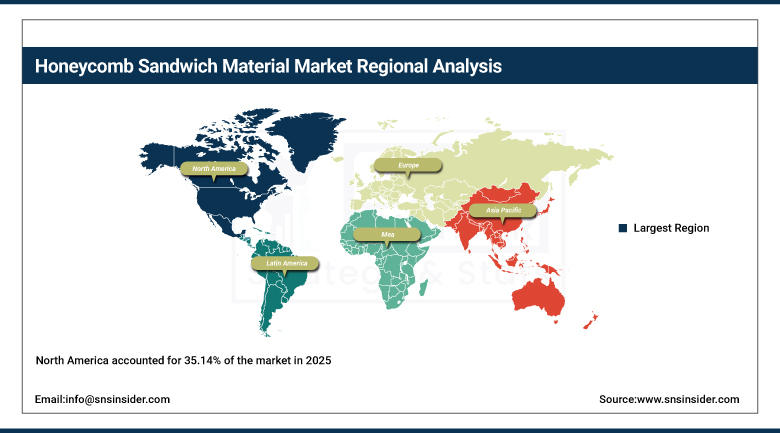
North America accounted for the largest regional share of 35.14% in 2025.
-
Asia Pacific is projected to register the fastest regional CAGR of 6.74% from 2026 to 2035.
-
Producers are developing thermoplastic and recycled cores, vented and formable aluminum cores, and continuous production lines that lower cost and open new uses in vehicles, packaging, and buildings.
Growth Outlook
Aircraft production is the largest single call on honeycomb supply. In October 2025, the Federal Aviation Administration approved a rise in the monthly production limit for the Boeing 737 MAX from 38 to 42 aircraft, and airframe makers in Europe and Asia are also lifting output of narrow body and regional aircraft. Every airliner uses honeycomb cores in floors, doors, flaps, fairings, and engine nacelles, so higher build rates translate into steady orders for aluminum and aramid paper cores and for the adhesives and skins that go with them.
A second source of growth is the spread of sandwich panels outside aerospace. Electric vehicle makers use lightweight panels in floors and battery covers to offset the weight of battery packs, shipbuilders use them in cabins and decks, and rail makers use them in interiors that must meet fire and smoke rules. Builders use honeycomb faced facade panels because they are flat, light, and easy to fit. These uses are smaller in value than aircraft but give producers a wider base of buyers and reduce exposure to the aircraft build cycle.
Market Dynamics
Driver: Lightweighting Needs in Aircraft, Vehicles, and Wind Energy Support Demand
Lighter structures save fuel and extend range, which makes weight reduction a central goal for aircraft and vehicle designers. A honeycomb core separates two thin skins, so the panel resists bending far better than a solid sheet of the same weight, and designers can cut material use while keeping stiffness. Aluminum cores serve floors and control surfaces, aramid paper cores serve engine and cabin parts, and thermoplastic cores serve interior and transport panels where cost and recyclability matter. Operators also value the long fatigue life of bonded sandwich parts, which reduces the cost of replacement over the life of an aircraft.
Space launch and defense programs add demand for high performance cores. Launch vehicles use vented and high density cores in fairings, interstages, and payload structures, and military aircraft use them in radomes and flight surfaces. Wind blade makers and train builders also specify cores for stiffness and acoustic control. This spread across many sectors supports regular orders and encourages makers to widen their range of cell sizes, densities, and coatings. Airlines and defense operators also order replacement panels for ageing fleets, and maintenance centers stock cores for floor and flap repairs, which adds aftermarket demand that does not depend on new aircraft deliveries.
Restraint: High Production Cost, Raw Material Swings, and Long Qualification Cycles Slow Adoption
Honeycomb cores cost more than foam and solid panels, because expansion, corrugation, and bonding need specialized plants and careful quality control. Prices of aluminum foil, aramid paper, and resin move with commodity markets, and swings in these inputs affect margins for producers that sell under long contracts. Smaller buyers in construction and transport often choose cheaper cores or conventional panels when cost matters more than weight. Energy cost is another factor, because foil rolling, adhesive curing, and expansion lines use large amounts of power, and producers in high energy cost regions face further pressure on price.
Qualification adds time and cost. A core used in a certified aircraft part must pass tests for strength, moisture, fire, and aging, and a change of supplier or process can trigger new testing. Repair is also harder than for metal parts, because moisture can enter damaged panels, so operators need trained staff and approved methods. Buyers should weigh unit price, test history, supply security, and repair support before they commit to a new material. Supply of certified aerospace grade cores is also concentrated in a few producers, so new entrants face a long path before they can bid for aircraft programs.
Opportunity: Thermoplastic Cores, Recycled Materials, and Formable Cores Open New Revenue
Thermoplastic honeycomb produced on continuous lines is opening uses in vehicles, packaging, and building panels, where lower cost and recyclability matter more than the peak stiffness of aluminum. Cores made from recycled polyethylene terephthalate and polypropylene add a sustainability benefit for buyers with recycled content targets. Continuous production also lowers unit cost and shortens delivery times, which helps producers win business from foam and plywood cores. Suppliers can also offer digital design tools and panel data sheets that shorten engineering time, which strengthens customer ties. Panel makers can also offer repair kits and recycling programs that extend product life.
High value specialty uses also offer room for growth. Vented and formable aluminum cores simplify the making of curved space and engine parts, and acoustic cores reduce noise in nacelles. Producers that combine cores with machining, shaping, and kitting services can capture more value per panel, and long term supply agreements with aircraft makers provide a base of stable demand that supports investment in new capacity. Growth in drones, air taxis, and small launch vehicles adds a further group of buyers that need light and stiff structures in small series, and these programs often accept new materials faster than large airliners.
Market Characteristics & Concentration
The Honeycomb Sandwich Material Market is Moderately Fragmented. A few large composite materials groups supply aerospace grade cores under long contracts, while a wider group of regional producers sells aluminum, aramid, and thermoplastic cores to transport, marine, and building customers. Aerospace suppliers compete on certification, quality, and delivery, while industrial suppliers compete on price and panel design support.
The level of merger and acquisition activity is moderate. Larger groups buy core makers and fabricators to secure supply and extend their offer, and thermoplastic technology firms license production lines to partners in several regions. Long supply agreements with aircraft makers reduce churn among suppliers and create high entry barriers in aerospace. Licensing models help thermoplastic technology spread across regions without heavy capital spending by the technology owner.
Regional expansion is led by North American and European producers that serve aircraft programs, and by Asian makers that supply aluminum cores and panels for rail, marine, and construction at lower prices. Certification and customer trust are the main entry barriers in aerospace. Distributors and panel fabricators also play a key role in reaching smaller buyers.
Analyst Perspective
Honeycomb sandwich materials are moving from a specialty aerospace product to a broader lightweighting platform. Buyers no longer judge a core only on density and strength. They ask how it forms, how it recycles, how it behaves in fire and moisture, and how easily it fits into automated panel production. Producers that combine certified aerospace cores with lower cost thermoplastic and recycled options will capture the largest share of new demand through 2035. Aircraft output will remain the anchor of value, while transport, marine, and building uses add volume. An SNS Insider Analyst, Santosh Bhul, commented, "Honeycomb cores will keep gaining ground wherever designers need stiffness without weight, and the winners will be those that pair certified performance with lower cost production."
Segment Analysis
Material Type Insights
Aluminum accounted for the largest share of 33.46% in 2025. Aluminum honeycomb offers high strength to weight, good heat transfer, and a long record of use in certified aircraft floors, flaps, and panels, and it is also the standard core for facades and transport panels. Anodized and coated grades resist corrosion, and vented grades suit space launch parts. Wide supplier choice and mature production keep aluminum at the center of purchases across aerospace and industrial users. Cell size and foil gauge can be tuned for a wide range of loads.
Composites are anticipated to grow at the fastest CAGR of 6.88% from 2026 to 2035. Aramid paper, fiberglass, carbon, and thermoplastic cores reduce weight further, resist fire and moisture, and suit complex shapes in aircraft interiors, engine parts, and vehicles. Producers are adding capacity for these cores as aircraft makers and electric vehicle builders specify lighter parts and as recycled thermoplastic options reach larger buyers. Aramid paper cores also provide good fire and acoustic performance for cabins and nacelles, while carbon and fiberglass cores serve parts that need very low weight.
Technology Insights
Expansion held the largest share of 27.38% in 2025. In this process, adhesive coated foil or paper sheets are stacked, bonded, cut, and pulled apart to form hexagonal cells, and the method has served aerospace for decades. It yields cores with high quality control and wide choice of cell size and density, and it suits low volume and high value parts. Its established place in aircraft specifications supports continued use. Producers also invest in automated cutting and shaping so that expanded cores can be delivered as ready to bond kits.
Molding is projected to expand at the fastest CAGR of 6.52% from 2026 to 2035. Thermoformed and molded cores make curved and shaped parts in a single step, which saves machining and cuts waste, and they suit transport, packaging, and interior panels. Faster cycle times and a lower cost per panel make this route attractive to automotive and building buyers that need volume. Continuous extrusion lines also produce thermoplastic cores at high output, which supports the spread of recycled content in packaging and vehicle parts.
Application Insights
Aerospace held the largest share of 27.84% in 2025. Honeycomb cores are used in floor panels, galleys, doors, flaps, spoilers, fairings, radomes, and engine nacelles, and each new aircraft carries a large quantity of sandwich structure. Production increases at the main airframe makers, a growing fleet that needs replacement parts, and space launch programs support steady demand from this group. Orders are placed under long agreements that run for several years, which gives producers clear visibility and supports investment in capacity.
Automotive is projected to expand at the fastest CAGR of 6.71% from 2026 to 2035. Makers of electric and performance vehicles use sandwich panels in floors, roofs, battery enclosures, and interior parts to cut weight and improve range, and thermoplastic cores suit high volume lines. Rising weight targets, falling panel costs, and the spread of recycled cores support faster adoption than in marine, locomotive, and building uses. Marine, locomotive, and construction uses together form a steady base of demand, particularly for fire resistant panels in ships, trains, and facades.
Regional Insights
North America accounted for 35.14% of the market in 2025. The region hosts the largest airframe, engine, and space launch programs, together with a strong base of core producers, fabricators, and composite suppliers. Aerospace and defense lead demand, and automotive, marine, and building uses add volume. Canada contributes aerospace parts and honeycomb production, and Mexico is reported within Latin America. Universities and national laboratories add research on lighter core designs and recycled materials.
Get Customized Report as per Your Business Requirement - Enquiry Now
U.S. Honeycomb Sandwich Material Market
The U.S. Honeycomb Sandwich Material Market was valued at USD 466.01 Million in 2025 and is projected to expand at a CAGR of 5.18% from 2026 to 2035. The country builds more aircraft, engines, missiles, and launch vehicles than any other, and these programs buy certified aluminum and aramid cores in large quantity. Higher commercial aircraft output, military aircraft upgrades, and private space launch growth support demand, while panel use in rail, marine, and building uses adds a smaller but steady share of volume.
Europe Honeycomb Sandwich Material Market
Europe accounted for 24.62% of the market in 2025, with Germany, France, the United Kingdom, Italy, and Spain hosting the leading aircraft, rail, and composite programs. Airframe and engine makers in the region buy large volumes of cores, and thermoplastic honeycomb technology was developed by producers in the region for transport and packaging. The revised Construction Products Regulation entered into force on 7 January 2025 and strengthens performance and sustainability information for building products, which supports panels with documented fire and environmental data.
Asia Pacific Honeycomb Sandwich Material Market
Asia Pacific is projected to register the fastest regional CAGR of 6.74% from 2026 to 2035, and the region held 31.47% of the market in 2025. China is the largest producer of aluminum honeycomb panels, and the Civil Aviation Administration of China granted a type certificate to the COMAC C919 narrow body airliner in September 2022, which supports local demand for aerospace grade cores.
India, Japan, and South Korea add strong growth. India is building aircraft parts, defense platforms, and metro rail under local manufacturing programs, Japan supplies composite materials and parts to global airframe makers, and South Korea builds aircraft structures, ships, and trains. Southeast Asian countries add shipbuilding and building demand, and Australia adds defense and rail projects. Local producers are also expanding capacity.
Latin America Honeycomb Sandwich Material Market
Latin America held 3.92% of the market in 2025, led by Brazil and Mexico. Brazil builds regional jets and defense aircraft, and its aerospace cluster buys cores and composite parts, while Mexico hosts aerospace part plants that supply North American programs. Smaller local production, import costs, and limited certified suppliers slow wider use, although aerospace, rail, and building projects continue to add demand.
Middle East & Africa Honeycomb Sandwich Material Market
The Middle East and Africa accounted for 4.85% of the market in 2025. Demand is led by Saudi Arabia, the United Arab Emirates, Israel, South Africa, and Egypt, where airlines, maintenance centers, defense programs, and large building projects use sandwich panels. Gulf states are building aerospace and maintenance clusters, and fire safe facade panels are in demand for new towers. Limited local production means most cores are imported.
Key Honeycomb Sandwich Material Market Company Insights
Companies in the honeycomb sandwich material market are focusing on certified aerospace cores, formable and vented products, thermoplastic and recycled cores, and long supply agreements with aircraft makers. Producers compete on certification, quality, delivery, and design support.
Key Honeycomb Sandwich Material Companies:
-
Hexcel Corporation
-
Plascore Incorporated
-
Euro-Composites S.A.
-
Corex Honeycomb
-
EconCore N.V.
-
ThermHex Waben GmbH
-
The Gill Corporation
Recent Developments
-
In September 2026, Hexcel introduced the HexWeb CRPAA-5052-F80-12.0 Vented Flex-Core aluminum honeycomb, a high density, formable core with integrated venting for space launch vehicles and high temperature aerospace structures.
-
In July 2026, Hexcel announced new and extended long-term agreements with Boeing across commercial, defense, and space programs, including an enterprise-wide framework for composite materials and an extension of a contract for acoustic engineered core used in engine applications.
-
In June 2026, Hexcel and Deutsche Aircraft signed a long-term industrial partnership and supply agreement for composite materials for the D328eco regional turboprop, announced at the ILA Berlin Air Show.
-
In March 2026, EconCore exhibited with its licensee ThermHex Waben at JEC World in Paris, showing ThermHexWAVY and ThermHexCOEX thermoplastic honeycomb cores.
Scope and Research Methodology
The study defines the Honeycomb Sandwich Material Market as the revenue generated by the sale of honeycomb cores and the sandwich panels built from them, covering aluminum, steel, titanium, Inconel, aramid paper, fiberglass, carbon, and thermoplastic cores made by expansion, corrugation, molding, and extrusion. Foam, balsa, and other non-honeycomb cores, and bare skins and adhesives sold separately, are outside the scope. The base year is 2025, the forecast period runs from 2026 to 2035, and all values are expressed in USD. The segmentation covers material type, technology, application, and region, along with leading countries in each region. Mexico is reported within Latin America.
The research program combines secondary and primary research. Secondary research draws on company annual reports and filings, aviation authority and trade association releases, customs and trade statistics, patent filings, and industry publications. Primary research consists of structured interviews and surveys with core producers, panel fabricators, aircraft and vehicle makers, adhesive and skin suppliers, and distributors. These discussions validate assumptions on core price per square meter, panel content per aircraft or vehicle, and substitution among core types, and responses are weighted by the seniority and relevance of each respondent. Findings are cross-checked against customs records and producer disclosures to confirm volumes and prices.
Market engineering follows a bottom-up build from aircraft and vehicle output, core content per unit, and prices, cross-checked top-down against producer revenues and end use spending. Triangulation across both approaches narrows differences before values are finalized. Forecasts reflect drivers such as aircraft build rates, lightweighting targets, thermoplastic adoption, and raw material costs, and every estimate passes through an analyst quality review that tests consistency across segments, regions, and years. Sensitivity checks test the effect of changes in aircraft output, aluminum prices, and the share of composite cores, and regional estimates are aligned so that country values add to regional totals and regional totals add to the global value.
Honeycomb Sandwich Material Market Report Scope:
| Report Attributes | Details |
|---|---|
| Market Size in 2025 | USD 1.61 Billion |
| Market Size by 2035 | USD 2.74 Billion |
| CAGR | CAGR of 5.46% From 2026 to 2035 |
| Base Year | 2025 |
| Forecast Period | 2026-2035 |
| Historical Data | 2022-2024 |
| Report Scope & Coverage | Market Size, Segments Analysis, Competitive Landscape, Regional Analysis, DROC & SWOT Analysis, Forecast Outlook |
| Key Segments | • By Material Type (Aluminum, Steel, Composites, Titanium, Inconel, and Others) • By Technology (Expansion, Corrugation, Molding, Extrusion, and Others) • By Application (Aerospace, Automotive, Marine, Locomotive, Construction, and Others) |
| Regional Analysis/Coverage | North America (US, Canada), Europe (Germany, UK, France, Italy, Spain, Russia, Poland, Rest of Europe), Asia Pacific (China, India, Japan, South Korea, Australia, ASEAN Countries, Rest of Asia Pacific), Middle East & Africa (UAE, Saudi Arabia, Qatar, South Africa, Rest of Middle East & Africa), Latin America (Brazil, Argentina, Mexico, Colombia, Rest of Latin America). |
| Company Profiles | Hexcel Corporation, Plascore Incorporated, Euro-Composites S.A., Corex Honeycomb, EconCore N.V., ThermHex Waben GmbH, The Gill Corporation |

Frequently Asked Questions
The market was valued at USD 1.61 Billion in 2025 and is projected to reach USD 2.74 Billion by 2035.
The market is expected to register a CAGR of 5.46% from 2026 to 2035.
North America led the market with a 35.14% share in 2025.
Asia Pacific is expected to grow the fastest, at a CAGR of 6.74% from 2026 to 2035.
Aluminum led the material type segment with a 33.46% share in 2025, and aerospace led the application segment.
Key players include Hexcel Corporation, Plascore Incorporated, Euro-Composites S.A., Corex Honeycomb, and EconCore N.V.
