
Arc-based Plasma Lighting Market Size Analysis:
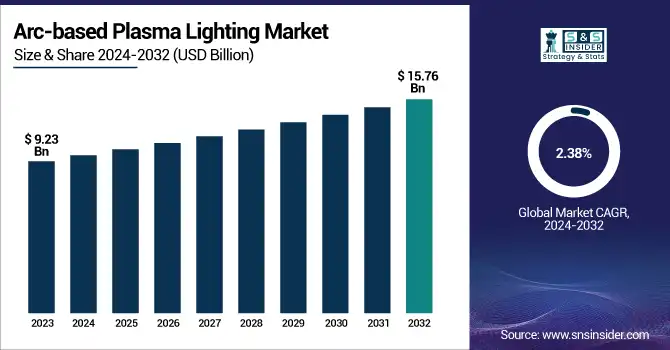
The Arc-based Plasma Lighting Market was valued at USD 9.23 billion in 2023 and is projected to reach USD 15.76 billion by 2032, growing at a CAGR of 2.38% from 2024 to 2032. Some of the primary growth enablers for this market are the integration of advanced technological solutions as well as the rising adoption of hybrid lighting systems that can offer the advantages of both traditional and new lighting technologies.
To Get more information on Arc-based Plasma Lighting Market - Request Free Sample Report
In the U.S., the market was valued at USD 0.10 billion in 2023 and is expected to grow to USD 0.13 billion by 2032, with a CAGR of 2.81%.The growing focus on sustainability and environmental benefits is further accelerating the demand for Arc-based Plasma Lighting, as these solutions offer energy efficiency and longer lifespan compared to conventional lighting. Additionally, improved supply chain resilience and the influence of regulatory impacts, especially in energy-efficient lighting standards, are expected to support continued growth in the market.
Arc-based Plasma Lighting Market Dynamics:
Drivers:
-
Evolution and Advancements in Arc-based Plasma Lighting
Arc-based plasma lighting systems are rapidly gaining traction for their ability to provide high-quality illumination, exceptional color rendering, and uniform brightness, making them ideal for demanding applications such as outdoor and industrial settings. These lighting solutions consume minimal energy, have longer life spans and require the least amount of maintenance, which make them the preferred solution in industries where high-performance and cost-effective solutions are demanded. Recent improvements in plasma light technologies are on the verge of increasing adoption across sectors such as entertainment, automotive, and public infrastructure. A Short History of Lighting: From Oil Lanterns to Plasma Lamps set the foundation for the sophisticated lighting systems we utilize today. For fluorescent and arc lamp plasmas, which are different, obviously, but have a large number of charged particles so they are also good energy consumers. These advances are making lighting systems more sustainable & accessible throughout industries.
Restraints:
-
Integrating arc-based plasma lighting into traditional systems is complex, requiring costly upgrades and skilled maintenance, which can deter adoption.
Adapting to arc-based plasma lighting is difficult to integrate into existing infrastructure, particularly in older or more traditional lighting industries. This process usually involves significant upgrades to the power supplies, controllers, and other electrical components throughout the facility to make them compatible with the plasma lighting systems. This can add time and costs to implementation. Additionally, the need for specialized wiring and modifications to electrical systems further adds to the complexity. Maintenance and operation also demand skilled personnel, as there is a learning curve associated with managing the technology. These factors contribute to higher upfront costs and extended implementation periods, making businesses hesitant to adopt arc-based plasma lighting due to the potential disruption and financial burden during the transition.
Opportunities:
-
IoT integration with arc-based plasma lighting enables efficient, automated, and adaptable solutions for commercial and residential use.
The integration of arc-based plasma lighting with IoT-enabled smart systems presents a significant opportunity for the lighting industry. This technology allows for more efficient, automated, and adaptable lighting solutions, particularly in commercial and residential applications. By incorporating smart sensors and controls, these lighting systems can adjust brightness, color temperature, and energy consumption based on real-time data, such as occupancy, daylight levels, and environmental conditions. This level of automation not only enhances convenience and user experience but also contributes to significant energy savings and reduced operational costs. The growing trend toward smart cities and connected infrastructure further accelerates the adoption of these advanced lighting solutions, positioning arc-based plasma lighting as a key player in the evolving smart lighting market.
Challenges:
-
Lack of Consumer Awareness Hindering the Growth of the Arc-based Plasma Lighting Market
Despite the numerous advantages of arc-based plasma lighting, such as energy efficiency, longevity, and superior lighting quality, limited consumer awareness remains a significant challenge. Many consumers, particularly in traditional lighting sectors, are unfamiliar with the benefits and applications of plasma lighting compared to conventional options like LED or incandescent bulbs. A lack of awareness causes market penetration and adoption to lag, particularly in residential and commercial spaces. Finally, the new technology and higher upfront cost may confuse and discourage potential users before they can appreciate the long-term cost and environmental benefits. Raising consumer and industry awareness of these advantages will be central to the speed of the growth of the market.
Arc-based Plasma Lighting Industry Segment Analysis:
By Light Source
The Xenon arc lamps segment held the largest revenue share of approximately 47% in the Arc-based Plasma Lighting Market in 2023 and is expected to be the fastest-growing segment during the forecast period from 2024 to 2032. The main reason for this dominance is their ability to deliver high-intensity, bright, and uniform light, making them an ideal choice for applications that require precision and high performance. Due to their good color rendering and long life, xenon arc lamps are commonly used in automotive, film projection, and medical lighting. They are often the preferred solution for high performance lighting systems, thanks to their consistent light output and efficiency, even under the most demanding thermal conditions. With increased demand for modern lighting systems, the xenon arc lamps segment is expected to continue dominating the market.
By Wattage Type
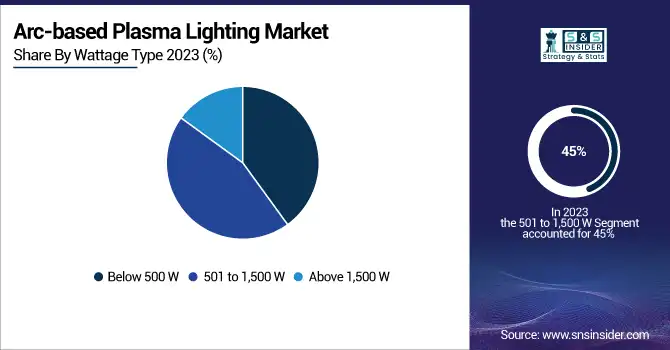
The 501 to 1,500 W segment dominated the Arc-based Plasma Lighting Market with the largest revenue share of approximately 45% in 2023 and is expected to be the fastest-growing segment during the forecast period from 2024 to 2032. This segment is expected to witness significant growth due to the increasing availability of high-performance lighting in automotive, industrial, and outdoor applications. Laser or arc based plasma lamps this powerful can produce high brightness with uniform light distribution and are therefore suitable for high energy-output industrial work and precision work. Owing to their capacity of providing the similar lighting for longer time period without using excessive energy, they are preferred by many industries on a larger scale as a sustainable solution for a cost-effective lighting solution. With industries focusing on high-quality lighting that consumes less power, 501 to 1,500 W segment is likely to be the fastest growing segment, establishing its prominent share in the motion sensor market.
By Application
The Entertainment & Projection segment dominated the Arc-based Plasma Lighting Market, accounting for approximately 30% of the revenue in 2023. This segment's dominance is driven by the need for high-quality, bright, and uniform lighting in film projection, stage lighting, and other entertainment applications. Arc-based plasma lights offer superior color rendering, long lifespan, and consistent performance, making them ideal for demanding environments where visual precision is crucial. As the entertainment industry continues to evolve and demand more advanced lighting solutions, the Entertainment & Projection segment is expected to maintain a strong position and see continued growth in the coming years.
The UV Applications segment is expected to be the fastest-growing in the Arc-based Plasma Lighting Market over the forecast period from 2024 to 2032. Demand for UV light sources is increasing in sterilization, water treatment, medical, and several other applications, which is driving this growth. Arc-based plasma lights excel in delivering powerful UV output, which is necessary for effective disinfection and industrial functions. Moreover, compared with its predecessor, they produce consistent and controllable UV light and consume less power while lasting longer, which have made them the preferred source for applications requiring precision and reliability. With industries focusing on cost effective, sustainable solutions, the demand for UV application in the arc-based plasma lighting market is expected to witness substantial growth.
Arc-based Plasma Lighting Market Regional Outlook:
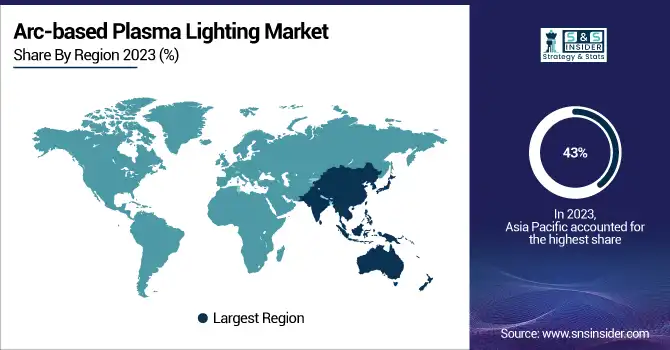
In 2023, the Asia-Pacific region dominated the Arc-based Plasma Lighting Market, capturing approximately 43% of the total revenue. Rapid industrialization, urbanization, and technological proliferation in major economies such as China, Japan, and India is driving this strong market presence. Emerging economies are rapidly adopting advanced lighting solutions across automotive, entertainment and industrial sectors, helping to improve their overall quality of life, and are increasingly demanding high-performance, energy-efficient lighting. Government initiatives promoting sustainable energy solutions contribute to the high demand for arc-based plasma lighting devices in the region and the increase in public spending on infrastructure development. In addition, the rising trend of environmental concerns coupled with the expansion of commercial and residential spaces has triggered the high efficiency lighting technologies market growth.
North America is expected to be the fastest-growing region in the Arc-based Plasma Lighting Market during the forecast period from 2024 to 2032. This growth is driven by increasing demand for advanced lighting solutions in sectors such as automotive, entertainment, and industrial applications, where high-intensity, efficient lighting is essential. The adoption of arc-based plasma lighting is also supported by stringent environmental regulations, which encourage the use of energy-efficient and sustainable lighting technologies. Furthermore, significant investments in smart lighting systems, infrastructure upgrades, and innovation in lighting technologies across countries like the U.S. and Canada are fueling market expansion. As North America continues to prioritize sustainable development and innovation, the Arc-based Plasma Lighting Market is expected to experience rapid growth in the coming years.
Get Customized Report as per Your Business Requirement - Enquiry Now
Key Players Listed in Arc-based Plasma Lighting Market are:
-
ams-OSRAM AG (Germany) – LED modules, light sensors, automotive lighting
-
Signify Holding (Netherlands) – Philips LED lighting, connected lighting
-
Ushio Inc. (Japan) – Xenon arc lamps, halogen lamps
-
Excelitas Technologies Corp. (US) – Plasma lamps, photodetectors
-
Hamamatsu Photonics K.K. (Japan) – Photodetectors, light sensors
-
LEDVANCE GmbH (Germany) – LED bulbs, smart lighting
-
Newport Corporation (US) – Xenon lamps, photonics instruments
-
General Electric (GE) (US) – Arc lamps, LED lighting systems
-
Iwasaki Electric Co. Ltd. (Japan) – High-intensity discharge lamps, specialty lighting
-
Toshiba Corporation (Japan) – High-pressure mercury lamps, lighting products
List of suppliers providing raw materials and components for the Arc-based Plasma Lighting Market:
-
Dow Inc.
-
3M
-
Saint-Gobain
-
Schott AG
-
Mitsubishi Chemical Corporation
-
Corning Incorporated
-
Hitachi Chemical Co., Ltd.
-
KEMET Electronics Corporation
-
Rubicon Technology
-
OSRAM Opto Semiconductors GmbH
Recent Development:
-
January 30, 2025 ,Excelitas Technologies® will showcase its advanced UV curing systems at MD&M West 2025, focusing on innovations in UV LED spot curing systems, which are crucial for the development of plasma-based lighting solutions, particularly in applications requiring high-intensity, stable light sources for industrial curing and medical device manufacturing.
| Report Attributes | Details |
|---|---|
| Market Size in 2023 | USD 0.61 Billion |
| Market Size by 2032 | USD 0.75 Billion |
| CAGR | CAGR of 2.38% From 2024 to 2032 |
| Base Year | 2023 |
| Forecast Period | 2024-2032 |
| Historical Data | 2020-2022 |
| Report Scope & Coverage | Market Size, Segments Analysis, Competitive Landscape, Regional Analysis, DROC & SWOT Analysis, Forecast Outlook |
| Key Segments | • By Light Source(Xenon arc lamps, Metal halide lamps, Deuterium lamps, Krypton arc lamps, Mercury vapor lamps) • By Wattage Light Source(Below 500 W, 501 to 1,500 W, Above 1,500 W) • By Application(Entertainment & projection, Searchlight & spotlight, Solar simulation and environmental testing, Spectroscopy, Medical lighting, Microscopic lights, UV applications, Others), |
| Regional Analysis/Coverage | North America (US, Canada, Mexico), Europe (Eastern Europe [Poland, Romania, Hungary, Turkey, Rest of Eastern Europe] Western Europe] Germany, France, UK, Italy, Spain, Netherlands, Switzerland, Austria, Rest of Western Europe]), Asia Pacific (China, India, Japan, South Korea, Vietnam, Singapore, Australia, Rest of Asia Pacific), Middle East & Africa (Middle East [UAE, Egypt, Saudi Arabia, Qatar, Rest of Middle East], Africa [Nigeria, South Africa, Rest of Africa], Latin America (Brazil, Argentina, Colombia, Rest of Latin America) |
| Company Profiles | ams-OSRAM AG, Signify Holding, Ushio Inc., Excelitas Technologies Corp., Hamamatsu Photonics K.K., LEDVANCE GmbH, Newport Corporation, General Electric (GE), Iwasaki Electric Co. Ltd., and Toshiba Corporation. |
Frequently Asked Questions
Asia-Pacific dominated the Arc-based Plasma Lighting Market in 2023.
The “Xenon arc lamps” segment dominated the Arc-based Plasma Lighting Market.
Include superior illumination quality, energy efficiency, long lifespan, environmental benefits, and increasing demand across sectors like automotive, entertainment, and UV applications.
The Arc-based Plasma Lighting Market was USD 0.61 Billion in 2023 and is expected to Reach USD 0.75 Billion by 2032.
The Arc-based Plasma Lighting Market is expected to grow at a CAGR of 2.38% during 2024-2032.
