
Smart Lighting Market Report Scope & Overview:
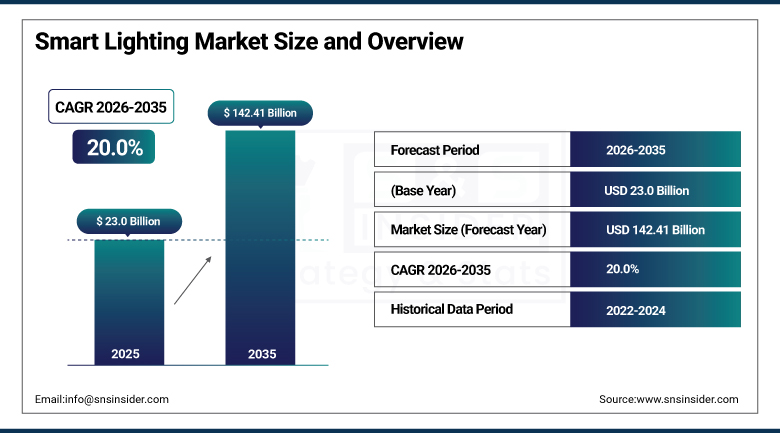
The Smart Lighting Market size was valued at USD 23.0 Billion in 2025 and is expected to reach USD 142.41 Billion by 2035, growing at a CAGR of 20.0% from 2026 to 2035.
The Smart Lighting Market continues to accelerate as national net-zero building codes, utility retrofit incentive programs, and the arrival of harmonized connectivity standards including Matter 1.4 remove the fragmentation that once slowed adoption across residential, commercial, and industrial buildings. Vendors continue weaving edge-AI dimming, Li-Fi data backhaul, and grid-interactive demand response directly into luminaire hardware, effectively turning ordinary light fixtures into data nodes and service gateways rather than passive illumination devices. Falling smart bulb pricing, now often under fifteen dollars at retail, continues democratizing residential access, while warehouses, factories, and logistics hubs increasingly treat high-bay smart lighting as a core energy-efficiency investment with genuinely short payback periods.
Signify Holding introduced a generative artificial intelligence lighting assistant for its Philips Hue product line at CES in January 2025, designed to create personalized lighting scenes through text or voice commands, while the Connectivity Standards Alliance released Matter 1.4 the same month, an update aimed at improving seamless interoperability between smart lighting devices manufactured by different companies.
Market Size and Forecast
-
Market Size in 2026E: USD 27.60 Billion
-
Market Size by 2035: USD 142.41 Billion
-
CAGR: 20.0% from 2026 to 2035
-
Fastest Growing Region: Middle East & Africa
-
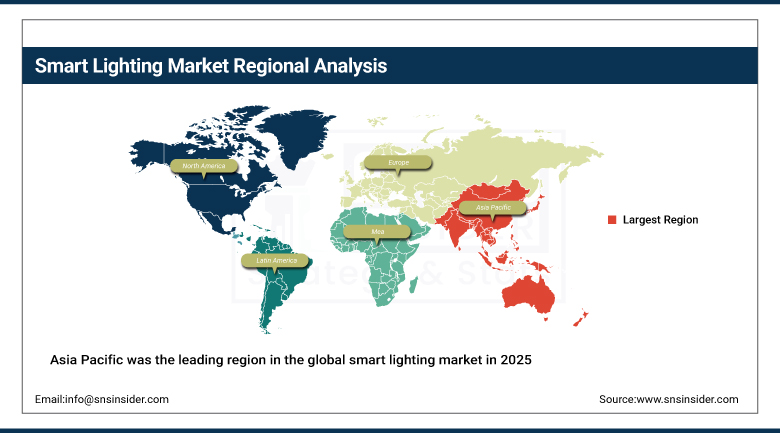
Largest Region: Asia Pacific
To Get more information On Smart Lighting Market- Request Free Sample Report
Smart Lighting Market Trends
-
National net-zero building codes and utility retrofit incentive programs are accelerating commercial and industrial smart lighting upgrades.
-
Harmonized connectivity standards including Matter 1.4 are reducing fragmentation across smart lighting device ecosystems.
-
Edge-AI dimming and grid-interactive demand response capability are turning luminaires into data nodes and service gateways.
-
Falling smart bulb retail pricing is democratizing residential adoption without requiring wiring changes.
-
Li-Fi data backhaul pilots are enabling indoor positioning and robotics communication without congesting wireless spectrum.
U.S. Smart Lighting Market Size Outlook
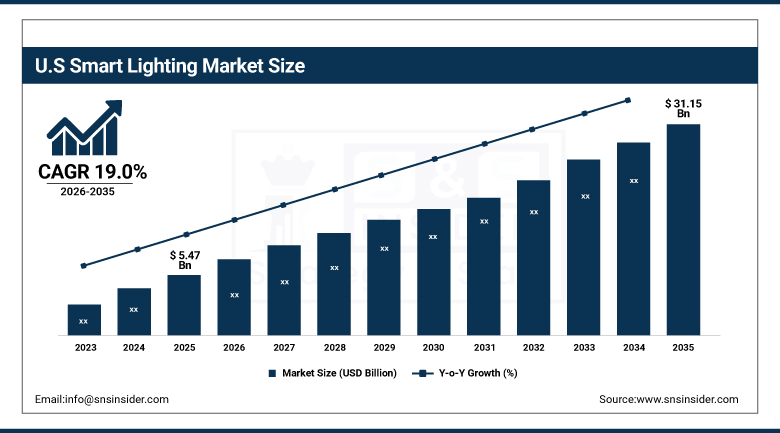
The U.S. Smart Lighting Market was valued at USD 5.47 Billion in 2025 and is expected to reach USD 31.15 Billion by 2035, growing at a CAGR of 19.0% from 2026 to 2035.
The U.S. remained at the forefront of demand for smart lighting solutions in North America, driven by stringent energy efficiency laws, LED replacement rebates, and increasing spending on smart buildings construction in commercial, industrial, and public infrastructure. Further development of street lighting, university campuses, and transport facilities helped the nation stay one of the most commercially relevant countries in terms of smart lighting demand, as the owners of buildings started to see smart lighting as a fundamental part of smart buildings and energy management strategy.
Brilliant introduced the second generation of smart home control panels in May 2025, featuring high-definition screens and increased speed of response in terms of integrated management of lighting and other smart home systems.
Smart Lighting Market Segment Analysis
-
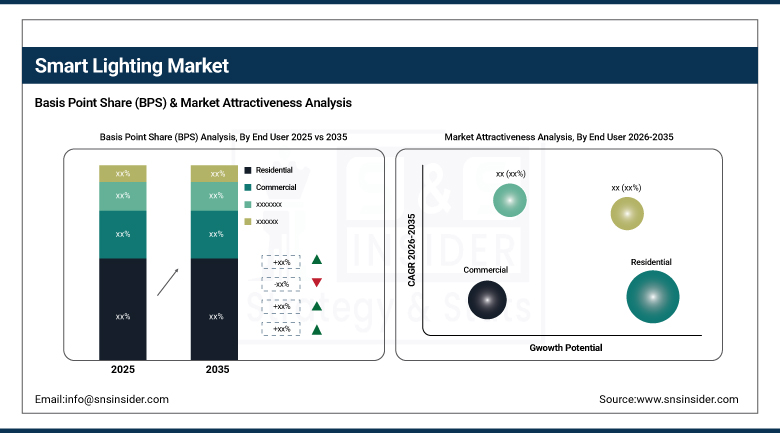
By End-User, the Residential segment held approximately 46.7% share in 2025, while the Industrial segment is the fastest growing.
-
By Connectivity, the Wired segment held approximately 81.3% share in 2025, while the Wireless segment is the fastest growing.
-
By Component, the Hardware segment held the larger share in 2025, while the Software segment is the fastest growing.
By End-User, Residential led the market, Industrial grew fastest
The Residential segment dominated the end-user category in 2025, holding approximately 46.7% of total revenue, driven by sub-fifteen-dollar smart bulb pricing and growing voice assistant convenience that continues making connected lighting an easy, low-commitment entry point into the broader smart home ecosystem. Homeowners increasingly favor bulbs and fixtures that require no wiring changes, and that combination of affordability and installation simplicity keeps residential adoption firmly ahead of every other end-user category in overall shipment volume across nearly every major consumer market worldwide.
The Industrial segment is projected to grow at the fastest CAGR during the forecast period, as warehouses, factories, and logistics hubs increasingly recognize lighting as a top-tier energy-efficiency investment. High-bay LED fixtures delivering strong luminous efficacy, combined with simple payback periods often under two years, continue placing industrial lighting retrofits at the top of corporate energy-efficiency priority lists, and edge-AI controls that adjust luminance by zone, shift, and daylight condition continue pushing industrial adoption well ahead of the broader end-user segmentation.
By Connectivity, Wired led the market, Wireless grew fastest
The Wired segment held the largest connectivity share in 2025, at approximately 81.3%, reflecting its continued dominance across permanent commercial and industrial installations where reliability and centralized control matter more than installation flexibility. Wired systems remain the preferred choice for large-scale building management deployments where consistent, low-latency control across hundreds or thousands of fixtures is genuinely mission-critical, keeping this connectivity category firmly in the lead across the majority of commercial and municipal lighting installations worldwide.
The Wireless segment is projected to grow at the fastest CAGR during the forecast period, driven by rising consumer and small-business preference for lights that connect via WiFi, Bluetooth, Zigbee, or Z-Wave without requiring professional installation or building rewiring. That flexibility makes wireless smart lighting particularly attractive to renters and consumers who want smart, remote-controlled features without a long-term commitment to fixed infrastructure, a preference that continues pushing wireless adoption well ahead of the broader connectivity segmentation.
By Component, Hardware led the market, Software grew fastest
The Hardware segment held the larger component share in 2025, anchored by continued high-volume shipment of smart bulbs, fixtures, sensors, and drivers across residential, commercial, and industrial installations. Physical luminaires and control hardware remain the foundational capital expenditure category for any smart lighting deployment, and that necessary hardware layer continues to represent the largest single component of overall market revenue across nearly every application category.
The Software segment is projected to grow at the fastest CAGR during the forecast period, as firmware, analytics, and cloud dashboard capability increasingly determine vendor differentiation rather than raw luminous output alone. As the installed hardware base continues to saturate across mature markets, software upgrades and subscription-based analytics services are emerging as a genuine recurring revenue opportunity, transforming what were once simple capital equipment purchases into ongoing digital platform relationships between vendors and building operators.
Regional Analysis
|
Region |
Major Country |
Share within Region, 2025 (%) |
|---|---|---|
|
Asia Pacific |
China |
39.0% |
|
North America |
United States |
85.0% |
|
Europe |
Germany |
28.0% |
|
Middle East & Africa |
UAE |
27.0% |
|
Latin America |
Brazil |
38.0% |
Asia Pacific Smart Lighting Market Insights
Asia Pacific was the leading region in the global smart lighting market in 2025, accounting for around 37.4% market share owing to large-scale urban development in the region, growth in smart city projects and increasing shift from LED lighting towards IoT-based lighting systems in the region. Increasing use of smart lighting technology in various applications, including commercial buildings, industries, residential buildings, and municipal infrastructure is supporting demand growth in the region, along with government-led digitalization efforts in China, India, and Southeast Asia.
China was the dominant country in the regional market, contributing about 39% revenue to the market, backed by substantial investments in smart cities, as well as strong manufacturing capabilities of lighting manufacturers in the region to serve regional as well as export markets at attractive prices. India and Southeast Asia made further contributions to regional demand due to rapid urbanization and government-led energy efficiency policies in the region.
Get Customized Report as per Your Business Requirement - Enquiry Now
North America Smart Lighting Market Insights
A considerable part of the smart lighting market globally was taken up by North America in 2025 owing to stringent rules for energy efficiency and reduction of carbon footprint coupled with rebates offered by American and Canadian government authorities. Growing investments in smart buildings and upgrades to infrastructure such as street lighting, universities and transport hubs were driving the replacement of traditional lighting systems with IoT-based solutions.
US had a regional market share of around 85%, which can be attributed to the presence of many leading lighting companies along with the continuous investment in retrofits by commercial and municipal establishments. Canada contributed towards regional market revenues through the growth in its own smart building and energy efficiency projects.
Europe Smart Lighting Market Insights
Europe held a meaningful share of the global Smart Lighting Market in 2025, supported by stringent energy-efficiency regulations and sustainability mandates set by European regulatory bodies that continue promoting widespread smart lighting adoption across commercial, industrial, and municipal sectors. Germany accounted for roughly 28% of regional revenue, supported by its concentration of building automation expertise and industrial manufacturing facilities integrating smart lighting into broader Industry 4.0 digital twin initiatives.
France, the United Kingdom, and the Nordic countries followed a broadly similar trajectory, as coordinated European Union sustainability initiatives continued extending smart lighting adoption across the continent's largest commercial and municipal markets. Continued regulatory tightening around building energy performance is expected to keep reinforcing steady European demand through the remainder of the forecast period.
MEA & Latin America Smart Lighting Market Insights
The Middle East and Africa region was the fastest-growing region in the global Smart Lighting Market, driven by ambitious national smart-city programs, renewable-energy mandates, and rising government investment in digital infrastructure across the Gulf states in particular. The UAE accounted for roughly 27% of regional revenue, supported by national smart-city platform investment and rising enterprise appetite for connected building infrastructure.
Latin America expanded at a comparable pace, led by Brazil at roughly 38% of regional revenue, where growing urban development and smart-city infrastructure investment continued to support category growth. Mexico and Argentina followed a similar trajectory as regional energy-efficiency and building modernization programs expanded further through the remainder of the forecast period.
Market Dynamics
Growth Drivers: Regulatory-driven energy efficiency and connectivity standardization
Establishment of harmonized digital and connectivity protocols by regulatory bodies, combined with increasing smart city initiatives globally, continues to be the central force behind smart lighting market growth. National net-zero building codes and utility retrofit programs, some now covering thirty to fifty percent of capital outlays for qualifying projects, continue removing the financial barriers that once slowed commercial and industrial adoption, while advancements in AI and edge computing continue improving the value proposition of connected lighting well beyond simple on-off control.
Growing adoption of LEDs and luminaires in outdoor applications, combined with rising demand for IoT-integrated smart lighting solutions and increasing penetration of data analytics platforms, continues reinforcing this growth trajectory across nearly every major building category. The arrival of Matter 1.4 and similar harmonized standards continues resolving the interoperability fragmentation that once forced building owners to commit to a single vendor ecosystem, a shift that keeps expanding the addressable market for smart lighting vendors capable of supporting open, standards-based connectivity.
Restraints: Interoperability fragmentation and upfront cost barriers
Although there have been advances in achieving standardization for connectivity, interoperability issues remain within smart lighting device ecosystems that have been developed using legacy proprietary protocols. The fact that a property owner has invested a considerable amount of money in the infrastructure of a certain vendor ecosystem creates a switching cost that may limit the replacement process even though standards-based devices offer clear advantages.
The capital expense involved in the installation of smart lighting devices, especially for commercial or industrial buildings where sensor networking is required, makes it difficult for building owners with limited budgets to deploy comprehensive smart lighting systems. This limits the deployment of comprehensive smart lighting installations only to commercial and institutional building owners who can afford to do so.
Opportunities: Expanding software services and grid-interactive lighting
Growing opportunity exists in transitioning smart lighting from a one-time capital equipment purchase toward an ongoing software and analytics service relationship, as firmware, cloud dashboards, and data-driven facility management capability increasingly determine vendor differentiation. Vendors capable of delivering recurring-revenue software platforms layered on top of their hardware installations stand to capture meaningfully higher lifetime customer value than hardware sales alone could ever provide.
Grid-interactive demand-response capability represents a further substantial growth avenue, as utilities increasingly look to lighting networks as a distributed, controllable load capable of supporting grid stability during peak demand periods. Manufacturers capable of delivering luminaires that seamlessly integrate with utility demand-response programs, building management systems, and renewable energy sources stand to capture a growing share of demand across commercial, industrial, and municipal applications through 2035.
Recent Developments:
-
2025: Acuity Brands launched Nightingale, a new patient-focused lighting brand targeting the healthcare sector, expanding its portfolio beyond traditional commercial and industrial lighting applications.
-
2025: Legrand expanded its product line with a new advanced LED dimmer, strengthening its residential and commercial smart lighting control portfolio.
-
2025: Signify initiated a patent infringement lawsuit against Nanoleaf Canada, highlighting the increasing strategic importance of intellectual property protection within the competitive smart lighting landscape.
Smart Lighting Companies are:
-
Acuity Brands, Inc.
-
Legrand SA
-
Honeywell International Inc.
-
Panasonic Holdings Corporation
-
Koninklijke Philips N.V.
-
TVILIGHT Projects B.V.
-
Zumtobel Group AG
-
Lutron Electronics Co., Inc.
-
Cree Lighting
-
Current Lighting Solutions, LLC
-
Leviton Manufacturing Co., Inc.
-
IDEAL INDUSTRIES, INC.
-
Brilliant Home Technology, Inc.
-
Nanoleaf
-
TP-Link Technologies Co., Ltd.
-
Belkin International, Inc.
-
Eaton Corporation plc
-
Ubiquiti Inc.
Smart Lighting Market Report Scope:
| Report Attributes | Details |
|---|---|
| Market Size in 2025 | USD 23.0 Billion |
| Market Size by 2035 | USD 142.41 Billion |
| CAGR | CAGR of 20.00% From 2026 to 2035 |
| Base Year | 2025 |
| Forecast Period | 2026-2035 |
| Historical Data | 2022-2024 |
| Report Scope & Coverage | Market Size, Segments Analysis, Competitive Landscape, Regional Analysis, DROC & SWOT Analysis, Forecast Outlook |
| Key Segments | • By Component (Hardware, Software) • By Product (Lamps and Fixtures, Building Management Systems) • By End-User (Residential, Commercial, Industrial) • By Connectivity (Wired, Wireless) |
| Regional Analysis/Coverage | North America (US, Canada), Europe (Germany, UK, France, Italy, Spain, Russia, Poland, Rest of Europe), Asia Pacific (China, India, Japan, South Korea, Australia, ASEAN Countries, Rest of Asia Pacific), Middle East & Africa (UAE, Saudi Arabia, Qatar, South Africa, Rest of Middle East & Africa), Latin America (Brazil, Argentina, Mexico, Colombia, Rest of Latin America). |
| Company Profiles | Signify Holding, Acuity Brands, Inc., Legrand SA, Honeywell International Inc., Panasonic Holdings Corporation, OSRAM GmbH, Koninklijke Philips N.V., TVILIGHT Projects B.V., Zumtobel Group AG, Lutron Electronics Co., Inc., Cree Lighting, Current Lighting Solutions, LLC, Leviton Manufacturing Co., Inc., IDEAL INDUSTRIES, INC., Brilliant Home Technology, Inc., Nanoleaf, TP-Link Technologies Co., Ltd., Belkin International, Inc., Eaton Corporation plc, Ubiquiti Inc. |
Frequently Asked Questions
The Smart Lighting Market is expected to grow at a CAGR of 20.0% from 2026 to 2035.
The Smart Lighting Market was valued at USD 23.0 Billion in 2025.
Regulatory-driven energy efficiency requirements combined with harmonized connectivity standards such as Matter 1.4 are the major growth factors.
The Residential segment held approximately 46.7% share in 2025.
Asia Pacific held the largest share of the Smart Lighting Market in 2025, at approximately 37.4%, while the Middle East and Africa was the fastest-growing region.
