
Augmented Reality Hardware Market Report Scope & Overview:
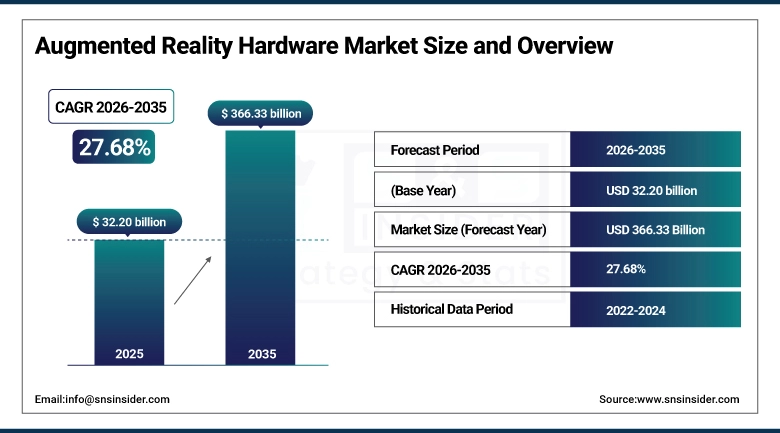
The Augmented Reality Hardware Market size is valued at USD 32.20 Billion in 2025 and is projected to reach USD 366.33 Billion by 2035, growing at a CAGR of 27.68% during the forecast period 2026–2035.
The Augmented Reality Hardware Market analysis report presents an insightful study of the dynamics of the market, technology advancements, and applications. The increased demand for display technology and optical devices, along with the growing usage of sensors and camera-based technologies for providing immersive and entertaining experiences, is significantly propelling the market growth through 2026 to 2035.
In 2025, the shipments of AR hardware devices surpassed the 25 million marks, driven by high consumer demand in the gaming and entertainment sectors, along with industrial and medical applications.
Market Size and Forecast:
-
Market Size in 2025: USD 32.20 Billion
-
Market Size by 2035: USD 366.33 Billion
-
CAGR: 27.68% from 2026 to 2035
-
Base Year: 2025
-
Forecast Period: 2026–2035
-
Historical Data: 2022–2024
To Get more information on Augmented Reality Hardware Market - Request Free Sample Report
Augmented Reality Hardware Market Trends:
-
Rapid growth in smart glasses adoption, moving from niche enterprise use to mainstream consumer markets.
-
Strong industrial and manufacturing demand for AR hardware in training, maintenance, and design visualization.
-
Expanding healthcare applications, including AR-assisted surgeries, diagnostics, and patient education.
-
Rising gaming and entertainment integration, with AR headsets becoming central to immersive experiences.
-
Increasing use of automotive AR HUDs for navigation, safety, and driver assistance.
-
Advances in displays & optics (micro-LED, holographic waveguides) improving device performance and comfort.
-
Integration of 5G and edge computing enabling real-time AR experiences with lower latency.
-
Growth in AI-powered AR hardware for object recognition, gesture tracking, and personalization.
-
Falling hardware costs and miniaturization driving wider accessibility and consumer adoption.
U.S. AR Hardware Market Size Outlook:
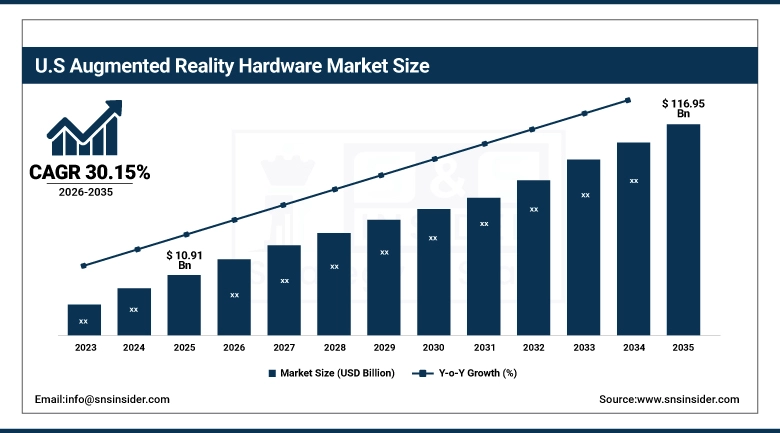
The U.S. AR Hardware Market is projected to grow from USD 10.91 Billion in 2025 to USD 116.95 Billion by 2035, at a CAGR of 30.15%. Market Growth in Augmented Reality Hardware can be attributed to fast development in optical systems, use of sensors and cameras to create an engaging environment, extensive adoption of HMDs and smart glasses, and the expansion of application areas such as industrial manufacturing, healthcare, automotive and entertainment industry.
Augmented Reality Hardware Market Growth Drivers:
-
Rapid advancements in display, sensor, and spatial computing technologies accelerating hardware innovation
Development in technology within the basic building blocks of AR systems including display, optics, sensors, and processing units has been one of the major factors driving the AR hardware market. Improvements in technologies such as micro-OLED display, waveguide optics, depth sensing, and AI-based spatial computing are contributing to improving the efficacy and performance of devices. Furthermore, technologies which includes 5G and edge computing are playing an essential role in providing real-time, latency-free AR experiences, thus adding to the demand for hardware devices.
More than 65% of next-generation AR devices launched in 2025 incorporate advanced sensors and AI-enabled processors, reflecting rapid technological evolution.
Augmented Reality Hardware Market Restraints:
-
High device costs and technical limitations restraining widespread adoption.
The exorbitant cost associated with AR hardware devices and technical constraints represent the major barriers that will impede the growth trajectory of the Augmented Reality Hardware Market. The higher-end AR hardware devices including headsets, smart glasses, and HUD technology require sophisticated technologies, which may include advanced display screens, sensors, and processing units; hence, the cost of these AR hardware devices is quite high. Other barriers include the issue of limited battery life, poor field of view, cumbersome size of the hardware devices, and excessive heat generation.
Less than 40% of small and mid-sized enterprises adopted AR hardware solutions in 2025 due to cost and usability constraints.
Augmented Reality Hardware Market Opportunities:
-
Expansion of enterprise and industrial applications creating significant growth opportunities.
The fast adoption and growth of applications for AR in the enterprise sector represents a significant business potential for the Augmented Reality Hardware Market. The industries where AR hardware can be used range from manufacturing, healthcare, logistics, to field services, where AR hardware helps with training and support, maintenance, and visualization. Further developments in AR technology that involve AI, IoT, and 5G enable more real-time applications of the hardware. As businesses become increasingly inclined toward their digital transformation, there will be a significant increase in demand for AR hardware.
Over 65% of large enterprises are expected to integrate AR hardware into their operational workflows by 2027, driven by productivity and cost-efficiency benefits.
AR Hardware Market Segmentation Analysis:
-
By Hardware Component, Displays & Optics held the largest market share of 28.32% in 2025, while Sensors & Cameras are expected to grow at the fastest CAGR of 29.10% during 2026–2035.
-
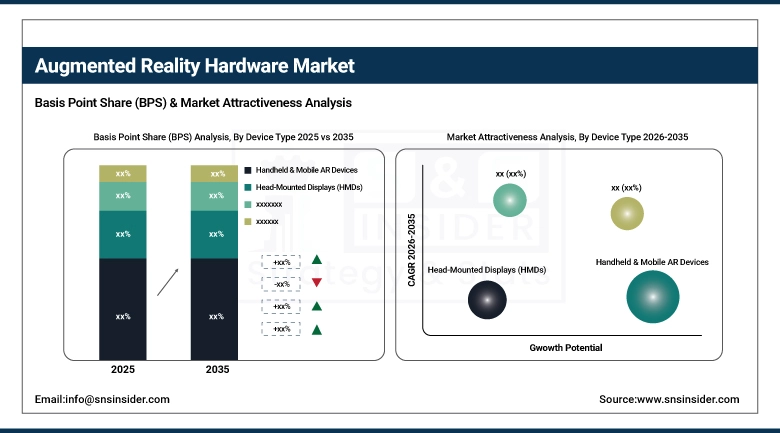
By Device Type, Handheld & Mobile AR Devices dominated with 62.33% market share in 2025, whereas Smart Glasses / AR Glasses are projected to record the fastest CAGR of 28.61% through 2026–2035.
-
By Hardware Type/Peripheral Systems, Sensors & Tracking Systems accounted for the highest market share of 24.65% in 2025, while Cameras & Vision Systems are expected to grow at the fastest CAGR of 28.63% during the forecast period.
-
By End-use Application/Industry Vertical, Industrial & Manufacturing dominated with a 31.58% share in 2025, while Healthcare & Medical are anticipated to expand at the fastest CAGR of 27.05% through 2026–2035.
By Hardware Component, Displays & Optics Dominate While Sensors & Cameras Grow Rapidly:
Displays & Optics was the dominant segment within the AR market due to the importance of this component in ensuring immersive visuals and functioning AR technology. This component provides the basis of AR technology in the form of smart glasses, HMDs, and head-up displays, and hence has high consumer and enterprise demand.
The Sensors & Cameras segment is the fastest-growing segment in the AR market as there is increased demand for depth perception, motion tracking, and interaction with surroundings. It is the result of developments in depth-sensing, computer vision, and AI-based tracking systems that are essential in next-generation AR technology.
By Device Type, Handheld & Mobile AR Devices Dominate While Smart Glasses / AR Glasses Grow Rapidly:
The Handheld & Mobile AR Devices segment was a market leader owing to the wide availability and significant penetration of smartphones and tablets that support AR applications. This segment provides affordable and convenient AR solutions, enabling it to be the main source of entry for customers and organizations alike.
The Smart Glasses / AR Glasses segment has the highest growth rate, fueled by the increasing need for hands-free and immersive AR applications that cater to various enterprise use cases. Growth in the segment is being supported by its growing application in sectors such as manufacturing, healthcare, and logistics.
By Hardware Type/Peripheral Systems, Sensors & Tracking Systems Dominate While Cameras & Vision Systems Grow Rapidly:
The Sensors & Tracking Systems segment held the largest market share since they are indispensable components in facilitating accurate motion sensing, spatial awareness, and real-time interaction in AR settings. The segment comprises technologies necessary for ensuring smooth AR experiences.
The Cameras & Vision Systems segment is projected to register the highest CAGR, fueled by the fast-paced development of computer vision, image recognition, and environment mapping using AI technology. Increasing need for quality visual inputs in enabling object detection and facial recognition is stimulating growth in the segment.
By End-use Application/Industry Vertical, Industrial & Manufacturing Dominate While Healthcare & Medical Grow Rapidly:
The Industrial & Manufacturing segment held the largest share in the market owing to growing application of AR devices for training, maintenance, assembling, and operational purposes. Organizations are using AR technology to improve efficiency and minimize mistakes through data-intensive processes.
The Healthcare & Medical segment is the fastest-growing one due to the increasing usage of AR in surgeries, training of medical practitioners, diagnosis of patients, and patient treatment. AR technology helps to achieve greater precision, provide overlay of data, and make decisions.
North America Augmented Reality Hardware Market Insights:
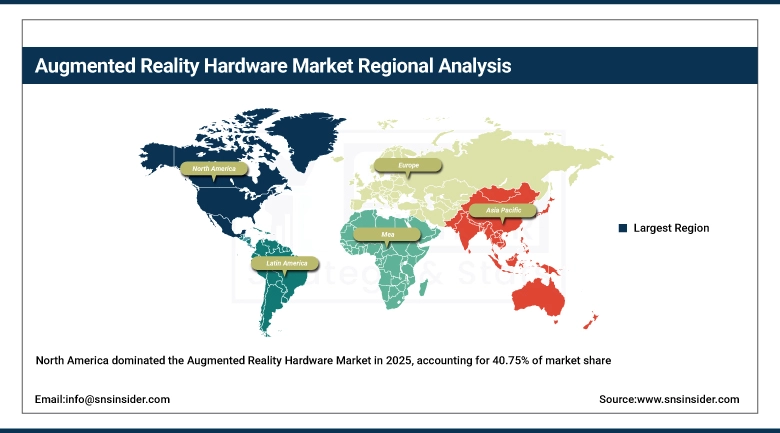
The North American region is currently dominating the AR hardware market, contributing 40.75% of the regional market share by 2025. This domination is fueled by increased acceptance of AR technology among enterprises working in healthcare, manufacturing, and military defense sectors. There is also increasing acceptance among consumers for use in gaming and entertainment applications. The US region dominates due to the presence of key players such as Meta, Apple, and Microsoft, while the Canadian region makes its contribution due to the use of AR technology in healthcare and educational sectors.
Get Customized Report as per Your Business Requirement - Enquiry Now
U.S. Augmented Reality Hardware Market Insights:
The United States is the biggest player in the emergence of the AR hardware industry in North America. The main factors influencing the market growth include growing consumer interest in gaming devices, corporate application in healthcare and manufacturing, and innovative contributions from leading companies such as Apple, Meta and Microsoft. The United States has an advanced technological platform, strong financial support for AI and 5G technologies, and widespread adoption of AR headsets and smart glasses.
Asia-Pacific Augmented Reality Hardware Market Insights:
The Asia-Pacific region is home to the highest rate of growth with CAGR of 28.88% in AR hardware market share, which is forecast to achieve a Compound Annual Growth Rate of 28.88% between 2025 and 2035. The growth in the market can be attributed to countries such as China, Japan, South Korea, and India, where large-scale manufacturing and usage of AR hardware are prevalent. The adoption of AR technology in the region is further fueled by inexpensive devices, government initiatives toward digitalization, and fast growth in the medical and educational industries.
China Augmented Reality Hardware Market Insights:
China dominates the AR hardware market in the Asia-Pacific region owing to its efficient manufacturing facilities, digitalization efforts funded by the government, and increasing customer demand. China is a market leader in the manufacturing of AR smart glasses, sensors, and display units with the help of firms such as Huawei and Lenovo. There is an increased uptake of AR in fields such as health care, automotive, and education, particularly through head-up displays in AR and applications in medical training.
Europe Augmented Reality Hardware Market Insights:
The European region is a major player in the AR hardware market, primarily due to the widespread use of AR technology in automotive, aerospace, and industrial training. The major players in Europe that are utilizing AR hardware include Germany, France, and the United Kingdom. The use of digitalization in government-supported initiatives, research and development activities, and AR hardware integration in manufacturing processes and automotive applications guarantees sustainable growth.
Germany Augmented Reality Hardware Market Insights:
Germany is a major player in AR hardware in Europe due to the dominance of the country's automobile and manufacturing industries. The application of AR head-up display technologies in cars, the use of AR helmets in industry, and AR-powered glasses in training and maintenance operations has been growing rapidly. German firms are increasingly developing their AR hardware and software capabilities to boost productivity and safety through such technologies. As such, government investments into Industry 4.0 programs continue to contribute significantly to AR hardware adoption.
Latin America Augmented Reality Hardware Market Insights:
Latin America’s AR hardware market is emerging, with growing adoption in retail, gaming, and education. Countries such as Brazil and Mexico are leading the region, driven by consumer demand for immersive experiences and enterprise use in training and healthcare. While infrastructure and affordability remain challenges, increasing smartphone penetration and government-backed digital initiatives support growth. AR smart glasses and handheld devices are gaining traction, particularly in retail for virtual try-ons and in education for interactive learning. Latin America shows strong potential for expansion.
Middle East & Africa Augmented Reality Hardware Market Insights:
The Middle East & Africa AR hardware market is in its early stages but shows promising growth. Adoption is driven by smart city projects in Dubai and Riyadh, defense applications, and enterprise integration in oil & gas and construction. Healthcare and education sectors are beginning to explore AR smart glasses and training devices. While affordability and infrastructure remain barriers, government investments in digital transformation and innovation hubs are accelerating adoption. The region is expected to grow steadily, contributing niche opportunities to the AR hardware market.
AR Hardware Market Competitive Landscape:
Meta
Meta is a prominent U.S. technology firm that leads the Augmented Reality Hardware segment. It is particularly successful due to its offerings of Quest headsets and Ray-Ban smart glasses. The firm’s product line focuses on delivering immersive customer experiences and augmented reality applications for businesses, supported by significant investments in AI-powered hardware and optical components. The strategy of Meta in 2025 involves reallocating financial resources from metaverse initiatives to wearable augmented reality devices, enhancing product development schedules.
-
In December 2025, Meta announced a new wearables strategy, prioritizing AR smart glasses and delaying the Phoenix headset release to 2027, signaling a long-term focus on AR hardware innovation.
Apple
Apple is an American consumer electronics manufacturer with an ambitious goal to become the leader of the Augmented Reality Hardware sector. Following its flagship product Vision Pro, Apple plans to develop lightweight AR glasses and sophisticated headsets. The company focuses on the tight coupling of AR and iOS-based devices, superior optical technology, and ergonomic design. Apple’s strategic plan from 2025 to 2028 outlines rapid expansion, which will transform the consumer AR experience.
-
In June 2025, Apple revealed plans for at least seven AR/VR devices, including next-generation Vision Pro models and smart glasses, reinforcing its commitment to large-scale AR adoption.
Microsoft
Microsoft is a major technology player with an extensive enterprise footprint in the Augmented Reality Hardware category via the HoloLens brand in previous years. They were focused on industries such as the manufacturing industry, the healthcare sector, and military usage and capitalized on their cloud capabilities to develop AR solutions. Nonetheless, in 2025, Microsoft made the announcement that it would stop developing the HoloLens line of products.
-
In February 2025, Microsoft confirmed it had ceased development of HoloLens 3, while continuing as a cloud provider for the U.S. Army’s USD22B Integrated Visual Augmentation System (IVAS) program, now led by Anduril.
Augmented Reality Hardware Companies are:
-
Meta
-
Microsoft
-
Google
-
Sony
-
Samsung Electronics
-
Qualcomm
-
Nvidia
-
Lenovo
-
HTC
-
Huawei
-
LG Electronics
-
Panasonic
-
Epson
-
Vuzix
-
PTC
-
Niantic
-
Snap Inc.
-
Toshiba
| Report Attributes | Details |
|---|---|
| Market Size in 2025 | USD 32.20 Billion |
| Market Size by 2035 | USD 366.33 Billion |
| CAGR | CAGR of 27.68% From 2026 to 2035 |
| Base Year | 2025 |
| Forecast Period | 2026-2035 |
| Historical Data | 2022-2024 |
| Report Scope & Coverage | Market Size, Segments Analysis, Competitive Landscape, Regional Analysis, DROC & SWOT Analysis, Forecast Outlook |
| Key Segments | • By Hardware Component (Displays & Optics, Sensors & Cameras, Processors & Compute Units, Connectivity & Power Modules, Others), • By Device Type (Handheld & Mobile AR Devices, Head-Mounted Displays (HMDs), Smart Glasses / AR Glasses, Head-Up Displays (HUDs), Others), • By Hardware Type/Peripheral Systems (Sensors & Tracking Systems, Cameras & Vision Systems, Input & Interaction Devices, Audio & Output Devices, Others), • By End-use Application/Industry Vertical (Industrial & Manufacturing, Healthcare & Medical, Gaming & Entertainment, Automotive & Aerospace, Others) |
| Regional Analysis/Coverage | North America (US, Canada), Europe (Germany, UK, France, Italy, Spain, Russia, Poland, Rest of Europe), Asia Pacific (China, India, Japan, South Korea, Australia, ASEAN Countries, Rest of Asia Pacific), Middle East & Africa (UAE, Saudi Arabia, Qatar, South Africa, Rest of Middle East & Africa), Latin America (Brazil, Argentina, Mexico, Colombia, Rest of Latin America). |
| Company Profiles | Meta, Apple, Microsoft, Google, Sony, Samsung Electronics, Qualcomm, Nvidia, Magic Leap, Lenovo, HTC, Huawei, LG Electronics, Panasonic, Epson, Vuzix, PTC, Niantic, Snap Inc., Toshiba. |

Frequently Asked Questions
North America dominated with a 40.75% share in 2025, while Asia-Pacific is the fastest-growing region, expected to expand at a CAGR of 28.88% during 2026–2035.
Handheld & Mobile AR Devices dominated with a 62.33% share in 2025, while Smart Glasses / AR Glasses are projected to grow at the fastest CAGR of 28.61% during 2026–2035.
Growth Market is driven by rapid advancements in displays and optics, increasing demand for sensors and cameras, rising adoption of smart glasses and head-mounted displays across consumer and enterprise sectors.
The market is valued at USD 32.20 Billion in 2025 and is projected to reach USD 366.33 Billion by 2035.
The Augmented Reality Hardware Market is projected to grow at a CAGR of 27.68% during 2026–2035.
