
Automated truck loading system Market Report Scope & Overview:
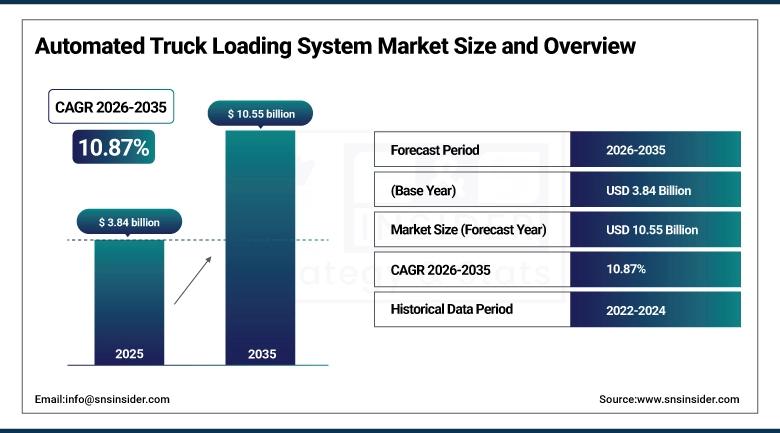
The Automated Truck Loading System Market was valued at USD 3.84 billion in 2025 and is expected to reach USD 10.55 billion by 2035, growing at a CAGR of 10.87% from 2026–2035.
The Automated Truck Loading System Market is witnessing significant growth due to the rapid proliferation of e-commerce fulfillment networks, warehouse automation trends, and the need for efficient and safe logistics operations. The need to boost truck loading efficiencies, reduce turnaround times for trucks, and mitigate employee injuries is encouraging logistics companies to adopt automated truck loading solutions at their logistics centers, manufacturing units, and cold chains. Moreover, labor shortage issues, rising freight traffic, and investments made by logistics companies in smart warehouses enabled by Industry 4.0 solutions are also supporting market growth.
Recent developments include strategic investments by leading intralogistics providers such as Daifuku, Vanderlande, and Dematic in AI-enabled loading automation platforms, robotic conveyor integration, and smart dock management technologies. Several logistics operators and e-commerce companies are modernizing distribution infrastructure with high-speed automated loading solutions capable of handling palletized cargo, parcel shipments, and temperature-sensitive goods with minimal manual intervention.
Additionally, partnerships between warehouse automation companies and industrial robotics providers are accelerating development of IoT-connected truck loading systems featuring predictive maintenance, real-time cargo positioning, and autonomous loading coordination.
To Get more information on Automated Truck Loading System Market - Request Free Sample Report
Automated truck loading system Market Trends
-
Rising expansion of e-commerce fulfillment centers and smart warehouses is accelerating adoption of automated truck loading systems across logistics networks.
-
Growing labor shortages and increasing warehouse automation requirements are boosting demand for high-speed automated loading solutions.
-
Expanding integration of AI-enabled conveyor controls, robotic loading arms, and IoT-based dock management systems is improving operational efficiency.
-
Increasing focus on reducing truck turnaround time and improving loading accuracy is driving deployment of automated loading technologies.
-
Rising adoption of touchless logistics operations and Industry 4.0-enabled material handling systems is strengthening market growth globally.
-
Growing investments in cold chain logistics, freight terminals, and large-scale distribution centers are expanding ATLS deployment across industries.
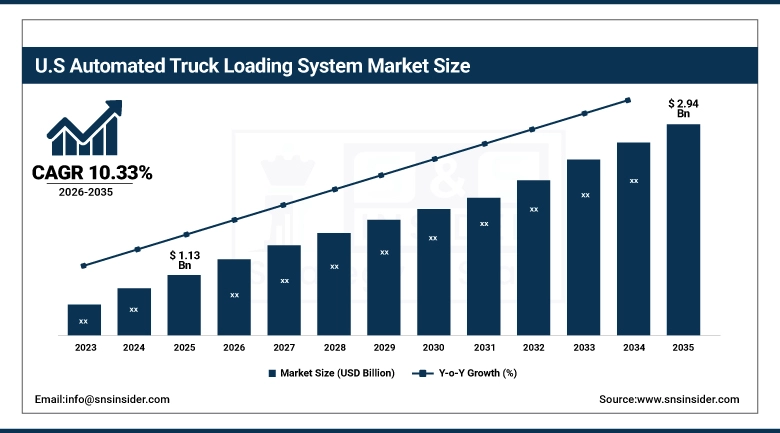
The U.S. Automated Truck Loading System Market was valued at USD 1.13 billion in 2025 and is expected to reach around USD 2.94 billion by 2035, growing at a CAGR of 10.33% from 2026–2035.
United States becomes the biggest market for the automated truck loading system due to its highly developed logistics system, existence of large scale e-commerce warehouses, and fast development of technologies of warehouse automation. Moreover, this demand is driven by the high volume of cargo, lack of workforce, and investments in smart distribution centers that require quick and error-free operations for truck loading.
Supporting this growth, major intralogistics and warehouse automation providers are expanding deployment of AI-enabled conveyor systems, robotic loading technologies, and intelligent dock management platforms across U.S. logistics facilities and manufacturing plants.
Additionally, recent developments such as Dematic expanding automated trailer loading integration for large e-commerce warehouses and Daifuku strengthening its smart conveyor and autonomous material handling portfolio for high-throughput freight operations are reinforcing long-term market growth and improving competitive positioning across the U.S. logistics automation industry.
Automated truck loading system Market Segment Highlights
-
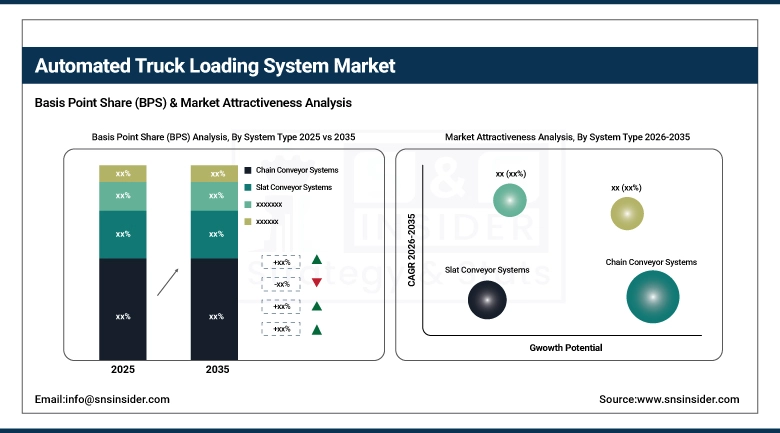
By System Type, Chain Conveyor Systems dominated the Automated Truck Loading System Market with 31.55% share in 2025; Belt Conveyor Systems fastest growing CAGR.
-
By Automation Level, Semi-Automated Systems dominated the Automated Truck Loading System Market with 58.15% share in 2025; Fully Automated Systems fastest growing CAGR.
-
By Operation Type, Loading Systems dominated the Automated Truck Loading System Market with 46.69% share in 2025; Combined Loading & Unloading Systems also projected as fastest growing CAGR.
-
By End-Use Industry, Logistics & Warehousing dominated the Automated Truck Loading System Market with 34.52% share in 2025; E-Commerce & Retail fastest growing CAGR.
-
By Technology, Hydraulic Systems dominated the Automated Truck Loading System Market with 33.51% share in 2025; IoT & AI-Integrated Systems fastest growing at CAGR.
By System Type, Chain Conveyor Systems segment dominates the Automated Truck Loading System Market, Belt Conveyor Systems expected to grow fastest
In 2025, the Chain Conveyor Systems segment maintained its dominant position in the Automated Truck Loading System Market, accounting for 31.55% of total revenue. Such leadership is mainly attributed to its extensive use in high-throughput logistics facilities, robust reliability when it comes to handling palletized cargo, and growing use in large-scale distribution centers that require heavy-duty freight movements.
From 2026 to 2035, the Belt Conveyor Systems segment is projected to record the highest CAGR. The rapid growth can be attributed to an increase in demand for flexible and efficient cargo handling solutions, increased deployment in e-commerce fulfillment centers, and preference for automated systems that are able to reduce product damage and loading efficiency.
By Automation Level, Semi-Automated Systems segment dominates the Automated Truck Loading System Market, Fully Automated Systems expected to grow fastest
The Semi-Automated Systems segment held the largest share of 58.15% in 2025, owing to its cost-effectiveness, simpler implementation into current warehouse facilities, and increased acceptance by medium-sized logistics companies shifting towards automation. Organizations still prefer semi-automation because it not only helps boost efficiency but also allows for less capital expenditure and smoother staff incorporation.
The Fully Automated Systems segment is expected to register the highest CAGR during the 2026–2035 forecast period. Growth is fueled by growing labor shortages, demand for touchless logistics facilities, and increased investments in AI-powered automated warehousing solutions that can handle large volumes of cargo around the clock.
By Operation Type, Loading Systems segment dominates the Automated Truck Loading System Market, Combined Loading & Unloading Systems expected to grow fastest
The Loading Systems segment accounted for the largest market share of 46.69% in 2025, Driven by increased use at big warehouses, freight yards, and manufacturing facilities, which emphasize greater efficiency in outbound logistics and shorter loading times for trucks, the market growth has been reinforced by the increasing requirement for efficient dock activities and labor efficiencies.
The Combined Loading & Unloading Systems segment is projected to witness the fastest CAGR from 2026 to 2035. The growth will be driven by higher levels of implementation of multi-functional material handling systems, increased spending on intelligent fulfillment facilities, and greater emphasis on improving dock efficiency, freight coordination, and full-fledged automation at warehouses.
By End-Use Industry, Logistics & Warehousing segment dominates the Automated Truck Loading System Market, E-Commerce & Retail segment expected to grow fastest
In 2025, the Logistics & Warehousing segment maintained its dominant position in the Automated Truck Loading System Market, accounting for 34.52% of total revenue. The dominance is further bolstered by the fast growth in distribution center capacity, the adoption of warehouse automation systems, and the need for quicker transport of freight within extensive logistics systems. There is increased investment in automated truck-loading systems that allow for improved throughput at the docks, lower dependence on manual labor, and enhanced handling of materials in high-capacity environments.
From 2026 to 2035, the E-Commerce & Retail segment is projected to record the highest CAGR
By Technology, Hydraulic Systems segment dominates the Automated Truck Loading System Market, IoT & AI-Integrated Systems segment expected to grow fastest
The Hydraulic Systems segment maintained the highest share of 33.51% in 2025. Such dominance arises because of robust reliability in operation, efficient capacity to cope with loads, and extensive use in heavy industrial logistics settings where there is a need for reliable freight loading. Hydraulics-based systems find extensive use in industrial facilities because of their durability, minimal maintenance, and capacity to handle bulk loading and unloading.
The IoT & AI-Integrated Systems segment is projected to achieve the highest growth rate of during 2026–2035.
Automated truck loading system Market Regional Analysis
|
Region |
Major Country |
Share within Region (%) |
|---|---|---|
|
North America |
United States |
34.72% |
|
Europe |
Germany |
27.07% |
|
Asia Pacific |
China |
24.89% |
|
Middle East & Africa |
UAE |
6.99% |
|
Latin America |
Brazil |
6.33% |
North America Automated Truck Loading System Market Insights
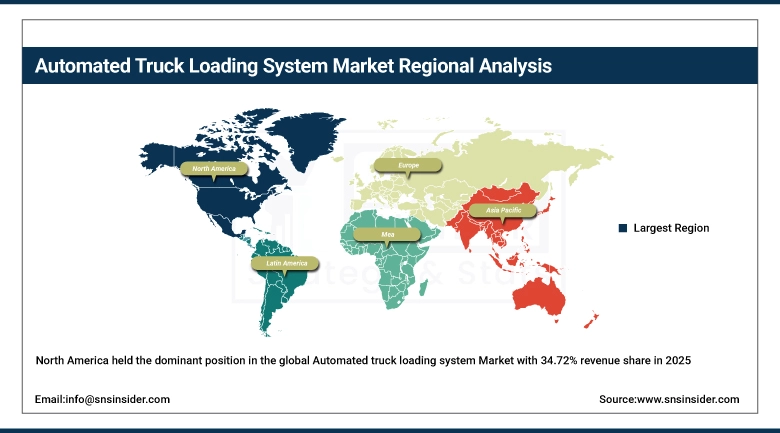
North America held the dominant position in the global Automated truck loading system Market with 34.72% revenue share in 2025, Backed by significant investments in intelligent logistics infrastructure, deep penetration of online retail platforms, and usage of Industry 4.0 innovations, the region reaps advantages of having key intralogistics vendors, advanced warehousing facilities, and extensive freight transport systems in both the United States and Canada. The region is led by the United States due to growth in the installation of automated docks, growing labor shortages, and increasing need for fast freight handling services in retail, manufacturing, and logistics companies.
Supporting this dominance, logistics operators across the U.S. and Canada are increasingly prioritizing warehouse modernization initiatives, accelerating adoption of robotic loading systems, AI-enabled dock management platforms, and intelligent conveyor automation technologies.
Additionally, recent developments such as Dematic expanding AI-integrated trailer loading systems for e-commerce fulfillment centers and Daifuku strengthening smart conveyor automation capabilities for high-volume warehouse operations are reinforcing innovation across North American logistics infrastructure.
Get Customized Report as per Your Business Requirement - Enquiry Now
Asia Pacific Automated Truck Loading System Market Insights
The Asia-Pacific is anticipated to witness the highest CAGR of 11.60% during the forecast period of 2026-2035, owing to high industrialization, development of warehousing facilities on a large scale, and investments in logistics automation technologies. China, India, Japan, South Korea, and the Southeast Asian countries are expected to act as important centers of growth, owing to growing freight transport, e-commerce, and intelligent industrial parks.
Supporting this growth, rising foreign direct investments, rapid urbanization, and strong expansion of third-party logistics operations are significantly accelerating deployment of automated truck loading solutions across manufacturing and distribution facilities in the region.
In addition, increasing adoption of AI-enabled warehouse management systems, growth of automated fulfillment centers, and expansion of regional logistics corridors are strengthening Asia Pacific’s position as the fastest-growing market globally.
Europe Automated Truck Loading System Market Insights
The continent of Europe had a significant contribution to the international Automated Truck Loading System market during the year 2025 because of its strong industrial automation industry, advanced warehouse infrastructure, and sustainability measures taken towards green and energy efficient logistics management. Nations like Germany, UK, France, Netherlands, and Italy have been leading in the deployment of such automated loading systems in response to higher labor costs, occupational safety regulations, and advanced manufacturing and intralogistics initiatives.
Supporting this position, European logistics operators are increasingly integrating intelligent dock automation, robotic freight handling systems, and energy-efficient conveyor technologies into distribution and manufacturing environments to improve operational productivity and reduce carbon emissions.
Additionally, increasing deployment of smart warehouses, expansion of cross-border e-commerce logistics networks, and innovation in autonomous material handling technologies are reinforcing Europe’s role as a key innovation-driven market for automated truck loading systems.
Latin America, Middle East & Africa (LAMEA) Automated Truck Loading System Market Insights
There is significant growth in the Automated Truck Loading System market in the LAMEA region, driven by increased investments in logistics infrastructure, growth in industrial warehouse space, and advancements in freight transportation operations. The countries such as Brazil, Mexico, UAE, Saudi Arabia, and South Africa are making considerable contributions towards the growth of demand for the product in the region.
Governments across the Middle East, particularly in the UAE and Saudi Arabia, are actively investing in smart logistics corridors, industrial megaprojects, and automated port infrastructure, accelerating demand for intelligent truck loading and dock automation systems.
In addition, increasing partnerships between global warehouse automation providers and regional logistics operators are improving technology accessibility, strengthening distribution networks, and expanding adoption of automated freight handling solutions across emerging markets.
Automated truck loading system Market Growth Drivers:
-
Rising expansion of e-commerce fulfillment networks, warehouse automation infrastructure, and smart logistics operations is driving strong demand for automated truck loading systems across global supply chain environments.
The major structural factor impacting the market of Automated Truck Loading System is the fast-paced development of logistics and freight handling processes towards high speed, labor-saving, and networked warehouse facilities. Due to increasing emphasis on shorter truck loading time, minimized manual labor, and constant flow of goods, the need for automated loading systems, robotic docks, and smart material handling solutions is growing steadily.
Additionally, strategic innovation initiatives by leading companies such as Daifuku Co. Ltd., Dematic (KION Group), and Vanderlande Industries are accelerating development of AI-enabled loading automation systems, predictive maintenance platforms, and IoT-connected dock management technologies.
Recent advancements in robotic freight handling, autonomous conveyor synchronization, and real-time cargo positioning systems are reinforcing modernization across next-generation warehouse and logistics environments.
Automated truck loading system Market Restraints:
-
High initial installation costs, infrastructure modification requirements, and complex system integration challenges are limiting adoption of automated truck loading systems across cost-sensitive logistics and industrial facilities.
The primary limitation in the market for Automated Truck Loading System is linked to the heavy expenditure involved in deploying such systems, which include conveyor systems, automated loading systems, dock automation systems, and integration with warehousing software. Small to mid-level logistics providers often find it difficult to embrace the latest automated loading techniques owing to the exorbitant expenses, long implementation periods, and redesign of facilities involved in the process.
Automated truck loading system Market Opportunities:
-
Expansion of smart logistics hubs, autonomous warehousing ecosystems, and high-throughput distribution infrastructure is creating strong opportunities for intelligent automated truck loading solutions across global supply chain networks.
Key opportunities in the Automated Truck Loading System Market include the conversion of traditional freight logistics hubs to digital, automated logistics environments where loading activities have become an integral part of comprehensive warehouse automation processes rather than independent material handling processes. The need for effective coordination of freight transportation and automated dock handling activities, as well as continuous monitoring of cargo flows, has driven the adoption of AI-enabled loading systems, robotic material handling solutions, and intelligent conveyor automation systems.
Recent Developments:
-
2026: Daifuku Co. Ltd. expanded its smart intralogistics portfolio with advanced automated truck loading systems integrating AI-enabled dock coordination and high-speed conveyor automation for large-scale warehouse and fulfillment operations.
-
2026: Dematic (KION Group) strengthened its warehouse automation ecosystem by deploying intelligent trailer loading technologies and real-time freight synchronization platforms across major e-commerce distribution centers in North America and Europe.
-
2025: Vanderlande Industries enhanced its automated loading and unloading solutions with robotic material handling integration and predictive maintenance capabilities designed for high-throughput parcel and freight logistics operations.
-
2025: BEUMER Group expanded its intelligent conveyor and truck loading technologies portfolio with energy-efficient automation systems aimed at improving dock throughput, cargo handling precision, and operational reliability across industrial logistics facilities globally.
Automated truck loading system Market Key Players
Some of the Automated truck loading system Market Companies
-
Daifuku Co. Ltd.
-
Dematic (KION Group)
-
Vanderlande Industries
-
Honeywell Intelligrated
-
BEUMER Group
-
Siemens Logistics
-
Fives Group
-
Murata Machinery Ltd.
-
JBT Corporation
-
Ancra Systems B.V.
-
Actiw Oy
-
Joloda International Ltd.
-
HAVER & BOECKER OHG
-
VDL Systems B.V.
-
Cargo Floor B.V.
-
Maschinenfabrik Möllers GmbH
-
GEBHARDT Fördertechnik GmbH
-
Secon Components S.L.
-
C&D Skilled Robotics Inc.
-
Duro Felguera S.A.
Automated truck loading system Market Report Scope:
| Report Attributes | Details |
|---|---|
| Market Size in 2025 | USD 3.84 Billion |
| Market Size by 2035 | USD 10.55 Billion |
| CAGR | CAGR of 10.87% From 2026 to 2035 |
| Base Year | 2025 |
| Forecast Period | 2026-2035 |
| Historical Data | 2022-2024 |
| Report Scope & Coverage | Market Size, Segments Analysis, Competitive Landscape, Regional Analysis, DROC & SWOT Analysis, Forecast Outlook |
| Key Segments | • By System Type (Chain Conveyor Systems, Slat Conveyor Systems, Belt Conveyor Systems, Skate Conveyor Systems, Others) • By Automation Level (Semi-Automated Systems, Fully Automated Systems, Others) • By Operation Type (Loading Systems, Unloading Systems, Combined Loading & Unloading Systems) • By End-Use Industry (Logistics & Warehousing, E-Commerce & Retail, Food & Beverage, Automotive, Pharmaceuticals, Others) • By Technology (Hydraulic Systems, Pneumatic Systems, Robotic Loading Systems, IoT & AI-Integrated Systems, Sensor-Based Systems) |
| Regional Analysis/Coverage | North America (US, Canada), Europe (Germany, UK, France, Italy, Spain, Russia, Poland, Rest of Europe), Asia Pacific (China, India, Japan, South Korea, Australia, ASEAN Countries, Rest of Asia Pacific), Middle East & Africa (UAE, Saudi Arabia, Qatar, South Africa, Rest of Middle East & Africa), Latin America (Brazil, Argentina, Mexico, Colombia, Rest of Latin America). |
| Company Profiles | Daifuku Co. Ltd., Dematic (KION Group), Vanderlande Industries, Honeywell Intelligrated, BEUMER Group, Siemens Logistics, Fives Group, Murata Machinery Ltd., JBT Corporation, Ancra Systems B.V., Actiw Oy, Joloda International Ltd., HAVER & BOECKER OHG, VDL Systems B.V., Cargo Floor B.V., Maschinenfabrik Möllers GmbH, GEBHARDT Fördertechnik GmbH, Secon Components S.L., C&D Skilled Robotics Inc., Duro Felguera S.A. |

Frequently Asked Questions
North America dominated the Automated truck loading system Market in 2025.
The Chain Conveyor Systems segment dominated the Automated truck loading system Market in 2025.
Rapid expansion of e-commerce fulfillment networks, warehouse automation infrastructure, and smart logistics operations is the primary growth driver of the Automated Truck Loading System Market.
The Automated truck loading system Market was valued at USD 3.84 billion in 2025.
The Automated truck loading system Market is expected to grow at a CAGR of 10.87% from 2026 to 2035.
