
Automotive Ethernet Market Report Scope & Overview:
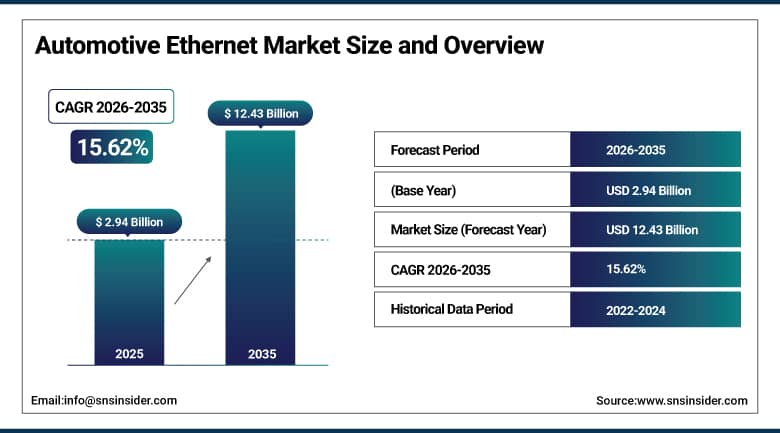
The automotive ethernet market was valued at USD 2.94 billion in 2025 and is expected to reach USD 12.43 billion by 2035, growing at a CAGR of 15.62% from 2026–2035.
The automotive ethernet market is experiencing continued global growth owing to the increasing demand for ADAS, autonomous driving features, and connectivity within infotainment systems. Electrification of vehicles, shift toward zonal and gateway architecture design, and demand for low latency communication between sensors, ECUs, and control units are some of the factors driving the market growth. Growth of initiatives within smart mobility, connectivity within vehicles, stringent requirements by governments with regard to vehicle safety and emissions, and demand for reliable networks are some other factors aiding market growth.
Spirent Communications PLC has recently developed its offering within Automotive Ethernet segment through developing high speed validation platforms for 400G, 800G and 1.6T Ethernet platforms as well as improved test solutions for Base T1 Ethernet from 10M to 10G that include TSN/AVB conformance testing allowing OEMs to verify ADAS, infotainment and Autonomous Driving applications. On the other hand, HMS Networks AB has been concentrating more on innovation and development within single pair Ethernet 10BASE T1S segment, developing new Ixxat solutions aimed at simplifying cabling and PoDL technology implementation, along with expansion of CAN FD/Ethernet gateways aimed at connecting legacy CAN buses with zonal Ethernet networks.
To Get More Information On Automotive Ethernet Market - Request Free Sample Report
Automotive Ethernet Market Trends
-
OEMs are shifting from decentralized ECUs towards centralized gateways, simplifying wiring and allowing the scaling of automotive networks. This shift is increasing the adoption of multi-gigabit Ethernet.
-
LiDAR, Radar, and camera sensor fusion needs ultra-low latency and high bandwidth communication. Automotive Ethernet will serve as a key enabler for communications within autonomous vehicles.
-
The need for HD content, streaming media, and in-car connectivity for passengers will promote adoption of Ethernet in infotainment systems. This development drives adoption of Ethernet at 1 Gbps and beyond.
-
EV battery management systems, powertrains, and charging stations use Ethernet for communications. The growth in number of EVs is driving adoption of Ethernet.
-
10BASE T1S and SPE protocols provide reduced wiring weight and cost while providing multi-drop capabilities. This technology breakthrough is key to an efficient zonal architecture.
The US Automotive Ethernet Market Size Outlook
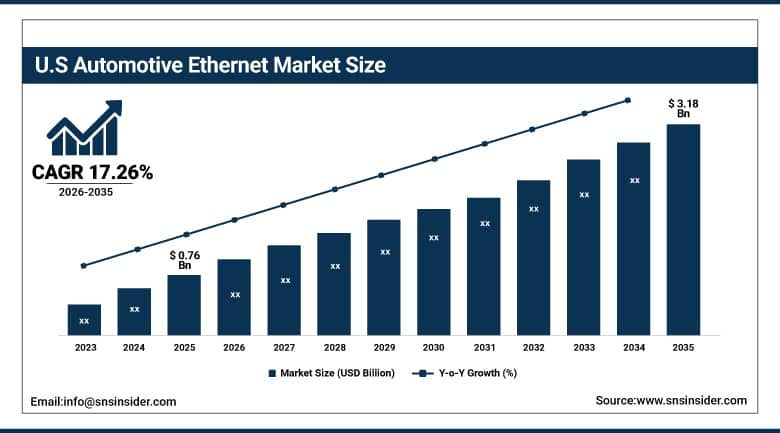
The U.S. automotive ethernet market was valued at USD 0.76 billion in 2025 and is expected to reach around USD 3.18 billion by 2035, growing at a CAGR of 17.26% from 2026–2035.
The US automotive ethernet market is regarded to be one of the most sophisticated markets in the world due to the dominance of key players from OEMs and Tier 1 suppliers, advanced research & development activities pertaining to autonomous driving systems, and high deployment of connected vehicles technologies in the market. Driving growth in the market is attributed to significant investments made by players in smart mobility initiatives, EV charging stations, and transition to zonal architecture that helps in minimizing wiring and creating scalable in-vehicle networks.
The U.S. automotive ethernet market is propelled by government policies that include the Infrastructure Investment and Jobs Act, which favors the development of smart mobility, adoption of electric vehicles, and connectivity technologies. Such policies, together with safety-related policies and incentives for the electrification of vehicles, have been leading to the growth of investments in ADAS solutions, autonomous driving technologies, and zonal architecture.
Automotive Ethernet Market Segment Analysis
-
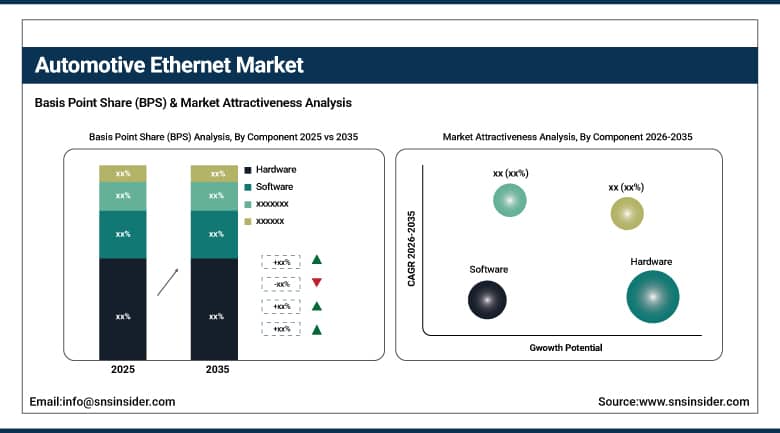
By Component, hardware dominated the automotive ethernet market with 55.10% share in 2025; software fastest growing CAGR.
-
By Bandwidth, 1 gbps dominated the automotive ethernet market with 35.38% share in 2025; 2.5 / 5 / 10 gbps membranes fastest growing CAGR.
-
By Vehicle Type, passenger cars dominated the automotive ethernet market with 54.55% share in 2025; electric vehicles fastest growing CAGR.
-
By Application, ADAS dominated the automotive ethernet market with 30.48% share in 2025; it is also fastest growing CAGR.
By Component, hardware dominated the automotive ethernet market, while software is registering the fastest-growing segment.
Hardware was the leading segment in terms of revenue share in the global automotive ethernet market for 2025, attributed to increasing adoption of ethernet switches, controllers, gateways, connectors, and transceivers in today’s connected cars. The increased use of ADAS, infotainment systems, digital cockpits, and zonal vehicle architecture solutions increased demand for advanced in-vehicle networked hardware.
Software was anticipated to be the fastest-growing segment in the global automotive ethernet market during the forecast period due to growing significance of network management, cyber security, over the air (OTA) updates, protocol optimization, and software defined vehicle architecture systems. Increased adoption of intelligent communication stacks and Ethernet-based vehicle operating systems was fueling demand for software solutions.
By Bandwidth, 1 Gbps dominated the automotive ethernet market, while 2.5 / 5 / 10 Gbps is expected to witness the fastest segment.
The 1 Gbps segment captured the largest share in the automotive ethernet market during 2025 because of its extensive implementation in ADAS technology, infotainment systems, 360-degree surround camera applications, and vehicle-to-vehicle communication networks. The speed range provides an ideal compromise between the need for high-speed data transfer, cost-effectiveness, and existing automobile electronics infrastructure.
The 2.5 / 5 / 10 Gbps segment is expected to register the highest CAGR over the forecast period driven by increasing requirement for ultra-high-speed data transfer needed for self-driving cars, LiDAR, high-performance sensors, computing devices, and future zonal electronics architectures.
By Vehicle Type, passenger cars dominated the automotive ethernet market, while electric vehicles are anticipated to record the fastest segment.
Passenger cars emerged as the largest contributor to automotive ethernet market share in 2025, thanks to the rising demands for connected car solutions, premium infotainment systems, and increased focus on offering advanced safety systems in passenger cars along with better digital experience for users within the vehicle.
Electric vehicles segment is expected to display the highest CAGR in the forecast period. This is attributable to growing adoption of EVs worldwide as well as the rising use of centralized electronic architecture in EVs. The electric vehicle companies are adopting automotive Ethernet for providing high-speed performance for their battery management systems and OTA software update services.
By Application, ADAS dominated the automotive ethernet market, it is also projected to register the fastest growing segment.
ADAS segment accounted for maximum shares in automotive ethernet market in 2025 because of increasing application of advanced safety systems such as adaptive cruise control, lane departure warnings, automatic emergency brakes, park assists, and collision avoidance systems. The Automotive Ethernet technology plays an important role in the functioning of these advanced driver assistance systems.
Moreover, the segment is likely to register a higher CAGR during the forecast period on account of rapid growth in autonomous driving technologies and AI-driven sensor-based systems in vehicles. The increasing demand for real-time data transmission and centralized computing in vehicles will help to increase the adoption of Automotive Ethernet in the ADAS segment.
Regional Analysis:
|
Region |
Major Country |
Share within Region, 2025(%) |
|---|---|---|
|
North America |
United States |
83.11% |
|
Europe |
Germany |
28.81% |
|
Asia Pacific |
China |
47.62% |
|
Middle East & Africa |
UAE |
23.55% |
|
Latin America |
Brazil |
38.10% |
North America Automotive Ethernet Market Insights
The North America’s automotive ethernet market is experiencing significant growth because of the increasing use of connected cars, ADAS, and autonomous vehicles in the USA and Canada. The growing investment in software-defined cars, electric vehicles (EVs), and in-vehicle high-speed network infrastructure by large-scale automobile manufacturers is driving market growth. The rising need for cutting-edge infotainment services and over-the-air (OTA) software updates within vehicles is propelling the usage of Ethernet in vehicles. Moreover, stringent vehicle safety laws, quick adoption of AI-powered mobility solutions, and robust innovation ecosystems for semiconductors and automobiles are some other factors boosting the market in the region.
TE Connectivity has introduced a new “Inside Device Connectivity” product range in 2025 for automotive ECUs and SDVs. The company offers highly advanced solutions for the development of board-to-board and wire-to-board connectors for ADAS, LiDAR, batteries, and zonal cars.
Europe Automotive Ethernet Market Insights
European automotive ethernet market is seeing rapid growth owing to the rising adoption of electric cars, autonomy, and other mobility solutions in various countries such as Germany, France, and United Kingdom. The significant presence of premium automotive companies, coupled with rising investment in software-defined architectures, is propelling the demand for advanced and high-speed communication in vehicles. Furthermore, the stringent safety requirements for vehicles, as well as the rising number of sustainable mobility initiatives, is fueling the need for ADAS and intelligent transportation solutions. The increasing application of artificial intelligence-based infotainment, real-time diagnostics, and software update capabilities is also contributing significantly toward Automotive Ethernet adoption.
In 2025, Continental AG widened its range of automotive networking solutions by offering new high-speed Ethernet communication solutions for software-defined vehicles and autonomy.
Asia Pacific Automotive Ethernet Market Insights
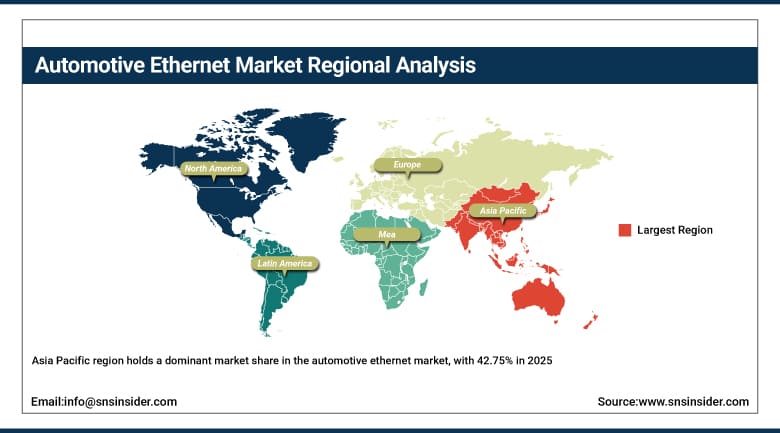
Asia Pacific region holds a dominant market share in the automotive ethernet market, with 42.75% in 2025, and it is also the fastest-growing region with 16.21% CAGR, owing to the growing vehicle manufacturing industry, increased penetration of electric vehicles, and increasing adoption of connectivity solutions in China, Japan, South Korea, and India. Increasing investment in autonomous driving, smart mobility, and advanced driver assistance systems is rapidly driving the demand for automotive Ethernet. The presence of automotive manufacturers, semiconductor companies, and electronic components suppliers is also propelling the market growth in the region. Government incentives for electric vehicles and increased customer preferences for sophisticated infotainment and safety systems are further boosting the adoption of Automotive Ethernet.
Samsung Electronics expanded its automotive semiconductor and connectivity business in 2025 by offering high-performance automotive networking solutions for connected cars and self-driving vehicles. The company concentrated on high-end processors and fast communication technologies for ADAS and infotainment systems.
Get Customized Report as Per Your Business Requirement - Enquiry Now
Middle East & Africa and Latin America Automotive Ethernet Market Insights
In the Middle East & Africa region, the automotive ethernet market will be propelled by fast-paced investments into the construction of smart mobility solutions, connected transport, as well as electric and autonomous vehicles. Smart cities projects, advanced digital infrastructure, and new automotive safety regulations will be adopted in the UAE, Saudi Arabia, and South Africa, resulting in the increased deployment of Ethernet technology in automotive applications. In Latin America, rising investments in EV manufacturing hubs in Brazil and Mexico, coupled with government incentives for connected vehicle technologies and smart transport infrastructure, are creating new opportunities for Automotive Ethernet adoption across passenger and commercial fleets.
NXP Semiconductors announcement in 2025 about expanding its Automotive Ethernet PHY product line featuring the integration of TSN and MACsec security will contribute towards further deployment of Ethernet technologies in connected EVs.
Market Dynamics:
The Growth Drivers: Rising adoption of advanced driver assistance systems (ADAS), autonomous driving technologies, and connected infotainment platforms, all of which demand high‑bandwidth, low‑latency communication.
The increase in vehicle electrification and movement towards zone-based designs is changing vehicle networks, allowing for simpler wiring systems while improving scalability and reliability. The demand for Ethernet in automotive applications by Original Equipment Manufacturers and Tier 1 vendors will enhance the efficiency of their vehicles by improving safety, performance, and connectivity. Additionally, increased regulations concerning vehicle emissions, cybersecurity, and the development of connected vehicles by governments will speed up the use of Ethernet in vehicle applications. All this is driving the Ethernet Automotive Market.
Restraints: Stem from the continued availability and reliance on low‑cost conventional in‑vehicle networking technologies such as CAN, LIN, and FlexRay, which remain widely used due to their affordability and established ecosystem.
Most of the OEMs and Tier 1 suppliers in developing countries opt for this kind of network system due to reduced costs and easy integration, thus delaying the shift from standard to advanced Ethernet technology. Other factors that might hinder adoption include lack of knowledge about the advantages of Ethernet in the long term, fears of interoperability, and security threats that might arise during installation and use. Poor installation and adherence to standards can also affect the efficiency of Ethernet.
Opportunities: Rising adoption of multi‑gigabit Ethernet standards, single‑pair Ethernet (SPE), and zonal architectures that reduce wiring complexity and enhance scalability.
Technological innovations in the Ethernet segment such as the Time Sensitive Network (TSN) technology along with the security protocols like MACsec are offering huge scope for growth by supporting deterministic communication in critical systems along with enhanced security features. The integration of Ethernet in ADAS systems, infotainment systems and electric vehicle power train applications is becoming more popular among OEMs and Tier 1 suppliers due to its advantages in terms of increased bandwidth and enhanced security. Moreover, smart mobility ecosystem and EV infrastructure developments in emerging economies are also providing new opportunities.
Recent Developments
-
2026: Broadcom Inc. enhanced its Automotive Ethernet product line by adding AI-powered networking and leading-edge Ethernet physical layer devices and switches for fast data transfer in zonal and software-defined vehicles, solidifying its position in connected and autonomous transport.
-
2025: Marvell Technology Group Ltd. sold its Brightlane® Automotive Ethernet business to Infineon Technologies in an all-cash acquisition worth $2.5 billion, letting Infineon innovate in software-defined vehicle solutions, while Marvell concentrated on data infrastructure optimized for AI applications.
-
2026: Microchip Technology Inc. introduced its LAN878x and LAN888x Single Pair Ethernet Physical Layer products with MACsec security, Time Sensitive Networking (TSN), and functional safety according to ISO 26262 standard, offering secure and deterministic Ethernet connectivity for ADAS, electric vehicle drivetrains, and zonal gateways.
Automotive Ethernet Market Key Players are:
-
Broadcom Inc.
-
Marvell Technology Group Ltd.
-
NXP Semiconductors N.V.
-
Microchip Technology Inc.
-
Texas Instruments Inc.
-
Infineon Technologies AG
-
Continental AG
-
Aptiv PLC
-
Molex Incorporated
-
TE Connectivity Ltd.
-
Cadence Design Systems Inc.
-
Keysight Technologies Inc.
-
TTTech Auto AG
-
Analog Devices Inc.
-
Renesas Electronics Corp.
-
Realtek Semiconductor Corp.
-
Rohde & Schwarz GmbH
-
Vector Informatik GmbH
-
Spirent Communications PLC
-
HMS Networks AB
Automotive Ethernet Market Report Scope:
| Report Attributes | Details |
|---|---|
| Market Size in 2025 | USD 2.94 Billion |
| Market Size by 2035 | USD 12.43 Billion |
| CAGR | CAGR of 15.62% From 2026 to 2035 |
| Base Year | 2025 |
| Forecast Period | 2026-2035 |
| Historical Data | 2022-2024 |
| Report Scope & Coverage | Market Size, Segments Analysis, Competitive Landscape, Regional Analysis, DROC & SWOT Analysis, Forecast Outlook |
| Key Segments | • By Component (Hardware, Software, Services), • By Bandwidth (10 Mbps, 100 Mbps, 1 Gbps, 2.5 / 5 / 10 Gbps, Others), • By Vehicle Type (Passenger Cars, Commercial Vehicles, Electric Vehicles, Others), • By Application (ADAS, Infotainment Systems, Powertrain Control, Body & Comfort Systems, Gateway / Zonal Architecture, Others) |
| Regional Analysis/Coverage | North America (US, Canada), Europe (Germany, UK, France, Italy, Spain, Russia, Poland, Rest of Europe), Asia Pacific (China, India, Japan, South Korea, Australia, ASEAN Countries, Rest of Asia Pacific), Middle East & Africa (UAE, Saudi Arabia, Qatar, South Africa, Rest of Middle East & Africa), Latin America (Brazil, Argentina, Mexico, Colombia, Rest of Latin America). |
| Company Profiles | Broadcom Inc., Marvell Technology Group Ltd., NXP Semiconductors N.V., Microchip Technology Inc., Texas Instruments Inc., Infineon Technologies AG, Continental AG, Aptiv PLC, Molex Incorporated, TE Connectivity Ltd., Cadence Design Systems Inc., Keysight Technologies Inc., TTTech Auto AG, Analog Devices Inc., Renesas Electronics Corp., Realtek Semiconductor Corp., Rohde & Schwarz GmbH, Vector Informatik GmbH, Spirent Communications PLC, HMS Networks AB. |

Frequently Asked Questions
The Automotive Ethernet market is expected to grow at a CAGR of 15.62% from 2026 to 2035.
The Automotive Ethernet market was valued at USD 2.94 billion in 2025.
Rising demand for advanced driver assistance systems (ADAS), autonomous driving technologies, and connected infotainment platforms is the primary growth driver of the Automotive Ethernet market.
The hardware segment dominated the Automotive Ethernet market in 2025.
Asia Pacific dominated the Automotive Ethernet market in 2025.
