
Autonomous Fighter Jet Market Report Scope & Overview:
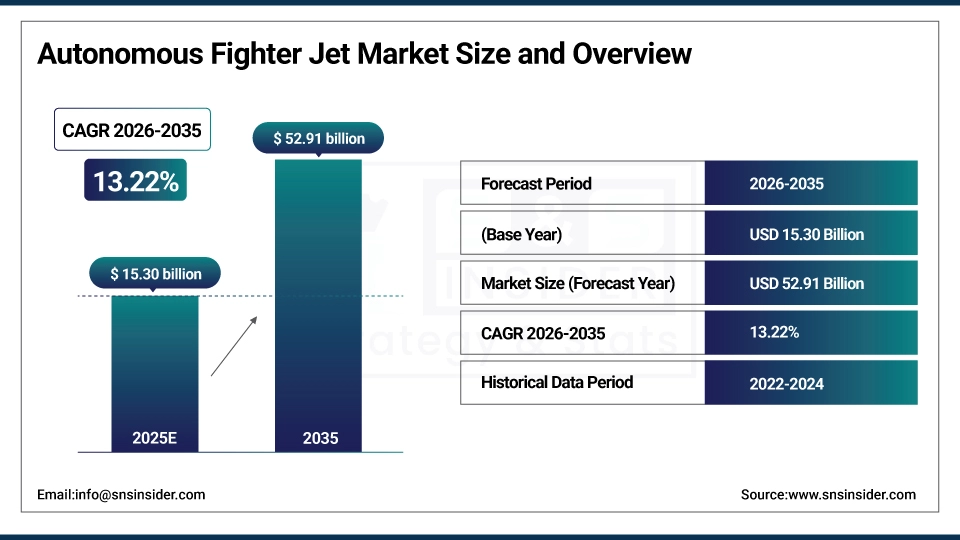
The Autonomous Fighter Jet Market was valued at USD 15.30 Billion in 2025 and is expected to reach USD 52.91 Billion by 2035, growing at a CAGR 13.22% of from 2026-2035.
The Autonomous Fighter Jet Market is experiencing considerable growth due to the developments in AI, machine learning and autonomous flight technology. These are increasing mission effectiveness while lowering the probabilities pilots of being taking out in combat. Rising defense modernization programs, increasing military budgets, and the need for strategic force multiplication are fueling adoption. Inclusion with the network centric warfare, loyal wingman system and intelligent autonomous decision-making further cements it as a strategic focus area for future air warfare innovation and defense modernization.
To Get more information on Autonomous Fighter Jet Market - Request Free Sample Report
Key Trends in the Autonomous Fighter Jet Market
-
Loyal wingman programs are expanding, with autonomous drones supporting manned fighters in coordinated missions.
-
AI-driven systems enable real-time threat assessment, target prioritization, and autonomous combat maneuvers.
-
Swarming and networked operations allow multiple autonomous aircraft to execute multi-role missions efficiently.
-
Hybrid manned-autonomous platforms combine human oversight with autonomous capabilities for safer operations.
-
Advanced sensor fusion integrates radar, LIDAR, infrared, and electronic warfare for enhanced situational awareness.
U.S. Autonomous Fighter Jet Market Insights:
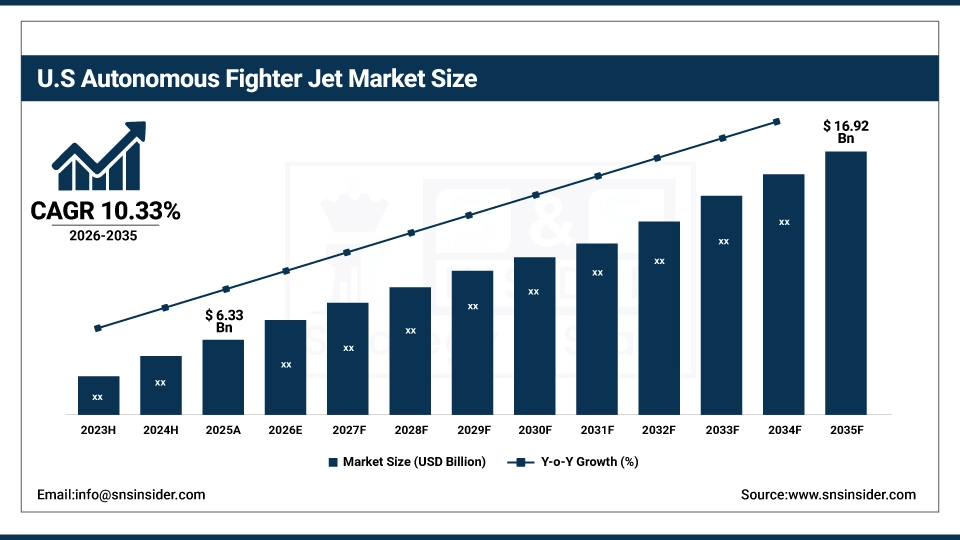
The U.S. Autonomous Fighter Jet Market is projected to grow from USD 6.33 Billion in 2025 to USD 16.92 Billion by 2035, at a CAGR of 10.33%. Growth is influenced because of the growing defense modernization programs, increasing military budgets and adoption of AI-enabled autonomous systems and development of loyal wingman drones and need for better combat effectiveness with lesser pilot risk.
Autonomous Fighter Jet Market Growth Drivers:
-
Rising Defense Modernization and Adoption of Autonomous Systems
Market growth is helped by rise in military budgets and defense modernization programs as well as strategic requirement for force multipliers. AI systems, loyal-wingman drones and other autonomous combat technologies streamline operations, decrease risk to pilots and allow for the performance of missions too dangerous for humans. Increasing spending on R&D, evolution of sophisticated sensor fusion and the focus on network-centric warfare are accelerating adoption by air forces across the world.
Autonomous Fighter Jet Market Restraints:
-
High Development Costs, Technical Complexity, and Regulatory Challenges
Market growth is limited due to high developmental cost of autonomous fighters, advanced AI systems and the UCAV platforms. Technical difficulties include stable autonomy, swarm organization and secure communication. Moreover, rigid defense requirements, extended test periods and complicated government procurement procedures can slow the introduction to market and commercialization of such technologies, thereby hampering fast global adoption.
Autonomous Fighter Jet Market Opportunities:
-
Advancements in AI, Sensor Fusion, and Unmanned Combat Technologies
Artificial intelligence-based decision-making, swarming operations, loyal wingman programs and enhanced sensor integration are opportunities. Growing partnerships between defense manufacturers, governments, and research establishments, as well as investment in home-grown autonomous fighter projects provide new areas for innovation. The introduction of new technologies such as networked combat systems, autonomous navigation and hybrid manned-unmanned platforms is anticipated to broaden AEW&C operational capabilities and yield substantial business opportunities in contemporary aerial warfare.
Autonomous Fighter Jet Market Segment Analysis:
-
By Platform Type: In 2025, Unmanned Combat Air Vehicles dominated with 50% share; Loyal Wingman Drones fastest growing segment during 2026-2035
-
By Technology: In 2025, AI & Machine Learning Systems dominated with 45% share; Autonomous Navigation & Flight Control fastest growing segment during 2026-2035
-
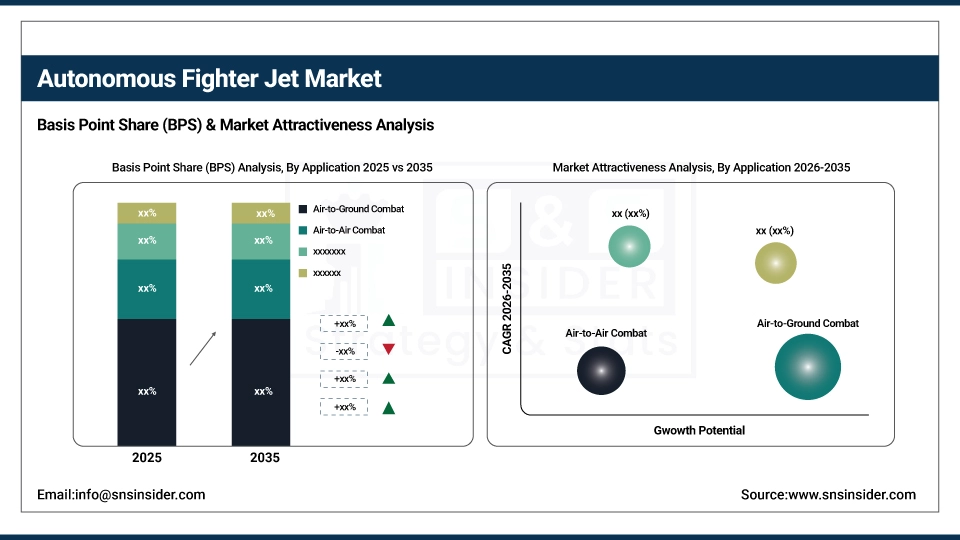
By Application: In 2025, Air-to-Ground Combat dominated with 48% share; Surveillance & Reconnaissance fastest growing segment during 2026-2035
-
By End User: In 2025, Air Forces dominated with 70% share; Defense Contractors fastest growing segment during 2026-2035
By Application: Air-to-Ground Combat Dominates, Surveillance & Reconnaissance Fastest-Growing
Air-to-Ground Combat dominates the application segment because precision strike capabilities, strategic target elimination, and integration with AI-guided weapons make it the primary mission profile for autonomous fighters and UCAVs. The tactical capabilities of the aircraft make it a key asset for air forces around the world, providing strong compelling factors for continual purchase and deployment.
The Surveillance & Reconnaissance segment is growing at the quickest pace as demand for intelligence, and battlefield monitoring aerial platforms combined with advance threat detection services drive the growth in this segment. The use of UCAVs and facial wingman drones fitted with sophisticated sensors, and communication equipment is spurring the uptake, especially in contested or high-threat regions.
By Platform Type: Unmanned Combat Air Vehicles Dominate, Loyal Wingman Drones Fastest-Growing
Unmanned Combat Air Vehicles (UCAVs) dominate the platform segment due to their extensive deployment in precision strike missions, long endurance, and proven integration with existing air force operations. UCAVs reduce pilot risk, enable high-value target engagement, and support multiple combat roles, making them the most relevant platform globally.Their capability to support various weapon systems, sensors, and AI-based systems will drive continued utilization in current aerial battlefield.
Loyal Wingman Drones are the fastest growing platform type because of increasing adoption of swarming drones and AI-based coordination with manned fighter aircraft. These drones work as force multipliers during combat situations and ensure flexible mission completion, fueling the demand for R&D and defense procurement programs.
By Technology: AI & Machine Learning Systems Dominate, Autonomous Navigation & Flight Control Fastest-Growing
AI & Machine Learning Systems hold the greatest share as they deliver essential autonomous decision making, threat perception and target prioritisation in real time. These features improve operational efficiency and survivability, and are increasingly found across both UCAVs and hybrid fighters, they have consequently become central to the makeup of modern autonomous combat aircraft.
Autonomous Navigation & Flight Control is the largest technology area, driven by high demand for use in both hybrid and fully unmanned systems. The market is in turn experiencing growth as increasingly efficient path planning, collision avoidance and real-time flight modification support safer operations, greater mission success and more sophisticated autonomous actions.
By End User: Air Forces Dominate, Defense Contractors Fastest-Growing
Air Forces is estimated to lead the market among end-users and operate most of the autonomous fighters, UCAVs, and hybrid platforms across the world. Their extensive modernization plans, investments in AI-equipped systems, and widespread use across mission profiles make them the dominant market participant.
Defense Contractors are the fastest-growing end-user segment, driven by rising involvement in R&D, autonomous fighter testing, and loyal wingman program development. Growing cooperation with governments and air forces, combined with developments in AI, sensors and autonomous avionics, is driving rapid expansion
Regional Analysis
North America Autonomous Fighter Jet Market Insights:
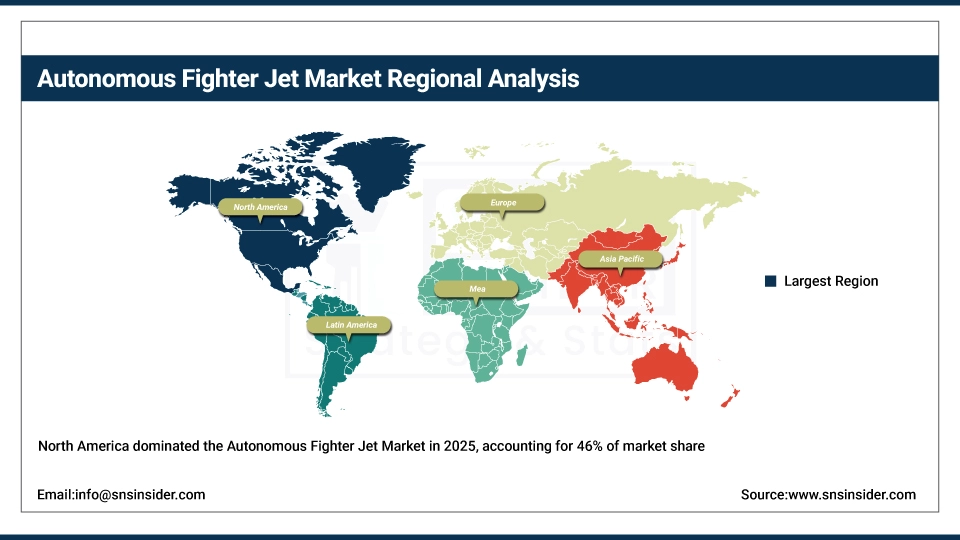
In 2025, North America dominates the autonomous fighter jet market, holding approximately 46% of the global market share. The leadership in the region is fueled by large defense budgets, government support and advanced research into AI, autonomous flight systems and unmanned combat applications. And the US are leading the charge in this with module UCAV deployment, and loyal wingman programs/generation fighters. Advanced acceptance of combat capabilities as well as a strong defense-industrial alliance bolster North America’s market leadership.
Get Customized Report as per Your Business Requirement - Enquiry Now
Europe Autonomous Fighter Jet Market Insights:
Europe is a strong market for autonomously built fighter jets, with high development of defence programs and joint military programs. The UK, France, Germany and Sweden are all actively funding research into autonomous combat systems like UCAVs and next gen fighters. The area stresses on interoperability, state-of-the-art avionics and use of artificial intelligence for decision-making in a bid to strengthen air combat capabilities. Rising cross-border defense alliances and a growing emphasis on autonomous and unmanned aerial combat systems is further solidifying Europe’s role in defining the future of air warfare.
Asia-Pacific Autonomous Fighter Jet Market Insights:
Asia-Pacific is the fastest-growing region in the autonomous fighter jet market, projected to register a CAGR of 18.04% during 2026–2035. The growth of the market is driven by various factors, such as rapid military modernization programs being carried out by various countries in recent years, and increasing use of UCAVs in military operations. The increasing involvement in AI-enabled battlefield systems such as loyal wingman, and network-central warfare programs are adding to the growth of the regional market.
Latin America Autonomous Fighter Jet Market Insights:
Latin America is an up-and-coming market for UAVs fighter, as defense modernization continues to push full power and interest grows for unmanned aircraft, and semi-autonomous flying weapon carriers. The emphasis remains on beefing up surveillance, border protection and limited use of force, rather than full-scale autonomous fighter planes. Nations, like Brazil, are also seeking to develop indigenous aerospace and unmanned combat technologies and others through partnerships and technology transfers. Budget limitations and a focus on internal security drive adoption, but increasing awareness of the benefits of autonomous combat is anticipated to underpin slow market growth over time.
Middle East & Africa Autonomous Fighter Jet Market Insights:
The Middle East & Africa region is gaining importance in the autonomous fighter jet market, driven by rising security concerns, regional conflicts, and increasing defense investments. Countries such as the UAE, Saudi Arabia, Israel, and South Africa are focusing on advanced unmanned and autonomous combat air platforms to enhance deterrence and operational readiness. Emphasis on precision strike capabilities, surveillance dominance, and reduced pilot risk is encouraging adoption. Strategic partnerships with global defense contractors and growing investments in indigenous aerospace programs are further supporting market growth.
Autonomous Fighter Jet Market Competitive Landscape:
Lockheed Martin, headquartered in Bethesda, Maryland, USA, is a leading global defense contractor and a key player in the autonomous fighter jet ecosystem. The company focuses on integrating advanced AI, autonomous flight control, sensor fusion, and network-centric warfare capabilities into next-generation combat aircraft. Through platforms such as the F-35 and its involvement in future air dominance programs, Lockheed Martin emphasizes manned–unmanned teaming, loyal wingman concepts, and scalable autonomous combat solutions to enhance mission effectiveness and reduce pilot risk in complex battle environments.
-
In March 2025: Lockheed Martin advanced its autonomous combat systems roadmap by expanding AI-enabled decision-support and manned–unmanned teaming capabilities for next-generation fighter programs.
Northrop Grumman, headquartered in Falls Church, Virginia, USA, is a major innovator in autonomous and unmanned combat air systems, with strong expertise in stealth, AI-driven autonomy, and advanced avionics. The company has played a critical role in developing autonomous flight technologies and UCAV platforms, emphasizing long-endurance, high-survivability aircraft for contested environments. Northrop Grumman’s focus on autonomous mission execution, sensor integration, and secure communications supports air superiority, intelligence, and strike operations.
-
In February 2025: Northrop Grumman strengthened its autonomous aviation portfolio by enhancing AI-based mission autonomy and collaborative combat aircraft capabilities for future air combat systems.
Autonomous Fighter Jet Market Key Players
-
Lockheed Martin
-
Northrop Grumman
-
Boeing
-
General Atomics Aeronautical Systems
-
BAE Systems
-
Dassault Aviation
-
Saab AB
-
Mitsubishi Heavy Industries
-
China Aerospace Science & Technology Corporation
-
AVIC
-
Hindustan Aeronautics Limited
-
Israel Aerospace Industries
-
Thales Group
-
Leonardo S.p.A.
-
Korea Aerospace Industries
-
Embraer Defense & Security
-
Elbit Systems
-
Textron Systems
-
QinetiQ
-
Tata Advanced Systems / DRDO
| Report Attributes | Details |
|---|---|
| Market Size in 2025 | USD 15.30 Billion |
| Market Size by 2035 | USD 52.91 Billion |
| CAGR | CAGR of 13.22% From 2026 to 2035 |
| Base Year | 2025 |
| Forecast Period | 2026-2035 |
| Historical Data | 2022-2024 |
| Report Scope & Coverage | Market Size, Segments Analysis, Competitive Landscape, Regional Analysis, DROC & SWOT Analysis, Forecast Outlook |
| Key Segments | • By Platform Type: (Manned-Autonomous Hybrid Fighters, Unmanned Combat Air Vehicles (UCAVs), Loyal Wingman Drones) • By Technology: (AI & Machine Learning Systems, Sensor Fusion Systems, Autonomous Navigation & Flight Control) • By Application: (Air-to-Air Combat, Air-to-Ground Combat, Surveillance & Reconnaissance) • By End User: (Air Forces, Defense Contractors, Government Research Agencies) |
| Regional Analysis/Coverage | North America (US, Canada), Europe (Germany, UK, France, Italy, Spain, Russia, Poland, Rest of Europe), Asia Pacific (China, India, Japan, South Korea, Australia, ASEAN Countries, Rest of Asia Pacific), Middle East & Africa (UAE, Saudi Arabia, Qatar, South Africa, Rest of Middle East & Africa), Latin America (Brazil, Argentina, Mexico, Colombia, Rest of Latin America). |
| Company Profiles | Lockheed Martin, Northrop Grumman, Boeing, General Atomics Aeronautical Systems, BAE Systems, Dassault Aviation, Saab AB, Mitsubishi Heavy Industries, China Aerospace Science & Technology Corporation (CASC), AVIC, Hindustan Aeronautics Limited (HAL), Israel Aerospace Industries (IAI), Thales Group, Leonardo S.p.A., Korea Aerospace Industries (KAI), Embraer Defense & Security, Elbit Systems, Textron Systems, QinetiQ, Tata Advanced Systems / DRDO |
Frequently Asked Questions
The Autonomous Fighter Jet Market is expected to grow at a CAGR of 13.22% during 2026–2035.
The market was valued at USD 15.30 Billion in 2025 and is projected to reach USD 52.91 Billion by 2035.
The key drivers of the Autonomous Fighter Jet Market include rising defense budgets, military modernization programs, advances in AI and autonomous technologies, demand for force multiplication, reduced pilot risk, and increasing adoption of unmanned and manned–unmanned combat systems.
The Unmanned Combat Air Vehicles segment dominated during the projected period.
North America dominated the Autonomous Fighter Jet Market in 2025.
