
Ayurveda Market Report Scope & Overview:
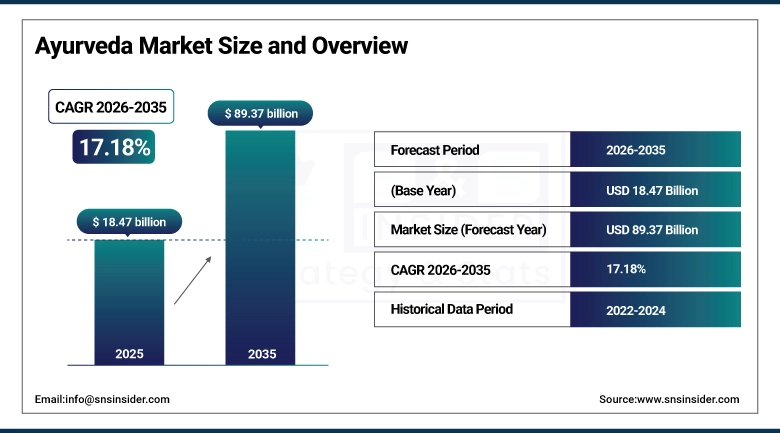
The Ayurveda Market size was estimated at USD 18.47 Billion in 2025 and is expected to reach USD 89.37 Billion by 2035 and grow at a CAGR of 17.18% over the forecast period of 2026-2035.
The analysis report of Ayurveda Market discusses market dynamics, product advancements, and therapeutic uses. Increasing consumer interest in plant-based healthcare products, lifestyle disorders, herbal supplements, and wellness centers are some of the key factors contributing to strong growth in the market during 2026-2035.
The usage of Ayurvedic products crossed USD 16.5 billion in terms of global sales in 2025 due to an increasing need for preventive healthcare products, herbal personal care products, and immunity-boosting products.
To Get more information on Ayurveda Market - Request Free Sample Report
Ayurveda Market Trends:
-
Preventive healthcare is witnessing an increasing trend with strong demand for immunity boosters and herbal supplements.
-
Ayurveda is being increasingly used in mainstream healthcare for the management of chronic conditions.
-
Wellness tourism is also contributing to the growth of premium segments of Ayurveda.
-
Nutraceuticals and functional foods are emerging as promising segments of Ayurveda.
-
Sustainability and authenticity are gaining ground, with eco-friendly packaging and QR codes becoming more common.
-
Government initiatives are also promoting Ayurveda, especially through India’s Ministry of AYUSH.
U.S. Ayurveda Market Insights:
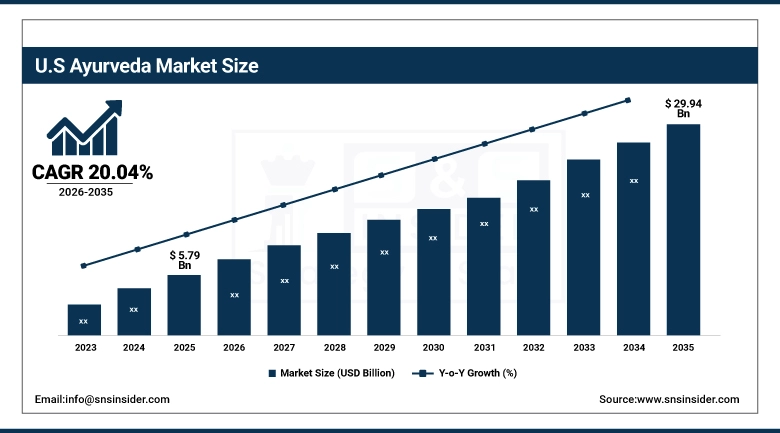
The United States Ayurveda Market is estimated to grow from USD 5.79 Billion in 2025 to USD 29.94 Billion in 2035 at a CAGR of 20.04%. The market is driven by the rise in demand for preventive healthcare services, personal care products, high growth in digital space, and investment in innovative nutraceuticals, functional food products, and wellness services in clinics, retail, and e-commerce.
Growth Drivers:
-
Rising Consumer Demand for Natural and Plant-Based Healthcare Solutions, Increasing Prevalence of Lifestyle-Related Disorders, And Strong Adoption of Herbal Supplements Are Key Drivers of Ayurveda Market Growth.
Healthcare services such as Hospitals, specialty clinics, wellness centers, and home healthcare providers are increasingly adopting Ayurvedic therapies such as herbal formulations, nutraceuticals, and personalized wellness programs to manage chronic diseases and promote preventive healthcare. Advances in oral supplements, functional foods, digital Ayurveda, safety, efficacy, and consumer adherence are also driving the adoption of Ayurvedic therapies, which is accelerating the growth of the market.
Advanced Ayurveda-based therapies, such as those offered by over 58% of hospitals, specialty clinics, and wellness providers in the U.S., in 2025.
Restraints:
-
High Certification Costs and Compliance Requirements Reducing Accessibility for Smaller Providers.
Despite its potential for growth, the Ayurveda market in the United States faces several challenges. These include unclear regulations, the need for standardized products, and concerns about the quality of herbal formulations. Additionally, healthcare providers face difficulties in integrating Ayurveda into traditional healthcare systems. Limited consumer awareness and misconceptions about Ayurveda’s scientific validation further restrict adoption, as many potential users remain uncertain about its efficacy compared to conventional therapies.
According to a 2025 survey, over 42% of healthcare providers in the U.S. expressed concerns about product authenticity, regulatory issues, and clinical validation of Ayurveda-based therapies.
Opportunities:
-
The U.S. Ayurveda Market Presents Significant Opportunities Driven by Rising Consumer Awareness.
Awareness is fueled by a growing interest in holistic wellness, the popularity of plant-based healthcare options, and the incorporation of Ayurveda into both preventive care and the management of long-term health issues. Hospitals, specialized clinics, wellness centers, and online platforms are all increasingly offering Ayurveda-based therapies, supplements, and nutraceuticals, responding to the demand for more natural approaches to healthcare. Furthermore, the emergence of innovative functional food products, sustainable packaging, and AI-driven personalized Ayurveda recommendations is opening doors for business expansion.
In 2025, more than 61% of wellness centers and specialty clinics in the United States have planned to increase their Ayurveda-based services, indicating significant opportunities for diversification, digitalization, and mainstreaming of Ayurveda-based products.
Ayurveda Market Segmentation Analysis:
-
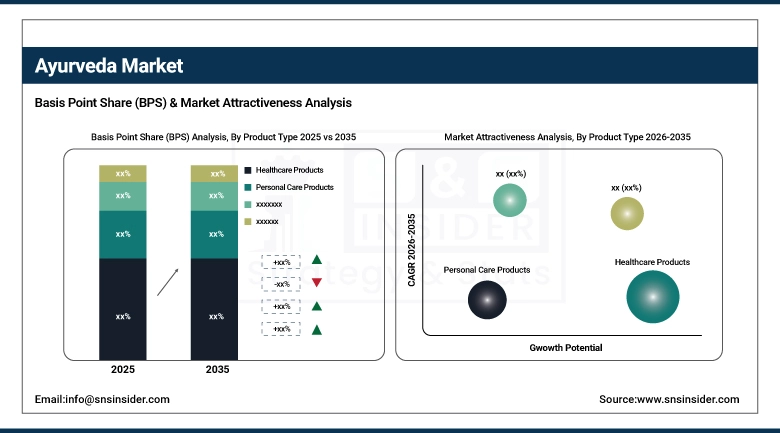
By Product Type, Healthcare Products held the largest market share of 45.38% in 2025, while Personal Care Products are expected to grow at the fastest CAGR of 17.18% during 2026–2035.
-
By Distribution Channel, Retail (Supermarkets, Pharmacies, Dept. Stores) dominated with 48.54% market share in 2025, whereas Online/E-commerce are projected to record the fastest CAGR of 18.31% through 2026–2035.
-
By Consumer Type, B2C (Business-to-Consumer) accounted for the highest market share of 61.82% in 2025, while they are also expected to grow at the fastest CAGR of 16.84% during the forecast period.
-
By Application, Therapeutics & Healthcare dominated with a 39.71% share in 2025, while Cosmetics & Personal Care are anticipated to expand at the fastest CAGR of 18.04% through 2026–2035.
By Product Type, Healthcare Products Dominate While Personal Care Products Grow Rapidly:
Healthcare Products segment dominated the Ayurveda industry due to its prevalence in preventive healthcare, immunity enhancement, and management of chronic ailments. Consumer perception towards herbal remedies and growing acceptability in hospitals, clinics, and healthcare centers further contributed to the segment’s leadership position in 2025.
Personal Care Products is the fastest-growing segment in the Ayurveda industry, mainly due to increased demand for herbal personal care products. Natural and organic personal care products, along with clean label and eco-friendly packaging, are driving demand for personal care products.
By Distribution Channel, Retail Dominates While Online/E-commerce Expands Rapidly:
The retail channels, such as supermarkets, pharmacies, and department stores, accounted for the domianted share in the Ayurveda market in 2025. This is due to their accessibility and trust among consumers. These channels are widely available in both rural and urban areas.
Online/E-commerce is another segment of the market, which is growing at fastest pace. This is due to an increase in digital literacy and the number of smartphones. Consumers are increasingly opting for online shopping due to its convenience. There is an increase in the number of online users, which is contributing to the growth of this market.
By Consumer Type, B2C Leads While Also Growing Rapidly:
The Business-to-Consumer (B2C) segment held the dominated market share in the Ayurveda industry in 2025, as a result of a high demand for Ayurvedic products from consumers. The direct engagement of the Ayurveda industry also contributed to this, as it ensured that Ayurveda products reached a wider number of individual consumers.
The Business-to-Consumer segment is also the fastest-growing segment of the Ayurveda industry, as a result of a high level of awareness of holistic wellness and the need for natural products. The growth of the segment can also be attributed to the increasing number of people adopting e-commerce platforms, especially the youth.
By Application, Therapeutics & Healthcare Dominate While Cosmetics & Personal Care Expand Rapidly:
The Therapeutics & Healthcare segment held the dominate the share in the Ayurveda market in 2025. This is because the segment witnessed robust adoption of herbal formulations in the prevention of health issues and enhancement of immunity. In addition, the segment saw robust adoption in the management of chronic health conditions.
The Cosmetics & Personal Care segment is growing at the fastest rate in the Ayurveda market. This is because the segment is witnessing robust demand for natural cosmetics and personal care products. The segment is growing due to the increasing demand for natural and herbal products.
Ayurveda Market Regional Analysis:
Asia-Pacific Ayurveda Market Insights:
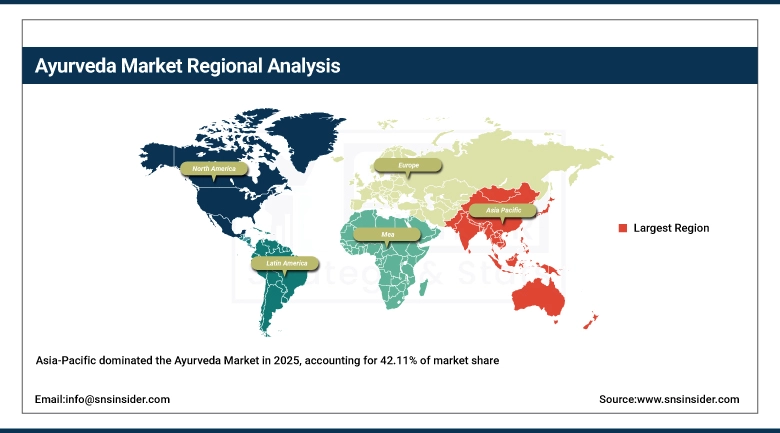
The Asia-Pacific Ayurveda Market, currently accounting for a significant market share of 42.11%, is expected to grow significantly from 2026-2035. The growth of the Asia-Pacific Ayurveda Market can be attributed to the increasing consumer affinity for natural products, the rise of lifestyle diseases, and the expansion of the healthcare industry in India, China, Japan, and Southeast Asia. The Asia-Pacific region also possesses a high adoption rate for herbal supplements, nutraceuticals, and personal care products, along with favorable government policies promoting Ayurveda.
Get Customized Report as per Your Business Requirement - Enquiry Now
China Market Insights:
The China Ayurveda Market is growing at an impressive rate due to an increasing interest in natural healthcare products among consumers, an increase in lifestyle-related health conditions, and an increase in investment in hospital and wellness infrastructure. Strong adoption of herbal supplements, nutraceuticals, and personal care products based on Ayurveda is also contributing to market growth, especially in cities.
North America Ayurveda Market Insights:
The North America Ayurveda Market is one of the most growing markets with a CAGR of 19.54%, fueled by the increasing awareness of the importance of holistic well-being and the demand for plant-based healthcare and herbal supplements. The Ayurveda segment is increasingly being adopted in hospitals and clinics. The rise of digital technologies and e-commerce has also contributed significantly to the growth of the Ayurveda industry in the region.
The fastest-growing Ayurveda Market in North America is the "U.S. Ayurveda Market," driven by the growing consumer affinity for natural products, a surge in wellness tourism, and a high rate of adoption of Ayurvedic personal care and nutraceutical products. The "U.S. Ayurveda Market" is expected to assume a pivotal role in determining global Ayurveda Market trends by 2035, as the integration of Ayurveda into mainstream healthcare and lifestyle programs will add impetus to the growth of this Market.
Europe Market Insights:
The Europe Ayurveda market is growing steadily, with increasing consumer awareness of the importance of holistic well-being, a growing preference for plant-based healthcare, and an increasing demand for herbal supplements and personal care products. Strong market adoption in countries such as Germany, France, and the UK can be attributed to wellness tourism, Ayurveda spa retreats, and the increasing interest in alternative medicine for preventive healthcare. The government is also making efforts to standardize herbal supplements to increase their availability in the market.
Germany Market Insights:
The Germany Ayurveda Market is one of the significant contributors in the European region, driven by the growing demand for natural products, herbal supplements, and Ayurveda-based personal care products. Ayurveda is being gradually accepted in hospitals, clinics, and wellness centers for preventive healthcare and management of chronic conditions. The demand for wellness tourism, eco-friendly products, and digital Ayurveda is also contributing to the growth.
Latin America Market Insights:
Latin America’s Ayurveda market is growing as an emerging market due to increased demand for natural and herbal healthcare products, growing awareness about preventive healthcare, and increased adoption of herbal supplements and personal care products. Latin American countries like Brazil, Mexico, and Argentina are increasingly adopting Ayurveda in wellness centers, spas, and clinics, and hence, there is a growing trend towards Ayurveda in Latin American culture.
Middle East and Africa Market Insights:
The Middle East & Africa Ayurveda Market is growing at a steady pace, driven by factors like growing awareness and demand for natural and holistic healthcare solutions, as well as increased awareness and adoption of preventive healthcare. The Middle East & Africa region is also experiencing increased adoption and integration of Ayurveda in countries like the UAE, Saudi Arabia, and South Africa due to cultural openness and increased disposable incomes.
Ayurveda Market Competitive Landscape:
Dabur, a leading Indian consumer goods company, has a long history of Ayurveda and is renowned for offering a wide range of herbal-based healthcare, personal care, and food products. With a focused approach of combining traditional Ayurveda and modern science, Dabur has managed to establish itself as a leader in the herbal supplements, immunity, and personal care segments. Its wide network of distribution and continuous innovations in wellness products have further strengthened Dabur's position as a leader in the Ayurveda segment.
-
In January 2025, Dabur expanded its nutraceuticals line with immunity-focused herbal formulations, strengthening its preventive healthcare positioning and boosting its share in the global Ayurveda market.
Himalaya Wellness is a well-known global brand that specializes in Ayurvedic and herbal-based healthcare products. The brand offers a range of pharmaceutical, personal care, and wellness products. It has gained recognition for the scientific validation of Ayurvedic and herbal products. The brand has managed to establish a presence in more than 90 countries, and this, along with the quality and safety of the products, makes it a leading player in the global Ayurvedic industry.
-
In November 2025, Himalaya launched a new line of plant-based dermatology solutions, expanding its footprint in natural skincare and reinforcing its global leadership in herbal personal care.
Patanjali Ayurved is one of the fastest-growing FMCG companies in India. The organization was established with the aim of making Ayurveda accessible to the masses. The organization has dominated the domestic market with the availability of Ayurvedic products in the fields of healthcare, food, and personal care. The low prices and mass reach of the organization’s products, along with the brand’s strong association with Ayurveda and traditional Indian culture of yoga and natural living, have made it the leader in the Ayurveda industry.
-
In October 2025, Patanjali expanded its food and beverage portfolio with Ayurvedic nutrition products, enhancing its market share in functional foods and consolidating its leadership in India’s Ayurveda-driven FMCG sector.
Ayurveda Market Key Players:
Some of the Ayurveda Market Companies are:
-
Dabur
-
Himalaya Wellness
-
Patanjali Ayurved
-
Emami
-
Baidyanath
-
Vicco Laboratories
-
Hamdard Laboratories
-
Zandu Realty (part of Emami)
-
Charak Pharma
-
Sandu Pharmaceuticals
-
Kerala Ayurveda Ltd
-
Arya Vaidya Sala (Kottakkal)
-
Sri Sri Tattva
-
Maharishi Ayurveda
-
Organic India
-
Amrutanjan Healthcare
-
Unilever (Ayush brand)
-
Colgate-Palmolive (Ayurvedic oral care lines)
-
Procter & Gamble (Herbal/Ayurvedic personal care extensions)
-
Shahnaz Husain Group
Ayurveda Market Report Scope:
| Report Attributes | Details |
|---|---|
| Market Size in 2025 | USD 18.47 Billion |
| Market Size by 2035 | USD 89.37 Billion |
| CAGR | CAGR of 17.18% From 2026 to 2035 |
| Base Year | 2025 |
| Forecast Period | 2026-2035 |
| Historical Data | 2022-2024 |
| Report Scope & Coverage | Market Size, Segments Analysis, Competitive Landscape, Regional Analysis, DROC & SWOT Analysis, Forecast Outlook |
| Key Segments | • By Product Type (Healthcare Products, Personal Care Products, Oral Care Products, Others), • By Distribution Channel (Retail (Supermarkets, Pharmacies, Dept. Stores), Online/E-commerce, Direct Sales (Clinics, Ayurveda centers), Beauty Spa/Salon, Others), • By Consumer Type (B2C (Business-to-Consumer), B2B (Business-to-Business), Others), • By Application (Therapeutics & Healthcare, Nutrition & Dietary Supplements, Cosmetics & Personal Care, Wellness & Lifestyle, Others) |
| Regional Analysis/Coverage | North America (US, Canada, Mexico), Europe (Eastern Europe [Poland, Romania, Hungary, Turkey, Rest of Eastern Europe] Western Europe] Germany, France, UK, Italy, Spain, Netherlands, Switzerland, Austria, Rest of Western Europe]), Asia Pacific (China, India, Japan, South Korea, Vietnam, Singapore, Australia, Rest of Asia Pacific), Middle East & Africa (Middle East [UAE, Egypt, Saudi Arabia, Qatar, Rest of Middle East], Africa [Nigeria, South Africa, Rest of Africa], Latin America (Brazil, Argentina, Colombia, Rest of Latin America) |
| Company Profiles | Dabur, Himalaya Wellness, Patanjali Ayurved, Emami, Baidyanath, Vicco Laboratories, Hamdard Laboratories, Zandu Realty (part of Emami), Charak Pharma, Sandu Pharmaceuticals, Kerala Ayurveda Ltd, Arya Vaidya Sala (Kottakkal), Sri Sri Tattva, Maharishi Ayurveda, Organic India, Amrutanjan Healthcare, Unilever (Ayush brand), Colgate-Palmolive (Ayurvedic oral care lines), P&G (Herbal/Ayurvedic personal care extensions), Shahnaz Husain Group. |
Frequently Asked Questions
Rising consumer preference for plant-based healthcare, government support (especially in India through AYUSH initiatives), digital retail penetration, and growing distrust of synthetic pharmaceuticals are the main growth drivers.
The global Ayurveda market is expected to grow at a CAGR of 17.18% from 2025 to 2035, expanding from USD 18.47 billion to USD 89.37 billion.
Online/e-commerce platforms are the fastest-growing channel with a CAGR of 18.31%, overtaking traditional retail.
Asia-Pacific, led by India, dominates with 42.11% share in 2025, expected to rise to 43.31% by 2035.
Personal care products (skin, hair, and cosmetics) are the fastest-growing segment, with a projected CAGR of 17.18% between 2025 and 2035, driven by global demand for natural beauty and clean-label products.
