
Black Pepper Market Report Scope & Overview:
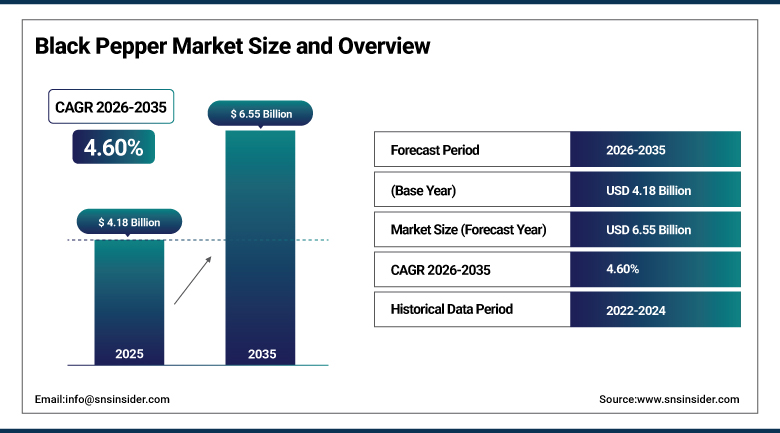
The Black Pepper Market was valued at USD 4.18 Billion in 2025 and is expected to reach USD 6.55 Billion by 2035, growing at a CAGR of 4.60% from 2026 to 2035.
The growth in the Black Pepper Market can be attributed to the increasing worldwide consumption of spices as ingredients in cuisine and food products, along with growing consumer awareness of black pepper’s health benefits. Increasing use in food processing, globalization of food trends, and gradual evolution of retail channels will continue to drive the demand in both developed and developing countries. Growing popularity of natural and organic products, along with high demand from the nutraceutical, pharmaceutical, and personal care industries for extracts containing piperine are expanding the market’s addressable segment. Apart from this, the improved supply chain efficiency and consumer preferences for traceable sources of pepper, along with an increased interest in premium and single origin pepper products are driving this trend.
In 2025, Olam Spices & Vegetable Ingredients completed an expansion of its spice processing facility in Ho Chi Minh City, Vietnam, enhancing cleaning and storage capabilities for black pepper while adding processing capacity for cinnamon, ginger, and nutmeg products.
To Get more information Black Pepper Market - Request Free Sample Report
Black Pepper Market Trends
- Growing consumer preference for organic and sustainably farmed black pepper is commanding premium pricing across retail and foodservice channels.
- Rising demand for piperine-rich extracts is expanding black pepper’s application beyond culinary use into nutraceutical and pharmaceutical formulations.
- Expanding adoption of blockchain-enabled traceability tools is helping buyers secure certified, lot-level traceable shipments and improve customs clearance efficiency.
- Increasing diversification of sourcing toward Brazil, Madagascar, and Nigeria is emerging as buyers seek to reduce dependency on concentrated production in Vietnam.
- Growing incorporation of black pepper into premium and specialty food products, including flavored dairy and confectionery, is broadening category use beyond traditional seasoning applications.
U.S. Black Pepper Market Outlook
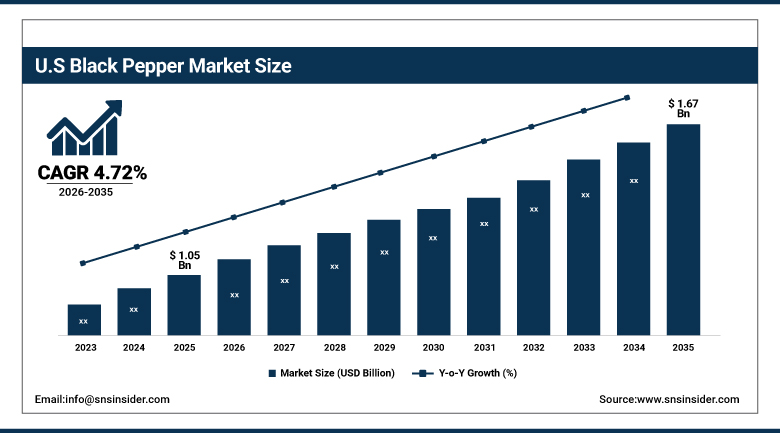
The U.S. Black Pepper Market was valued at USD 1.05 Billion in 2025 and is projected to reach USD 1.67 Billion by 2035, growing at a CAGR of 4.72% during 2026-2035.
The U.S. Black Pepper Market is on a steady growth trajectory, attributed to consumer awareness regarding culinary spice quality and demand for premium and specialty pepper types from the retail as well as food service segment consumers. The rising popularity of ethnic cuisines and those that have a global appeal is fueling the growth of consumption in both packaged foods and the restaurant segment. Increasing sourcing of piperine content from black pepper extract by food manufacturers for nutraceutical applications is being witnessed as consumers become increasingly aware of the health benefits offered by black pepper. The adoption of innovations like organic certification and traceability sourcing programs is providing the consumers with choices. The strong distribution through supermarket chains, foodservice distributors and even e-commerce channels is boosting the availability of the products.
In October 2024, Lactalis UK & Ireland launched a black pepper-flavored cheese spread within its Seriously Spreadable range, reflecting continued mainstream food manufacturer interest in incorporating black pepper into premium flavored product formats.
Black Pepper Market Segment Analysis
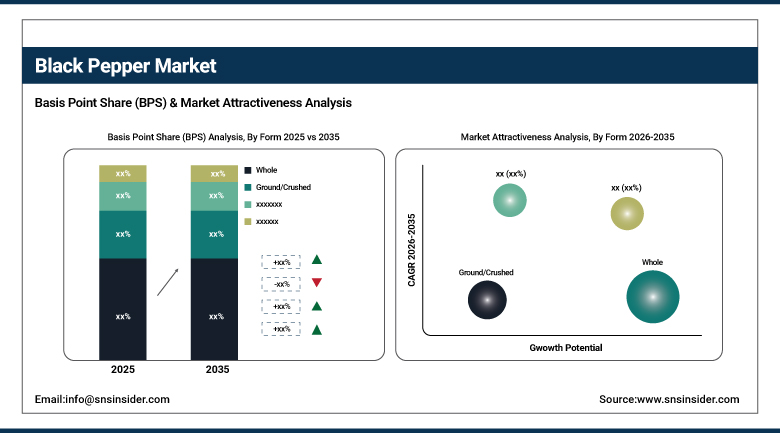
- By Form, whole segment dominated the black pepper market in 2025 with around 52% share; ground/crushed segment is the fastest-growing segment.
- By Nature, conventional segment dominated the market in 2025 with around 58% share; organic segment is the fastest-growing segment.
- By Application, food & beverages segment dominated the market in 2025; nutraceuticals & pharmaceuticals segment is the fastest-growing segment.
- By Distribution Channel, supermarkets & hypermarkets segment dominated the market in 2025 with around 50% share; online segment is the fastest-growing segment.
By Form, Whole Dominates the Black Pepper Market While Ground/Crushed Registers the Fastest Growth
Whole dominates the Black Pepper Market owing to its superior freshness retention, extended shelf life, and versatility across both retail and foodservice applications where consumers and chefs prefer grinding pepper fresh at the point of use. Whole peppercorns benefit from established global trade infrastructure connecting producing regions such as Vietnam, India, and Indonesia with import markets worldwide. The strong consumer preference for freshness and flavor intensity associated with freshly ground whole peppercorns is reinforcing this segment’s continued market leadership.
Ground/Crushed is experiencing rapid growth driven by increasing consumer demand for convenient, ready-to-use spice formats that eliminate the need for grinding at the point of consumption. Rising adoption among food processors and foodservice operators seeking consistent, pre-measured seasoning for large-scale production is compelling suppliers to expand ground pepper processing capacity. Growing popularity of pre-packaged seasoning blends incorporating ground black pepper is opening up several opportunities for commercial utilization in this segment.
By Nature, Conventional Dominates the Black Pepper Market While Organic Emerges as the Fastest-Growing Nature Segment
The Conventional product segment is leading the Black Pepper Market as it enjoys cost efficiency, widespread availability, and an existing production system in major growing regions that helps in international trade on a large scale. Conventional black pepper enjoys the advantage of existing cultivation practices and distribution network which connects cultivators to processors and retailers all around the world. The low costs and availability of conventional black pepper are driving its growth in the market.
The Organic black pepper market segment is experiencing high growth as a result of growing consumer readiness to pay higher prices for pesticide-free and sustainable farming methods of growing pepper with retailers offering high price premiums to organic certified batches of black pepper. Increasing awareness about the environmental and health benefits of organic farming practices is driving farmers in various growing regions to go for organic certification.
By Application, Food & Beverages Dominates the Black Pepper Market While Nutraceuticals & Pharmaceuticals Experiences the Fastest Growth
Food & Beverages dominates the Black Pepper Market due to black pepper’s fundamental role as one of the world’s most widely used culinary spices across virtually every cuisine and food processing category. Rising global demand for spicy and flavorful food, combined with the expanding packaged and processed food industry, continues driving sustained consumption across this application category. The broad applicability of black pepper across home cooking, foodservice, and industrial food processing is reinforcing this segment’s continued market leadership.
Nutraceuticals & Pharmaceuticals is growing rapidly on account of increasing scientific interest in piperine, black pepper’s active alkaloid compound, for its potential bioavailability-enhancing and health-supporting properties. Rising demand from supplement manufacturers seeking piperine as a bioavailability enhancer for other nutraceutical ingredients is compelling processors to expand standardized extract production. Advances in extraction and standardization technology enabling precision-drying and certified labeling are opening up several opportunities for commercial utilization in this segment.
By Distribution Channel, Supermarkets & Hypermarkets Dominates the Black Pepper Market While Online Registers the Fastest Growth
Supermarkets & Hypermarkets dominates the Black Pepper Market due to consumer preference for purchasing spices through established retail channels offering wide product selection and the ability to compare brands and formats in person. Such stores give customers access to a broad range of black pepper products, from whole peppercorns to pre-ground formats, allowing convenient one-stop shopping. Established relationships between spice suppliers and major retail chains, along with dedicated shelf space for spices and seasonings, also contribute to sales in this channel.
Online is growing rapidly because of the convenience of ordering, subscription-based purchasing, and access to specialty, single-origin, and premium pepper varieties that may not be available in local physical stores. E-commerce platforms enable consumers and foodservice buyers to compare product origin, certification, and pricing before making bulk purchases. The increased adoption of direct-to-consumer and business-to-business online ordering by specialty food retailers and foodservice operators is facilitating the growth of this channel.
Regional Analysis
|
Region |
Country |
Share (2025) |
|
Asia Pacific |
Vietnam |
52.50% |
|
North America |
United States |
84.60% |
|
Europe |
Germany |
22.30% |
|
Middle East & Africa |
UAE |
17.60% |
|
Latin America |
Brazil |
24.50% |
North America Black Pepper Market Insights
North America held a significant share of the Black Pepper Market in 2025, supported by high consumer awareness of culinary spice quality and expanding demand for premium and specialty pepper varieties. Rising popularity of ethnic and globally inspired cuisines across the United States and Canada is supporting product innovation and premium positioning. Increasing food manufacturer interest in piperine-rich extracts for nutraceutical applications is further reinforcing North America’s market position.
The United States accounted for approximately 84.60% of the North American market in 2025, reflecting its large food processing base and extensive spice distribution infrastructure. Canada is contributing to regional growth through steady demand for culinary and foodservice spice applications.
Europe Black Pepper Market Insights
Europe is expected to register the fastest CAGR in the Black Pepper Market during 2026–2035, growing at approximately 5.60%, driven by strong consumer demand for clean-label reforms in packaged foods, widening premium spice menus in foodservice, and rising interest in traceable, sustainably sourced spices. Germany, France, and the United Kingdom are witnessing increased incorporation of premium and organic black pepper varieties across both retail and foodservice channels. Rising product innovation and growing consumer awareness regarding piperine’s nutraceutical benefits are further supporting market expansion. Rising demand for certified organic and traceable pepper products is also reinforcing Europe’s above-average growth trajectory compared with more mature markets.
Germany led the European market with a 22.30% regional share in 2025, supported by its strong food processing infrastructure and growing consumer interest in premium and organic spice products. France and the United Kingdom are also contributing meaningfully to regional growth, supported by well-established foodservice and specialty retail networks.
Asia Pacific Black Pepper Market Insights
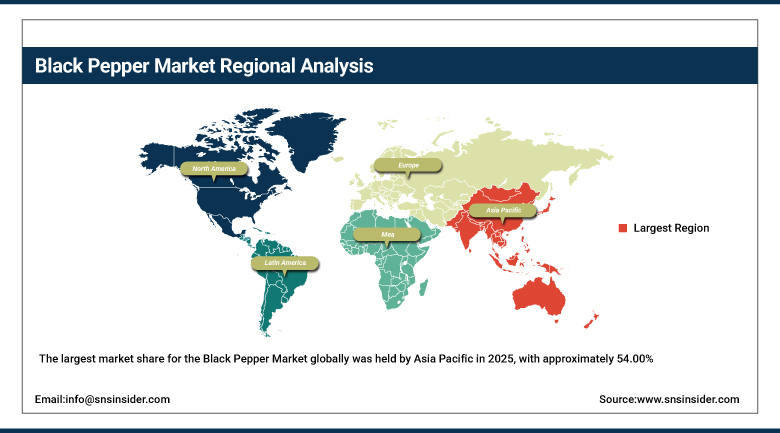
The largest market share for the Black Pepper Market globally was held by Asia Pacific in 2025, with approximately 54.00% of the total global revenue attributed to the market due to its being the leading producer and exporter of black pepper in the world, with Vietnam, India, and Indonesia playing prominent roles. The favorable climatic conditions, established practices, and export infrastructure of decades of experience in producing black pepper in the regions are the key contributors to market development in the region, along with increasing domestic consumption and adoption of organic and sustainable agriculture methods. Improved cultivation and export infrastructure of Vietnam, India, and Indonesia helps in maintaining the reliability of global supply chain and sustaining market development in the region.
Approximately 52.50% of the Asia Pacific market was held by Vietnam in 2025, backed by the country’s status as a leading producer and exporter of black pepper in the world; however, there are concerns for climate change and diseases as a result of diminishing farmlands and poor soil quality. India and Indonesia are the other contributors to market development in the region, with India known for premium varieties such as Malabar and Tellicherry pepper.
Get Customized Report as per Your Business Requirement - Enquiry Now
Middle East & Africa and Latin America Black Pepper Market Insights
The Middle East & Africa region is exhibiting steady growth as culinary spice consumption expands across the Gulf states, supported by growing modern retail and foodservice infrastructure. Latin America is similarly benefiting from expanding food processing capacity and growing consumer interest in premium and specialty spice products across major regional markets.
The UAE led the Middle East & Africa market with a 17.60% regional share in 2025, supported by growing culinary spice consumption and expanding modern retail penetration. Brazil represented 24.50% of the Latin American market in 2025, driven by its role as an emerging alternative production source amid supply diversification trends, with Mexico also contributing to regional growth through rising interest in premium spice products.
Market Dynamics
Growth Drivers: Culinary Demand and Nutraceutical Applications Driving Market Growth
The primary driving forces behind the expansion of the Black Pepper Market can be attributed to growing global demand for spicy and flavorful food products, greater consumer knowledge about the medicinal properties of black pepper, and globalization of food trends that facilitate culinary experimentation globally. With continued recognition of black pepper in the areas of culinary application, processing, and formulation of nutraceuticals using piperine, food industry companies and supplement producers have been experiencing steady growth opportunities, thus leading to further expansion in the global market for this segment.
Growing demand from the fragrance and pharmaceutical industries is continuously expanding the scope of applications of black pepper beyond just its culinary application. Innovation in the areas of extraction and standardization is shaping product development trends in the overall black pepper market.
Restraints: Climate-Induced Crop Volatility and Supply Concentration Limiting Market Expansion
Although the outlook on demand is positive, however, the category will still be facing constraints related to weather-related volatility of crop production, resulting in very high futures prices owing to supply constraints. Supply concentration within Vietnam, an important producer of the product, makes the entire market subject to climate- and disease-related risks, which can lead to price instability. Differences in regulations related to food safety standards and pesticides residue content across different regions will continue to play a role in determining timing of market entries and investments in certification process.
Higher costs related to certification process, traceability infrastructure development and quality testing make the costs of production higher as well, making the products non-competitive in price terms for small producers. In addition, competitive landscape of producing countries and new alternative regions will increase the pressure on prices. As the category develops, exporters will need to find the right balance between competitiveness, supply reliability and certification standards.
Opportunities: Organic Farming Expansion and Supply Diversification Creating New Growth Avenues
There are many opportunities that are inherent in the expansion of organic black pepper production, development of innovations, and diversification of export markets. It is possible to develop organic and sustainable production of black pepper by taking into consideration the rising tendency of consumers' desire to pay more money for pesticide-free certified products. It is possible to use the increased interest in diversification of export markets in order to decrease the dependency on the concentration of demand. Expansion of innovation within piperine extracts, flavored food products, and premium single-origin products represents another opportunity to increase value of this category.
Diversification toward Brazil, Madagascar, and Nigeria as alternative production sources presents another chance for the industry to overcome the climate and geopolitical risks. Innovation around blockchain-enabled traceability and lot-level certification may bring the opportunity to differentiate and focus on the trust factor in product positioning. Expansion of nutraceutical and pharmaceutical applications for piperine extracts may represent additional differentiation point.
Recent Developments:
- 2025: Olam Spices & Vegetable Ingredients completed an expansion of its spice processing facility in Ho Chi Minh City, Vietnam, enhancing black pepper cleaning, storage, and milling capabilities.
- 2025: McCormick & Company continued expanding its Grown for Good sustainable sourcing program, supporting over 2,500 black pepper farmers in Vietnam with training and certification support.
- 2024: Lactalis UK & Ireland launched a black pepper-flavored cheese spread within its Seriously Spreadable range.
Black Pepper Market key players are:
- McCormick & Company, Inc.
- Olam Agri (Olam International Limited)
- Nedspice Group B.V.
- Kerry Group plc
- Synthite Industries Ltd.
- Ungerer & Company
- Phuc Sinh Corporation
- Everest Food Products Pvt. Ltd.
- MDH Spices Pvt. Ltd.
- Catch Foods Pvt. Ltd.
- Badia Spices, Inc.
- Spice World, Inc.
- Griffith Foods Worldwide, Inc.
- McCormick Ducros S.A.S.
- Tone Brothers, Inc.
- Frontier Co-op
- Sonwin Foods LLC
- Vanns Spices
- DS Group (Dharampal Satyapal Limited)
- Baria-Vungtau Pepper Joint Stock Company
Black Pepper Market Report Scope :
| Report Attributes | Details |
|---|---|
| Market Size in 2025 | USD 4.18 Billion |
| Market Size by 2035 | USD 6.55 Billion |
| CAGR | CAGR of 4.60% From 2026 to 2035 |
| Base Year | 2025 |
| Forecast Period | 2026-2035 |
| Historical Data | 2022-2024 |
| Report Scope & Coverage | Market Size, Segments Analysis, Competitive Landscape, Regional Analysis, DROC & SWOT Analysis, Forecast Outlook |
| Key Segments | • By Form (Whole, and Ground/Crushed) • By Nature (Conventional, and Organic) • By Application (Food & Beverages, Nutraceuticals & Pharmaceuticals, and Others) • By Distribution Channel (Supermarkets & Hypermarkets, and Online) |
| Regional Analysis/Coverage | North America (US, Canada), Europe (Germany, UK, France, Italy, Spain, Russia, Poland, Rest of Europe), Asia Pacific (China, India, Japan, South Korea, Australia, ASEAN Countries, Rest of Asia Pacific), Middle East & Africa (UAE, Saudi Arabia, Qatar, South Africa, Rest of Middle East & Africa), Latin America (Brazil, Argentina, Mexico, Colombia, Rest of Latin America). |
| Company Profiles | McCormick & Company, Inc.; Olam Agri (Olam International Limited); Nedspice Group B.V.; Kerry Group plc; Synthite Industries Ltd.; Ungerer & Company; Phuc Sinh Corporation; Everest Food Products Pvt. Ltd.; MDH Spices Pvt. Ltd.; Catch Foods Pvt. Ltd.; Badia Spices, Inc.; Spice World, Inc.; Griffith Foods Worldwide, Inc.; McCormick Ducros S.A.S.; Tone Brothers, Inc.; Frontier Co-op; Sonwin Foods LLC; Vanns Spices; DS Group (Dharampal Satyapal Limited); Baria-Vungtau Pepper Joint Stock Company. |

Frequently Asked Questions
Key players include McCormick & Company, Inc., Olam Agri (Olam International Limited), Nedspice Group B.V., Kerry Group plc, and Synthite Industries Ltd., among others.
Key opportunities include organic black pepper farming expansion, new product innovation across piperine extracts and flavored foods, diversification of export markets, blockchain-enabled traceability, and expanding nutraceutical and pharmaceutical applications.
The market is driven by increasing global demand for spicy and flavorful food, heightened consumer awareness of black pepper’s medicinal benefits, and rapid globalization of food trends.
The Whole segment dominated the Black Pepper Market in 2025, accounting for 52.00% of revenue share.
The Asia Pacific region dominated the Black Pepper Market in 2025, accounting for approximately 54.00% of global market share, driven by Vietnam, India, and Indonesia’s leadership in global pepper production and export infrastructure.
