
Breast Adenocarcinoma Treatment Market Report Scope & Overview:
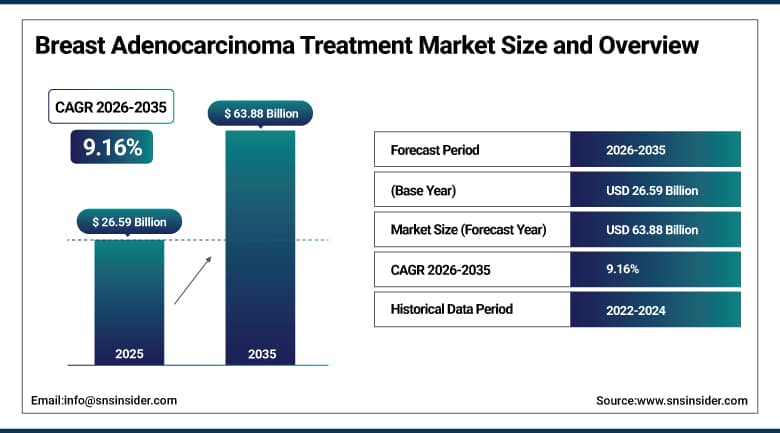
The Breast Adenocarcinoma Treatment Market was valued at USD 26.59 Billion in 2025 and is expected to reach USD 63.88 Billion by 2035, growing at a CAGR of 9.16% from 2026–2035.
Breast Adenocarcinoma accounts for the greatest percentage of breast cancer cases because it develops from the glandular tissues lining the milk ducts and lobules and its management involves a combination of chemotherapy, targeted therapy, hormonal therapy, immunotherapy, and radiation therapy. Market growth in this area is driven by the increasing incidence of breast cancers, increasing availability of genetic and companion diagnostics tests, and introduction of a new wave of target therapies. Improved diagnostic equipment, continuous oncology R&D, government screening campaigns, and increasingly favorable reimbursement policies are all widening access to these therapies, while an aging population and shifting lifestyle factors continue pushing overall demand higher across both developed and emerging healthcare markets.
According to the National Cancer Institute, breast cancer remains the leading non-skin cancer diagnosed in women in the United States, with an estimated 59,080 cases of ductal carcinoma in situ and 316,950 cases of invasive breast cancer expected in 2025. Of those diagnosed, roughly 42,170 women are expected to die of the disease, a toll that puts breast cancer just behind lung cancer among female cancer deaths and underscores why continued investment in more effective, better-tolerated treatment options remains a public health priority.
To Get More Information On Breast Adenocarcinoma Treatment Market - Request Free Sample Report
Breast Adenocarcinoma Treatment Market Trends
-
Antibody-drug conjugates (ADCs) are transforming breast adenocarcinoma treatment by improving targeted drug delivery and clinical outcomes in HER2-positive and HER2-low patients.
-
Companion diagnostics and genomic profiling are enabling precision oncology by matching patients with targeted therapies based on specific molecular biomarkers.
-
Cell-based immunotherapies, including CAR T-cell and tumor-infiltrating lymphocyte (TIL) therapies, are advancing through clinical trials for difficult-to-treat breast cancers.
-
Oral selective estrogen receptor degraders (SERDs) are emerging as effective treatment options for hormone receptor-positive, HER2-negative breast adenocarcinoma with improved patient convenience.
-
Specialty clinics and outpatient cancer centers are expanding treatment delivery as targeted therapies and minimally invasive approaches reduce dependence on hospital-based care.
The U.S. Breast Adenocarcinoma Treatment Market Outlook
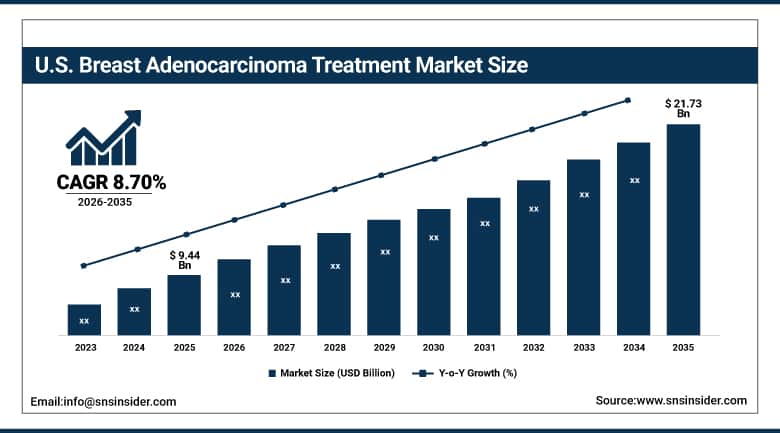
The U.S. breast adenocarcinoma treatment market was valued at approximately USD 9.44 Billion in 2025 and is expected to reach approximately USD 21.73 Billion by 2035, growing at a CAGR of approximately 8.70%.
United States of America leads the market for breast adenocarcinoma treatments in North America due to their developed healthcare facilities and high incidence rates along with many leading pharmaceutical firms based in the country. The constant conduct of clinical trials and quick adoption of newer treatments allows the USA to continue with their lead in the market, whereas the FDA's quick approval processes such as 'fast track' and 'breakthrough therapy' designation bring the newer targeted and monoclonal drugs to the market quickly compared to other nations.
In January 2025, the FDA approved Datroway (datopotamab deruxtecan) for adults with unresectable or metastatic hormone receptor-positive, HER2-negative breast cancer who have already received prior endocrine-based therapy and chemotherapy. The approval followed encouraging results from the TROPION-Breast01 Phase III trial and gives oncologists another antibody-drug conjugate option for patients who have progressed on standard treatment, extending the same drug delivery approach that transformed HER2-positive treatment to a much larger patient population.
Breast Adenocarcinoma Treatment Market Segment Analysis
-
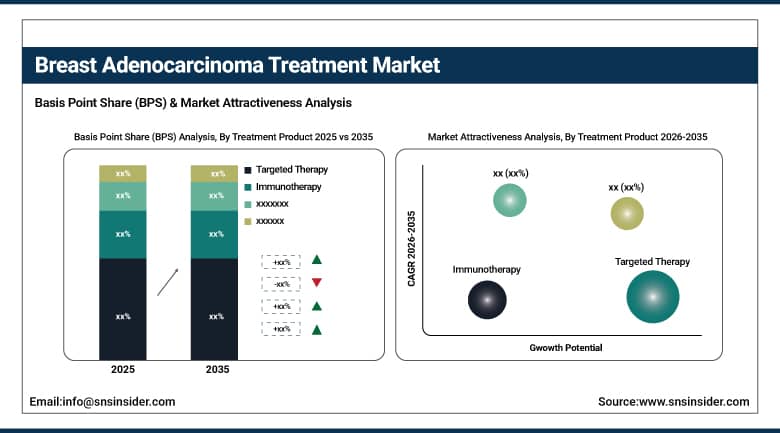
By Treatment Product, the targeted therapy segment dominated the breast adenocarcinoma treatment market with a 28.14% revenue share in 2025, while the immunotherapy segment is the fastest growing with a CAGR of approximately 10.13%.
-
By Line of Therapy, the first line segment dominated the breast adenocarcinoma treatment market with a 44.2% revenue share in 2025, while the maintenance therapy segment is the fastest growing with a CAGR of approximately 10.4%.
-
By Cancer Stages, the early stage segment dominated the breast adenocarcinoma treatment market with a 47.8% revenue share in 2025, while the metastatic segment is the fastest growing with a CAGR of approximately 11.2%.
-
By End-Use, the hospitals segment dominated the breast adenocarcinoma treatment market with a 64.21% revenue share in 2025, while the specialty clinics segment is the fastest growing.
By Treatment Product, targeted therapy dominates, immunotherapy grows fastest
Targeted therapy held about 28.14% of the market in 2025, reflecting how thoroughly precision-driven treatment has moved into everyday clinical practice. Unlike conventional chemotherapy, targeted therapies zero in on specific molecular pathways that drive cancer growth, HER2 or PI3K mutations among them, and widely adopted drugs including trastuzumab, pertuzumab, and the CDK4/6 inhibitor palbociclib have consistently improved progression-free and overall survival, particularly in hormone receptor-positive and HER2-positive patients. Growing use of companion diagnostics and genomic profiling continues to expand the pool of patients who can benefit from individualized, targeted treatment.
Immunotherapy is the fastest growing treatment area, with an expected CAGR of around 10.13%, owing to the ability of these drugs to bring changes for the better in the case of aggressive forms like triple negative breast cancer. Unlike other types of drug treatment, immunotherapy does not target cancer cells, but rather it trains the immune system of the patient to recognize and kill them. With ongoing developments in immune checkpoint and cell-based therapy trials, there is hope for people who have run out of other treatment options.
By End-Use, hospitals dominate, specialty clinics grow fastest
Hospitals accounted for about 64.21% of end-use demand in 2025, largely because they offer the complete infrastructure that complex breast cancer cases require: advanced imaging, pathology labs, operating theaters, and multidisciplinary care teams capable of coordinating chemotherapy, radiation, and surgery under one roof. Hospitals also tend to be the first point of care after diagnosis and often continue managing patients throughout treatment, particularly for cases involving surgery or extended hospital stays.
The specialty clinics have been identified to be the leading end-use segment, thanks to the increasing preference for outpatient treatments, the advancements in minimally invasive treatments, and the need for customized treatment among patients. Specialty clinics provide services related to oncology and breast care only, thereby making it easy for them to provide customized treatment, as well as manage targeted therapy management and follow-up treatments. Improved coordination between specialty clinics and diagnostic laboratories and drug manufacturers is enabling specialty clinics to emerge as a more credible option than hospital care for early stage patients.
Regional Analysis
|
Region |
Major Country |
Share within Region, 2025 (%) |
|---|---|---|
|
North America |
United States |
82.0% |
|
Europe |
United Kingdom |
24.0% |
|
Asia Pacific |
China |
39.0% |
|
Middle East & Africa |
Saudi Arabia |
27.0% |
|
Latin America |
Brazil |
38.0% |
North America Breast Adenocarcinoma Treatment Market Insights
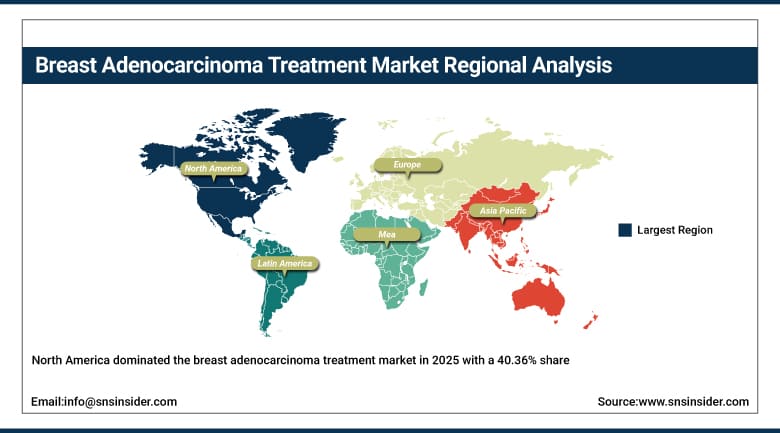
North America dominated the breast adenocarcinoma treatment market in 2025 with a 40.36% share, driven by sophisticated healthcare infrastructure, strong disease awareness, and heavy investment in cancer research and treatment. This area takes advantage of screening programs that began early, the availability of target therapies and immunotherapy, and the presence of large pharmaceutical companies that are developing new oncology drugs.
Specifically, the United States boasts excellent regulatory practices, good reimbursement policies, and early access to new clinical trials. Breast cancer is the second most common cause of cancer deaths in women in the United States, a figure that keeps the momentum of investments in early detection and better treatments going strong.
Get Customized Report as Per Your Business Requirement - Enquiry Now
Europe Breast Adenocarcinoma Treatment Market Insights
The European market for breast adenocarcinoma treatments is still technologically advanced because of the United Kingdom’s well-developed health care system, considerable research and development expenditure, and fast adaptation of innovations. Universities and major drug manufacturers continue innovating in this field, whereas the National Health Service provides easy access to advanced treatments for patients.
Germany, France, and Italy round out regional demand, supported by well-established oncology care networks and growing emphasis on personalized medicine and biologic therapies. As European regulators continue approving new targeted agents and antibody-drug conjugates, the region's focus on precision oncology is expected to keep raising treatment standards across the continent.
Asia Pacific Breast Adenocarcinoma Treatment Market Insights
APAC will experience the highest growth rate of 9.83% CAGR till 2035 in the breast adenocarcinoma therapy market. This will be because of increasing healthcare expenditure, increasing incidence of breast cancer, and increased accessibility of advanced treatment facilities. There are government-funded screening programs and campaigns increasing awareness regarding the early detection of the disease, especially in countries like China, India, and Japan.
The continued rapid growth of Asia-Pacific’s economy has seen a development in the healthcare infrastructure sector and an increase in the use of cutting-edge treatments, and multinational drug makers have shifted their focus to this region. The increasing number of patients along with low-cost treatment alternatives entering the market is what will make Asia-Pacific outpace others during the forecast period.
MEA & Latin America Breast Adenocarcinoma Treatment Market Insights
The Middle East and Africa are seeing substantial growth in the breast adenocarcinoma treatment market, driven by rising cancer incidence, improving healthcare facilities, and growing uptake of the latest therapies. Saudi Arabia leads regional demand, supported by expanding public awareness campaigns, government healthcare funding, and increasing engagement from major pharmaceutical companies that are together improving early diagnosis and access to novel treatments.
The Latin American region is rapidly increasing its size owing to the increase in the occurrence of breast cancer along with developments in health care infrastructure and new treatment methods like targeted therapy and immunotherapy. The largest consumer base in the Latin American region is Brazil, while the second largest consumer base is Mexico.
Market Dynamics
Growth Drivers: Advancements in medical technology improving treatment precision
Technological innovation in the medical field is a prominent driver of breast adenocarcinoma treatment market growth. There are advanced diagnostic technologies like 3D mammograms and genetic tests that enable early and precise diagnosis and personalized treatments, and there is the use of drugs with minimal side effects in comparison to conventional chemotherapeutic drugs. There is also minimally invasive surgery and targeted radiation that are helping enhance treatment and recovery processes.
National Cancer Institute scientists are investigating cellular therapy approaches such as CAR-T cell and T-cell transfer therapy for solid tumors, with one particular clinical trial assessing the use of tumor-infiltrating lymphocytes in reducing tumors for patients suffering from metastatic breast cancer. All these innovations are leading to improved success rates in treatment as well as increasing accessibility to advanced medical services, hence contributing to the growth in the global market.
Restraints: Limited access to advanced therapies in low-income regions
Breast cancer remains one of the principal health challenges globally as the most common malignancy in women, affecting an estimated 2.1 million new patients each year and representing 24.2% of all new female cancer cases. It's responsible for 15% of cancer deaths in women and accounts for one in every four female malignancies, yet access to the newest targeted therapies and immunotherapies remains highly uneven across income levels and geographies.
Early-onset breast cancer, diagnosed in women under 50, tends to be more aggressive with a worse prognosis, while late-onset breast cancer in women over 70 is generally less aggressive. Lifetime risk varies substantially by country and ethnicity due to differing exposure to risk factors, and patients in low-income regions frequently lack access to the genomic testing and advanced therapies that have transformed outcomes elsewhere, a gap that continues to constrain broader market growth.
Opportunities: Targeted therapy expansion opening treatment access for more patients
The growth in the breast cancer market is sustained by the use of targeted therapy because of the more effective treatment options available due to the targeted nature of the treatments against the molecular mechanisms responsible for cancer growth. This treatment strategy is distinct from chemotherapy because it focuses on the specific biological mechanisms that cause tumors.
As more targeted therapies gain approval and expand into additional breast cancer subtypes, their use is climbing steadily. Trastuzumab deruxtecan, an antibody-drug conjugate originally approved for HER2-positive breast cancer, illustrates this trend well: the monoclonal antibody trastuzumab binds to HER2-expressing tumor cells and delivers the chemotherapy payload deruxtecan directly to them, a targeted delivery mechanism that continues to expand into new patient populations and represents a substantial opportunity for continued market growth.
Recent Developments:
-
2025: In January 2025, the FDA approved Datroway (datopotamab deruxtecan) for adults with unresectable or metastatic hormone receptor-positive, HER2-negative breast cancer who had received prior endocrine-based therapy and chemotherapy, following positive results from the TROPION-Breast01 Phase III trial.
-
2024: In October 2024, Roche received FDA approval for Itovebi (inavolisib) in combination with palbociclib and fulvestrant to treat adults with endocrine-resistant, PIK3CA-mutated, HR-positive, HER2-negative locally advanced or metastatic breast cancer.
-
2024: In September 2024, Novartis announced FDA approval of Kisqali (ribociclib) with an aromatase inhibitor for adjuvant treatment of patients with HR-positive, HER2-negative stage II and III early breast cancer at high risk of recurrence, including node-negative cases.
-
2024: In November 2024, Eli Lilly presented new Phase 3 EMBER-3 trial data for imlunestrant, an oral selective estrogen receptor degrader, evaluated both alone and in combination with Verzenio for patients with ER-positive, HER2-negative breast cancer previously treated with endocrine therapy.
Breast Adenocarcinoma Treatment Market key players are:
-
F. Hoffmann-La Roche Ltd.
-
Novartis AG
-
Pfizer Inc.
-
AstraZeneca PLC
-
Eli Lilly and Company
-
Merck & Co., Inc.
-
Bristol Myers Squibb
-
Sanofi S.A.
-
AbbVie Inc.
-
Johnson & Johnson
-
Gilead Sciences, Inc.
-
Daiichi Sankyo Company, Limited
-
Amgen Inc.
-
Exelixis, Inc.
-
Puma Biotechnology, Inc.
-
Arvinas, Inc.
-
Menarini Group
-
Exact Sciences Corporation
-
BioNTech SE
-
BeiGene, Ltd.
Breast Adenocarcinoma Treatment Market Report Scope:
| Report Attributes | Details |
|---|---|
| Market Size in 2025 | USD 26.59 Billion |
| Market Size by 2035 | USD 63.88 Billion |
| CAGR | CAGR of 9.16% From 2026 to 2035 |
| Base Year | 2025 |
| Forecast Period | 2026-2035 |
| Historical Data | 2022-2024 |
| Report Scope & Coverage | Market Size, Segments Analysis, Competitive Landscape, Regional Analysis, DROC & SWOT Analysis, Forecast Outlook |
| Key Segments | • By Treatment Product (Chemotherapy, Targeted Therapy, Hormonal Therapy, Immunotherapy, Radiation Therapy, Other) • By Line of Therapy (First Line, Maintenance Therapy, Second Line, Third Line) • By Cancer Stages (Early Stage, Locally Advanced, Metastatic) • By End-Use (Hospitals, Specialty Clinics, Others) |
| Regional Analysis/Coverage | North America (US, Canada), Europe (Germany, UK, France, Italy, Spain, Russia, Poland, Rest of Europe), Asia Pacific (China, India, Japan, South Korea, Australia, ASEAN Countries, Rest of Asia Pacific), Middle East & Africa (UAE, Saudi Arabia, Qatar, South Africa, Rest of Middle East & Africa), Latin America (Brazil, Argentina, Mexico, Colombia, Rest of Latin America). |
| Company Profiles | F. Hoffmann-La Roche Ltd., Novartis AG, Pfizer Inc., AstraZeneca PLC, Eli Lilly and Company, Merck & Co., Inc., Bristol Myers Squibb, Sanofi S.A., AbbVie Inc., Johnson & Johnson, Gilead Sciences, Inc., Daiichi Sankyo Company, Limited, Amgen Inc., Exelixis, Inc., Puma Biotechnology, Inc., Arvinas, Inc., Menarini Group, Exact Sciences Corporation, BioNTech SE, BeiGene, Ltd. |
Frequently Asked Questions
Advancements in medical technology, including targeted therapies and improved diagnostic tools, that are enabling earlier detection and more precise, effective treatment.
The Breast Adenocarcinoma Treatment Market was valued at USD 26.59 Billion in 2025.
The Breast Adenocarcinoma Treatment Market is expected to grow at a CAGR of 9.16% from 2026 to 2035.
North America dominated the Breast Adenocarcinoma Treatment Market in 2025 with a 40.36% market share.
Targeted Therapy dominated with a 28.14% revenue share in 2025.
