
Broad-Spectrum Antivirals Market Report Scope & Overview:
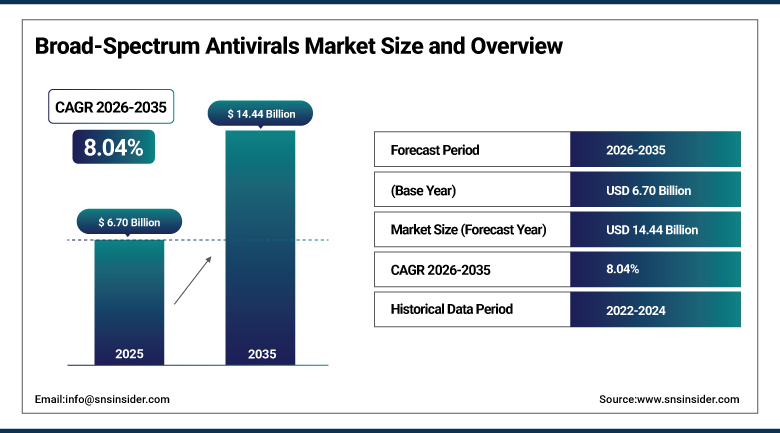
The Broad-Spectrum Antivirals Market was valued at USD 6.70 billion in 2025 and is expected to reach USD 14.44 billion by 2035, growing at a CAGR of 8.04% from 2026-2035.
The Broad-Spectrum Antivirals Market is witnessing steady growth owing to the rising number of viral infections and the necessity for antiviral medicines that can be used to treat several viruses and strains. The rise and recurrence of infectious diseases have been prompting pharmaceutical organizations and organizations to hasten the development of broad-spectrum antivirals. Moreover, increased spending on drug discovery, clinical trials, and pandemic preparedness is driving the growth of the market. Developments in antiviral mechanisms, drug repositioning, and host-based therapies are adding to the scope for treatment options. Higher healthcare spending, increasing demand for treatment during viral infections, and partnerships among pharmaceutical and biotech companies are also driving market growth.
WHO identifies viral diseases, including influenza, COVID-19, hepatitis, HIV, and other viral infections, as major contributors to global morbidity and mortality, supporting continued demand for antiviral therapies.
To Get more information Broad-Spectrum Antivirals Market - Request Free Sample Report
Broad-Spectrum Antivirals Market Trends
-
Rising prevalence of viral infections is driving demand for broad-spectrum antiviral therapies capable of targeting multiple viruses and improving treatment flexibility.
-
Increasing emergence of novel and drug-resistant viral strains is encouraging development of antivirals with broader activity and alternative mechanisms of action.
-
Growing focus on pandemic preparedness is accelerating investments in broad-spectrum antiviral research, development, stockpiling, and rapid-response therapeutic strategies.
-
Advancements in antiviral drug discovery, molecular screening, and computational technologies are improving identification of compounds with activity against diverse viral pathogens.
-
Increasing investments in host-targeted antiviral therapies are creating opportunities for treatments designed to reduce viral replication while limiting resistance development.
U.S. Broad-Spectrum Antivirals Market Outlook
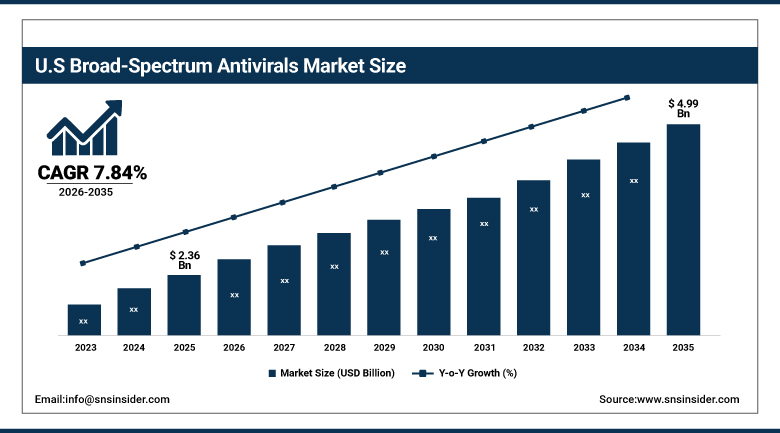
U.S. Broad-Spectrum Antivirals Market was valued at USD 2.36 billion in 2025 and is expected to reach USD 4.99 billion by 2035, growing at a CAGR of 7.84% from 2026-2035.
The U.S. Broad-Spectrum Antivirals Market is witnessing steady growth as a result of the increased threat posed by virus infections and the need for antiviral drugs that can treat multiple viruses or strains of viruses. Fears about newly emerging or re-emerging viral infections are leading to an increased investment in broad-spectrum antiviral drugs. Besides, rising health care costs, advances in antiviral drug discovery, and increasing research in this field are aiding in the growth of the market. The increased need for quick treatment solutions in cases of viral infections and pandemics is adding another dimension to the need for these antivirals. The collaboration between pharmaceutical companies and other organizations for the development of broad-spectrum antivirals is also aiding in the process.
NIH researchers reported progress toward a broad-spectrum antiviral capable of blocking infection from six deadly viruses representing three different viral families, demonstrating advances in multi-virus antiviral development.
Broad-Spectrum Antivirals Market Segment Analysis
-
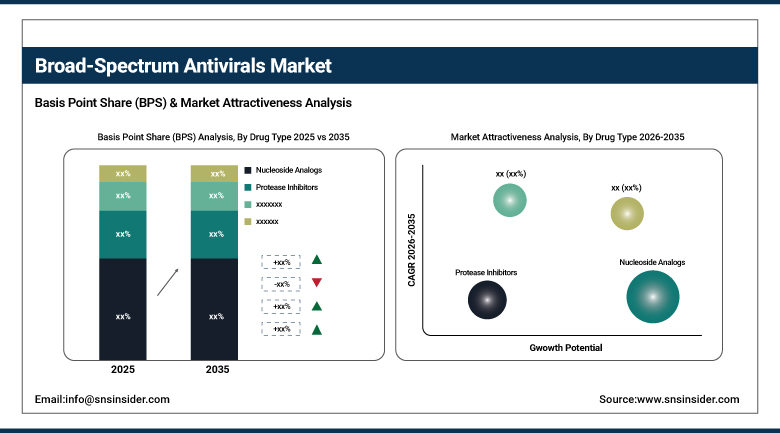
By Drug Type, Nucleoside Analogs dominate the Broad-Spectrum Antivirals Market with 43% share in 2025; Polymerase Inhibitors are expected to grow at the fastest CAGR of 9.86% from 2026–2035.
-
By Application, HIV dominates the Broad-Spectrum Antivirals Market with 40% share in 2025; Coronavirus is expected to grow at the fastest CAGR of 10.71% from 2026–2035.
-
By Route of Administration, Oral dominates the Broad-Spectrum Antivirals Market with 48% share in 2025; Injectable is expected to grow at the fastest CAGR of 8.83% from 2026–2035.
-
By Distribution Channel, Hospital Pharmacies dominate the Broad-Spectrum Antivirals Market with 44% share in 2025; Online Pharmacies are expected to grow at the fastest CAGR of 10.60% from 2026–2035.
-
By End-User, Hospitals dominate the Broad-Spectrum Antivirals Market with 54% share in 2025; Homecare is expected to grow at the fastest CAGR of 9.86% from 2026–2035.
By Drug Type, Nucleoside Analogs dominate the Broad-Spectrum Antivirals Market, Polymerase Inhibitors grow fastest.
Nucleoside Analogs segment dominated the Broad-Spectrum Antivirals Market with the highest revenue share of about 43% in 2025 owing to their well-documented clinical use, broad antiviral spectrum, and capacity to inhibit the synthesis of viral nucleic acid. Due to the wide use of these drugs for treating different types of viruses, proven safety record, and presence of several commonly used drugs in the category, they have a strong market presence.
Polymerase Inhibitors segment is expected to grow at the fastest CAGR of 9.86% from 2026-2035 due to increased studies on the development of antivirals that can block viral replication. With advancements made in drug discovery and molecular targeting, the development of inhibitors is improving. Growing worries about future outbreaks and demand for antivirals with broad-spectrum efficacy are expected to drive the market forward.
By Application, HIV dominates the Broad-Spectrum Antivirals Market, Coronavirus grows fastest.
HIV segment dominated the Broad-Spectrum Antivirals Market with the highest revenue share of about 40% in 2025 because of the ongoing burden of HIV infections throughout the world and the need for antiviral medication in the long term. There are extensive treatment programs, well-established treatment protocols, and demand for combination antiviral drugs in the market, which are strengthened by efforts to enhance treatment effectiveness and accessibility.
Coronavirus segment is expected to grow at the fastest CAGR of 10.71% from 2026-2035 as a result of the constant emergence of coronavirus strains and increasing need for antiviral medicines. The experience gathered from recent pandemics has spurred the funding of research into antiviral medicines. With greater surveillance, clinical studies, and research on new antivirals, market growth is likely to be stimulated worldwide.
By Route of Administration, Oral dominates the Broad-Spectrum Antivirals Market, Injectable grows fastest.
Oral segment dominated the Broad-Spectrum Antivirals Market with the highest revenue share of about 48% in 2025 because of easy administration, ease of use, patient compliance, and applicability in long-term outpatient therapy. Antiviral drugs administered orally can make treatment easier and more convenient than other forms of administration that require clinical help. Widespread availability of oral drugs and increased outpatient care make their usage more appealing.
Injectable segment is expected to grow at the fastest CAGR of 8.83% from 2026-2035 Due to the rising need for fast and dependable drug delivery especially in cases of serious infections. It can assist in enabling dosing and administration in cases where oral dosing is not feasible. Rising number of hospitalizations, advancements in antiviral drug formulations, and the need for effective treatment methods are likely to drive growth in the market.
By Distribution Channel, Hospital Pharmacies dominate the Broad-Spectrum Antivirals Market, Online Pharmacies grow fastest.
Hospital Pharmacies segment dominated the Broad-Spectrum Antivirals Market with the highest revenue share of about 44% in 2025 because of their importance in providing antiviral drugs for hospitalization and specialization. The hospitals ensure that there is controlled dispensation, professional monitoring, and availability of prescription drugs. The growing demands for antiviral treatment of infectious diseases, antiviral administration in hospitals, and already existing systems for pharmaceutical acquisition support the segment globally.
Online Pharmacies segment is expected to grow at the fastest CAGR of 10.60% from 2026-2035 because of growing digitization in the pharmaceutical supply chain and rising demand among consumers for convenient drug ordering. Digital platforms enable more access to products, delivery at home, and easier processing of prescriptions. Growing internet usage, increased use of digital healthcare solutions, and rising popularity of online drug purchases are expected to drive growth.
By End-User, Hospitals dominate the Broad-Spectrum Antivirals Market, Homecare grows fastest.
Hospitals segment dominated the Broad-Spectrum Antivirals Market with the highest revenue share of about 54% in 2025 Due to the high patient numbers, availability of specialized infectious disease services, and widespread use of antiviral drugs in treating infections. Hospitals offer professional monitoring and medication administration. Higher rates of infectious disease patients coupled with the development of healthcare infrastructure increase the need for antivirals.
Homecare segment is expected to grow at the fastest CAGR of 9.86% from 2026-2035 This is due to an increasing tendency towards convenience of outpatient care and enhanced availability of oral anti-viral drugs. Homecare reduces the need for visiting hospitals and ensures continued care. Increasing healthcare costs, remote monitoring facilities, older population demographics, and the decentralization of healthcare services will drive the trend towards homecare globally.
Regional Analysis
|
Region |
Major Country |
Share within Region, 2025 (%) |
|---|---|---|
|
North America |
United States |
92.0% |
|
Europe |
Germany |
23.0% |
|
Asia Pacific |
China |
40.0% |
|
Middle East & Africa |
UAE |
15.0% |
|
Latin America |
Brazil |
34.0% |
North America Broad-Spectrum Antivirals Market Insights
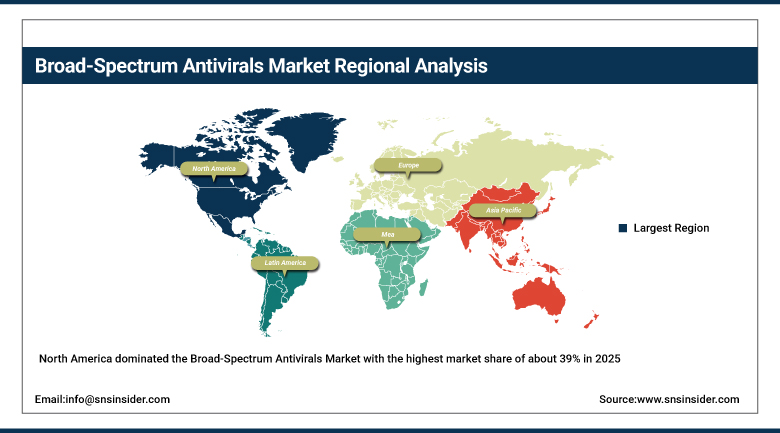
North America dominated the Broad-Spectrum Antivirals Market with the highest market share of about 39% in 2025, Driven by robust healthcare infrastructure, heavy investment in drug development, and high demand for antiviral treatments. Presence of pharmaceutical companies, well-developed clinical research, favorable regulatory conditions, and increased preparedness for new viruses also contribute to market dominance.
The U.S. Broad-Spectrum Antivirals Market accounted for a market share of 92.0%, Backed by a well-developed healthcare sector, robust R&D capacities in the pharmaceutical industry, and high demand for antiviral treatments, the market is expected to gain traction owing to rising investments in drug discovery, clinical research, and pandemic preparation. The presence of major pharmaceutical players and growing focus on emerging viruses is fueling market growth across the US.
Get Customized Report as per Your Business Requirement - Enquiry Now
Europe Broad-Spectrum Antivirals Market Insights
Europe Broad-Spectrum Antivirals Market is experiencing consistent growth due to the availability of sophisticated healthcare infrastructure, good pharmaceutical research facilities, and increased demand for efficient antiviral medicines that can effectively combat newly occurring as well as recurring viral infections. Increased investment in antiviral drugs, research, and pandemic preparations is driving market growth. Healthcare policies, existing pharmaceuticals firms, and innovations in antivirals are contributing to the growth of the regional market.
The Germany Broad-Spectrum Antivirals Market accounted for a market share of 23.0%, Powered by a robust healthcare system, good research base in pharmaceuticals, and rising need for antivirals. Increasing investments in drug discovery, clinical testing, and infectious diseases are driving adoption. Large pharmaceutical firms, healthcare programs, and increased emphasis on pandemic preparation are aiding market development in Germany.
Asia Pacific Broad-Spectrum Antivirals Market Insights
Asia Pacific is expected to grow at the fastest CAGR of about 9.45% from 2026–2035, Backed by an increase in viral infections and improvements in healthcare infrastructure and availability of anti-viral drugs. Expansion of drug manufacturing, increase in healthcare spending, government strategies for disease control and more investment in drug development within China, India, Japan, and South Korea are further propelling the regional market.
The China Broad-Spectrum Antivirals Market accounted for a market share of 40.0%, Backed by a considerable number of patients, improved healthcare infrastructure, and enhanced manufacturing capability of the pharmaceuticals. Higher demand for antiviral drugs and development in the field of drugs is fuelling the market growth. Governments' efforts to control diseases, increased clinical research, and higher spending on healthcare are further boosting the development of broad-spectrum antivirals in China.
Middle East & Africa and Latin America Broad-Spectrum Antivirals Market Insights
The Middle East & Africa and Latin America Broad-Spectrum Antivirals Market is gradually increasing due to an increasing burden of viral infections, improvement in healthcare infrastructure, and increasing availability of antiviral treatments. Increasing investment in drug production, disease control, and healthcare modernization is providing new opportunities. The government initiative, increasing clinical trials, increasing awareness regarding antiviral therapy, and preparedness against new infectious diseases are helping in market growth.
The UAE Broad-Spectrum Antivirals Market accounted for a market share of 15.0%, Backed by better infrastructure in healthcare facilities, availability of superior medication, and investment in modernizing the healthcare sector. Increasing demand for antiviral therapies, along with emphasis on disease management, is driving the market’s development. Other factors that have driven market growth in the UAE include government efforts towards healthcare, collaboration between pharma firms, and clinical research investments.
Market Dynamics
Growth Drivers: Increasing threat of emerging viral infections and future pandemics is accelerating demand for broad-spectrum antiviral therapies globally
The persistent emergence of novel viral pathogens is significantly driving demand for broad-spectrum antiviral therapies. Development of traditional antivirals usually involves development for specific pathogens, thus posing problems when a new virus appears and antiviral drugs for it are not yet available. Broad-spectrum antivirals are drugs that should affect multiple viruses due to common mechanisms of action in them or in the host organism. Recent studies have shown the necessity of broad-spectrum drugs for pandemic preparation because of the slow development of pathogen-specific drugs. Therefore, the danger posed by such viruses as respiratory viruses, coronaviruses, filoviruses, and many others is driving pharmaceutical companies and laboratories to develop antiviral drugs working on multiple viral types.
Restraints: High development complexity and limited clinical validation can restrict commercialization of broad-spectrum antiviral candidates
The development of broad-spectrum antiviral drugs remains technically and clinically challenging. It is necessary to show a substantial antiviral effect against different pathogens while ensuring adequate safety. Drugs directed against the host may interfere with the physiological functioning of cells, thus posing problems with toxicity and therapeutic windows. In addition, the ability to inhibit the virus in the lab does not guarantee success in clinical practice. The most recent studies have identified safety and the transition from in-vitro efficiency to in-vivo efficiency as the major barriers for the development of broad-spectrum host-targeting antivirals. These scientific difficulties will delay the development process and increase expenses.
Opportunities: Growing investment in pandemic preparedness creates significant opportunities for next-generation broad-spectrum antiviral drug developers globally
Increasing emphasis on pandemic preparedness is creating substantial opportunities for broad-spectrum antiviral developers. It is clear from the current COVID-19 pandemic that using pathogen-specific therapies alone was not effective and the importance of having a therapy developed prior to the emergence of a new pathogen became evident. In contemporary studies, more attention is paid to viruses as a whole and the use of host pathways for a rapid response to various pathogens. In recent experiments, promising antiviral activities against several highly pathogenic viruses have been observed through targeted therapy against conserved carbohydrate residues in virus membranes. Thus, drug development companies and governmental research institutions can develop a platform for antiviral drugs development.
Recent Developments:
-
2026 : Gilead Sciences advanced its virology portfolio with continued development of antiviral therapies and received FDA approval for Bixlenvo™, a once-daily bictegravir/lenacapavir combination for virologically suppressed adults with HIV.
-
2026 : Shionogi received U.S. FDA approval for XOCOVA® (ensitrelvir), expanding its antiviral portfolio with an oral treatment designed to help prevent COVID-19 following exposure.
-
2026 : Enanta Pharmaceuticals advanced its zelicapavir clinical development program for respiratory syncytial virus (RSV), strengthening its pipeline of small-molecule antiviral therapies targeting respiratory viral infections.
-
2026 : Gilead continued expanding its research into emerging and neglected viral diseases, pursuing broad antiviral preparedness strategies aimed at developing countermeasures against future viral threats and potential pandemics.
Broad-Spectrum Antivirals Market key players are:
-
Gilead Sciences, Inc.
-
Roche Holding AG
-
Merck & Co., Inc.
-
GSK plc
-
Johnson & Johnson
-
Pfizer Inc.
-
AbbVie Inc.
-
Bristol Myers Squibb Company
-
Novartis AG
-
Sanofi S.A.
-
Atea Pharmaceuticals, Inc.
-
Shionogi & Co., Ltd.
-
BioCryst Pharmaceuticals, Inc.
-
Enanta Pharmaceuticals, Inc.
-
Vir Biotechnology, Inc.
-
Cocrystal Pharma, Inc.
-
Cipla Limited
-
Dr. Reddy’s Laboratories Ltd.
-
Sun Pharmaceutical Industries Ltd.
-
Viatris Inc.
Broad-Spectrum Antivirals Market Report Scope:
| Report Attributes | Details |
|---|---|
| Market Size in 2025 | USD 6.7 Billion |
| Market Size by 2035 | USD 14.44 Billion |
| CAGR | CAGR of 8.04% From 2026 to 2035 |
| Base Year | 2025 |
| Forecast Period | 2026-2035 |
| Historical Data | 2022-2024 |
| Report Scope & Coverage | Market Size, Segments Analysis, Competitive Landscape, Regional Analysis, DROC & SWOT Analysis, Forecast Outlook |
| Key Segments | • By Drug Type (Nucleoside Analogs, Protease Inhibitors, Polymerase Inhibitors, Fusion Inhibitors, Others) • By Application (Influenza, Hepatitis, HIV, Coronavirus, Others) • By Route of Administration (Oral, Injectable, Others) • By Distribution Channel (Hospital Pharmacies, Retail Pharmacies, Online Pharmacies, Others) • By End-User (Hospitals, Clinics, Homecare, Others) |
| Regional Analysis/Coverage | North America (US, Canada), Europe (Germany, UK, France, Italy, Spain, Russia, Poland, Rest of Europe), Asia Pacific (China, India, Japan, South Korea, Australia, ASEAN Countries, Rest of Asia Pacific), Middle East & Africa (UAE, Saudi Arabia, Qatar, South Africa, Rest of Middle East & Africa), Latin America (Brazil, Argentina, Mexico, Colombia, Rest of Latin America). |
| Company Profiles | Gilead Sciences, Inc., Roche Holding AG, Merck & Co., Inc., GSK plc, Johnson & Johnson, Pfizer Inc., AbbVie Inc., Bristol Myers Squibb Company, Novartis AG, Sanofi S.A., Atea Pharmaceuticals, Inc., Shionogi & Co., Ltd., BioCryst Pharmaceuticals, Inc., Enanta Pharmaceuticals, Inc., Vir Biotechnology, Inc., Cocrystal Pharma, Inc., Cipla Limited, Dr. Reddy’s Laboratories Ltd., Sun Pharmaceutical Industries Ltd., and Viatris Inc. |

Frequently Asked Questions
Key opportunities in the broad-spectrum antivirals market include increasing investment in antiviral drug development, expansion of pandemic preparedness programs, and growing demand for therapies targeting emerging and re-emerging viral infections.
The market is driven by increasing prevalence of viral infections, rising demand for effective antiviral therapies, and growing investments in broad-spectrum drug development and pandemic preparedness.
The Nucleoside Analogs segment dominated the Broad-Spectrum Antivirals Market, accounting for approximately 42.30% market share.
