
Spectrum Analyzer Market Report Scope & Overview:
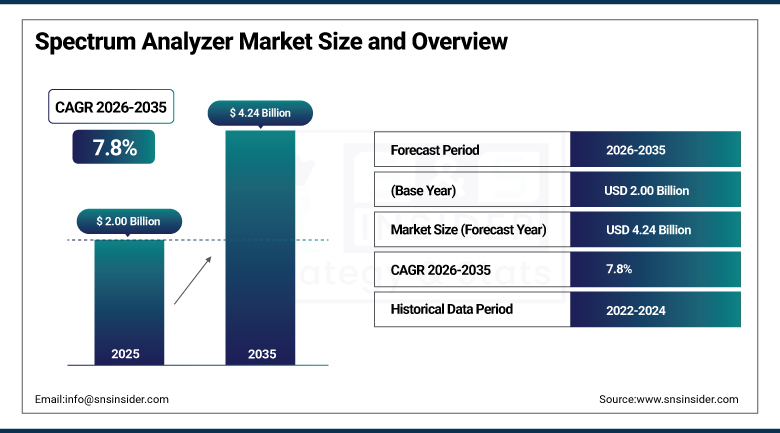
The Spectrum Analyzer Market size was valued at USD 2.00 Billion in 2025 and is projected to reach USD 4.24 Billion by 2035, registering a CAGR of 7.8% from 2026 to 2035.
The Spectrum Analyzer Market includes electronic test instruments that provide the amplitude of the signal as a function of frequency. The market is driven by the increasing need for regulatory compliance verification, deployment of wireless networks, and complexity of radar/electronic warfare applications. With the increasing complexity of wireless networks and 5G network deployment, the market will continue to grow until 2025. The increase in use of portable, real-time, and vector signal spectrum analyzers has increased their adoption rate and replaced traditional testing equipment due to better performance in terms of bandwidth analysis, interference analysis, and real-time monitoring capabilities for the complex radio frequency environment. Increasing use of IoT devices, self-driving vehicles, and radars has increased demand for high-performance spectrum analyzer operating in ultra-high frequency and millimeter wave range.
In June 2025, Keysight Technologies announced the acquisition of a high-frequency signal analytics software business. The move helped Keysight Technologies establish itself as one of the leading players in the RF test and measurement market segment.
Market Size and Forecast
-
Market Size in 2026E: USD 2.16 Billion
-
Market Size by 2035: USD 4.24 Billion
-
CAGR: 7.8% from 2026 to 2035
-
Fastest Growing Region: Asia Pacific
-
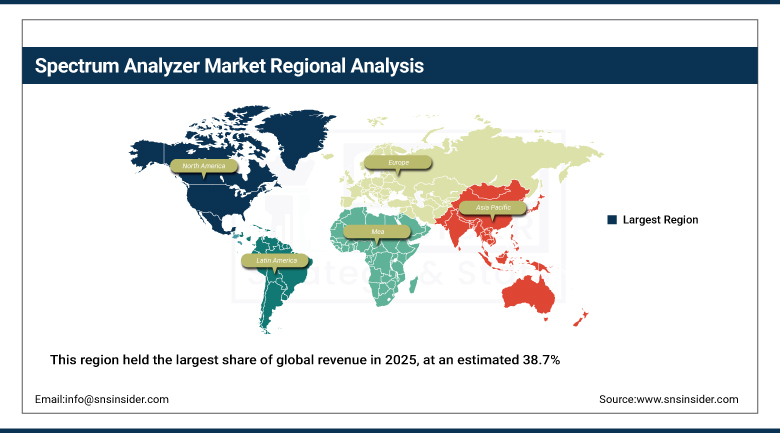
Largest Region: North America (38.7% share in 2025)
To Get more information On Spectrum Analyzer Market - Request Free Sample Report
Spectrum Analyzer Market Trends
-
Over 72% of technological advancements in the category continued being driven by innovation in signal processing, spectrum monitoring, and vector analysis.
-
Leading vendors continued investing in portable analyzers, software-defined measurement platforms, and cloud-based data analytics to expand usability.
-
Approximately 64% of enterprises continued engaging in regional collaboration with telecom clusters, aerospace hubs, and educational research centers to strengthen local support infrastructure.
-
Rising integration of AI-based signal processing continued enabling faster sweep times, enhanced resolution, and smarter analytics across increasingly complex RF environments.
-
Handheld and portable instruments continued gaining popularity due to field testing needs across mobile communication expansion and defense applications.
U.S. Spectrum Analyzer Market Size Outlook
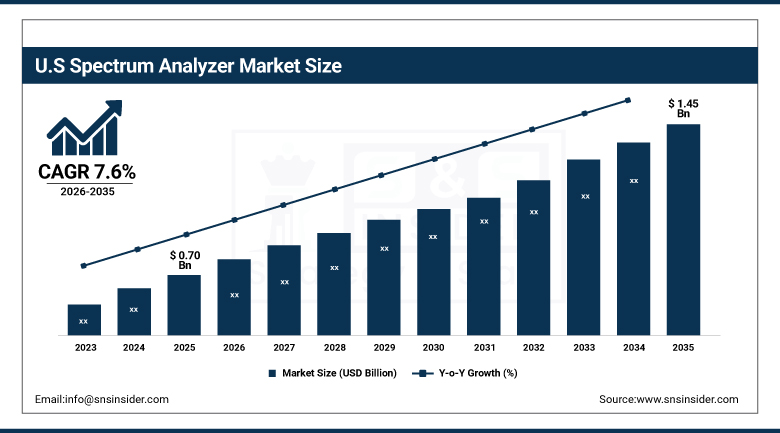
The U.S. Spectrum Analyzer Market was valued at approximately USD 0.70 Billion in 2025 and is projected to reach approximately USD 1.45 Billion by 2035, registering a CAGR of approximately 7.6% from 2026 to 2035.
The growth of the U.S. market in 2025 was fueled by rising demand in telecommunications, aerospace and defense, electronics assembly, and academic institutions. Deployment of 5G infrastructure, utilization of wireless communication technologies, and increasing complexity of RF environment contributed to increased equipment investment and unit sales in previous years that surpassed 47,000 units per year due to high number of testing and measuring infrastructure in the United States. Development of signal analyzing capabilities, portable and real-time analyzing equipment, as well as investments into testing and measuring infrastructure helped to boost the domestic market outlook with high concentration of large telecommunication, aerospace and semiconductor companies located in the USA.
In March 2025, Rohde & Schwarz completed its acquisition of a 5G and microwave test technology provider with wideband signal processing solutions and improved American customer support capabilities.
Spectrum Analyzer Market Segment Analysis
-
By Offering, Hardware led the market with an estimated 72.4% share in 2025, while Software was the fastest-growing offering, tracking a projected 10.2% CAGR.
-
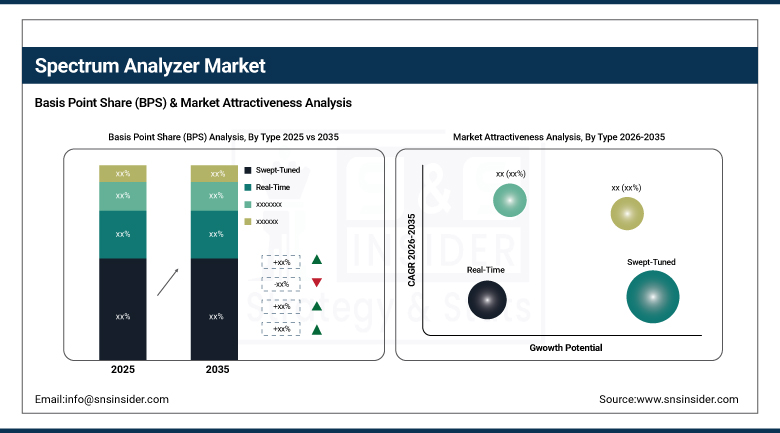
By Type, Swept-Tuned instruments led with an estimated 44.7% share in 2025, while Real-Time instruments were the fastest-growing type, tracking a projected 11.1% CAGR.
-
By Frequency Range, Below 6 GHz led with an estimated 53.8% share in 2025, reflecting extensive deployment across wireless communication systems and conventional RF infrastructure.
-
By Form Factor, Handheld and portable instruments were the fastest-growing form factor, tracking a projected 10.4% CAGR, supported by rising field-testing requirements.
-
By Network Technology, Wireless led with an estimated 67.2% share in 2025, driven by rapid expansion of 5G infrastructure, IoT ecosystems, and satellite communication systems.
Hardware Leads the Offering Segment While Software Grows Fastest
Hardware captured the dominating market share among offerings in 2025, representing an estimated 72.4%, due to the inherent requirement for physical instrumentation that was able to measure and analyze the frequency of signals. The superior ability of such equipment to accurately and reliably perform these operations in a variety of environments was what ensured their superiority where frequency measurement and electromagnetic interference testing were concerned.
Software emerged as the fastest-growing segment in terms of offerings, posting a 10.2% CAGR during the forecast period, due to increasing use of cloud-connected testing software, AI-enabled signal diagnostics and analysis software solutions. Demand for remotely accessible test software that could help optimize wireless networks saw this segment grow increasingly popular, as it allowed the existing hardware to perform more sophisticated analyses than ever before.
Swept-Tuned Instruments Lead Type Segmentation While Real-Time Grows Fastest
The dominant market segment share by type was swept-tuned instruments, at an estimated 44.7%, because of their popularity in traditional RF signal testing, broadcast monitoring, and telecommunication infrastructure maintenance applications. They continued being popular due to their cost-effectiveness for frequency domain measurements in an environment that didn't require a real-time measurement capability.
Real-time instruments saw the highest increase among all other segments in 2025, growing at a projected 11.1% CAGR driven by the increasing use in 5G communication testing, radar monitoring, and electronic warfare. The growing need for instant measurements of signals became the key driver for the market of real-time instruments growing much faster than the rest of the market dominated by swept-tuned instruments.
Sub-6 GHz Instruments Dominate Frequency Range Segmentation
Devices functioning below 6 GHz had the dominant market share in 2025, making up 53.8% of the segment because of their widespread use in wireless communication systems, Wi-Fi testing, IoT devices, and RF systems. The constant use of 4G infrastructure and short-range communication technology helped create continuous demand for these devices, owing to their cost-effectiveness and reliability across all kinds of testing requirements.
Devices working in the 6 to 18 GHz range, as well as above 18 GHz, catered to more specific requirements such as radar testing, satellite communication, defense communications, and millimeter-wave systems. With 5G millimeter-wave usage and 6G prototype testing gaining momentum, there was increasing demand for these types of devices despite sub-6 GHz devices still making up the largest market share.
Handheld Instruments Record Fastest Form Factor Growth
Benchtop instruments still remained to be the more established type of equipment in 2025 due to their wide application in labs, plants, and other places where thorough and complete spectral analysis was needed. The superior design of the benchtop instruments and their advantages over the handheld instruments allowed RF and microwave engineers to select them for precise research.
Handheld and portable instruments recorded the fastest growth among form factors in 2025, tracking a projected 10.4% CAGR, supported by increasing field-testing requirements across telecommunication infrastructure deployment, military communication systems, and industrial wireless network monitoring applications. Rising demand for lightweight, battery-powered testing devices continued contributing to this segment's growth as field technicians and defense personnel increasingly needed genuinely portable measurement capability.
Wireless Network Technology Dominates the Segment
Wireless Network Technology accounted for the dominant revenue market share in 2025, estimated to be around 67.2% due to fast expansion of 5G infrastructures, IoT systems, satellite communications and wireless consumer electronics across the globe. The complexity of wireless spectrum environments increased the demand for sophisticated radio frequency monitoring devices that could deal with such complexity.
Wired Network Technology was witnessing gradual growth in 2025, mainly fueled by rising deployment of high-speed data centers, industrial Ethernet and fiber optic communication systems. With the rise of global development of data centers and industrial automation, the need for wired-network-oriented testing equipment increased accordingly.
Regional Analysis
|
Region |
Major Country |
Share within Region, 2025 (%) |
|---|---|---|
|
North America |
United States |
83.20% |
|
Europe |
Germany |
24.30% |
|
Asia Pacific |
China |
31.60% |
|
Middle East & Africa |
UAE |
26.85% |
|
Latin America |
Brazil |
34.90% |
North America Spectrum Analyzer Market Insights
This region held the largest share of global revenue in 2025, at an estimated 38.7%, supported by strong investments in 5G infrastructure, early adoption of advanced RF testing technologies, and the presence of major telecommunications, aerospace, and semiconductor companies across the United States and Canada. Strong research infrastructure alongside sustained aerospace and defense spending kept this region firmly in the lead across virtually every application category.
The United States accounted for roughly 83.20% of regional revenue in 2025, anchored by deep telecommunications, aerospace, and semiconductor sector investment. Canada added further regional demand through its own growing wireless infrastructure and defense communications sectors, and that combined regional strength kept this region the largest addressable base for equipment vendors through the forecast period.
Get Customized Report as per Your Business Requirement - Enquiry Now
Europe Spectrum Analyzer Market Insights
This region maintained dominance alongside North America in 2025, supported by strong research infrastructure, sustained aerospace and defense spending, and advanced communication laboratories across the continent's major economies. Continuous innovation in signal processing and vector analysis, often conducted in close collaboration with regional research institutes, kept the continent a genuinely important contributor to global technology development.
Germany led regional demand at roughly 24.30% of European revenue, supported by its substantial industrial and aerospace manufacturing base. The UK and France contributed substantial additional demand, and continued European investment in defense communications and 5G infrastructure should keep regional demand climbing through the forecast period.
Asia Pacific Spectrum Analyzer Market Insights
In terms of growth, this region proved to be the fastest growing globally in 2025, exhibiting a CAGR of around 10.2% during the forecast period, owing to fast advancements in telecommunication sector, growth in electronics manufacture and robust deployment of 5G technology in major economies in the region. Fast adoption of technology and domestic manufacturing capacity further enhanced this region’s growth trend far ahead of every other region analyzed in this report.
Among the regions, China remained the leader on the back of substantial investment in telecommunication infrastructure and electronics manufacturing center in the world. Additional demand came from India and Japan, wherein the latter benefitted from substantial investment in telecom infrastructure and fast adoption of IoT and smart cities driving demand for advanced signal analysis solutions.
MEA & Latin America Spectrum Analyzer Market Insights
These regions both showed steady growth in 2025, driven by expanding telecommunications infrastructure investment, growing defense modernization programs, and rising government focus on wireless network deployment across both areas. As these economies continued building out modern communications infrastructure, demand for reliable testing and measurement equipment grew correspondingly from a comparatively smaller base than in more mature markets.
The UAE led Middle East & Africa demand, supported by substantial telecommunications infrastructure investment and defense modernization programs. Saudi Arabia contributed further regional demand through its own infrastructure development initiatives. In Latin America, Brazil accounted for the largest share of regional revenue, with growing telecommunications and industrial automation investment continuing to anchor regional demand for signal analysis equipment.
Market Dynamics
Growth Drivers: 5G Deployment and Regulatory Compliance Requirements
The increased complexity of wireless networks and the introduction of the 5G technology were the key factors in the equipment demand over the period under review, when the category posted growth of more than 35% in recent years in accordance with the industry reports. The telecommunication companies, the equipment vendors and regulatory bodies depended on the usage of such devices to perform the spectrum monitoring and management activities effectively, including the interference detection and resolution and compliance check with the specific frequency bands.
The regulatory compliance requirements continued being the key factor behind the equipment demand in 2025, as the telecommunications companies and other regulatory authorities needed the verification of the spectrum efficiency and interference-free operation of the frequencies, which became more and more crowded. With the proliferation of the wireless technologies for civilian, industrial and military purposes, the need in the frequencies monitoring increased accordingly.
Restraints: High Equipment Costs and Skilled Technician Requirements
High equipment costs and complex calibration requirements continued restraining faster adoption throughout 2025, particularly among smaller organizations and research institutions operating on constrained budgets. The need for skilled technical personnel capable of properly calibrating and operating advanced instruments added a further genuine barrier, as specialized RF engineering expertise remained in comparatively short supply relative to demand.
The growing usage of software-defined radios and software-based signal analysis technologies represented a further, longer-term challenge throughout 2025, as some traditional hardware-centric revenue models faced genuine pressure from increasingly capable, lower-cost software alternatives. That technology transition, while creating opportunity for software-forward vendors, continued complicating revenue and margin planning for manufacturers still primarily reliant on hardware sales.
Opportunities: IoT Network Testing and Automated RF Measurement Systems
Growing demand for IoT network testing and satellite communication monitoring represented a genuinely significant opportunity throughout 2025, as the proliferation of connected devices across consumer, industrial, and infrastructure applications continued expanding the addressable base of equipment requiring precise, ongoing spectrum validation. Vendors offering genuinely scalable, cost-effective testing solutions stood to capture meaningful share of this rapidly expanding device population.
Wider adoption of automated RF measurement systems offered a second substantial opportunity, as facilities increasingly sought to reduce dependence on manual, skilled-technician-driven testing workflows in favor of automated, software-orchestrated measurement processes. As AI-driven analytics and cloud-based data platforms continued maturing, vendors that could deliver genuinely automated, remotely monitored testing infrastructure stood to capture meaningful share as enterprises consolidated around fewer, more capable measurement platforms.
Recent Developments:
-
June 2025: Keysight Technologies acquired a high-frequency signal analytics software business, reinforcing its position as a leader in the RF test and measurement segment and enhancing its spectrum analysis capability.
-
March 2025: Rohde & Schwarz completed the acquisition of a 5G and microwave test technology provider, integrating wideband signal processing platforms into its broader testing and measurement portfolio.
-
November 2023: Signal Hound launched its SP145 spectrum analyzer, expanding the company's lineup of accessible, high-performance test equipment aimed at field engineers and smaller research institutions.
Spectrum Analyzer Companies are:
-
Rohde & Schwarz GmbH & Co KG
-
Anritsu Corporation
-
Tektronix, Inc. (Fortive Corporation)
-
National Instruments Corporation (Emerson Electric Co.)
-
Anapico AG
-
Signal Hound, LLC
-
Siglent Technologies Co., Ltd.
-
Advantest Corporation
-
Yokogawa Electric Corporation
-
Berkeley Nucleonics Corporation
-
B&K Precision Corporation
-
GW Instek (Good Will Instrument Co., Ltd.)
-
Aaronia AG
-
RF Explorer (Seeed Technology Co., Ltd.)
-
Narda Safety Test Solutions GmbH
-
Teledyne LeCroy, Inc.
-
Bird Technologies
-
Boonton Electronics Corporation
Spectrum Analyzer Market Report Scope:
| Report Attributes | Details |
|---|---|
| Market Size in 2025 | USD 2.00 Billion |
| Market Size by 2035 | USD 4.24 Billion |
| CAGR | CAGR of 7.8% From 2026 to 2035 |
| Base Year | 2025 |
| Forecast Period | 2026-2035 |
| Historical Data | 2022-2024 |
| Report Scope & Coverage | Market Size, Segments Analysis, Competitive Landscape, Regional Analysis, DROC & SWOT Analysis, Forecast Outlook |
| Key Segments | • By Offering (Hardware, Software) • By Type (Swept-Tuned, Real-Time, Vector Signal, FFT) • By Frequency Range (Below 6 GHz, 6–18 GHz, Above 18 GHz) • By Form Factor (Benchtop, Handheld/Portable) • By Network Technology (Wireless, Wired) |
| Regional Analysis/Coverage | North America (US, Canada), Europe (Germany, UK, France, Italy, Spain, Russia, Poland, Rest of Europe), Asia Pacific (China, India, Japan, South Korea, Australia, ASEAN Countries, Rest of Asia Pacific), Middle East & Africa (UAE, Saudi Arabia, Qatar, South Africa, Rest of Middle East & Africa), Latin America (Brazil, Argentina, Mexico, Colombia, Rest of Latin America). |
| Company Profiles | Keysight Technologies, Inc., Rohde & Schwarz GmbH & Co KG, Anritsu Corporation, Tektronix, Inc. (Fortive Corporation), National Instruments Corporation (Emerson Electric Co.), Anapico AG, Signal Hound, LLC, RIGOL Technologies, Inc., Siglent Technologies Co., Ltd., Advantest Corporation, Yokogawa Electric Corporation, Berkeley Nucleonics Corporation, B&K Precision Corporation, GW Instek (Good Will Instrument Co., Ltd.), Aaronia AG, RF Explorer (Seeed Technology Co., Ltd.), Narda Safety Test Solutions GmbH, Teledyne LeCroy, Inc., Bird Technologies, Boonton Electronics Corporation. |

Frequently Asked Questions
The Spectrum Analyzer Market is expected to grow at a CAGR of approximately 7.8% from 2026 to 2035, based on triangulated secondary research estimates.
The Spectrum Analyzer Market was valued at approximately USD 2.00 Billion in 2025, based on triangulation across multiple independent research sources.
The major growth factor is growing complexity of wireless networks and rapid deployment of 5G technology, combined with rising regulatory compliance requirements.
The Hardware segment dominated the Spectrum Analyzer Market by offering, representing an estimated 72.4% of revenue in 2025.
North America dominated the Spectrum Analyzer Market in 2025, holding an estimated 38.7% share of total global market revenue.
