
Sterile Injectables CDMO Market Report Scope & Overview:
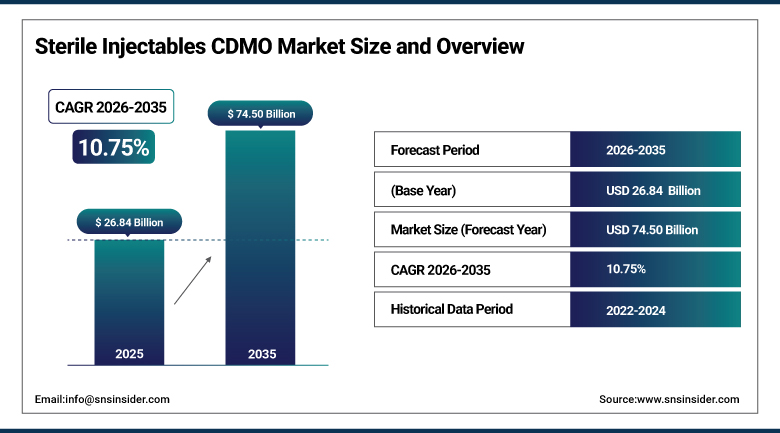
The Sterile Injectables CDMO Market was valued at USD 26.84 Billion in 2025 and is expected to reach USD 74.50 Billion by 2035, growing at a CAGR of 10.75% from 2026-2035.
The Sterile Injectables CDMO Market is expanding as drug developers outsource formulation, aseptic filling, lyophilization, inspection and packaging of injectable medicines to specialist partners. Biologics, peptide therapies, vaccines and antibody-drug conjugates require isolator-based filling lines and strict contamination control that many sponsors prefer not to build themselves. Capacity shortages, drug shortage concerns and onshoring policies are driving new investment in the United States and Europe. Contract manufacturers are adding prefilled syringe and cartridge lines to serve self-injection products. Regulatory inspections and quality records shape partner choice.
⮞In July 2026, the U.S. Food and Drug Administration listed 46 novel drug approvals by its drug center for 2025. A steady flow of new injectable therapies keeps demand high for sterile manufacturing capacity.
To Get more information Sterile Injectables CDMO Market - Request Free Sample Report
Sterile Injectables CDMO Market Trends
- Growth of prefilled syringe and cartridge lines for self-injection products
- Isolator-based aseptic filling replacing open and RABS lines
- Expansion of antibody-drug conjugate and high-potency injectable capacity
- Acquisitions of pharmaceutical sterile sites by contract manufacturers
- Onshoring of injectable production in the U.S. and Europe
U.S. Sterile Injectables CDMO Market Outlook
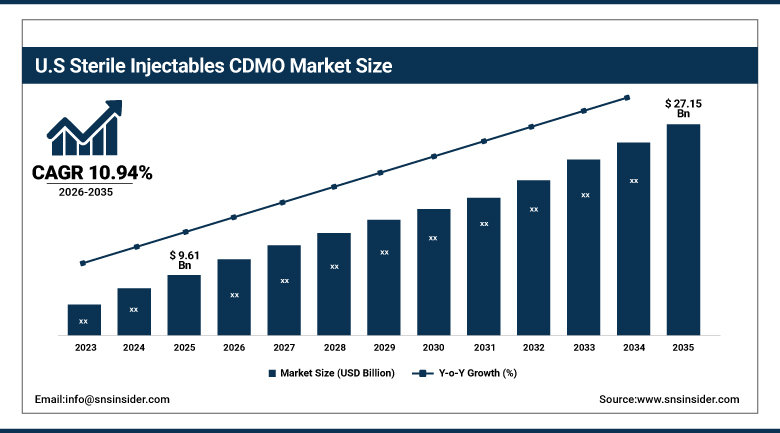
The U.S. Sterile Injectables CDMO Market was valued at USD 9.61 Billion in 2025 and is expected to reach USD 27.15 Billion by 2035, growing at a CAGR of 10.94% from 2026-2035.
The U.S. Sterile Injectables CDMO Market is the largest national market, supported by a deep biotechnology pipeline, a large installed base of injectable brands and strong policy attention to drug shortages. Venture-funded biotech companies depend on contract partners for clinical and commercial filling. Contract manufacturers have bought pharmaceutical sterile sites in New Jersey, Arizona, Indiana and California to add capacity. Federal onshoring programs and tariff measures are encouraging local production. Inspection findings by regulators influence which partners sponsors select.
⮞In July 2026, the American Society of Health-System Pharmacists reported 227 active U.S. drug shortages in the second quarter, the third straight quarterly increase. Persistent shortages of sterile injectables are drawing investment into new filling capacity.
Sterile Injectables CDMO Market Segment Analysis
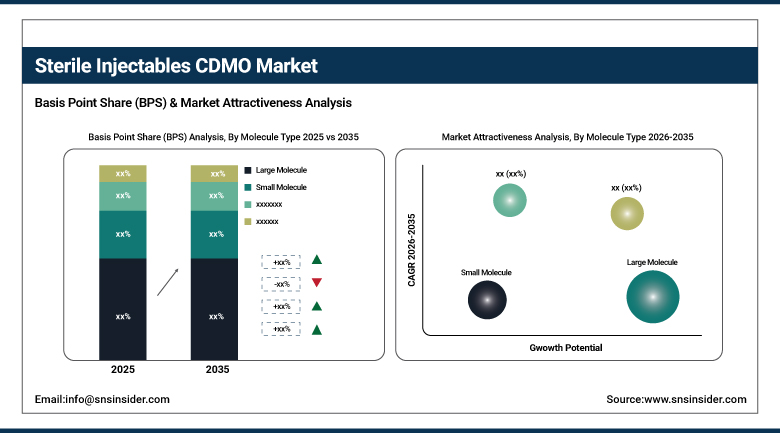
- By Molecule Type, the Large Molecule segment dominated the Sterile Injectables CDMO Market with approximately 65.11% share in 2025, and is also the fastest growing with a CAGR of approximately 11.85%.
- By Service Type, the Manufacturing segment dominated the Sterile Injectables CDMO Market with approximately 54.13% share in 2025, while the Analytical and Testing segment is the fastest growing with a CAGR of approximately 13.03%.
- By Dosage Form, the Vials and Ampoules segment dominated the Sterile Injectables CDMO Market with approximately 41.30% share in 2025, while the Prefilled Syringes segment is the fastest growing with a CAGR of approximately 11.36%.
- By End User, the Pharmaceutical Companies segment dominated the Sterile Injectables CDMO Market with approximately 56.71% share in 2025, while the Biotechnology Companies segment is the fastest growing with a CAGR of approximately 11.35%.
By Molecule Type, Large Molecule Dominates the Sterile Injectables CDMO Market and Is Also the Fastest Growing
Large molecules, mainly monoclonal antibodies, vaccines, peptides, fusion proteins and cell-derived products, lead because almost all of them must be given by injection. These products are sensitive to heat and shear, so they need gentle aseptic filling, controlled cold-chain handling and often lyophilization. Few sponsors own such capacity, which makes outsourcing the norm and keeps utilization at contract sites high.
The same segment leads growth as biologics pipelines expand into oncology, immunology, obesity and rare diseases. New formats such as antibody-drug conjugates, bispecifics and long-acting peptides demand isolator filling, potent compound containment and small-batch flexibility. Biosimilar launches add volume, and sponsors seeking speed to clinic choose partners with integrated drug substance and drug product services.
⮞In April 2026, Samsung Bioepis reported that 92 biosimilars covering 20 molecules had been approved in the United States, with 67 launched. The count shows the steady widening of biologic injectable supply.
By Service Type, Manufacturing Dominates the Sterile Injectables CDMO Market and Analytical and Testing Grows Fastest
Manufacturing leads because aseptic filling, lyophilization, inspection and packaging are the core reasons sponsors turn to contract partners. Building a sterile line requires heavy investment, clean-room expertise and years of regulatory validation. Outsourcing converts these fixed costs into campaign fees. Commercial supply agreements run for many years, which gives manufacturing services the largest weight in total demand.
Analytical and testing services are the fastest growing as regulators raise expectations for sterility assurance, particulate control, extractables and leachables, and container closure integrity. Complex biologics and conjugates need advanced characterization before and after filling. Sponsors prefer partners that can offer release testing and stability studies under one quality system, and CDMOs are adding laboratories to capture this work.
⮞In 2025, Lonza announced a USD 547 million large-scale commercial drug product fill-finish facility in Stein, Switzerland, due to be operational in 2027. The investment shows how providers are scaling manufacturing capacity.
By Dosage Form, Vials and Ampoules Dominate the Sterile Injectables CDMO Market and Prefilled Syringes Grow Fastest
Vials and ampoules lead because they remain the standard container for hospital-administered drugs, lyophilized products and many biologics. They are cost-effective, widely accepted by regulators and suitable for both liquid and freeze-dried formulations. Established filling lines, inspection systems and stoppering equipment keep capacity abundant. Generic injectables and clinical-stage products also lean on vial formats.
Prefilled syringes are the fastest growing as sponsors move toward self-administration, convenience and dose accuracy. Autoinjector and pen platforms for diabetes, obesity, autoimmune and migraine therapies rely on syringes and cartridges. Filling them requires specialized nest-and-tub equipment, siliconization control and device assembly. Contract providers are installing new syringe lines to meet growing demand.
⮞In April 2025, PCI Pharma Services announced the acquisition of Ajinomoto Althea, a San Diego provider with large-scale aseptic facilities for prefilled syringes, cartridges and potent vial filling. The deal added dedicated injectable capacity to PCI's network.
By End User, Pharmaceutical Companies Dominate the Sterile Injectables CDMO Market and Biotechnology Companies Grow Fastest
Pharmaceutical companies lead because they run large portfolios of injectable brands and generics and use contract partners to add capacity, handle peaks and transfer technology between sites. Large drugmakers often sign multi-year supply agreements covering commercial volumes. Tariff and shortage concerns are prompting them to qualify second sources, which adds to outsourced volume.
Biotechnology companies are the fastest growing as many have no manufacturing assets and rely on partners from preclinical supply to launch. Venture funding for oncology, metabolic and rare disease programs creates new demand for small clinical batches and quick tech transfers. Emerging companies value partners that offer development, analytical work and fill-finish in one location, which speeds timelines.
⮞In January 2026, Samsung Biologics announced that its fifth plant adds 180,000 liters of capacity, taking its Korean capacity to 784,000 liters. The expansion shows the scale at which outsourcing partners are preparing for biopharma demand.
Regional Analysis
|
Region |
Major Country |
Share within Region, 2025 (%) |
|---|---|---|
|
North America |
U.S. |
89.20 |
|
Europe |
Germany |
28.14 |
|
Asia Pacific |
China |
38.27 |
|
Latin America |
Brazil |
41.35 |
|
Middle East & Africa |
Saudi Arabia |
33.58 |
North America Sterile Injectables CDMO Market Insights
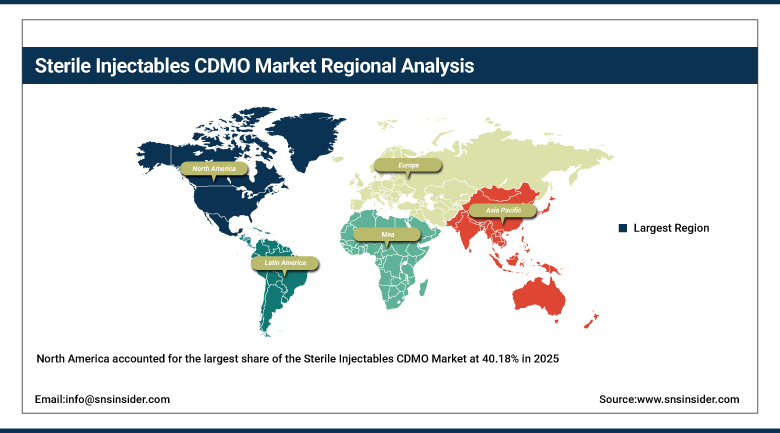
North America accounted for the largest share of the Sterile Injectables CDMO Market at 40.18% in 2025, led by the United States. The region has the world's deepest biotechnology pipeline, the largest base of injectable brands and the strictest regulatory expectations. Sponsors rely on contract partners across New Jersey, Indiana, Arizona, North Carolina and California for clinical and commercial filling.
Capacity additions are underway. Providers are acquiring pharmaceutical sterile sites and adding isolator lines for prefilled syringes, cartridges and potent compounds. Federal onshoring programs and import tariff measures are encouraging local production, while FDA inspection outcomes strongly influence partner selection. Skilled labor and clean-room construction timelines remain the main constraints on speed.
⮞In September 2025, Thermo Fisher Scientific completed its acquisition of Sanofi's sterile fill-finish site in Ridgefield, New Jersey. More than 200 employees joined the company with the site.
Get Customized Report as per Your Business Requirement - Enquiry Now
Europe Sterile Injectables CDMO Market Insights
Europe Sterile Injectables CDMO Market is led by Germany, Switzerland, Italy, Spain, France and the United Kingdom. The region is home to some of the oldest and largest aseptic fill-finish specialists, and it supplies many of the world's biologics and vaccines. Pharmaceutical hubs in Germany, Belgium and Ireland attract continuous investment.
Providers are modernizing legacy lines to isolator technology and adding prefilled syringe capacity. Italy and Switzerland are seeing multi-line expansions, and acquisitions of German sterile sites are widening networks. Annex 1 contamination control requirements are pushing upgrades, and energy cost and skilled labor supply influence expansion plans. Demand from European sponsors and exports to North America sustain utilization.
⮞In June 2026, the European Medicines Agency reported that 104 human medicines were recommended for marketing authorization in 2025, 38 of them with a new active substance. The approvals widen the pool of injectable products needing manufacturing partners.
Asia Pacific Sterile Injectables CDMO Market Insights
Asia Pacific is projected to be the fastest growing region, with a CAGR of 12.00% over 2026-2035. China, South Korea, India and Japan lead. Korean and Chinese biologics specialists have built very large drug substance capacity and are adding drug product lines, while India is a hub for generic injectables.
Western sponsors are looking to Asia for cost-effective capacity and speed, and local biotech companies are outsourcing as pipelines grow. Government programs, including India's production-linked incentives, support investment. Geopolitical concerns and biosecure legislation influence how some sponsors split their supply. Quality systems are improving as plants obtain approvals from the FDA and European regulators.
⮞In May 2026, WuXi Biologics announced that its 18th drug product facility in Shanghai reached GMP release, with isolator-based liquid and lyophilized vial filling. The plant adds integrated drug substance to drug product capacity.
MEA & Latin America Sterile Injectables CDMO Market Insights
In Latin America, Brazil, Mexico and Argentina lead through local injectable producers and growing hospital demand. Regulators such as Brazil's ANVISA are inspecting overseas plants that supply the region, which raises quality expectations.
In the Middle East and Africa, Saudi Arabia, the United Arab Emirates, Egypt and South Africa are building local pharmaceutical manufacturing as part of health security and diversification programs. Contract partners are limited, so most sponsors rely on imports from Europe, India and North America. Government localization policies could create new projects for fill-finish capacity.
⮞In August 2025, Eris Lifesciences announced that Brazil's ANVISA had approved its Ahmedabad sterile injectable facility. The approval opens a Latin American route for Indian injectable producers.
Market Dynamics
Growth Drivers: Biologics Pipelines and Drug Shortages Drive Growth in the Sterile Injectables CDMO Market
Biologics pipelines are the main driver. Antibodies, peptides, vaccines and conjugates are among the fastest-growing drug classes, and nearly all require sterile injection. Sponsors, especially small biotech firms, lack their own aseptic capacity and turn to partners for clinical and commercial supply. Obesity and diabetes therapies add very large injectable volumes.
Drug shortages and supply security add momentum. Repeated shortages of generic injectables have led hospitals, governments and manufacturers to seek more reliable capacity and second sources. Technology transfer to contract sites is a quick way to add supply. Regulators are encouraging resilient networks, and investors are funding new lines.
⮞In December 2025, the World Health Organization issued its first global guideline on GLP-1 medicines for obesity, noting that more than 1 billion people live with obesity. The guideline points to long-term demand for injectable therapies.
Restraints: Tariffs and Compliance Burdens Restrain Growth in the Sterile Injectables CDMO Market
Tariffs and trade uncertainty restrain growth. Pharmaceutical supply chains cross many borders, and new duties on imported drugs raise costs and complicate sourcing decisions. Sponsors may delay tech transfers while policy settles. Companies with sites in several countries must assess where to place capacity.
Compliance burdens add further limits. Sterile manufacturing has strict contamination control standards, and inspection findings can halt production and damage reputations. Building clean rooms and validating isolator lines takes years, and shortages of skilled operators slow expansion. Smaller providers struggle with the cost of meeting the latest requirements.
⮞In April 2026, a U.S. presidential proclamation imposed a 100% duty on patented pharmaceuticals, effective July 2026 for 17 large importers and September 2026 for others, with a 15% rate for the European Union, Japan, South Korea and Switzerland. Generic drugs were exempt.
Opportunities: Onshoring Programs and Next-Generation Modalities Create Opportunities in the Sterile Injectables CDMO Market
Onshoring programs offer a major opportunity. Governments in the United States, Europe and Asia are supporting local drug manufacturing, and sponsors want regional capacity for resilience. Providers that acquire or expand sites near customers can win long-term contracts. Public funding and incentive schemes lower the cost of building new lines.
Next-generation modalities offer further potential. Antibody-drug conjugates, radioligands, mRNA, cell and gene therapy products and long-acting injectables need specialized filling and containment. Autoinjector-ready prefilled syringes and cartridges are also expanding. Providers that invest in flexible isolators and small-batch lines can secure high-value programs.
⮞In 2025, India's Department of Pharmaceuticals reported a production-linked incentive scheme of INR 15,000 crore, about USD 1.8 billion, with 55 selected applicants. The program supports new injectable and active ingredient capacity in India.
Recent Developments:
- In November 2025, Simtra BioPharma Solutions outlined plans to grow from 11 to 18 fill-finish lines by 2028, including a USD 250 million Bloomington, Indiana project with at least six isolator lines. The company said the first line will be a high-speed vial line with three lyophilizers for antibody-drug conjugates.
- In April 2026, Grand River Aseptic Manufacturing announced a USD 100 million investment in a fifth filling line for prefilled syringes and cartridges. The company said the line will handle 50 million units a year, with GMP readiness targeted for the first quarter of 2027.
- In April 2026, ROIS CDMO, a unit of ROVI, closed its acquisition of Bristol Myers Squibb's injectable manufacturing site in Phoenix, Arizona. The site offers vials, prefilled syringes, cartridges and commercial lyophilization, and ROIS plans a prefilled syringe isolator line in 2027.
- In September 2026, CordenPharma detailed a multi-year expansion at its Caponago site near Milan to reach up to 500 million sterile units a year. The company said a new building will house at least four aseptic fill-finish lines, with isolator lines due in mid-2027 and 2028.
Sterile Injectables CDMO Market Key Players are:
- Vetter Pharma
- Simtra BioPharma Solutions
- Catalent (Novo Holdings)
- Thermo Fisher Scientific (Patheon)
- Lonza Group
- Samsung Biologics
- Fujifilm Biotechnologies
- Recipharm AB
- Siegfried Holding AG
- PCI Pharma Services
- Grand River Aseptic Manufacturing
- Jubilant HollisterStier
- Sharp Services
- FAMAR Group
- Piramal Pharma Solutions
- WuXi Biologics
- CordenPharma
- ROIS CDMO (ROVI)
- Bora Pharmaceuticals
- Lotte Biologics
Sterile Injectables CDMO Market Report Scope:
| Report Attributes | Details |
|---|---|
| Market Size in 2025 | USD 26.84 Billion |
| Market Size by 2035 | USD 74.50 Billion |
| CAGR | CAGR of 10.75% From 2026 to 2035 |
| Base Year | 2025 |
| Forecast Period | 2026-2035 |
| Historical Data | 2022-2024 |
| Report Scope & Coverage | Market Size, Segments Analysis, Competitive Landscape, Regional Analysis, DROC & SWOT Analysis, Forecast Outlook |
| Key Segments | • By Molecule Type (Small Molecule and Large Molecule) • By Service Type (Manufacturing, Formulation Development, Analytical and Testing, and Others) • By Dosage Form (Vials and Ampoules, Prefilled Syringes, Cartridges, IV Bags, and Others) • By End User (Pharmaceutical Companies, Biotechnology Companies, and Others) |
| Regional Analysis/Coverage | North America (US, Canada), Europe (Germany, UK, France, Italy, Spain, Russia, Poland, Rest of Europe), Asia Pacific (China, India, Japan, South Korea, Australia, ASEAN Countries, Rest of Asia Pacific), Middle East & Africa (UAE, Saudi Arabia, Qatar, South Africa, Rest of Middle East & Africa), Latin America (Brazil, Argentina, Mexico, Colombia, Rest of Latin America). |
| Company Profiles | Vetter Pharma, Simtra BioPharma Solutions, Catalent (Novo Holdings), Thermo Fisher Scientific (Patheon), Lonza Group, Samsung Biologics, Fujifilm Biotechnologies, Recipharm AB, Siegfried Holding AG, PCI Pharma Services, Grand River Aseptic Manufacturing, Jubilant HollisterStier, Sharp Services, FAMAR Group, Piramal Pharma Solutions, WuXi Biologics, CordenPharma, ROIS CDMO (ROVI), Bora Pharmaceuticals, Lotte Biologics |

Frequently Asked Questions
Key players include Vetter, Simtra BioPharma Solutions, Catalent, Thermo Fisher Scientific, Lonza, Samsung Biologics, Fujifilm Biotechnologies, Recipharm, Siegfried, PCI Pharma Services, Grand River Aseptic Manufacturing, Jubilant HollisterStier, Sharp Services, FAMAR, Piramal Pharma Solutions, WuXi Biologics, CordenPharma, ROIS CDMO, Bora Pharmaceuticals and Lotte Biologics.
Key opportunities include onshoring programs, prefilled syringe and cartridge capacity, antibody-drug conjugate and high-potency filling, and fast-growing Asia Pacific demand.
Growing biologics pipelines and the need for resilient injectable supply are the main growth factors, since most sponsors outsource aseptic filling.
By Molecule Type, the Large Molecule segment dominated the market in 2025 with an estimated 65.11% share, supported by the injectable nature of biologics.
North America dominated the market with a share of 40.18% in 2025, driven by a deep biotechnology pipeline and strong demand for contract fill-finish.
