
Cellulose Esters Market Report Scope & Overview:
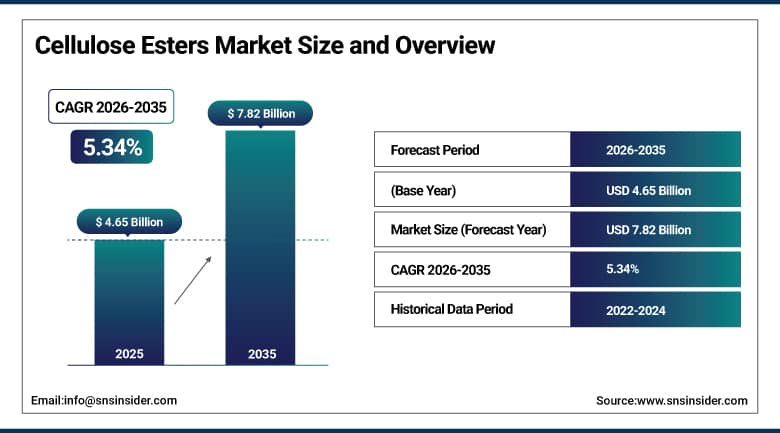
The Cellulose Esters Market was valued at USD 4.65 Billion in 2025 and is expected to reach USD 7.82 Billion by 2035, growing at a CAGR of 5.34% from 2026-2035.
Manufacturers across coatings, films, textiles and pharmaceutical excipients continue favoring cellulose esters for their biodegradability and compatibility with existing processing equipment, a preference strengthening as buyers seek alternatives to petroleum-based plastics. Cellulose acetate carries the largest type share today because its established production base serves coatings, films and filter tow applications simultaneously, while cellulose acetate propionate is the fastest-growing type as automotive, electronics and eyewear manufacturers specify its added impact resistance and clarity. Asia Pacific is the largest region with a 39.68% share in 2025 and also the fastest growing, expanding at a CAGR near 7.86% from 2026 to 2035 as regional chemical manufacturers scale dissolving-pulp-based production.
⮞In September 2026, the board of Jinan Acetate Chemical approved the acquisition of 100% of Cerdia Holding from a Blackstone-managed fund for about USD 368 million, payable partly in cash and partly in shares. Cerdia is one of the world's three largest cellulose acetate tow producers, and the deal gives the Asia-based buyer a manufacturing network spanning Asia, Europe, North America and South America.
To Get More Information On Cellulose Esters Market - Request Free Sample Report
Cellulose Esters Market Trends:
-
Demand for biodegradable alternatives to petroleum-based plastics continues pulling manufacturers toward cellulose ester formulations.
-
Pharmaceutical use of cellulose esters as excipients and drug-delivery coating materials continues expanding steadily.
-
Technology improvements in solubility and thermal stability are opening new electronics and specialty-film applications.
-
Automotive and eyewear manufacturers are increasingly specifying cellulose acetate propionate for its impact resistance and optical clarity.
-
Regional chemical manufacturers in Asia Pacific continue scaling dissolving-pulp-based cellulose ester production capacity.
U.S. Cellulose Esters Market Outlook:
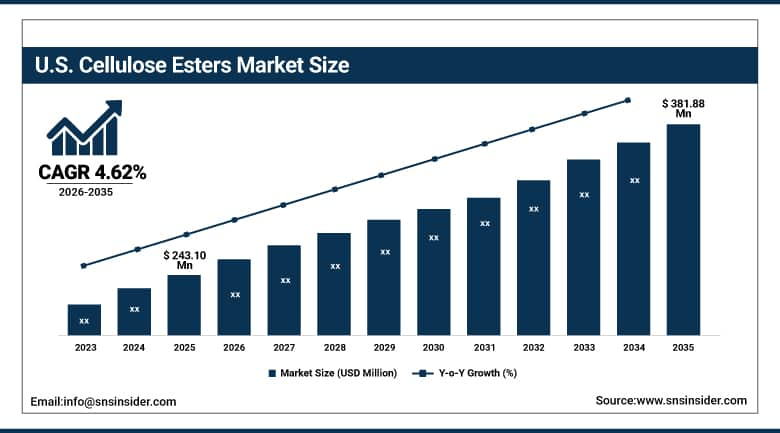
The U.S. Cellulose Esters Market was valued at USD 243.10 Million in 2025 and is expected to reach USD 381.88 Million by 2035, growing at a CAGR of 4.62% from 2026-2035.
U.S. demand is anchored by the country's established specialty chemical base and its concentration of coatings, film and filter-tow producers that rely on locally sourced cellulose acetate. Pharmaceutical excipient demand continues expanding steadily as drug manufacturers specify cellulose ester coatings for controlled-release and taste-masking formulations. Specialty chemical producers throughout the country continue investing in bio-based feedstock sourcing to meet rising demand for renewably derived materials. U.S.-based manufacturers continue prioritizing production efficiency and sustainable sourcing to meet this shift, keeping the United States the leading North American market through the forecast period. Packaging and personal-care formulators across the country are also steadily increasing their use of cellulose ester films and coatings.
⮞In June 2025, Eastman launched Eastman Esmeri CC1N10, a readily biodegradable cellulose ester micropowder for color cosmetics, announced from its Kingsport, Tennessee headquarters. The ingredient was developed to meet the European Union's microplastics regulations and extends Eastman's cellulose ester range into personal care.
Cellulose Esters Market Segment Analysis:
-
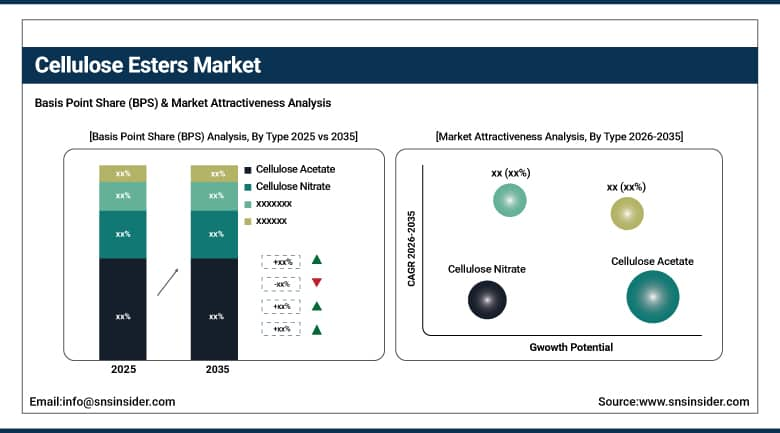
By Type, the Cellulose Acetate segment dominated the Cellulose Esters Market with approximately 54.72% share in 2025, while the Cellulose Acetate Propionate segment is the fastest growing with a CAGR of approximately 8.17%.
-
By Form, the Powder segment dominated the Cellulose Esters Market with approximately 46.83% share in 2025, while the Granules segment is the fastest growing with a CAGR of approximately 7.62%.
-
By Application, the Coatings & Inks segment dominated the Cellulose Esters Market with approximately 33.91% share in 2025, while the Films & Packaging segment is the fastest growing with a CAGR of approximately 8.43%.
-
By End-Use Industry, the Paper & Pulp segment dominated the Cellulose Esters Market with approximately 41.38% share in 2025, while the Textiles segment is the fastest growing with a CAGR of approximately 7.94%.
By Type, Cellulose Acetate Dominates the Cellulose Esters Market and Cellulose Acetate Propionate Grows Fastest
Cellulose acetate holds the largest type share because its established production infrastructure and broad compatibility let it serve coatings, films, filter tow and textile fiber applications without specialized reformulation. Decades of production experience have optimized its cost structure relative to newer, less-established cellulose ester variants, and suppliers continue expanding dissolving-pulp-based feedstock capacity to support this production base.
Cellulose acetate propionate is growing fastest as automotive, electronics and eyewear manufacturers increasingly specify its added impact resistance and optical clarity over standard cellulose acetate formulations. Eyewear frame producers favor it for its light weight, flexibility and scratch resistance relative to conventional plastics, and propionate grades are being engineered for durable, transparent components that must withstand repeated handling and environmental exposure. As automotive and electronics specification broadens, it is expected to keep growing faster than the broader type category through 2035.
⮞In September 2023, Eastman announced that Italian compounder Gibaplast would offer Eastman Tenite Renew, a cellulose acetate propionate that adds more than 20% certified recycled content to the grade's existing biobased content, for injection-molded eyewear frames produced in Europe.
By Form, Powder Dominates the Cellulose Esters Market and Granules Grow Fastest
Powder form holds the largest share because it gives manufacturers the most flexible feedstock for downstream processing across coatings, films and molding compound production without form-specific equipment investment. Its fine particle size dissolves and disperses readily in the solvent systems common to coatings and inks, and suppliers continue refining particle-size distribution to improve processing consistency for formulators.
Granules are growing fastest as plastics and molding compound manufacturers prefer this form for automated feeding systems, where powder can cause dust and flow inconsistency. Granule formulations are being engineered for the injection-molding and extrusion processes used in automotive and electronics component production, and processors value their reduced dust and improved flow relative to powder. As automated molding and extrusion expand, granules are expected to keep growing faster than the broader form category through 2035.
⮞In March 2025, Daicel launched BELLOCEA BS7, a spherical cellulose acetate particle for cosmetic texture improvement that combines high surface smoothness with biodegradability, passing the OECD 301F test with 60% biodegradation in 28 days.
By Application, Coatings & Inks Dominates the Cellulose Esters Market and Films & Packaging Grows Fastest
Coatings and inks hold the largest application share because cellulose esters provide the film-forming and gloss properties that wood, metal and automotive coating formulators have relied on for decades. Their proven durability and compatibility with existing solvent-based application systems keep them in premium coating formulations, and formulators value the balance of flexibility and hardness they bring to finished films.
Films and packaging are growing fastest as brand owners seek biodegradable alternatives to conventional plastic film for food and consumer-product packaging. Converters specify cellulose ester films for their clarity, barrier properties and compostability relative to petroleum-based films, supporting sustainability commitments without compromising shelf appeal. As these commitments continue shaping packaging specification, films and packaging are expected to keep growing faster than the broader application category through 2035.
⮞In January 2026, Daicel announced ISCC PLUS certification for cellulose acetate produced at its Aboshi Plant in Himeji and for CAFBLO, its marine-biodegradable cellulose acetate resin, with both certified in July 2025. The certification supports traceable sustainable-content claims for biodegradable cellulose acetate materials.
By End-Use Industry, Paper & Pulp Dominates the Cellulose Esters Market and Textiles Grow Fastest
Paper and pulp holds the largest end-use industry share because specialty papers and premium packaging consume substantial volumes of cellulose ester additives for coating and finishing across established production lines. Producers supply these materials because they improve printability, gloss and moisture resistance in finished specialty papers, and long-standing supply relationships give the segment more consistent purchasing than newer end-use categories.
Textiles are growing fastest as fiber manufacturers specify cellulose acetate fiber for its silk-like drape and biodegradability relative to petroleum-based synthetic fibers. Fashion and apparel brands increasingly favor cellulose-based fibers to meet sustainability commitments their customers expect, and fiber makers are adding dedicated cellulose acetate fiber capacity to serve this demand. As sustainability-driven specification expands, textiles are expected to keep growing faster than the broader end-use category through 2035.
⮞In August 2025, Eastman announced a strategic partnership with Huafon Chemical to establish a joint facility in China producing Eastman Naia cellulose acetate filament yarns locally, adding capacity and product-development capability for textile customers in the world's largest textile supply chain.
Regional Analysis:
|
Region |
Major Country |
Share within Region, 2025 (%) |
|---|---|---|
|
Asia Pacific |
China |
52.38 |
|
Europe |
Germany |
29.64 |
|
North America |
United States |
82.47 |
|
Latin America |
Brazil |
47.15 |
|
Middle East and Africa |
Saudi Arabia |
38.76 |
Asia Pacific Cellulose Esters Market Insights
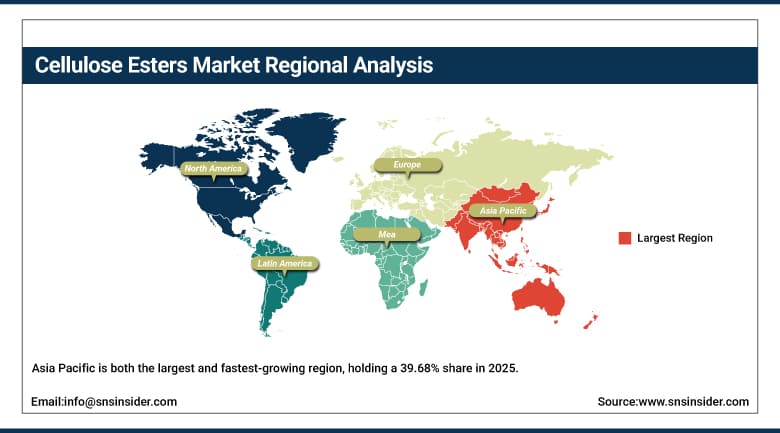
Asia Pacific is both the largest and fastest-growing region, holding a 39.68% share in 2025 and projected to expand at a CAGR of 7.86% from 2026 to 2035, as China, India, Japan and South Korea's chemical manufacturers scale dissolving-pulp-based production capacity. China supplies 52.38% of regional output, anchored by major specialty chemical manufacturers and a dense dissolving-pulp supply chain. India and Japan contribute substantial additional demand, supported by growing textile, coatings and pharmaceutical excipient manufacturing activity. That combination of manufacturing scale and feedstock access keeps Asia Pacific the leading region across both current share and forecast growth. Government chemical-industry investment programs in several countries are also funding dissolving-pulp capacity expansion.
Regional manufacturers are increasingly producing cellulose esters for both local textile and coatings industries as well as rapidly growing export demand, extending established production expertise into new international markets. Government environmental agencies across several Asia Pacific markets continue updating chemical manufacturing and emissions regulations to accommodate rising production volumes. Pharmaceutical excipient manufacturers across the region continue expanding dedicated cellulose ester production for both local and multinational drug manufacturers. As manufacturing scale and export demand continue rising together, this region's share of global demand is expected to keep increasing steadily through 2035 at a pace other regions are unlikely to match.
⮞In August 2025, Eastman and China's Huafon Chemical announced a joint facility to produce Naia cellulose acetate filament yarn in China, localizing production in the region's textile hub and adding capacity for Asia Pacific customers.
Get Customized Report as Per Your Business Requirement - Enquiry Now
Europe Cellulose Esters Market Insights
Europe's market is anchored by a cluster of established specialty chemical manufacturers headquartered in Germany and Norway that have driven early cellulose ester production and sustainability-focused research. Germany anchors regional demand through its large specialty chemical manufacturing base and strong automotive and coatings customer demand. Norway and France contribute substantial additional demand, supported by established dissolving-pulp feedstock access and research institution partnerships. That combination of manufacturing density and feedstock access keeps Europe an important region relative to its moderate percentage growth outlook through the forecast period. Regional research institutes continue publishing bio-based material findings that feed directly into new product development.
Regulatory frameworks across the European Union, including REACH, continue requiring extensive chemical safety documentation, raising compliance costs for manufacturers selling cellulose esters across the region. Automotive and coatings customers throughout the region continue specifying cellulose ester materials for next-generation sustainable product formulations. Cross-border research collaboration among European chemical manufacturers and research institutes remains common, accelerating shared bio-based material development. Even with slower growth relative to Asia Pacific, Europe's production and research leadership is expected to keep the region an influential, if more measured, market through most of the forecast period to 2035. Several national chemical industry associations continue publishing compliance guidance for REACH-related documentation requirements.
⮞In September 2026, Jinan Acetate Chemical agreed to acquire Cerdia, the Basel-headquartered cellulose acetate tow producer with European production, from a Blackstone-managed fund for about USD 368 million, moving ownership of a major European producer to an Asia-based group.
North America Cellulose Esters Market Insights
Holding a 6.34% share in 2025, North America trails Asia Pacific and Europe in overall volume but maintains an established specialty chemical manufacturing base concentrated in coatings, film and pharmaceutical excipient production. The United States supplies 82.47% of regional output, anchored by major specialty chemical manufacturers and a well-developed forest-products feedstock supply chain. Canada contributes a smaller but steady share, supported by chemical distribution closely integrated with the broader North American manufacturing ecosystem. That combination of manufacturing specialization and feedstock access keeps North America a meaningful, if comparatively smaller, regional market through the forecast period. Rising pharmaceutical excipient demand continues reinforcing this regional specialization advantage over time.
Pharmaceutical manufacturers throughout the United States and Canada continue expanding cellulose ester excipient specification for controlled-release and taste-masking drug formulations. Specialty chemical producers across the region continue investing in bio-based feedstock sourcing, reinforcing sustainability positioning relative to petroleum-based plastic alternatives. Regulatory oversight of chemical manufacturing and environmental compliance continues shaping how aggressively producers can expand local capacity. As pharmaceutical demand and sustainable sourcing continue reinforcing each other, North America is expected to remain a meaningful market through most of the forecast period to 2035. Industry groups continue publishing bio-based sourcing guidance to support this specialized regional category across both coatings and pharmaceutical end markets.
⮞In June 2025, Eastman, headquartered in Kingsport, Tennessee, launched Esmeri CC1N10, a readily biodegradable cellulose ester micropowder for color cosmetics, extending North American cellulose ester supply into personal-care formulations.
MEA & Latin America Cellulose Esters Market Insights
The Middle East and Africa region remains a comparatively small but steadily growing cellulose esters market, with Saudi Arabia accounting for the largest regional share on the strength of its large petrochemical manufacturing base and growing specialty chemical diversification initiatives. The United Arab Emirates contributes additional demand as rising industrial diversification investment broadens access to specialty chemical production capacity. South Africa anchors demand across the African continent, supported by an established specialty cellulose and pulp industry more developed than most neighboring markets. Elsewhere in the region, most markets rely heavily on imported cellulose ester products rather than developing local manufacturing capacity of their own.
Latin America's cellulose esters demand is tied closely to expanding packaging and textile industry investment, with Brazil accounting for the largest regional share on the strength of its large pulp and paper industry and well-developed chemical manufacturing base. Mexico contributes additional demand tied to its expanding automotive and coatings manufacturing sector. Currency volatility across several Latin American countries continues complicating long-term pricing and import planning for international manufacturers operating on thin margins. Even so, the region's established pulp and paper industry is expected to keep supporting steady cellulose esters demand growth through most of the forecast period to 2035, reinforced by ongoing packaging-sector investment.
⮞In September 2026, Jinan Acetate Chemical agreed to acquire Cerdia for about USD 368 million, giving the buyer a production and sales network that includes South America, where cellulose acetate demand is linked to textile and packaging industries.
Market Dynamics:
Growth Drivers: Sustainability demand and pharmaceutical expansion are lifting global demand
Demand for biodegradable alternatives to petroleum-based plastics continues strengthening across coatings, films and packaging applications, pulling manufacturers toward cellulose ester formulations that decompose more readily than conventional plastics. Brand owners are increasingly specifying cellulose ester materials specifically to support corporate sustainability commitments their customers and investors increasingly expect. Chemical manufacturers continue publishing new cellulose ester formulations that expand what sustainability-focused buyers can achieve without redesigning entire production processes. Together these forces are expanding the addressable cellulose esters market across a broader range of end-use industries than in prior years. Specialty feedstock suppliers are also expanding dedicated dissolving-pulp research divisions to support this growing demand.
A second driver is expanding pharmaceutical use of cellulose esters as excipients and drug-delivery coating materials, as drug manufacturers increasingly specify these materials for controlled-release and taste-masking formulations. Manufacturers are responding by developing pharmaceutical-grade cellulose ester formulations that meet the stringent purity requirements regulatory agencies impose on excipient materials. Regulatory agencies are expanding dedicated excipient-approval pathways specifically to accommodate rising pharmaceutical-grade cellulose ester applications. As pharmaceutical specification continues broadening, this trend is expected to keep broadening cellulose esters demand through 2035. Industry groups are expanding dedicated pharmaceutical-grade quality publications specifically to help manufacturers meet rising purity standards across multiple national markets.
⮞In March 2025, Daicel launched BELLOCEA BS7, a spherical cellulose acetate particle that passed OECD 301F testing with 60% biodegradation in 28 days, showing how biodegradability is shaping new cellulose ester product launches.
Restraints: Raw material volatility and regulatory compliance slow broader category expansion
Raw material price volatility continues pressuring manufacturer input costs, since cellulose ester production relies heavily on wood pulp and cotton feedstock subject to agricultural and forestry supply fluctuations. Manufacturers without long-term feedstock supply agreements face a difficult choice between absorbing higher input costs and raising prices that risk pushing buyers toward conventional petroleum-based alternatives. Smaller manufacturers in particular struggle to secure the feedstock supply agreements that larger, vertically integrated producers routinely negotiate. These pressures weigh most heavily on smaller companies without the balance sheet to absorb a prolonged feedstock price spike. Industry trade groups are increasingly publishing supply-chain guidance to help smaller manufacturers navigate this cost volatility.
Regulatory compliance costs also constrain broader category expansion, since frameworks such as the European Union's REACH regulation require extensive chemical safety documentation before new formulations reach commercial production. Manufacturers face a difficult choice between absorbing substantial compliance documentation cost and limiting the markets where new formulations can legally be sold. Supply chain complexity for specialty feedstock grades adds further cost unpredictability for manufacturers sourcing from a limited number of qualified dissolving-pulp suppliers. Combined, raw material volatility and regulatory compliance represent the category's most persistent restraint on broader commercial expansion. Smaller manufacturers without long-term feedstock contracts face the greatest exposure to these persistent cost pressures across most producing regions.
⮞In June 2025, Eastman launched Esmeri CC1N10, a cellulose ester micropowder designed to meet the European Union's stringent microplastics regulations, illustrating how regulation is pushing producers to reformulate products for regulated markets.
Opportunities: Electronics-grade innovation and emerging-market expansion open new revenue paths
Investment in improved solubility and thermal stability is accelerating as manufacturers seek to open new electronics applications that conventional cellulose ester formulations have not historically served. Companies that secure reliable advanced-formulation capability are positioned to capture share from manufacturers still reliant entirely on conventional, lower-performance cellulose ester grades. Chemical manufacturers are expanding dedicated advanced-formulation research programs specifically to meet rising demand for these more capable material grades. That combination of technical advantage and manufacturer investment gives well-capitalized advanced-formulation-focused companies a credible path to meaningful share over the next decade. Reliability testing investment is increasing as companies seek credible performance data supporting new electronics-grade formulations.
A second opportunity lies in emerging-market expansion, as regional manufacturers in Asia Pacific and Latin America increasingly build dedicated production capacity to capture rapidly growing textile, coatings and packaging demand in these markets. Regional producers benefit from feedstock proximity and lower production costs relative to manufacturers importing finished cellulose esters from established Western markets. Manufacturers pursuing this localized strategy are capturing emerging-market share faster than competitors relying solely on imported products. Companies continuing this localized strategy are positioned to capture growth that imported product sales alone will likely cede more slowly. Smaller regional producers remain attractive partnership and acquisition targets for larger companies pursuing this approach.
⮞In September 2026, Jinan Acetate Chemical agreed to acquire Cerdia, extending a business built around a single China production base into a network across Asia, Europe, North America and South America, an example of producers building regional presence close to customers.
Recent Developments:
-
In June 2025, Eastman launched Eastman Esmeri CC1N10, a readily biodegradable cellulose ester micropowder for color cosmetics designed to meet the European Union's microplastics regulations.
-
In August 2025, Eastman announced a strategic partnership with Huafon Chemical to build a joint facility in China producing Naia cellulose acetate filament yarns.
-
In January 2026, Daicel announced ISCC PLUS certification for cellulose acetate from its Aboshi Plant and for its CAFBLO marine-biodegradable cellulose acetate resin.
-
In September 2026, Jinan Acetate Chemical agreed to acquire Cerdia Holding, one of the world's three largest cellulose acetate tow producers, from a Blackstone-managed fund for about USD 368 million.
Cellulose Esters Companies are:
-
Eastman Chemical Company
-
Celanese Corporation
-
Daicel Corporation
-
Cerdia International GmbH
-
Nantong Cellulose Fibers Co., Ltd.
-
Sichuan Push Acetati Co., Ltd.
-
Nitro Química
-
Nitrex Chemicals
Cellulose Esters Market Report Scope:
| Report Attributes | Details |
|---|---|
| Market Size in 2025 | USD 4.65 Billion |
| Market Size by 2035 | USD 7.82 Billion |
| CAGR | CAGR of 5.34% From 2026 to 2035 |
| Base Year | 2025 |
| Forecast Period | 2026-2035 |
| Historical Data | 2022-2024 |
| Report Scope & Coverage | Market Size, Segments Analysis, Competitive Landscape, Regional Analysis, DROC & SWOT Analysis, Forecast Outlook |
| Key Segments | • By Type (Cellulose Acetate, Cellulose Acetate Propionate, Cellulose Acetate Butyrate & Cellulose Nitrate) • By Form (Powder, Granules, Flakes & Liquid/Solution) • By Application (Coatings & Inks, Films & Packaging, Filter Tow & Plastics & Molding Compounds) • By End-Use Industry (Paper & Pulp, Textiles, Construction & Pharmaceuticals) |
| Regional Analysis/Coverage | North America (US, Canada), Europe (Germany, UK, France, Italy, Spain, Russia, Poland, Rest of Europe), Asia Pacific (China, India, Japan, South Korea, Australia, ASEAN Countries, Rest of Asia Pacific), Middle East & Africa (UAE, Saudi Arabia, Qatar, South Africa, Rest of Middle East & Africa), Latin America (Brazil, Argentina, Mexico, Colombia, Rest of Latin America). |
| Company Profiles | Eastman Chemical Company, Celanese Corporation, Daicel Corporation, Cerdia International GmbH, Nantong Cellulose Fibers Co., Ltd., Sichuan Push Acetati Co., Ltd., Nitro Química, Nitrex Chemicals |

Frequently Asked Questions
The market includes Eastman Chemical, Celanese, Daicel, Cerdia International, Nantong Cellulose Fibers, Sichuan Push Acetati, Mitsubishi Chemical, Nitro Química, Hagedorn-NC and Nitrex Chemicals, among others.
The main opportunities lie in improved solubility and thermal stability that open new electronics applications, and in emerging-market expansion through dedicated regional production capacity.
The key growth factor is rising demand for biodegradable alternatives to petroleum-based plastics, combined with expanding pharmaceutical excipient use.
By type, the Cellulose Acetate segment dominated the market with approximately 54.72% share in 2025, supported by its established production infrastructure and broad application compatibility.
Asia Pacific dominated the market with approximately 39.68% share in 2025, supported by its dense dissolving-pulp supply chain, and is also the fastest-growing region with a projected CAGR of approximately 7.86% from 2026 to 2035. North America held a 6.34% share in 2025.
