
Dicalcium Phosphate Market Report Scope & Overview:
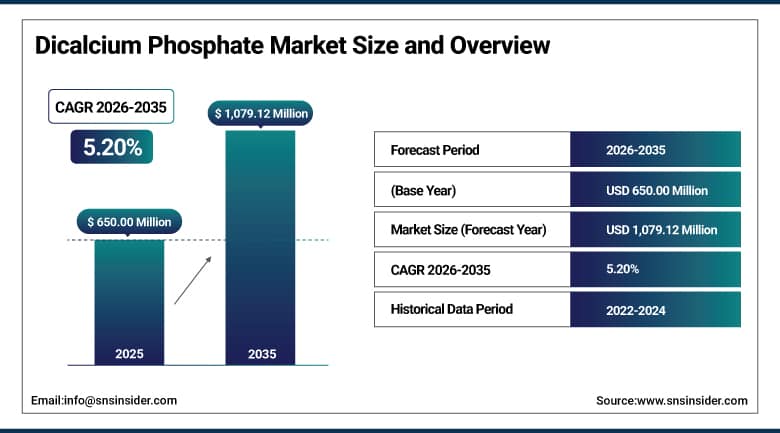
The Dicalcium Phosphate Market was valued at USD 650.00 Million in 2025 and is expected to reach USD 1,079.12 Million by 2035, growing at a CAGR of 5.20% from 2026-2035.
Feed compounders and fertilizer blenders buy dicalcium phosphate as a concentrated calcium and phosphorus source that livestock cannot get in sufficient quantity from grain-based rations alone. Producers draw the compound from phosphate rock processed through either a phosphoric acid or hydrochloric acid route, with the choice shaping both production cost and the fluorine-removal steps feed-grade material requires. Pharmaceutical and food-grade buyers increasingly draw on the same upstream supply chain as feed producers, competing for purified material meeting tighter heavy-metal limits than agricultural grades need. Export policy in a handful of phosphate-rock-rich countries shapes global supply more than demand-side factors do. Asia Pacific leads on both installed volume and growth rate.
⮞Alltech's 2026 Agri-Food Outlook, covering 142 countries and 38,837 feed mills, found global feed production rose 2.9% in 2025 to about 1.44 billion metric tonnes, with aquaculture and broiler feed posting the fastest species-level growth. Feed tonnage growth of that scale directly expands the base demand for the calcium and phosphorus supplements, including dicalcium phosphate, that modern feed formulations depend on.
To Get More Information On Dicalcium Phosphate Market - Request Free Sample Report
Dicalcium Phosphate Market Trends:
-
Producers are expanding hydrochloric acid process capacity as an alternative to phosphoric acid routes, citing lower byproduct handling cost in some regional plants.
-
Feed compounders are specifying granular dicalcium phosphate over powder to cut dust loss and improve flow through automated mixing and dosing equipment.
-
Pharmaceutical and food-grade buyers are competing more directly with feed-grade accounts for purified phosphoric acid output as purity requirements tighten across all grades.
-
Export policy shifts in major phosphate-rock-producing countries are pushing importing nations to diversify supplier relationships rather than depend on a single origin country.
-
Recycled and recovered phosphorus sources are entering early regulatory review in several countries as a potential supplement to phosphate-rock-derived supply.
U.S. Dicalcium Phosphate Market Outlook:
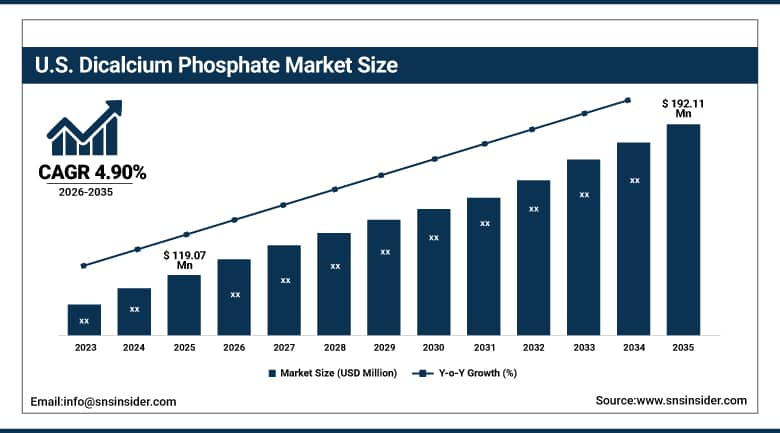
The U.S. Dicalcium Phosphate Market was valued at USD 119.07 Million in 2025 and is expected to reach USD 192.11 Million by 2035, growing at a CAGR of 4.90% from 2026-2035.
U.S. demand concentrates around large-scale feed compounders and premix manufacturers that buy dicalcium phosphate under supply contracts tied to poultry, swine and dairy production cycles. Long-standing antidumping and countervailing duties on phosphate fertilizer imports from select origin countries have kept prices elevated, a policy major farm groups have recently pressed producers to reconsider. Federal recognition of phosphate as a critical mineral has elevated supply security as a policy priority, shaping investment decisions across the processing base. Feed-grade buyers increasingly compete with pharmaceutical and food-grade accounts for the same purified phosphoric acid output, tightening supply in periods of strong demand, keeping the United States the largest single market within North America.
⮞The U.S. Department of the Interior added phosphate and potash to the nation's Critical Minerals List on November 6, 2025, a designation the U.S. Geological Survey said guides federal policy, investment priorities and permitting decisions. Recognition at that level for an input used across feed, food and pharmaceutical dicalcium phosphate grades signals how seriously supply security is now weighed in U.S. policy circles.
Dicalcium Phosphate Market Segment Analysis:
-
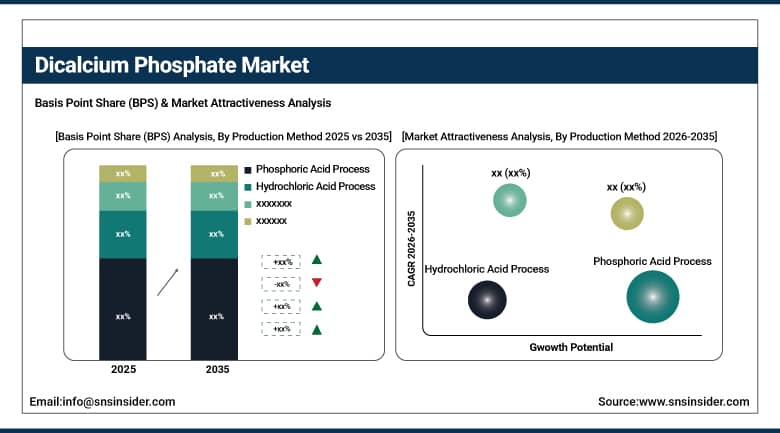
By Production Method, the Phosphoric Acid Process segment dominated the Dicalcium Phosphate Market with approximately 62.34% share in 2025, while the Hydrochloric Acid Process segment is the fastest growing with a CAGR of approximately 5.98%.
-
By Product Form, the Powder segment dominated the Dicalcium Phosphate Market with approximately 58.11% share in 2025, while the Granules segment is the fastest growing with a CAGR of approximately 6.07%.
-
By End-Use, the Animal Feed segment dominated the Dicalcium Phosphate Market with approximately 45.07% share in 2025, while the Pharmaceuticals segment is the fastest growing with a CAGR of approximately 6.33%.
-
By Grade, the Feed Grade segment dominated the Dicalcium Phosphate Market with approximately 51.80% share in 2025, while the Food Grade segment is the fastest growing with a CAGR of approximately 6.45%.
By Production Method, Phosphoric Acid Process Dominates the Dicalcium Phosphate Market and Hydrochloric Acid Process Grows Fastest
The phosphoric acid process leads production-method share because most large-scale phosphate rock processing capacity worldwide was built around this route, giving established producers decades of operating experience and optimized byproduct handling. Producers running phosphoric acid lines can direct output flexibly between fertilizer, feed and purified phosphoric acid grades depending on which market offers the strongest returns in a given period. That flexibility has made phosphoric acid plants the backbone of integrated phosphate groups that serve multiple downstream industries from the same upstream processing asset. That combination of installed capacity and multi-grade flexibility keeps the phosphoric acid process the dominant production method across most producing regions.
The hydrochloric acid process is growing fastest as some regional producers find it offers lower byproduct disposal cost on certain phosphate rock sources, particularly where gypsum stockpiling faces tightening environmental restrictions in several jurisdictions. Smaller and newer entrants are more willing to build hydrochloric acid capacity from the ground up, since they are not locked into existing phosphoric acid infrastructure the way established producers are. Regional supply chains serving smaller national markets are also finding the hydrochloric acid route more capital-efficient at smaller plant scales. As more smaller-scale and newer producers weigh these trade-offs, the hydrochloric acid process is expected to keep growing faster through 2035.
⮞In October 2024, Cleveland Bay Chemical Company of North Queensland said it was a step closer to building a production facility for dicalcium phosphate animal feed supplement after receiving grant funding from the Queensland Government, an example of a newer entrant building dedicated DCP capacity from the ground up.
By Product Form, Powder Dominates the Dicalcium Phosphate Market and Granules Grow Fastest
Powder holds the largest product-form share because it remains the most widely compatible format across legacy feed-mixing and fertilizer-blending equipment installed at smaller and mid-size facilities worldwide across most producing and consuming regions alike. Producers can manufacture powder with less specialized equipment than granulation requires, keeping production cost lower and making powder the default choice for cost-sensitive buyers. Established supply contracts between producers and compounders were negotiated around powder specifications for decades, reinforcing powder's position even as granular alternatives have matured. That combination of equipment compatibility and lower production cost keeps powder the dominant product form across most dicalcium phosphate applications worldwide.
Granules are growing fastest as feed compounders running automated, high-speed mixing and dosing lines specify granular material to cut the dust loss and flow problems that powder can cause in modern equipment. Producers investing in dedicated phosphate-salt production units are increasingly building granulation capability directly into new plants rather than treating it as a secondary processing step. Larger industrial and export-oriented feed compounders in particular are driving this shift, since their automated facilities depend on consistent particle size that powder cannot always deliver reliably. As more compounders upgrade to automated mixing equipment, granules are expected to keep growing faster than powder through 2035.
⮞In October 2026, Shivam Chemicals began Phase I production of feed-grade dicalcium phosphate at its subsidiary's plant in Dahej, Gujarat, moving from distribution into in-house DCP manufacturing; the company describes Phase I as a platform for further expansion of its feed phosphate business.
By End-Use, Animal Feed Dominates the Dicalcium Phosphate Market and Pharmaceuticals Grow Fastest
Animal feed accounts for the largest end-use share because livestock and poultry rations require a concentrated, bioavailable calcium and phosphorus source that grain-based ingredients alone cannot reliably supply at the volumes modern production systems demand. Feed compounders buy dicalcium phosphate under standing supply agreements tied directly to poultry, swine and dairy production cycles, giving this end-use steady, predictable order volume. Record global feed production growth, driven particularly by poultry and aquaculture expansion, continues to widen the base of compounders placing recurring dicalcium phosphate orders. That combination of nutritional necessity and production-cycle-linked demand keeps animal feed the dominant end-use category by volume across nearly every producing region.
Pharmaceuticals are growing fastest as drug formulators specify dicalcium phosphate as an excipient and calcium supplement ingredient requiring purity standards well beyond what feed-grade material provides. Formulators increasingly compete directly with feed-grade buyers for the same purified phosphoric acid output, since pharmaceutical-grade material draws on the same upstream processing chain before diverging into tighter heavy-metal and fluorine specifications. Calcium supplement and tablet-excipient demand continues to expand as a broader health and wellness market specifies dicalcium phosphate for its compressibility and calcium content in solid dosage forms. As pharmaceutical-grade qualification expands and competes more directly for shared upstream supply, this end-use is expected to keep growing faster than feed through 2035.
⮞The USDA's initial 2026 outlook projected global poultry meat production would reach a record 109.6 million tons, up 2% from 2025, led by the United States, China, Brazil and the European Union, alongside a projected record 14.7 million tons of poultry exports. Production growth of that scale in the protein category most dependent on compound feed underscores the breadth of demand that animal-feed dicalcium phosphate buyers are serving.
By Grade, Feed Grade Dominates the Dicalcium Phosphate Market and Food Grade Grows Fastest
Feed grade leads the grade segment because it serves the largest downstream volume category by a wide margin, with specifications calibrated to livestock nutritional needs rather than the tighter purity standards food, pharmaceutical and technical grades require. Producers have built the majority of their fluorine-removal and processing capacity specifically around meeting feed-grade specifications at the scale integrated feed compounders demand. Established, long-running supply relationships between feed-grade producers and compounders give this grade a stability that higher-purity grades, often sold into smaller and more fragmented markets, do not share. That combination of volume scale and specification fit keeps feed grade the dominant category across nearly every producing and consuming region.
Food grade is growing fastest as bakery, beverage and processed-food manufacturers specify dicalcium phosphate as a calcium fortification ingredient and leavening agent component meeting food-safety standards well beyond feed-grade requirements. Producers are increasingly repositioning a larger share of their purified phosphoric acid output toward food-grade qualification as fortification trends expand across packaged food categories. ICL has identified specialty food solutions as one of its core growth engines going forward, signaling how established phosphate producers are prioritizing capital toward higher-value food-grade qualification over commodity output. As fortification and clean-label reformulation trends continue expanding food-grade demand, this grade is expected to keep growing faster than feed grade through 2035.
⮞In July 2025, Innophos launched VersaCal Bright, a calcium phosphate ingredient positioned as a clean-label whitening alternative to titanium dioxide in selected food applications, following FDA approval of the company's calcium phosphate color-additive petition. The launch shows phosphate producers extending food-grade calcium phosphates into new functional uses.
Regional Analysis:
|
Region |
Major Country |
Share within Region, 2025 (%) |
|---|---|---|
|
Asia Pacific |
China |
38.70 |
|
North America |
United States |
85.20 |
|
Europe |
Germany |
22.90 |
|
Middle East and Africa |
Jordan |
28.60 |
|
Latin America |
Brazil |
43.80 |
Asia Pacific Dicalcium Phosphate Market Insights
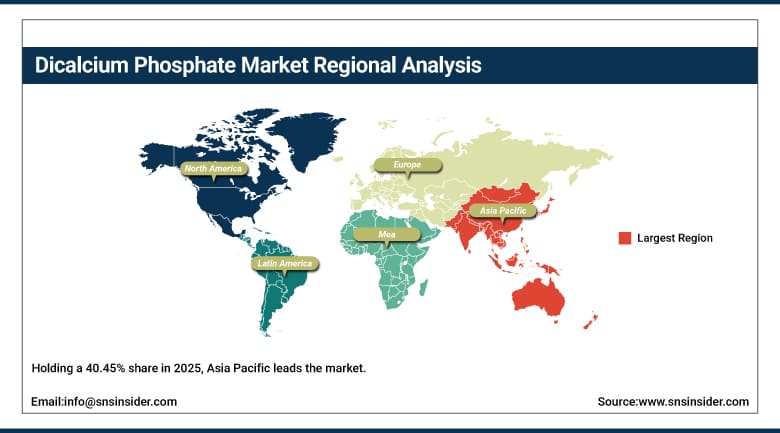
Holding a 40.45% share in 2025, Asia Pacific leads the market as the region where livestock and poultry production scales fastest relative to installed phosphate rock processing capacity. China anchors regional volume, supported by the largest compound feed base in the world and a growing commercial feed sector displacing smaller, informal feeding practices. India's phosphate fertilizer and feed sectors depend heavily on imports to meet rising demand, with government data showing import volumes fluctuating sharply as local supply struggles to keep pace. That combination of feed-sector scale and import dependence gives Asia Pacific both the largest share and the fastest growth trajectory among all regions.
Government-backed agricultural and import-financing programs across several Asia Pacific markets are helping compounders secure dicalcium phosphate and related phosphate inputs despite tight global supply. Regional feed compounders are increasingly qualifying multiple supplier origins rather than depending on a single exporting country, following disruptions tied to export policy shifts elsewhere in the world. Rising commercial feed adoption across Southeast Asian markets is widening the base of compounders placing recurring dicalcium phosphate orders beyond China and India alone. As regional feed production and import-diversification efforts continue to scale together, Asia Pacific's share of global demand is expected to keep rising through 2035.
⮞In October 2025, Chatham Rock Phosphate advanced its Korella North project in Queensland, planning to supply phosphate rock to a Cloncurry plant targeting dicalcium and monocalcium phosphate for cattle lick blocks in phosphorus-deficient Northern Queensland, adding regional DCP supply in Asia Pacific.
Get Customized Report as Per Your Business Requirement - Enquiry Now
North America Dicalcium Phosphate Market Insights
North America holds a meaningful share of global demand, with the United States supplying 85.20% of regional output on the strength of large-scale feed compounders serving established poultry, swine and dairy production systems. Canada contributes a smaller share, relying heavily on imports since the country has no phosphate mines of its own to draw on. Long-running antidumping and countervailing duties on phosphate fertilizer imports from select origin countries have kept regional prices elevated, a policy major farm groups have recently pressed U.S. producers to reconsider. That combination of established feed-sector demand and trade-policy-driven pricing defines the region's near-term supply and cost environment.
Federal recognition of phosphate as a critical mineral has elevated supply security as an explicit policy priority, shaping investment and permitting decisions across the region's processing base and its wider supply chain. Producers are also exploring strategic alternatives for underperforming phosphate assets, including potential divestitures or partnerships, as part of broader portfolio simplification efforts across their business lines. Feed-grade buyers increasingly compete with pharmaceutical and food-grade accounts for the same purified phosphoric acid output, tightening available supply during periods of strong demand across the region. Even with these pressures, established feed-sector infrastructure is expected to keep North America a significant contributor to global demand through 2035.
⮞In August 2024, Prayon acquired Natural Enrichment Industries, a U.S. producer of calcium phosphate salts with sites in Herrin and Sesser, Illinois, adding North American calcium phosphate capacity for food and technical applications.
Europe Dicalcium Phosphate Market Insights
Europe's market rests on a smaller local phosphate rock base than Asia Pacific or North America, making the region more dependent on imported rock and intermediate phosphoric acid to supply its feed, food and fertilizer processing base. Germany anchors regional demand through a large compound feed and food-processing sector drawing on both local and imported dicalcium phosphate supply. Producers across the region continue investing in cost reduction and operational efficiency even as persistent input cost pressure and geopolitical supply disruptions weigh on margins. That combination of import dependence and cost pressure defines the near-term operating environment for European dicalcium phosphate producers and buyers alike.
Regulatory interest in recycled and recovered phosphorus sources is advancing fastest in Europe, where several countries are reviewing whether recovered calcium phosphate products can supplement traditional phosphate-rock-derived supply across more applications. Strict environmental and due-diligence requirements covering mined commodities have added compliance cost and complexity to European phosphate sourcing in recent years and continue to evolve. Cross-border supply agreements remain common among European producers, letting a single processing asset serve multiple national feed and food specifications with only minor adjustment. As cost pressures and recycled-phosphorus regulatory review continue to evolve, Europe's demand growth is expected to track global trends but below the fastest-growing regions through 2035.
⮞In July 2025, Brenntag Specialties began distributing Budenheim's phosphate-based pharmaceutical excipients to customers across Germany, France, Benelux, Poland and the Nordics, widening commercial reach for calcium-phosphate-based excipients in European oral solid dosage manufacturing.
MEA & Latin America Dicalcium Phosphate Market Insights
The Middle East and Africa region sits close to some of the world's largest phosphate rock reserves, with Jordan and Saudi Arabia anchoring a growing processing base adding value-added capacity rather than exporting raw rock alone. Jordan in particular has moved to expand integrated phosphoric acid and specialized fertilizer production, positioning itself to capture more downstream value from its reserves. Elsewhere in the region, most markets rely on imported dicalcium phosphate rather than local processing capacity, leaving supply exposed to shipping-cost and currency volatility. Regulatory frameworks for feed and food-grade phosphate imports vary across the region, adding complexity for producers serving multiple markets from one production base.
Latin America combines significant phosphate rock reserves with a growing processing base, led by Brazil's feed and fertilizer manufacturing sector drawing on both local and imported supply. Export restrictions imposed by major phosphate-exporting countries elsewhere have pushed some Latin American buyers to diversify sourcing and, in some cases, invest in local processing capacity of their own. Currency volatility across several Latin American markets continues to complicate long-term procurement contracts, pushing some buyers toward shorter-term pricing arrangements instead. Even so, the region's combination of reserves and growing feed-sector demand is expected to keep supporting steady dicalcium phosphate demand growth through 2035.
⮞Jordan Phosphate Mines Company and Arab Potash Company signed an agreement in July 2025 for an integrated USD 600 million industrial complex producing phosphoric acid, purified phosphoric acid and specialized fertilizers across sites in the Aqaba Special Economic Zone and near Ma'an, with operations targeted to begin by 2028. An investment of that scale in value-added processing by two of the region's largest phosphate companies illustrates how producers near major reserves are moving to capture more downstream value rather than exporting raw material alone.
Market Dynamics:
Growth Drivers: Rising compound feed production and premium phosphate-derivative demand are lifting procurement across grades
Global compound feed production keeps expanding as poultry, aquaculture and swine operations scale to meet rising protein consumption, and every tonne needs a calcium and phosphorus supplement grain alone cannot adequately provide. Feed compounders are formulating increasingly precise rations that specify dicalcium phosphate inclusion rates matched to species and stage, rather than a single generic rate across all formulations. Established phosphate producers serving multiple downstream grades from a single processing asset are capturing this expanding feed demand alongside growing food and pharmaceutical-grade orders from the same supply chain. Together these forces are expanding total dicalcium phosphate volume even as individual grades compete for a finite pool of purified output.
A second driver is expanding demand for purified dicalcium phosphate in pharmaceutical tablets and food fortification, where formulators specify it as a calcium source and compressible excipient in solid dosage forms and as a calcium fortification ingredient in packaged foods. Buyers in these categories require tighter heavy-metal and fluorine limits than feed-grade material, so producers are qualifying higher-purity grades to serve them. As pharmaceutical and fortified-food demand broaden, overall market growth is expected to outpace feed-tonnage growth alone through 2035.
⮞In October 2025, Innophos presented its calcium phosphate excipient portfolio, including A-Tab, Di-Tab, Tri-Tab and Calipharm products, at CPHI Frankfurt 2025, reflecting pharmaceutical formulators' demand for calcium phosphate excipients.
Restraints: Export policy concentration and phosphate rock supply concentration create persistent price volatility
A small number of countries control the large majority of the world's phosphate rock reserves and processing capacity, meaning a single exporting country's policy shift can move global prices for every downstream grade almost immediately. China, one of the world's largest phosphate fertilizer producers, has repeatedly restricted exports to prioritize its own home market, tightening global supply and pushing importing countries toward costlier alternative sources. Buyers with limited supplier diversification are particularly exposed when a major exporting country adjusts policy with little advance notice, since replacement supply often carries a higher landed cost. These pressures weigh most heavily on import-dependent regions that lack meaningful phosphate rock reserves of their own.
Antidumping and countervailing duties imposed by some importing countries on phosphate fertilizer from specific origin countries add a further layer of cost and complexity, even as the policies aim to protect local producers. Farm and agricultural groups in several markets have begun pushing back against these duties, arguing they keep input costs elevated and limit supply diversification for end buyers. Smaller processors and compounders without long-term supply contracts are more exposed to these trade-policy-driven cost swings than large, vertically integrated buyers can absorb. Combined, export policy concentration and trade-remedy duties represent the category's most significant near-term restraint on predictable procurement planning.
⮞China maintained its phosphate fertilizer export suspension into 2026, with DAP and MAP export volumes remaining uncertain as the restriction continued into the latter part of the year. Because fertilizers and feed phosphates draw on the same phosphate rock and phosphoric acid base, a sustained export restriction from one of the largest producers tightens shared upstream supply and raises feedstock costs for dicalcium phosphate producers outside China.
Opportunities: Recycled phosphorus sources and premium pet and specialty nutrition demand open new revenue paths
Recovered and recycled phosphorus products are emerging as a potential supplement to phosphate-rock-derived supply, with several companies now seeking regulatory approval to use high-purity recycled material in animal feed where only mined phosphate has traditionally been permitted. Producers that secure early regulatory approval for recycled-phosphorus feed applications stand to capture business from compounders seeking diversification away from concentrated mined-rock origins. Countries without their own phosphate mines are particularly motivated to support these applications, since recycled sources could meaningfully reduce reliance on a small number of exporting countries. That combination of regulatory openness and real supply-diversification appeal gives recycled phosphorus a credible path to meaningful volume over the next decade.
A second opportunity lies in premium pet nutrition and specialty calcium supplementation, where formulators keep specifying dicalcium phosphate for its bioavailability even as broader spending on pet supplements has moderated from faster growth seen years ago. Suppliers that can demonstrate clear nutritional and sourcing credentials stand to retain premium positioning even as category growth slows, since owners cutting discretionary spending still prioritize core nutritional products. Specialty ingredient makers investing in traceable, high-purity grades for both pharmaceutical and premium pet nutrition applications are positioned to capture margin commodity competitors cannot match. Suppliers that deepen these capabilities are positioned to capture growth commodity-only producers will likely cede over the coming decade.
⮞Packaged Facts reported that U.S. pet supplement sales reached USD 2.9 billion in 2025, with annual growth slipping below 3% as a December 2025 survey found 65% of pet owners had cut discretionary spending. A moderating but still substantial sales base of that size shows calcium and phosphorus supplementation remains a meaningful specialty demand channel for dicalcium phosphate suppliers.
Recent Developments:
-
In October 2026, Shivam Chemicals commenced Phase I production of feed-grade dicalcium phosphate at its subsidiary's plant in Dahej, Gujarat, expanding from distribution into in-house DCP manufacturing.
-
In November 2025, Nutrien initiated a formal review of strategic alternatives for its phosphate business, which mines and processes phosphate at sites in North Carolina and Florida, with CEO Ken Seitz citing portfolio simplification goals.
-
In December 2025, Friesen Group filed an application with Canadian authorities, in cooperation with Ragn-Sells and its EasyMining innovation arm, to approve RevoCaP, a high-purity recycled phosphorus product, for use in animal feed.
-
In July 2025, Innophos launched VersaCal Bright, a calcium phosphate-based, clean-label alternative to titanium dioxide for selected food applications, following FDA approval of its calcium phosphate color-additive petition.
Dicalcium Phosphate Market Key Players:
-
Nutrien Ltd.
-
OCP Group
-
ICL Group Ltd.
-
Prayon S.A.
-
The Mosaic Company
-
Phosphea (Groupe Roullier)
-
Aliphos
-
Innophos Holdings, Inc.
-
Chemische Fabrik Budenheim KG
-
Yunnan Yuntianhua Co., Ltd.
Dicalcium Phosphate Market Report Scope:
| Report Attributes | Details |
|---|---|
| Market Size in 2025 | USD 650.00 Million |
| Market Size by 2035 | USD 1,079.12 Million |
| CAGR | CAGR of 5.20% From 2026 to 2035 |
| Base Year | 2025 |
| Forecast Period | 2026-2035 |
| Historical Data | 2022-2024 |
| Report Scope & Coverage | Market Size, Segments Analysis, Competitive Landscape, Regional Analysis, DROC & SWOT Analysis, Forecast Outlook |
| Key Segments | • By Production Method (Phosphoric Acid Process & Hydrochloric Acid Process) • By Product Form (Powder & Granules) • By End-Use (Animal Feed, Pharmaceuticals, Food & Beverage, Fertilizers & Others) • By Grade (Feed Grade, Food Grade, Pharmaceutical Grade & Technical Grade) |
| Regional Analysis/Coverage | North America (US, Canada), Europe (Germany, UK, France, Italy, Spain, Russia, Poland, Rest of Europe), Asia Pacific (China, India, Japan, South Korea, Australia, ASEAN Countries, Rest of Asia Pacific), Middle East & Africa (UAE, Saudi Arabia, Qatar, South Africa, Rest of Middle East & Africa), Latin America (Brazil, Argentina, Mexico, Colombia, Rest of Latin America). |
| Company Profiles | Nutrien Ltd., OCP Group, ICL Group Ltd., Prayon S.A., The Mosaic Company, Phosphea (Groupe Roullier), Aliphos, Innophos Holdings, Inc., Chemische Fabrik Budenheim KG, Yunnan Yuntianhua Co., Ltd. |

Frequently Asked Questions
The market includes Nutrien, OCP Group, ICL Group, Prayon, EuroChem Group, The Mosaic Company, Jordan Phosphate Mines Company, Phosphea, Aliphos, Innophos, Budenheim and Yunnan Yuntianhua, among others.
The main opportunities lie in recycled and recovered phosphorus sources gaining regulatory approval for animal feed use, and in premium pet nutrition and specialty calcium supplementation applications that command pricing above commodity feed grade.
The key growth factor is rising global compound feed production, particularly in poultry and aquaculture, combined with continued producer reinvestment toward higher-value food and pharmaceutical grade qualification.
By end-use, the Animal Feed segment dominated the market with approximately 45.07% share in 2025, supported by steady demand tied to poultry, swine and dairy production cycles.
Asia Pacific dominated the market with approximately 40.45% share in 2025 and is also the fastest-growing region, with a projected CAGR of approximately 6.15% from 2026 to 2035.
