
Cloud Sustainability Market Report Scope& Overview:
The Cloud Sustainability Market size was valued at USD 35.96 Billion in 2025E and is projected to reach USD 147.07 Billion by 2032, growing at a CAGR of 19.26% during 2026–2033.
The Cloud Sustainability Market is experiencing strong growth, driven by rising enterprise focus on reducing carbon emissions and improving energy efficiency. Increasing ESG compliance requirements, regulatory pressure, and corporate net-zero targets are accelerating adoption. Solutions include carbon management platforms, energy-efficient cloud infrastructure, and sustainability analytics tools. Advancements in AI, automation, and renewable-powered data centers enable improved environmental performance, operational efficiency, and transparent sustainability reporting across industries.
Cloud Sustainability Market Size and Forecast:
-
Market Size in 2025E: USD 35.96 Billion
-
Market Size by 2032: USD 147.07 Billion
-
CAGR: 19.26% from 2026 to 2033
-
Base Year: 2025E
-
Forecast Period: 2026–2033
-
Historical Data: 2022–2024

To Get more information On Cloud Sustainability Market - Request Free Sample Report
Key Cloud Sustainability Market Trends:
-
Growing ESG regulations and corporate sustainability commitments are increasing demand for cloud-based carbon tracking and reporting tools.
-
Rising adoption of renewable energy-powered data centers is reducing cloud infrastructure carbon footprints.
-
AI-driven energy optimization solutions are enhancing data-center efficiency and lowering operational emissions.
-
Enterprises are increasingly adopting multi-cloud sustainability dashboards for real-time emissions visibility.
-
Automation of sustainability compliance reporting is improving accuracy and reducing manual workloads.
-
Integration of sustainability metrics into cloud cost management platforms is supporting greener IT decision-making.
U.S. Cloud Sustainability Market Insights:
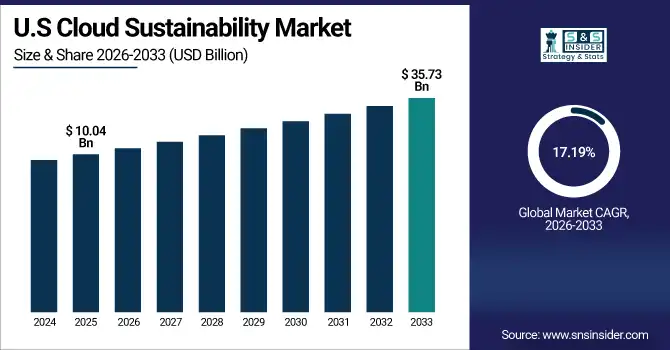
The U.S. Cloud Sustainability Market size was USD 10.04 billion in 2025 and is expected to reach USD 35.73 billion by 2033, growing at a CAGR of 17.19% over the forecast period of 2025–2033. According to a study, increasing regulatory pressure and corporate net-zero commitments have caused more than 60% of U.S. enterprises to integrate sustainability tools into cloud operations. This cause, stronger ESG accountability, effects reduced data-center energy consumption, improved carbon transparency, and accelerated adoption of energy-efficient cloud platforms across IT-intensive industries.
Cloud Sustainability Market Driver
-
Growing Demand for ESG Compliance and Carbon Transparency Across Enterprise Cloud Infrastructure Accelerates Market Growth
The growing demand for ESG compliance has emerged as a key driver of the Cloud Sustainability Market. This cause, rising regulatory mandates and investor scrutiny, effects widespread adoption of cloud-based sustainability monitoring platforms. Enterprises increasingly rely on real-time carbon accounting, energy optimization, and sustainability analytics to meet reporting requirements. Cloud sustainability solutions enable visibility into emissions, renewable energy usage, and workload efficiency. As organizations aim to align IT operations with corporate climate goals, demand for automated and scalable sustainability tools continues to rise, strengthening overall market growth.
In February 2025, a U.S.-based financial services firm deployed a cloud sustainability platform, achieving a 19% reduction in operational emissions through optimized workload distribution.
Cloud Sustainability Market Restraint
-
Complex Integration Requirements and Limited Standardization Across Hybrid Cloud Environments Restrict Market Expansion
Despite strong growth potential, integration complexity remains a major restraint in the Cloud Sustainability Market. This cause, fragmented hybrid and multi-cloud infrastructures, effects delayed adoption of sustainability platforms across enterprises. Organizations often struggle to unify carbon data, energy metrics, and workload visibility across legacy systems and multiple cloud providers. Limited standardization in emissions measurement and reporting frameworks further increases implementation challenges. These issues raise deployment costs and slow decision-making, particularly for small and mid-sized enterprises, restraining faster market penetration despite rising sustainability awareness.
In 2024, an enterprise IT survey showed that 44% of organizations postponed cloud sustainability initiatives due to integration complexity and unclear emissions data alignment.
Cloud Sustainability Market Opportunity
-
AI-Driven Energy Optimization and Real-Time Carbon Intelligence Create New Growth Opportunities Across Cloud Ecosystems
Significant opportunities are emerging from the integration of AI and advanced analytics into cloud sustainability platforms. This cause, rapid advancements in machine learning and cloud automation, effects improved energy optimization, predictive emissions tracking, and real-time carbon intelligence. AI-enabled tools allow enterprises to automatically shift workloads to low-carbon regions, optimize server utilization, and forecast sustainability outcomes. As organizations increasingly pursue net-zero strategies, demand for intelligent, automated sustainability solutions is expected to unlock long-term growth opportunities across the Cloud Sustainability Market.
In June 2025, a global cloud provider launched an AI-based sustainability optimization engine, enabling enterprise clients to reduce cloud-related emissions by up to 23%.
Cloud Sustainability Market Segmentation Analysis
By Solution Type, Energy-Efficient Infrastructure Leads Market While Carbon Management Solutions Register Fastest Growth
The Energy-efficient Infrastructure segment dominated the Cloud Sustainability Market with the largest revenue share of 25% in 2025E. This dominance is driven by rising enterprise focus on reducing data-center power consumption and operational emissions. This cause, increasing energy costs and sustainability mandates, effects widespread deployment of efficient servers, cooling systems, and renewable-powered cloud infrastructure. Cloud providers continuously invest in low-energy hardware, liquid cooling, and workload optimization technologies, strengthening the segment’s leadership and supporting overall market sustainability goals.
The Carbon Management Solutions segment is growing at the highest CAGR of 23.71% during the forecast period. This growth is driven by enterprise demand for real-time emissions tracking and ESG reporting. This cause, regulatory pressure and investor transparency requirements, effects accelerated adoption of carbon accounting, Scope 1–3 monitoring, and analytics platforms. Continuous product innovation, including automated dashboards and AI-based forecasting, positions carbon management as a high-growth contributor to the Cloud Sustainability Market.
By Service Model, SaaS Dominates Market While PaaS Registers Fastest Growth
The Software as a Service (SaaS) segment dominated the Cloud Sustainability Market with a revenue share of 45% in 2025E. This leadership is driven by ease of deployment, scalability, and lower upfront costs. This cause, rising preference for subscription-based sustainability tools, effects faster adoption across enterprises seeking rapid ESG compliance. SaaS solutions provide automated reporting, real-time insights, and seamless updates, reinforcing their dominance within cloud sustainability ecosystems.
The Platform as a Service (PaaS) segment is growing at the highest CAGR of 23.24% during the forecast period. This growth is fueled by enterprises seeking customizable sustainability frameworks. This cause, demand for tailored analytics and API integration, effects increased adoption of PaaS platforms. These solutions enable developers to build advanced sustainability applications, strengthening innovation and expanding Cloud Sustainability Market capabilities.
By Deployment Mode, Public Cloud Leads Market While Hybrid Cloud Registers Fastest Growth
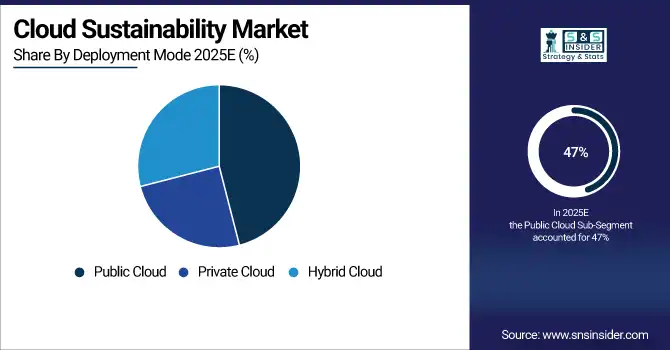
The Public Cloud segment dominated with a revenue share of 47% in 2025E. This dominance is driven by scalability, cost efficiency, and access to renewable-powered infrastructure. This cause, enterprise migration toward centralized cloud platforms, effects widespread use of public cloud sustainability tools. Public cloud providers offer integrated carbon dashboards and energy optimization, reinforcing adoption across industries.
The Hybrid Cloud segment is growing at the fastest CAGR of 21.98% during the forecast period. This growth is driven by organizations balancing data sovereignty and sustainability goals. This cause, need for flexible workload management, effects rising hybrid cloud deployment. Hybrid models allow enterprises to optimize emissions while maintaining control, supporting sustainable IT strategies.
By End User, IT & Telecom Leads Market While Energy & Utilities Register Fastest Growth
The IT & Telecom segment dominated the Cloud Sustainability Market with a revenue share of 27% in 2025E. This dominance is driven by high data consumption and infrastructure intensity. This cause, rising network traffic and cloud dependency, effects strong adoption of sustainability tools to reduce emissions and energy usage, reinforcing segment leadership.
The Energy & Utilities segment is growing at the highest CAGR of 23.52% during the forecast period. This growth is fueled by decarbonization initiatives and smart grid integration. This cause, regulatory mandates and renewable integration, effects increased use of cloud sustainability platforms to monitor emissions and optimize energy systems.
Cloud Sustainability Market Regional Insights:
North America Dominates Cloud Sustainability Market in 2025
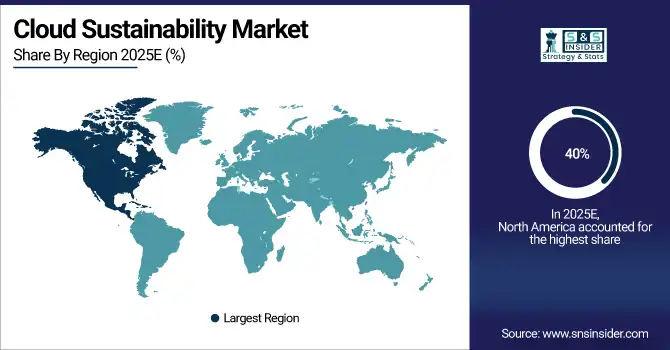
In 2025, North America commands an estimated 40% share of the Cloud Sustainability Market, driven by advanced cloud infrastructure, stringent ESG regulations, and strong enterprise sustainability commitments. The region benefits from widespread adoption of energy-efficient data centers, carbon management platforms, and AI-driven optimization tools. Increasing regulatory pressure and corporate net-zero targets across industries are accelerating cloud sustainability adoption, positioning North America as the leading region for implementation and innovation.
Get Customized Report as per Your Business Requirement - Enquiry Now
The United States is the dominating country in North America, supported by a mature cloud ecosystem, strong regulatory enforcement, and high enterprise cloud penetration. U.S. organizations are rapidly integrating sustainability analytics, emissions tracking, and renewable-powered cloud services. Continuous investments by major cloud providers in green data centers and carbon-neutral operations further reinforce the country’s leadership in the Cloud Sustainability Market.
Asia Pacific Is the Fastest-Growing Region in Cloud Sustainability Market in 2025
Asia Pacific is projected to grow at an estimated CAGR of 21.49% in 2025, driven by rapid cloud adoption, expanding data center infrastructure, and increasing government mandates for carbon reduction. Rising enterprise focus on ESG compliance and energy-efficient IT operations is accelerating demand for cloud sustainability platforms across emerging and developed economies.
China dominates the Asia Pacific Cloud Sustainability Market due to large-scale digitalization initiatives, rapid expansion of green data centers, and strong government support for sustainable cloud infrastructure. Enterprises across manufacturing, IT, and energy sectors are increasingly deploying carbon management and energy optimization solutions, strengthening China’s leadership and positioning Asia Pacific as the fastest-growing regional market.
Europe Cloud Sustainability Market Insights, 2025
Europe held a significant share of the Cloud Sustainability Market in 2025, driven by strict environmental regulations and strong emphasis on corporate sustainability reporting. EU-wide climate policies and mandatory carbon disclosure requirements are encouraging enterprises to adopt cloud-based sustainability and emissions management solutions. Germany leads Europe’s Cloud Sustainability Market due to its advanced industrial base, strong digital transformation initiatives, and commitment to energy-efficient IT operations.
Middle East & Africa and Latin America Cloud Sustainability Market Insights, 2025
In 2025, the Middle East & Africa region showed steady growth driven by smart city projects, rising cloud adoption, and energy-efficiency initiatives. The UAE leads the region through investments in green data centers and digital sustainability platforms. Latin America also experienced moderate growth, led by Brazil and Mexico, supported by expanding cloud infrastructure and increasing corporate sustainability commitments across industries.
Competitive Landscape for the Cloud Sustainability Market
Amazon Web Services (AWS)
Amazon Web Services (AWS) is a global leader in cloud computing and a major contributor to cloud sustainability through large-scale renewable energy adoption and carbon management tools. AWS offers sustainability-focused services such as carbon footprint tracking, energy-efficient infrastructure, and region-based workload optimization to help enterprises reduce emissions. Its extensive global data-center network enables customers to migrate workloads to low-carbon regions, improving energy efficiency and ESG compliance. AWS plays a critical role in the Cloud Sustainability Market by enabling scalable, cost-effective, and environmentally responsible cloud operations across industries.
-
In April 2025, AWS expanded its renewable energy portfolio by adding new solar and wind projects to support carbon-neutral cloud operations.
Microsoft Corporation (Azure)
Microsoft Azure is a key player in the Cloud Sustainability Market, offering comprehensive sustainability solutions integrated into its cloud ecosystem. Azure provides carbon accounting, emissions tracking, and AI-driven energy optimization tools through its sustainability platform. Microsoft’s commitment to becoming carbon negative supports enterprise adoption of green cloud services. Azure enables organizations to measure, manage, and reduce their environmental impact while maintaining performance and scalability. Its strong enterprise presence and regulatory alignment make it a central contributor to sustainable cloud transformation.
-
In February 2025, Microsoft enhanced Azure’s sustainability dashboard with advanced Scope 3 emissions tracking capabilities.
Google LLC (Google Cloud)
Google Cloud is a prominent provider of sustainable cloud infrastructure, known for operating carbon-neutral data centers and leveraging AI for energy efficiency. The company integrates sustainability analytics, carbon footprint reporting, and intelligent workload optimization into its cloud services. Google Cloud supports enterprises in achieving net-zero targets by enabling data-driven sustainability decisions. Its leadership in renewable energy usage and automation positions Google Cloud as a major innovator in the Cloud Sustainability Market.
-
In March 2025, Google Cloud launched an AI-powered carbon optimization tool to help enterprises reduce cloud-related emissions.
IBM Corporation (IBM Cloud)
IBM Cloud plays an important role in the Cloud Sustainability Market by offering enterprise-grade sustainability and carbon management solutions. IBM integrates environmental intelligence, emissions analytics, and sustainability reporting into its cloud platforms. Its focus on regulated industries such as finance, energy, and manufacturing strengthens adoption of cloud sustainability solutions. IBM’s hybrid cloud capabilities allow organizations to balance sustainability goals with data sovereignty requirements, reinforcing its position in enterprise sustainability transformation.
-
In January 2025, IBM introduced enhanced sustainability analytics within its cloud platform to support ESG reporting and compliance initiatives.
Cloud Sustainability Market Key Players:
-
Amazon Web Services (AWS)
-
Microsoft Corporation (Azure)
-
Google LLC (Google Cloud)
-
IBM Corporation (IBM Cloud)
-
Oracle Corporation (Oracle Cloud)
-
SAP SE
-
Salesforce, Inc.
-
Dell Technologies Inc.
-
Equinix, Inc.
-
Nutanix
-
Accenture plc
-
Schneider Electric SE
-
Siemens AG
-
Atos SE
-
Hewlett Packard Enterprise (HPE)
-
Cisco Systems, Inc.
-
Capgemini SE
-
Infosys Limited
-
Wolters Kluwer (Enablon)
-
Sustainalytics (Morningstar, Inc.)
| Report Attributes | Details |
|---|---|
| Market Size in 2025E | US$ 35.96 Billion |
| Market Size by 2032 | US$ 147.07 Billion |
| CAGR | CAGR of 19.26 % From 2026 to 2033 |
| Base Year | 2025E |
| Forecast Period | 2026-2033 |
| Historical Data | 2022-2024 |
| Report Scope & Coverage | Market Size, Segments Analysis, Competitive Landscape, Regional Analysis, DROC & SWOT Analysis, Forecast Outlook |
| Key Segments | • By Solution Type (Energy-efficient Infrastructure, Green Software Solutions, Carbon Management Solutions, Sustainable Cloud Platforms, Sustainable Cloud Optimization, Carbon Footprint Management, Waste and Water Management, Others) • By Service Model (Infrastructure as a Service (IaaS), Platform as a Service (PaaS), Software as a Service (SaaS), Others) • By Deployment Mode (Public Cloud, Private Cloud, Hybrid Cloud) • By End-User (IT & Telecom, BFSI, Healthcare, Retail & E-commerce, Manufacturing, Government & Public Sector, Energy & Utilities, Others) |
| Regional Analysis/Coverage | North America (US, Canada), Europe (Germany, UK, France, Italy, Spain, Russia, Poland, Rest of Europe), Asia Pacific (China, India, Japan, South Korea, Australia, ASEAN Countries, Rest of Asia Pacific), Middle East & Africa (UAE, Saudi Arabia, Qatar, South Africa, Rest of Middle East & Africa), Latin America (Brazil, Argentina, Mexico, Colombia, Rest of Latin America). |
| Company Profiles | Amazon Web Services (AWS), Microsoft Corporation (Azure), Google LLC (Google Cloud), IBM Corporation (IBM Cloud), Oracle Corporation (Oracle Cloud), SAP SE, Salesforce, Inc., Dell Technologies Inc., Equinix, Inc., Nutanix, Accenture plc, Schneider Electric SE, Siemens AG, Atos SE, Hewlett Packard Enterprise (HPE), Cisco Systems, Inc., Capgemini SE, Infosys Limited, Wolters Kluwer (Enablon), Sustainalytics (Morningstar, Inc.) |
Frequently Asked Questions
North America dominated the Cloud Sustainability Market in 2025E.
The “Energy-efficient Infrastructure” segment dominated during the projected period.
The key drivers of the Cloud Sustainability Market include rising ESG compliance mandates, increasing enterprise focus on carbon reduction, growing energy costs, and expanding adoption of energy-efficient cloud infrastructure.
The market was valued at USD 35.96 Billion in 2025E and is projected to reach USD 147.07 Billion by 2033.
The Cloud Sustainability Market is expected to grow at a CAGR of 19.96% during 2026–2033.
