
Event Stream Processing Market Report Scope & Overview:
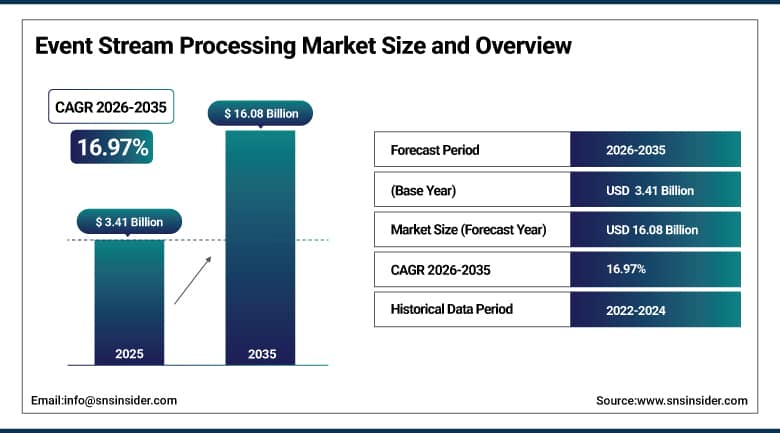
The Event Stream Processing Market size reached USD 3.41 Billion in 2025, and is anticipated to touch USD 16.08 Billion by 2035, exhibiting a growth rate (CAGR) of 16.97% during the forecast period.
The ESP market analysis report provides a detailed assessment of technology integration, application diversity, and regional leadership. Rising adoption in real-time analytics, IoT ecosystems, and cloud-native platforms, growing demand for fraud detection, predictive maintenance, and algorithmic trading, and expanding use by BFSI, telecom, retail, and manufacturing sectors are driving robust market growth during 2026–2035.
In 2025, ESP deployments rose by over 14%, with more than 20,000 enterprise implementations across financial institutions, telecom operators, and e-commerce platforms.
Event Stream Processing Market Size and Forecast:
-
Market Size in 2025: USD 3.41 Billion
-
Market Size by 2035: USD 16.08 Billion
-
CAGR: 16.97% from 2026 to 2035
-
Base Year: 2025
-
Forecast Period: 2026–2035
-
Historical Data: 2022–2024
To Get More Information On Event Stream Processing Market - Request Free Sample Report
Event Stream Processing Market Trends:
-
Cloud-based ESP solutions dominate and are the fastest-growing, offering scalability and cost efficiency.
-
Real-time analytics increasingly leverage machine learning for anomaly detection, predictive insights, and automated decision-making.
-
ESP adoption is accelerating in IoT ecosystems, smart cities, and edge deployments to process data closer to the source.
-
Fraud detection in BFSI and personalization in retail/e-commerce remain the largest application drivers.
-
Organizations are outsourcing ESP operations, fuelling rapid growth in professional and managed services.
-
Manufacturing and energy sectors are using ESP for predictive maintenance and supply chain optimization.
U.S. Event Stream Processing Market Insights:
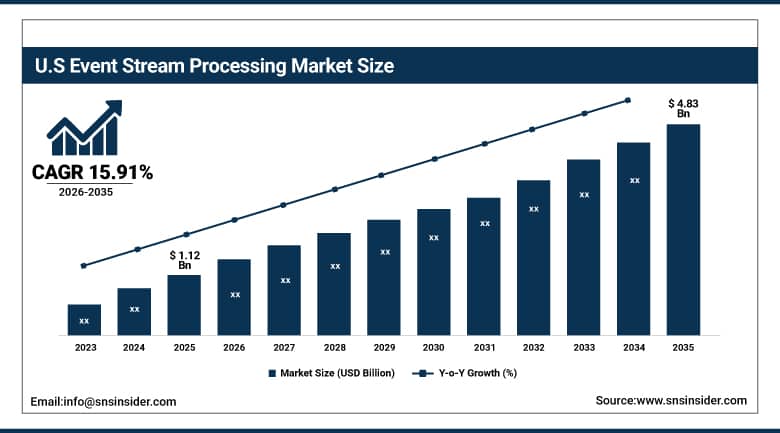
The U.S. Event Stream Processing Market is expected to grow from USD 1.12 Billion in 2025 to USD 4.83 Billion in 2035 at a CAGR of 15.91%. The growth in this market is due to increased adoption in real-time analytics in BFSI, Telecom, and Retail sectors; increased need for fraud detection and risk management; high adoption rates for cloud-native technologies such as AWS Kinesis, Confluent Cloud, and Azure Event Hubs; and increased usage in predictive maintenance and algorithmic trading.
Event Stream Processing Market Growth Drivers:
-
Rising demand for real-time analytics and fraud detection driving adoption of Event Stream Processing solutions.
The growing demand for instant insights in the banking industry, telecom sector, and retail sector is one of the major growth drivers for the ESP market. Enterprises are using the ESP platform for monitoring transactions and responding to the data stream in milliseconds. The cloud-native solutions such as AWS Kinesis, Confluent Cloud, and Azure Event Hubs are also helping the market grow. The managed services segment is also growing as more and more companies are outsourcing the ESP services.
In 2025, over 60% of U.S. BFSI institutions implemented ESP-driven fraud detection systems to strengthen security and improve customer trust.
Event Stream Processing Market Restraints:
-
High implementation costs and data privacy concerns restraining Event Stream Processing adoption.
Another challenge facing enterprises that have legacy infrastructures is that they often find it difficult to justify the high cost associated with implementing ESP platforms, including integration into existing infrastructures and workforce training. Furthermore, other regulatory requirements such as HIPAA, PCI-DSS, and GDPR, pose a challenge to industries that handle personal financial information, health records, and other personal data. This has caused some enterprises to delay adopting ESP technology due to the complexity it adds to their operations, especially for mid-sized enterprises.
In 2025, nearly 40% of mid-sized U.S. enterprises reported cost and compliance challenges as the primary reasons for postponing ESP implementation.
Event Stream Processing Market Opportunities:
-
Expansion of Event Stream Processing in retail and e-commerce creating new growth opportunities.
The rise of online shopping and consumers’ engagement in the online world is providing opportunities for ESP platforms. Retailers are increasingly using the ESP platform for providing real-time personalization, real-time pricing, and real-time fraud detection. The analytics capabilities provided by the ESP platform’s cloud and artificial intelligence have helped retailers react to their consumers in real-time, which has increased brand loyalty and conversion rates for retailers. Considering that the e-commerce industry is expanding to more than a trillion dollars in the US market, opportunities for the ESP platform cannot be ignored.
In 2025, over 55% of large U.S. retailers deployed ESP-driven personalization engines to enhance customer engagement and boost sales performance.
Event Stream Processing Market Segmentation Analysis:
-
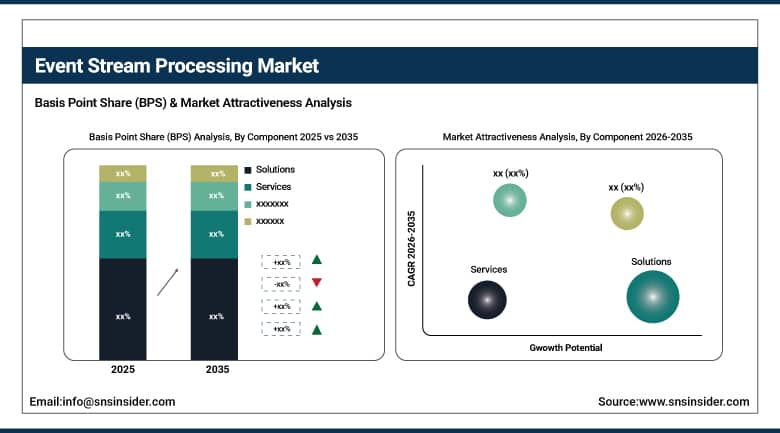
By Component, Solutions segment held the largest market share of 69.42% in 2025, while Services segment are expected to grow at the fastest CAGR of 18.61% during 2026–2035.
-
By Deployment Mode, Cloud-Based dominated with 64.74% market share in 2025, and they also projected to record the fastest CAGR of 17.58% through 2026–2035.
-
By Type, Data Integration accounted for the highest market share of 54.83% in 2025, while Analytics are expected to grow at the fastest CAGR of 16.54% during the forecast period.
-
By Application, Fraud Detection & Risk Analytics dominated with a 34.86% share in 2025, while Predictive Maintenance are anticipated to expand at the fastest CAGR of 18.94% through 2026–2035.
-
By End-User, BFSI held the largest share of 29.97% in 2025, while Retail & E-Commerce are expected to grow at the fastest CAGR of 17.81% during the forecast period.
By Component, Solutions Dominate While Services Grow Rapidly
Solutions are the market leaders due to organizations are already using established platforms such as Apache Flink, Kafka Streams, and Spark Streaming for handling vast amounts of data in real-time. These solutions are already being used by BFSI, telecom, and retail sectors for detecting fraud and transactions, and for instant analytics.
Services have the highest growth rate, mainly due to increasing demand for consulting services, integration services, and managed services. Organizations face difficulties while deploying and managing complex infrastructures of ESP, thus increasing the demand for outsourcing services. Outsourcing services help reduce costs, ensure compliance, and enable enterprises to grow quickly with minimal capital expenditure.
By Deployment Mode, Cloud-Based Dominates While Growing Rapidly
Cloud-based deployment is the most dominant and growing segment in the ESP market. More and more organizations are moving toward cloud-based flexible and cost-effective platforms for managing large-scale real-time data streams. The BFSI, Telecom, and Retail sectors are moving toward cloud-based platforms such as Amazon Web Services Kinesis, Confluent Cloud, and Azure Event Hubs for various use cases such as fraud detection, predictive analytics, and instant customer personalization. The integration of these platforms with AI and IoT ecosystems is making it the most preferred choice for organizations. Cloud-based ESP deployment is already at more than 14,500 enterprise implementations in 2025.
By Type, Data Integration Dominates While Analytics Grows Rapidly
Data Integration dominates the market as enterprises prioritize seamless ingestion and routing of massive data streams from diverse sources. Proven reliability and scalability make integration the backbone of ESP deployments. In 2025, enterprise implementations focused primarily on data integration and underscoring.
Analytics is the fastest-growing segment, driven by rising demand for advanced insights, anomaly detection, and predictive modelling. Organizations are increasingly leveraging ESP analytics to enhance fraud prevention, customer personalization, and operational efficiency.
By Application, Fraud Detection & Risk Analytics Dominates While Predictive Maintenance Grows Rapidly
Fraud Detection & Risk Analytics is the market leader with Proven reliability and integration with AI-driven anomaly detection. It is the most used application in this field. The existence of industries that specialize in fraud detection is a testament to the importance of this field itself.
Predictive Maintenance is the fastest-growing application, driven by manufacturing, energy, and transportation sectors adopting ESP to anticipate equipment failures and reduce downtime. By analysing continuous sensor data streams, enterprises can predict issues before they occur, saving costs and improving efficiency.
By End-User, BFSI Dominates While Retail & E-Commerce Grows Rapidly
BFSI is the market leader in the ESP market, with banking, insurance, and financial services companies using real-time data streaming for fraud detection, monitoring, and real-time transactional analytics. BFSI’s high dependence on data streaming solutions makes ESP absolutely essential.
Retail & E-commerce is the fastest-growing end-user market, driven by increasing e-commerce activity and the need for real-time personalization. Real-time data streaming solutions help e-commerce companies with real-time fraud detection, targeted promotions, and price optimization, thus increasing customer loyalty. With e-commerce in the United States reaching trillion-dollar market size, 2025 is seeing increased adoption.
Event Stream Processing Market Regional Analysis:
North America Event Stream Processing Market Insights
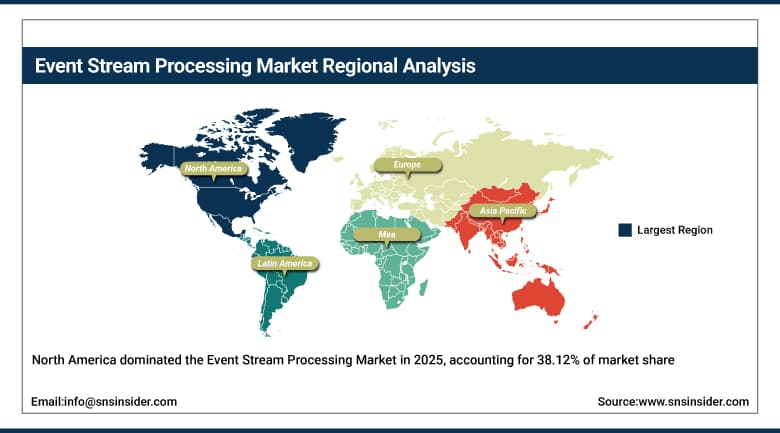
North America's ESP Market is also leading in this segment, holding a market share of 38.12% in 2025 due to high adoption rates for real-time analytics in industries such as BFSI, telecom, and retail. This region also benefits from an existing digital ecosystem, early adopter status for cloud-native technologies, and the presence of key players such as Confluent, AWS, and Microsoft. The region is also experiencing an increase in the need for fraud detection, predictive analysis, and IoT-based applications. The continuous innovations in AI technology, managed services, and compliance-related solutions also add to the leadership status of the North American ESP Market.
Get Customized Report as Per Your Business Requirement - Enquiry Now
U.S. Event Stream Processing Market Insights
The U.S. ESP Market holds the top position in the North American market with the highest number of ESP deployments due to its well-developed financial infrastructure, robust growth in the e-commerce industry, and high adoption of cloud technology. BFSI is the largest segment with the highest adoption of ESP for detecting and preventing fraud and transaction monitoring. Retail and E-commerce are the segments with the highest growth potential and are using ESP for personalization and dynamic pricing.
Asia-Pacific Event Stream Processing Market Insights
Asia-Pacific Event Stream Processing (ESP) Market is emerging as the fastest-growing market with a CAGR of 19.22%, attributed to the increasing rate of digital transformation, development of IoT environments, and the adoption of fintech services in countries such as India, Japan, and Korea. ESP platforms are increasingly being used for applications including fraud detection, predictive analytics, and personalization in the retail and ecommerce industries. Smart city initiatives and Industry 4.0 programs driven by governments and industries are boosting the growth of the ESP market.
China Event Stream Processing Market Insights
China leads ESP adoption within Asia-Pacific, driven by its huge e-commerce market, advanced telecommunication infrastructure, and robust investment in AI and IoT technologies. The retail and e-commerce industries are the main contributors, with ESP technology used for price management, promotional campaigns, and preventing fraud. BFSI and manufacturing industries are growing fast, using ESP technology in risk management and machine maintenance.
Europe Event Stream Processing Market Insights
The Europe Event Stream Processing Market is witnessing a steady rise and is being driven by high adoption in sectors such as BFSI, Telecom, and Manufacturing. Europe is a technologically advanced market with strict regulations and a high need for analytics-based compliance solutions. The market for fraud detection and risk management is still a major contributor to the ESP market in Europe. In 2025, Europe accounted for more than 5,900 enterprise deployments and is a mature and steadily expanding market in the ESP market.
Germany Event Stream Processing Market Insights
Germany is ahead of all other European countries in adopting ESP, mainly due to its high level of manufacturing sophistication and Industry 4.0 initiatives. Predictive maintenance and supply chain optimization are high-growth segments, while BFSI and telco segments continue to use ESP for fraud detection and real-time analytics. Government support is high for digital transformation and IoT integration.
Latin America Event Stream Processing Market Insights
The Latin America ESP Market is a new market, which is being fueled by an increasing fintech landscape, growing telecommunication networks, and increasing e-commerce activity. Brazil and Mexico are at the forefront of this growth, particularly in fraud detection and personalization. Despite challenges, cloud technology has helped in scalability and cost savings.
Middle East & Africa Event Stream Processing Market Insights
The Middle East & Africa ESP market is in its early growth stage due to investments in smart city projects, digital banking, and telco modernization. The BFSI and government sectors are early adopters, followed by the retail and energy sectors, which are slow adopters of ESP for real-time analytics and predictive maintenance. The Middle East & Africa ESP market is driven by cloud-native technology, which solves the infrastructure challenges faced by this region.
Event Stream Processing Market Competitive Landscape:
Confluent is the pioneer in data streaming, built around Apache Kafka, and has established itself as the leading ESP provider. Its dominance stems from offering a complete ecosystem for real-time data integration, stream processing, and analytics, with strong adoption across BFSI, telecom, and e-commerce. Confluent Cloud and Confluent Platform are widely used for mission-critical workloads, enabling enterprises to unify batch and stream processing.
-
In 2025, Confluent launched Confluent Platform 8.0, introducing advanced monitoring, enhanced security, and FlinkSQL integration, further strengthening its hybrid and cloud-native capabilities.
IBM dominates through IBM Event Streams, a robust enterprise-grade platform built on Apache Kafka. Its strength lies in delivering secure, scalable, and resilient event streaming for mission-critical workloads. IBM’s dominance is reinforced by its ability to integrate ESP into broader enterprise automation and AI ecosystems, making it a preferred choice for BFSI, healthcare, and government sectors.
-
In 2025, IBM expanded its Cloud Event Streams offering, enhancing throughput, resilience, and monitoring features to support real-time applications at scale, positioning itself as a trusted provider for regulated industries.
AWS dominates the ESP market with Amazon Kinesis, a fully managed cloud-native platform for real-time data ingestion, processing, and analytics. Its dominance is driven by seamless integration with AWS’s broader ecosystem, scalability, and cost efficiency, making it the go-to solution for enterprises across retail, BFSI, and IoT-heavy industries. AWS’s leadership is reinforced by continuous innovation in streaming analytics and AI integration.
-
In 2025, AWS introduced new enhancements to Kinesis Data Streams, focusing on ultra-low latency, improved schema evolution, and managed Iceberg tables optimized for streaming workloads, further cementing its market leadership.
Event Stream Processing Market Key Players:
-
Confluent Inc.
-
IBM Corporation
-
Amazon Web Services (AWS)
-
Microsoft Corporation (Azure Event Hubs)
-
Google LLC (Cloud Dataflow)
-
SAP SE
-
Software AG
-
TIBCO Software Inc.
-
SAS Institute Inc.
-
Apache Software Foundation (Kafka, Flink, Spark Streaming)
-
StreamSets Inc.
-
Cribl Inc.
-
Hazelcast Inc.
-
Red Hat Inc. (OpenShift Streams)
-
Cloudera Inc.
-
DataStax Inc.
-
Informatica Inc.
-
Imply Inc. (Apache Druid)
| Report Attributes | Details |
|---|---|
| Market Size in 2025 | USD 3.41 Billion |
| Market Size by 2035 | USD 16.08 Billion |
| CAGR | CAGR of 16.97% From 2026 to 2035 |
| Base Year | 2025 |
| Forecast Period | 2026-2035 |
| Historical Data | 2022-2024 |
| Report Scope & Coverage | Market Size, Segments Analysis, Competitive Landscape, Regional Analysis, DROC & SWOT Analysis, Forecast Outlook |
| Key Segments | • By Component (Solutions, Services, Hardware & Infrastructure, Others) • By Deployment Mode (Cloud-Based, On Premises, Edge Deployment, Others) • By Type (Data Integration, Analytics, Streaming Data Management, Others) • By Application (Fraud Detection & Risk Analytics, Predictive Maintenance, Algorithmic Trading & Monitoring, Sales & Marketing Personalization,Cybersecurity & Threat Detection, Smart Infrastructure & IOT Analytics, Others) • By End-User (BFSI,Retail & E-Commerce, IT & Telecommunication, Others) |
| Regional Analysis/Coverage | North America (US, Canada), Europe (Germany, UK, France, Italy, Spain, Russia, Poland, Rest of Europe), Asia Pacific (China, India, Japan, South Korea, Australia, ASEAN Countries, Rest of Asia Pacific), Middle East & Africa (UAE, Saudi Arabia, Qatar, South Africa, Rest of Middle East & Africa), Latin America (Brazil, Argentina, Mexico, Colombia, Rest of Latin America). |
| Company Profiles | Confluent Inc, IBM Corporation, Amazon Web Services (AWS), Microsoft Corporation (AWS), Google LLC (Cloud Dataflow),Oracle Corporation, SAP SE, Software AG, TIBCO Software Inc., SAS Institute Inc., Apache Software Foundation (Kafka, Flink, Spark Streaming), StreamSets Inc., Cribl Inc., Hazalcast Inc., EsperTech Inc., Red Hat Inc. (OpenShift Stream), Cloudera Inc, DataStax Inc., Informatica Inc., Imply Inc. (Apache Druid) |
Frequently Asked Questions
Solutions dominate the ESP market, as enterprises prefer proven platforms including Apache Kafka, Flink, and Spark Streaming for reliable, scalable, and mission-critical operations.
The ESP market is growing due to rising demand for real-time analytics, fraud detection, and instant decision-making across BFSI, telecom, and retail.
Services are the fastest-growing segment, driven by demand for consulting, integration, and managed operations.
North America dominates the ESP market, holding a 38.12% share in 2025, supported by advanced digital infrastructure, strong BFSI adoption, and leading vendors such as Confluent, AWS, and Microsoft.
Top players include Confluent, IBM, AWS, Microsoft, Google, Oracle, SAP, and Software AG, among others.
