
Conductive Inks Market Report Scope & Overview:
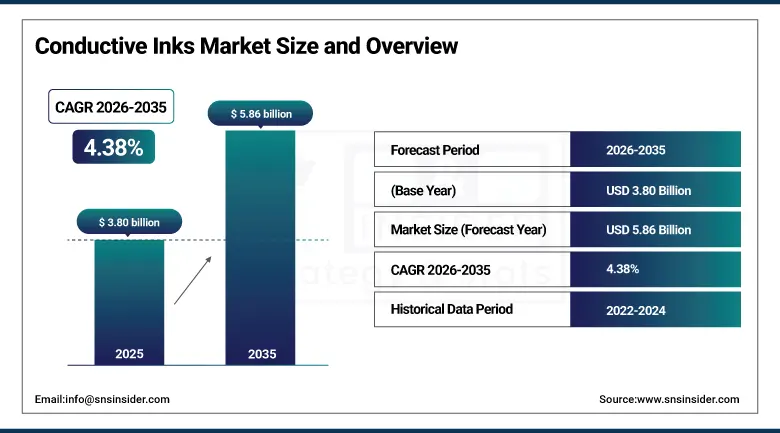
The Conductive Inks Market was valued at USD 3.80 billion in 2025 and is expected to reach USD 5.86 billion by 2035, growing at a CAGR of 4.38% from 2026–2035.
The Conductive Inks Market is experiencing steady Global growth owing to increasing demand for flexible and printed electronics across consumer electronics, automotive, healthcare, and energy applications, along with rising adoption of advanced miniaturized electronic components in IoT devices, wearable technologies, RFID systems, and smart packaging solutions. Expansion of photovoltaic solar cell manufacturing, rapid growth in electric vehicles, and increasing penetration of next-generation display technologies are further supporting market growth. Advancements in nanomaterial-based inks, including silver nanoparticles, graphene-based formulations, and hybrid conductive materials, along with improvements in inkjet, screen, and flexographic printing technologies, are also accelerating global market expansion.
Government initiatives such as the U.S. CHIPS and Science Act, China’s Made in China 2025, and the EU Chips Act are supporting semiconductor and advanced display manufacturing, driving demand for color filter glass in high-precision optical applications.
Rising investments in electronics and photonics under these programs, along with support from industry bodies like the Semiconductor Industry Association (SIA), are accelerating adoption of OLED, Mini-LED, and AR/VR technologies and strengthening demand for advanced optical filtering solutions.
To Get more information on Conductive Inks Market - Request Free Sample Report
Conductive Inks Market Trends
-
Rising adoption of silver-based, copper-based, and graphene conductive inks is improving electrical conductivity, printability, and performance in flexible and printed electronics applications.
-
Increasing demand from consumer electronics and IoT industries is accelerating the use of conductive inks in wearable devices, smart sensors, and miniaturized electronic components.
-
Growing deployment of inkjet and roll-to-roll printing technologies is enhancing production efficiency, scalability, and precision in printed circuit and electronic fabrication processes.
-
Rising replacement of traditional PCB wiring systems with printed conductive ink circuits is driven by lower manufacturing cost, design flexibility, and lightweight structure benefits.
-
Expansion of solar photovoltaic manufacturing and renewable energy systems is boosting demand for silver paste and conductive inks in high-efficiency solar cell electrodes.
-
Development of carbon/graphene-based and hybrid conductive inks is improving sustainability, cost efficiency, and thermal stability in next-generation electronic devices.
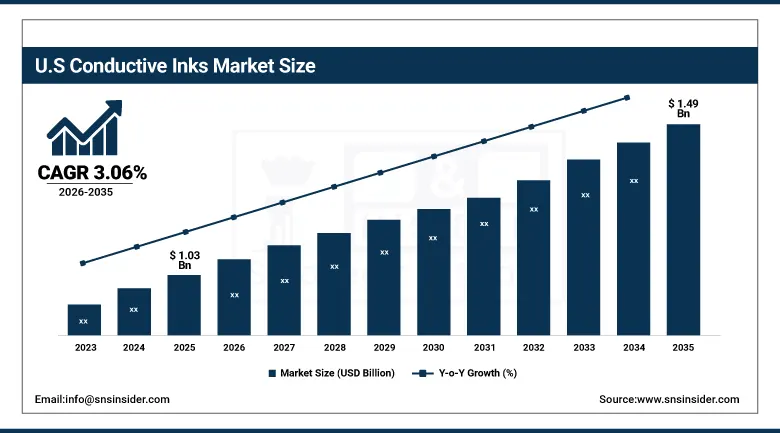
U.S. Conductive Inks Market was valued at USD 1.03 billion in 2025 and is expected to reach around USD 1.49 billion by 2035, growing at a CAGR of 3.06% from 2026–2035.
U.S. Conductive Inks Market is considered one of the most advanced printed electronics markets globally owing to strong semiconductor, consumer electronics, automotive electronics, and medical device infrastructure, along with increasing demand for flexible circuits, RFID systems, smart packaging, and wearable electronic components. Major companies such as DuPont de Nemours, Inc., Henkel AG & Co. KGaA, Heraeus Holding GmbH, Sun Chemical Corporation, and Johnson Matthey Plc are actively focusing on expanding high-performance conductive ink formulations and advanced nanomaterial-based printing solutions.
Government support through the U.S. CHIPS and Science Act and funding for semiconductor, IoT, and advanced electronics is boosting conductive ink adoption. Policies promoting energy-efficient manufacturing and flexible electronics are further driving investment in printed circuit and nanomaterial-based ink technologies in the U.S. market.
Conductive Inks Market Segment Analysis
-
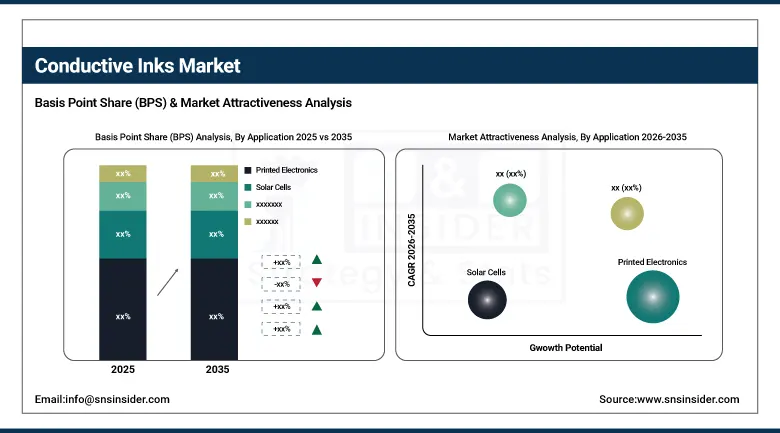
By Application, Printed Electronics dominated the Conductive Inks Market with 38.50% share in 2025; Solar Cells fastest growing (CAGR).
-
By Composition, Silver-Based Conductive Inks dominated the Conductive Inks Market with 42.80% share in 2025; Carbon/Graphene-Based Inks fastest growing (CAGR).
-
By Printing Technology, Screen Printing dominated the Conductive Inks Market with 44.20% share in 2025; Inkjet Printing fastest growing (CAGR).
-
By End Use, Consumer Electronics dominated the Conductive Inks Market with 34.80% share in 2025; Healthcare & Medical Devices fastest growing (CAGR).
-
By Device, Printed Circuit Boards (PCBs) dominated the Conductive Inks Market with 33.90% share in 2025; Biosensors fastest growing (CAGR).
By Application, Printed Electronics dominates the Conductive Inks Market, while Solar Cells is the fastest-growing segment.
Printed Electronics segment dominated the Conductive Inks Market with the highest revenue share of about 38.50% in 2025, due to its extensive use in flexible circuits, sensors, RFID tags, and consumer electronics manufacturing. Strong demand for miniaturized devices, cost-efficient production, and large-scale industrial adoption supports its dominant market position globally.
Solar Cells segment is anticipated to exhibit the highest growth rate in terms of CAGR during the forecast period of 2026-2035 due to the increasing adoption of renewable energy around the world and the growing requirement for efficient solar cells. The growing use of silver conductive ink in solar technology has boosted the growth of the segment.
By Composition, Silver-Based Conductive Inks dominates the Conductive Inks Market, while Carbon/Graphene-Based Inks is the fastest-growing segment.
Silver Based Conductive Inks held the dominated share of around 42.80% of the Conductive Inks Market, owing to its better electrical conductivity, reliability, and performance in photovoltaic cells, printed electronics, and PCBs. The established supply chain and extensive use of this ink in the industry are other factors contributing to its dominant market share.
Carbon/Graphene-based inks segment is projected to experience the highest CAGR during 2026-2035 owing to the increasing preference for affordable, flexible, and environmentally friendly conductive material options. This is fueled by their high mechanical flexibility, low weight, and expanding usage in wearable electronic products, IoT devices, and smart sensors, among others.
By Printing Technology, Screen Printing dominates the Conductive Inks Market, while Inkjet Printing is the fastest-growing segment.
Screen Printing division had the dominate market share of 44.20%, in terms of revenues, within the Conductive Inks Market owing to its ability to generate higher yields at economical prices along with the capacity for handling large scale industrial production requirements. This segment is largely used in manufacturing of printed electronic devices, solar cells, and PCBs.
Inkjet Printing Segment will most probably register the maximum CAGR during the forecast period, due to the precise and efficient material utilization characteristic of inkjet printing, as well as its ability to enable production of flexible circuits that do not require masks. Inkjet printing is very rapid and highly customizable.
By End Use, Consumer Electronics dominates the Conductive Inks Market, while Healthcare & Medical Devices is the fastest-growing segment.
Consumer Electronics segment dominated the Conductive Inks Market with the highest revenue share of about 34.80% in 2025 due to strong demand for smartphones, tablets, wearable, and smart devices. High integration of printed circuits, RFID components, and miniaturized electronics drives extensive use of conductive inks in mass production globally.
Healthcare & Medical Devices segment is expected to grow at the fastest CAGR from 2026–2035 due to rising adoption of biosensors, wearable health monitors, and diagnostic patches.
By Device, Printed Circuit Boards (PCBs) dominates the Conductive Inks Market, while Biosensors is the fastest-growing segment.
Printed Circuit Boards (PCBs) segment was the dominant market for Conductive Inks with maximum market share of 33.90% in the year 2025 owing to extensive application of PCBs in consumer electronics, automotive industry and industrial machinery. The ongoing trend towards miniaturization of electronic products supports the dominance of PCBs.
Biosensors segment is expected to grow at the fastest CAGR from 2026–2035 due to rising demand for advanced healthcare diagnostics, wearable medical devices, and real-time health monitoring systems.
Conductive Inks Market Regional Analysis
|
Region |
Major Country |
Share (%) |
|---|---|---|
|
North America |
United States |
78.40% |
|
Europe |
Germany |
29.60% |
|
Asia Pacific |
China |
41.20% |
|
Middle East & Africa |
UAE |
32.80% |
|
Latin America |
Brazil |
46.50% |
North America Conductive Inks Market Insights
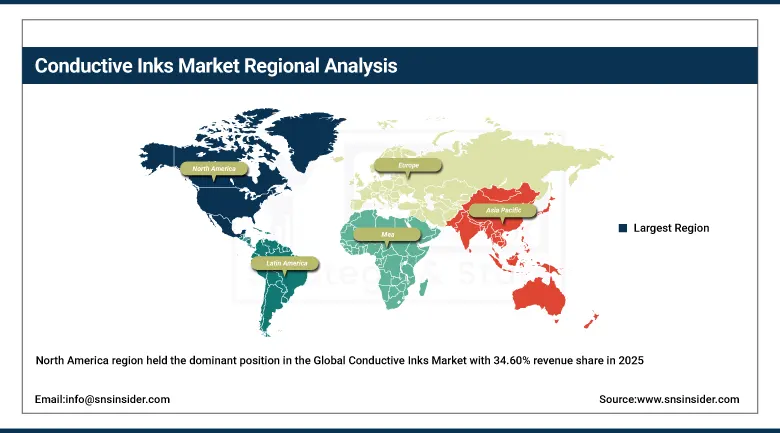
The North America region held the dominant position in the Global Conductive Inks Market with 34.60% revenue share in 2025 owing to strong semiconductor, consumer electronics, automotive electronics, and advanced healthcare device infrastructure, along with rising demand for printed electronics and flexible circuits. The market growth is further supported by high R&D capabilities and increasing replacement of conventional wiring systems with printed conductive ink-based circuits for improved efficiency and miniaturization. The United States remains the leading country due to large-scale electronics manufacturing, IoT adoption, and strong presence of key conductive ink manufacturers and technology developers.
Get Customized Report as per Your Business Requirement - Enquiry Now
Asia Pacific Conductive Inks Market Insights
Asia Pacific is projected to register the highest CAGR of 5.85% from 2026–2035, driven by rapid electronics manufacturing expansion, rising adoption of flexible displays, and increasing solar photovoltaic installations. The Asia-Pacific region is expected to witness the fastest growth rate in the Conductive Inks Market owing to strong demand for low-cost printed electronics and growing investments in consumer electronics and semiconductor industries across countries such as China, Japan, South Korea, and India.
China holds a significant share in the Asia Pacific market due to large-scale electronics production and dominance in display manufacturing. India, Japan, South Korea, and Taiwan are also supporting market expansion through rising electronics exports and industrial automation.
Europe Conductive Inks Market Insights
The Conductive Inks Market is highly significant in Europe because of strong demand from automotive electronics, renewable energy applications, and advanced industrial manufacturing systems. Major countries include Germany, the UK, France, and Italy. Rising focus on sustainability, green electronics, and energy-efficient printed circuit technologies is driving market growth across the region.
European regulations supporting eco-friendly materials and reduced electronic waste are accelerating adoption of carbon-based and graphene conductive inks. The region is witnessing increasing use of conductive inks in smart packaging, automotive sensors, and flexible electronic components.
Middle East & Africa and Latin America Conductive Inks Market Insights
The Middle East & Africa region is witnessing steady growth in the Conductive Inks Market owing to increasing adoption of smart infrastructure, renewable energy projects, and gradual expansion of electronics manufacturing capabilities. UAE, Saudi Arabia, and South Africa are emerging as key regional markets due to rising investments in digital transformation, smart cities, and industrial diversification initiatives.
In Latin America, countries such as Brazil and Mexico are contributing to market growth due to expanding consumer electronics demand, growing automotive production, and increasing adoption of smart packaging technologies. Favourable industrial development and rising penetration of IoT-based applications are further supporting regional market growth.
Conductive Inks Market Growth Drivers
Rising Demand for Flexible Electronics, IoT Devices, and Miniaturized Circuit Technologies: Rapid growth in flexible electronics, wearables, and IoT systems is driving adoption of conductive inks in the electronics industry. Rising demand for portable, lightweight, and energy-efficient devices is increasing the use of printed circuits over traditional wired and rigid boards. Conductive inks enable high-precision, low-cost manufacturing of sensors, antennas, and components used in smartphones and medical devices. Continuous advancement in consumer electronics and wider integration of smart technologies in daily-use products are further boosting demand for conductive inks globally.
Conductive Inks Market Restraints
Technical Limitations in Performance and Substrate Compatibility: Conductive inks face challenges in adhesion, stability, and curing across substrates such as plastics, glass, and textiles. High curing temperatures limit their use in flexible and heat-sensitive materials. Their performance can degrade under mechanical stress and humidity conditions. Compatibility issues with ultra-thin and flexible substrates further restrict applications. These limitations slow adoption in advanced next-generation electronic devices and impact large-scale commercialization in flexible and printed electronics markets.
Conductive Inks Market Opportunities
Growth of Smart Packaging, RFID Systems, and Printed Electronics Applications: Rise in adoption of smart packaging systems, RFID technology, and printed electronics is creating strong growth opportunities for conductive inks. Demand for real-time tracking, authentication, and supply chain transparency is increasing use across retail, logistics, and healthcare sectors. Conductive inks enable cost-effective production of flexible circuits on packaging materials. Growth in e-commerce and global trade is accelerating adoption of smart labels. Advances in printable electronics are expected to further expand applications of conductive inks in future technologies.
Recent Developments
-
2026: Conductive ink applications expanded across North America and Asia-Pacific due to rising demand from flexible electronics, IoT devices, and miniaturized printed circuit systems.
-
2025: Companies such as DuPont, Henkel, and Heraeus expanded portfolios focused on silver, copper, and graphene-based inks for advanced printed electronics.
-
2024: Adoption of conductive inks increased across consumer electronics, automotive, healthcare, and energy sectors driven by growth in smart devices, RFID, solar PV, and flexible displays.
Conductive Inks Market Key Players
-
DuPont de Nemours, Inc.
-
Henkel AG & Co. KGaA
-
Heraeus Holding GmbH
-
Johnson Matthey Plc
-
NovaCentrix
-
Creative Materials Inc.
-
Vorbeck Materials Corporation
-
Poly-Ink
-
Applied Ink Solutions
-
PPG Industries, Inc.
-
Agfa-Gevaert N.V.
-
Daicel Corporation
-
InkTec Co., Ltd.
-
Nano Dimension Ltd.
-
Methode Electronics, Inc.
-
Advanced Nano Products Co., Ltd.
-
Toyobo Co., Ltd.
-
Nippon Kayaku Co., Ltd.
| Report Attributes | Details |
|---|---|
| Market Size in 2025 | USD 3.80 Billion |
| Market Size by 2035 | USD 5.86 Billion |
| CAGR | CAGR of 4.38% From 2026 to 2035 |
| Base Year | 2025 |
| Forecast Period | 2026-2035 |
| Historical Data | 2022-2024 |
| Report Scope & Coverage | Market Size, Segments Analysis, Competitive Landscape, Regional Analysis, DROC & SWOT Analysis, Forecast Outlook |
| Key Segments | • By Application (Printed Electronics, Solar Cells, Flexible Displays, Smart Textiles, Printed Heaters) • By Composition (Silver-Based Conductive Inks, Copper-Based Conductive Inks, Carbon/Graphene-Based Inks, Polymer-Based Conductive Inks, Hybrid Conductive Inks) • By Printing Technology (Screen Printing, Inkjet Printing, Flexographic Printing, Gravure Printing) • By End-Use (Consumer Electronics, Automotive, Healthcare & Medical Devices, Energy & Power, Aerospace & Defense) • By Device (Printed Circuit Boards (PCBs), RFID Tags & Smart Packaging, Biosensors, Antennas, Electroluminescent (EL) Panels) |
| Regional Analysis/Coverage | North America (US, Canada), Europe (Germany, UK, France, Italy, Spain, Russia, Poland, Rest of Europe), Asia Pacific (China, India, Japan, South Korea, Australia, ASEAN Countries, Rest of Asia Pacific), Middle East & Africa (UAE, Saudi Arabia, Qatar, South Africa, Rest of Middle East & Africa), Latin America (Brazil, Argentina, Mexico, Colombia, Rest of Latin America). |
| Company Profiles | DuPont de Nemours, Inc., Henkel AG & Co. KGaA, Heraeus Holding GmbH, Sun Chemical Corporation, Johnson Matthey Plc, NovaCentrix, Creative Materials Inc., Vorbeck Materials Corporation, Poly-Ink, Applied Ink Solutions, PPG Industries, Inc., Agfa-Gevaert N.V., Daicel Corporation, InkTec Co., Ltd., Nano Dimension Ltd., Fujikura Ltd., Methode Electronics, Inc., Advanced Nano Products Co., Ltd., Toyobo Co., Ltd., Nippon Kayaku Co., Ltd. |

Frequently Asked Questions
North America dominated the Conductive Inks Market in 2025.
The Printed Electronics segment dominated the Conductive Inks Market in 2025.
Increasing demand for flexible electronics, IoT-enabled devices, miniaturized circuits, wearable technologies, and printed electronics applications across consumer electronics, automotive, healthcare, and energy sectors is the major growth factor driving the market.
The Conductive Inks Market was valued at USD 3.80 billion in 2025.
The Conductive Inks Market is expected to grow at a CAGR of 4.38% from 2026 to 2035.
