
Coolant Monitoring Sensors Market Report Scope & Overview:
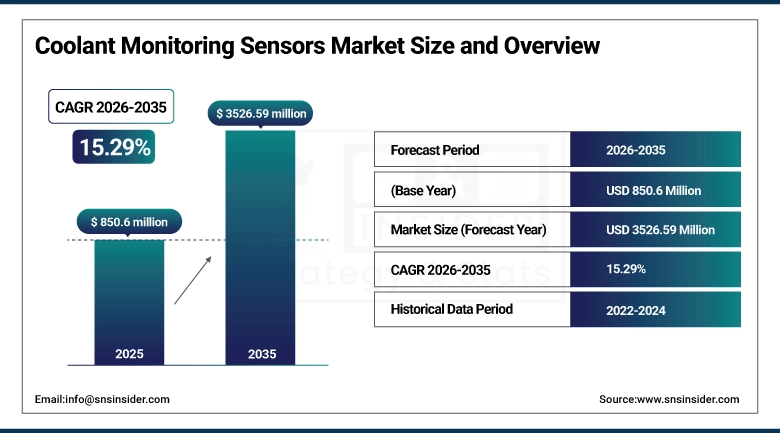
The Coolant Monitoring Sensors Market size was valued at USD 850.6 Million in 2025 and is projected to reach USD 3526.59 Million by 2035, growing at a CAGR of 15.29% during 2026–2035.
The Coolant Monitoring Sensors market is experiencing strong growth demand for deployment of real-time fluid condition monitoring along with automated coolant management in the industrial operations which in turn is driving the growth of the Coolant Monitoring Sensors market. To better stabilize processes and react experimentally to these different parameters in the future, manufacturers are applying advanced in-line sensing technologies that can continuously monitor attributes like pH, temperature, concentration, and conductivity, thus reducing equipment downtime. The growing appetite of predictive maintenance and operational efficiency are also a key booster in deploying intelligent monitoring systems in metalworking and manufacturing industries. Besides, increased emphasis on cost reduction, productivity improvement, and industrial digitalization is another factor propelling the adoption of sensor-based coolant monitoring solutions across the globe.
On Sept 2025, Castrol is launching its Smart Coolant solution, a smart coolant tracking system that continuously monitors and manages coolant conditions in real-time to optimize efficiency of manufacturing processes. It reduces the operational cost and increases the efficiency of the system by automating the control and maintenance of coolant parameters such as pH, temperature, concentration, and conductivity.
Coolant Monitoring Sensors Market Size and Forecast:
-
Market Size in 2025: USD 850.6 Million
-
Market Size by 2035: USD 3526.59 Million
-
CAGR: 15.29% (from 2026 to 2035)
-
Base Year: 2025
-
Forecast Period: 2026–2035
-
Historical Data: 2022–2024
To Get more information on Coolant Monitoring Sensors Market - Request Free Sample Report
Coolant Monitoring Sensors Market Trends Highlights:
-
Rising demand for predictive maintenance is driving market adoption.
-
Growth is supported by increasing industrial automation.
-
Data center expansion is a major demand driver.
-
Liquid cooling systems are boosting sensor deployment.
-
Semiconductor manufacturing requires high-precision coolant monitoring.
-
EV battery thermal management is expanding sensor use.
-
Industrial machinery safety regulations support market growth.
U.S. Coolant Monitoring Sensors Market Size Outlook:
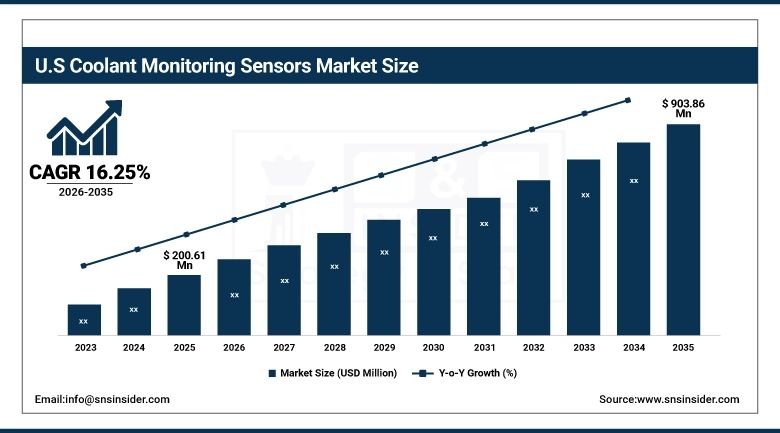
The U.S. Coolant Monitoring Sensors Market was valued at USD 200.61 Million in 2025 and is projected to reach USD 903.86 Million by 2035, growing at a CAGR of 16.25% during 2026–2035, driven by increasing preference for advanced thermal management in electric vehicles, industrial automation, and data center infrastructure respectively. Adoption is being driven to a more rapid pace by growing emphasis on predictive maintenance, energy efficiency, and reliability of equipment. Expansion end-use industries are being supported by stringent environmental regulations and reduced need for downtime of the systems.
Coolant Monitoring Sensors Market Drivers:
-
Rising Demand for Real-Time Thermal Intelligence Driving Coolant Monitoring Sensors Market
The coolant monitoring sensors is a part of the conditioning monitoring sensors segment which is a part of systematic predictive maintenance as an increasing number of industries are choosing real-time systems for temperature, flow, and equipment health across domestic and industrial environments which drive the growth in global market. The need for predictive maintenance, operational efficiency, and equipment reliability is further intensifying the market penetration of advanced sensor technologies in cooling systems. The increased demand for effective thermal monitoring solutions for intelligent thermal monitoring, is further fueled by the expansion of automated manufacturing, data centers, and smart factories. Moreover, the increasing emphasis on minimizing downtime, maximizing energy efficiency, and enhancing process stability is propelling the implementation of IoT-based coolant monitoring sensors in several high-performance industrial applications around the world.
In January 2025, ABB Ability SWICOM condition monitoring system tracked breaker performance, temperature and electrical conditions with advanced sensors to provide real-time switchgear health monitoring. Related to coolant monitoring sensors: Both technologies are focused on predictive maintenance, and as such, realize and enable real-time thermal monitoring to increase safety and reliability of industrial equipment.
Coolant Monitoring Sensors Market Restraints:
-
Integration Barriers and High Deployment Costs Limiting Market Expansion
High initial investment and complexity to integrate with existing industrial and cooling infrastructure are some of the major restraints for the market for coolant monitoring sensors during the forecast period. Advanced sensor systems, combined with supporting digital platforms, come at a significant cost for many end users, particularly small and medium enterprises. Installing newer monitoring technologies in older equipment typically necessitates system reconfiguration, adding to installation time and cost. Furthermore, sensor accuracy challenges in extreme operating environments, need to be calibrated, and continuous maintenance further decreased efficiency in adoption. Data management issues as well as cybersecurity concerns associated with such connected monitoring systems hinder their largescale adoption within industrial and data center applications.
Coolant Monitoring Sensors Market Opportunities:
-
AI-Driven Liquid Cooling Intelligence Creating High-Value Opportunities in Coolant Monitoring Sensors Market
The increasing adoption of intelligent liquid cooling systems in data centers and industrial environments is creating significant growth opportunities for coolant monitoring sensors. Rising demand for real-time fluid health tracking, predictive maintenance, and high-efficiency thermal management is driving integration of advanced sensing technologies. Expansion of high-density computing infrastructure and automation-based cooling optimization is further accelerating the need for smart sensors capable of monitoring temperature, flow, pH, and coolant quality. Additionally, growing focus on energy efficiency, system reliability, and operational safety is encouraging widespread deployment of IoT-enabled monitoring solutions across next-generation cooling applications.
In May 2025, Ecolab launched its 3D TRASAR Technology for Direct-to-Chip Liquid Cooling to enhance data center performance by enabling real-time monitoring of coolant health, including temperature, pH, flow, and concentration. The solution improves cooling efficiency, reduces downtime, and ensures reliable thermal management for high-density AI-driven computing infrastructure.
Coolant Monitoring Sensors Market Segment Highlights:
-
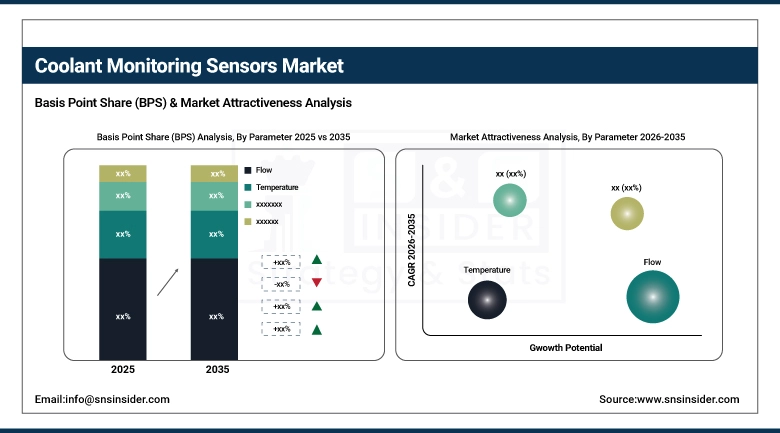
By Parameter: Dominant – Flow (31.84% in 2025 → 27.58% in 2035); Fastest Growing – Temperature (27.63% in 2025 → 33.96% in 2035)
-
By Technology: Dominant – MEMS (34.27% in 2025 → 29.18% in 2035); Fastest Growing – Optical (22.91% in 2025 → 27.41% in 2035)
-
By Integration Level: Dominant – Standalone Probes (38.46% in 2025 → 30.72% in 2035); Fastest Growing – Integrated Coolant Units (27.36% in 2025 → 32.74% in 2035)
-
By End User: Dominant – Industrial Cooling (33.17% in 2025 → 27.92% in 2035); Fastest Growing – Data Centers (29.63% in 2025 → 35.84% in 2035)
By Parameter - Flow (Dominant) and Temperature (Fastest-Growing)
The Flow segment holds the dominant share due to its critical role in coolant monitoring systems for ensuring accurate measurement of fluid circulation, system efficiency, and equipment protection across industrial applications. Its widespread use in manufacturing, automotive, and heavy machinery systems strengthens its market position. Conversely, the Temperature segment is witnessing the fastest growth due to increasing demand for precise thermal management, real-time monitoring, and predictive maintenance capabilities, driven by the rising adoption of advanced automation and smart industrial systems.
By Technology- MEMS (Dominant) and Optical (Fastest-Growing) – By Technology
Due to the high penetration level of MEMS devices in small size and high-performance coolant monitoring sensor for its reliability, affordability, and broad integration with overall industrial systems, MEMS segment accounts for a large market share. The company benefits from its proven applications in automotive, manufacturing, and industrial automation. On the contrary, Optical segment is poised to grow at the highest rate as it is increasingly being used in high performance industrial and cooling markets due to increasing need for high precision and non-contact sensing technologies.
By Integration Level - Standalone Probes (Dominant) and Integrated Coolant Units (Fastest-Growing)
Standalone Probes are the largest shareholder due to their easy installation, adaptability and their usage in existing industrial systems where application is for simple coolant monitoring. The cost advantage and adaption with the legacy infrastructure plays a significant role in its dominating the market. On the other hand, the Integrated Coolant Units segment is expected to grow at the fastest rate on account of the growing demand for completely automatic, smart, and system-integrated monitoring solutions that improve real-time performance tracking, electrical efficiency, and predictive maintenance features.
By End User - Industrial Cooling (Dominant) and Data Centers (Fastest-Growing)
The Industrial Cooling segment has the largest market share as the underlying concept finds application across manufacturing plants, heavy machinery and processing industries, where thermal issues can directly influence operational stability. The mass adoption of AI in traditional sectors fortifies its position in the market. On the other hand, the Data Centers segment is expected to experience the highest growth due to high digitalization, growing cloud infrastructure, and high-performance computing requirements, requiring advanced cooling efficiency and real-time monitoring systems..
Coolant Monitoring Sensors Market Regional Highlights:
-
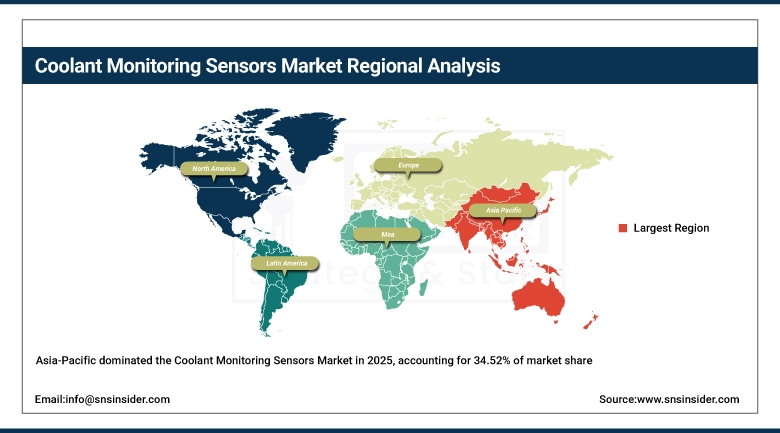
Asia-Pacific (Dominating – 34.52% in 2025 → 37.21% in 2035, CAGR 16.15%)
-
North America (Fastest Growing – 27.63% in 2025 → 29.48% in 2035, CAGR 16.04%)
-
Europe (24.11% in 2025 → 21.76% in 2035, CAGR 14.11%)
-
Latin America (7.28% in 2025 → 6.41% in 2035, CAGR 13.82%)
-
Middle East & Africa (6.46% in 2025 → 5.14% in 2035, CAGR 12.66%)
Asia-Pacific Coolant Monitoring Sensors Market Insights:
The Asia Pacific region dominates the Coolant Monitoring Sensors market due to rapid industrialization, expanding automotive production, and strong growth in manufacturing and electronics sectors. Increasing adoption of automation technologies across factories, rising demand for predictive maintenance, and strict efficiency requirements in industrial cooling systems further support market expansion. Additionally, growing investments in smart manufacturing infrastructure, along with the presence of large-scale production hubs in countries such as China, Japan, South Korea, and India, continue to strengthen regional market leadership and sustained growth momentum.
Get Customized Report as per Your Business Requirement - Enquiry Now
China Coolant Monitoring Sensors Market Insights:
China, with its large scale industrial expansion to be one of the widely applicable coolant monitoring sensors across domains, supported by growing automotive manufacturing base from over a decade, increasing automation adoption as well as the growing need for efficient thermal management systems.
North America Coolant Monitoring Sensors Market Insights:
North America is anticipated to hold the largest share and is expected to be the fastest growing region in the global Coolant Monitoring Sensors market, mainly due to the fast developed industrial automation, rising adoption of predictive maintenance systems, and increasing demand from automobile, aerospace and advanced manufacturing industries in the region. There is a large investment that is being done within the region towards smart factories and Industry 4.0 technologies that will lead to the introduction of advanced sensing solutions for real time coolant monitoring and equipment efficiency. Moreover, high regulatory standards associated with operational safety, energy efficiency and equipment reliability are also driving the growth of coolant monitoring sensors in industrial applications.
U.S. Coolant Monitoring Sensors Market Insights:
The high demand for predictive maintenance along with the strong manufacturing base in the USA are leading the country to become a dominant coolant monitoring sensors market as it encourages industrial automation by requiring efficient cooling and monitoring systems which are IoT-enabled and highly accurate for effective working of machines that can increase its productivity.
Europe Coolant Monitoring Sensors Market Insights:
The Europe Coolant Monitoring Sensors industry is predicted to experience continued growth through the forecast period owing to rising industrial automation, environmental and efficiency regulations, and demand for predictive maintenance solutions for manufacturing which could be facilities focused in manufacturing, automotive, and energy. Further, the rising inclination towards sustainability and energy-efficient operations in the region is propelling the adoption of such advanced monitoring technologies. Also, steady investments in smart factory infrastructure and in Industry 4.0 initiatives are encouraging coolant monitoring sensors so that equipment can be more efficient and reliable.
Germany Coolant Monitoring Sensors Market Insights:
The steady growth in Germany Coolant Monitoring Sensors market can be attributed to the mature automotive and industrial manufacturing sectors, which drive the demand for automation in production facilities to meet the ever-increasing global standards.
Latin America Coolant Monitoring Sensors Market Insights:
The coolant monitoring sensors market in Latin America is gradually increasing across several countries owing to industrialization, bolstering automotive production and rising adoption of automation technologies in manufacturing and processing industries. Increasing focus on equipment efficiency, maintenance optimization and operational safety are fostering the adoption of smart monitoring systems. Finally, the consistent investments in industrial infrastructure and the gradual digital transformation process in Brazil and Mexico are contributing to market growth, along with the growing demand for low-cost predictive maintenance solutions for industrial applications.
Brazil Coolant Monitoring Sensors Market Insights:
Brazil holds the highest share in the Latin America Coolant Monitoring Sensors market owing to its vast industrial base, growth in automotive sector, and rising adoption of automation and predictive maintenance technologies. Increasing investments in manufacturing facilities and rising emphasis on operational efficiency are further aiding the market growth across the country.
Middle East & Africa Coolant Monitoring Sensors Market Insights:
The Middle East & Africa Coolant Monitoring Sensors market is witnessing significant momentum due to expanding industrial diversification, increasing investments in oil & gas, manufacturing, and power generation sectors, and rising adoption of automation technologies. Growing focus on operational efficiency, equipment reliability, and predictive maintenance is driving the deployment of advanced sensor-based monitoring systems. Additionally, infrastructure development projects, smart industrial initiatives, and gradual digital transformation across key economies are further supporting market growth. Increasing emphasis on reducing downtime and improving cooling system performance is also accelerating adoption across the region.
Saudi Arabia Coolant Monitoring Sensors Market Insights:
Saudi Arabia is one of the leading regions driven by high oil & gas industry along with rapid industrial diversification, extensive manufacturing investment, and increasing deployment of automation and predictive maintenance technologies.
Coolant Monitoring Sensors Market Competitive Landscape:
Siemens, established in 1847, is a global leader in industrial automation, electrification, and digitalization solutions, serving industries such as manufacturing, energy, healthcare, and infrastructure. The company focuses on smart manufacturing, IoT-enabled systems, and AI-driven industrial software to enhance efficiency and productivity. Siemens also provides advanced predictive maintenance, sensing technologies, and digital twin solutions, supporting the global transition toward intelligent and sustainable industrial ecosystems.
-
In Feb 2024 Siemens announced the integration of generative AI into its Senseye Predictive Maintenance platform to enhance industrial maintenance efficiency and enable more intuitive, conversational decision-making. BlueScope Steel is an early adopter of this solution, using it to improve predictive maintenance performance, streamline operations, and accelerate digital transformation across its manufacturing facilities.
Honeywell International Inc. is a 1906 diversified company that produces aerospace, industrial automation, and sensing technology. It creates advanced sensor solutions that are used for industrial safety and coolant monitoring applications, such as gas detection and temperature and flow monitoring systems. This company provides operational excellence, predictive maintenance, and industrial safety in the most important sectors in the world.
-
In March 2026, Honeywell introduced a new NDIR Hydrocarbon Gas Sensor using infrared technology to enhance industrial safety by detecting hazardous gases in harsh environments. This advancement is highly relevant to coolant monitoring sensors as both technologies support real-time industrial condition monitoring, improving system safety, preventing equipment failure, and ensuring reliable thermal and fluid management in critical industrial operations.
Coolant Monitoring Sensors Companies are:
-
Honeywell
-
Robert Bosch GmbH
-
ABB
-
Schneider Electric
-
Emerson Electric
-
ifm electronic
-
Balluff
-
Omron Corporation
-
Endress+Hauser
-
Yokogawa Electric
-
SICK AG
-
Sensata Technologies
-
Danfoss
-
Parker Hannifin
-
SKF
-
Fluke Corporation
-
Keysight Technologies
-
Pepperl+Fuchs
| Report Attributes | Details |
|---|---|
| Market Size in 2025 | USD 850.6 Million |
| Market Size by 2035 | USD 3526.59 Million |
| CAGR | CAGR of 15.29% From 2026 to 2035 |
| Base Year | 2025 |
| Forecast Period | 2026-2035 |
| Historical Data | 2022-2024 |
| Report Scope & Coverage | Market Size, Segments Analysis, Competitive Landscape, Regional Analysis, DROC & SWOT Analysis, Forecast Outlook |
| Key Segments | • By Parameter (Flow, Temperature, Pressure and Conductivity or Other) • By Technology (MEMS, Ultrasonic, Optical and Other) • By Integration Level (Standalone Probes, Inline Modules and Integrated Coolant Units) • By End User (Data Centers, Industrial Cooling, Battery Cooling and Others) |
| Regional Analysis/Coverage | North America (US, Canada), Europe (Germany, UK, France, Italy, Spain, Russia, Poland, Rest of Europe), Asia Pacific (China, India, Japan, South Korea, Australia, ASEAN Countries, Rest of Asia Pacific), Middle East & Africa (UAE, Saudi Arabia, Qatar, South Africa, Rest of Middle East & Africa), Latin America (Brazil, Argentina, Mexico, Colombia, Rest of Latin America). |
| Company Profiles | Siemens, Honeywell, Robert Bosch GmbH, ABB, Schneider Electric, Emerson Electric, TE Connectivity, ifm electronic, Balluff, Omron Corporation, Endress+Hauser, Yokogawa Electric, SICK AG, Sensata Technologies, Danfoss, Parker Hannifin, SKF, Fluke Corporation, Keysight Technologies, Pepperl+Fuchs. |

Frequently Asked Questions
Asia-Pacific dominated the Coolant Monitoring Sensors Market in 2025.
The “Flow” segment dominated during the projected period.
The key drivers of the Coolant Monitoring Sensors market include rising demand for real-time coolant condition monitoring, increasing adoption of predictive maintenance in manufacturing, growing need to reduce equipment downtime and operational costs, and rapid industrial automation across metalworking industries.
The Market was valued at USD 850.6 Million in 2025 and is projected to reach USD 3526.59 Million by 2035.
The Market is expected to grow at a CAGR of 15.29% during 2026–2035.
