
Covalent Organic Framework (COF) Market Report Scope & Overview:
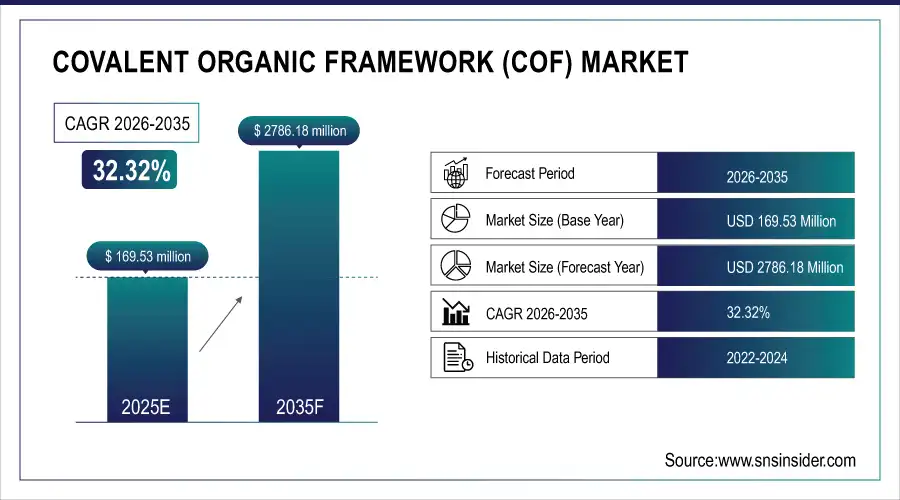
The Covalent Organic Framework (COF) Market was valued at USD 169.53 Million in 2025 and is expected to reach USD 2786.18 Million by 2035, growing at a CAGR 32.32% of from 2026-2035.
The Covalent Organic Framework (COF) market is rapidly growing, driven by the material’s high surface area, tunable porosity, and chemical stability. COFs are increasingly used in gas storage, separation, energy storage, catalysis, environmental remediation, and sensing applications. Strong research and development, industrial adoption, and focus on sustainable, high-performance materials are fueling market expansion, with innovations in synthesis, functionalization, and scalability enhancing commercial potential across multiple sectors.
Around 42% of research and industrial organizations use Covalent Organic Frameworks (COFs) for applications such as gas separation, energy storage, catalysis, and environmental remediation worldwide.
To Get more information On Covalent Organic Framework (COF) Market - Request Free Sample Report
Key Trends in the Covalent Organic Framework (COF) Market
-
COFs are increasingly applied in batteries and supercapacitors for enhanced energy storage.
-
High selectivity and stability drive COF adoption in gas separation and carbon capture.
-
Companies are scaling COF production from laboratory to industrial levels.
-
Functionalized COFs are being developed for catalysis and advanced sensing.
-
COFs are promoted as sustainable, recyclable, and eco-friendly materials.
U.S. Covalent Organic Framework (COF) Market Insights:
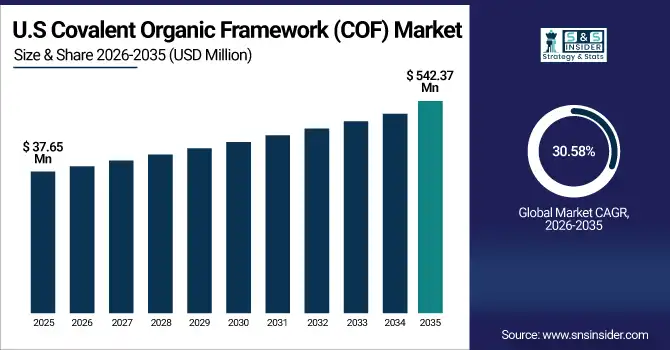
The U.S. Covalent Organic Framework (COF) Market is projected to grow from USD 37.65 Million in 2025 to USD 542.37 Million by 2035, at a CAGR of 30.58%. Growth is driven by increasing adoption in energy storage, gas separation, and catalysis, strong R&D, government funding, industrial collaborations, and rising demand for sustainable, high-performance materials.
Covalent Organic Framework (COF) Market Growth Drivers:
-
Expansion of Energy Storage, Gas Separation, and Catalysis Applications
Rising demand for COFs in energy storage, gas separation, and catalytic applications is a major driver of the market. COFs’ high surface area, tunable porosity, and chemical stability make them ideal for batteries, supercapacitors, carbon capture, and selective gas separation. Increasing industrial adoption and research activities are fueling the development and commercialization of COF-based materials, encouraging investments in scalable synthesis and functionalization technologies to meet growing performance requirements across multiple sectors.
Covalent Organic Framework (COF) Market Restraints:
-
High Production Costs and Complex Synthesis Processes
High production costs and complex synthesis procedures act as key restraints in the COF market. The need for specialized reagents, precise reaction conditions, and multi-step functionalization limits large-scale manufacturing. These challenges increase overall material costs and slow industrial adoption. Small and medium-scale enterprises, in particular, face difficulties in scaling up production and maintaining consistency in quality, restraining market growth despite strong research interest.
Covalent Organic Framework (COF) Market Opportunities:
-
Rising Focus on Sustainable and High-Performance Materials
The COF market presents significant opportunities driven by the global emphasis on sustainable and high-performance materials. Growing demand for eco-friendly, recyclable, and tunable porous materials in energy storage, catalysis, and environmental applications is creating avenues for innovation. Advancements in scalable COF synthesis, functionalization for targeted applications, and integration into industrial processes offer potential for commercialization, strategic partnerships, and long-term market expansion across research and industrial sectors.
Covalent Organic Framework (COF) Market Segment:
-
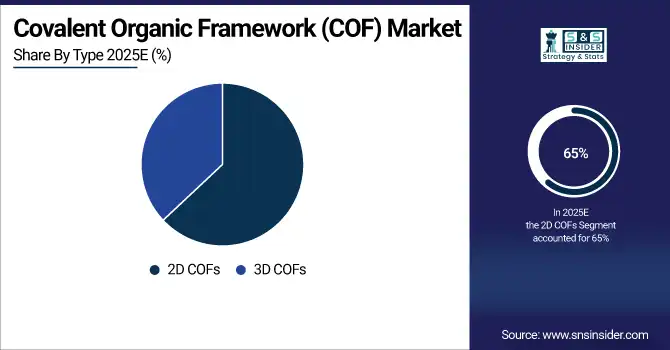
By Type: In 2025, 2D COFs dominated with 65% share; 3D COFs fastest growing segment during 2026-2035
-
By Linkage Chemistry: In 2025, Imine-based COFs dominated with 35% share; β-Ketoenamine COFs fastest growing segment during 2026-2035
-
By Application: In 2025Gas Storage & Separation dominated with 40% share; Energy Storage fastest growing segment during 2026-2035
-
By End User: In 2025, Research Institutes & Universities dominated with 45% share; Chemical & Material Manufacturers fastest growing segment during 2026-2035
Covalent Organic Framework (COF) Market Segment Analysis:
By Type: 2D COFs Dominate, 3D COFs Fastest-Growing
2D COFs dominate the COF type segment due to their high crystallinity, large surface area, and relatively simpler synthesis routes. Their layered structures enable efficient charge transport and molecular diffusion, making them widely adopted in gas separation membranes, sensors, and optoelectronic applications. Established laboratory protocols and scalability advantages further support their dominance in both academic and early commercial use.
3D COFs are the fastest-growing segment, driven by their interconnected pore networks, superior mechanical stability, and enhanced mass transport properties. Increasing demand for high-capacity gas storage, heterogeneous catalysis, and advanced energy storage systems is accelerating the adoption of 3D COFs, particularly in industrial-scale and performance-critical applications.
By Linkage Chemistry: Imine-Based COFs Dominate, β-Ketoenamine COFs Fastest-Growing
Imine-based COFs dominate the linkage chemistry segment owing to their synthetic versatility, mild reaction conditions, and compatibility with a wide range of functional monomers. These COFs offer a balanced combination of stability, tunable porosity, and cost-effective production, making them the preferred choice for gas adsorption, separation, and catalytic applications.
β-Ketoenamine COFs represent the fastest-growing linkage type, supported by their exceptional chemical, thermal, and hydrolytic stability. Their robustness under harsh acidic and basic conditions makes them increasingly attractive for long-term industrial applications, including energy storage electrodes, environmental remediation, and catalytic processes.
By Application: Gas Storage & Separation Dominate, Energy Storage Fastest-Growing
Gas storage and separation dominate the COF application segment due to the materials’ ultra-high surface area, controllable pore size, and strong affinity for gases such as hydrogen, methane, and carbon dioxide. COFs are increasingly used in carbon capture, hydrogen storage, and selective gas separation membranes, positioning this segment as the primary revenue contributor.
Energy storage, including batteries and supercapacitors, is the fastest-growing application segment. The rapid growth is driven by rising demand for advanced electrode materials with high conductivity, ion transport efficiency, and structural tunability. COFs’ ability to be functionalized for redox activity and conductivity enhancement is accelerating their adoption in next-generation energy storage systems.
By End User: Research Institutes & Universities Dominate, Chemical & Material Manufacturers Fastest-Growing
Research institutes and universities dominate the end-user segment, as COFs remain heavily research-driven materials with extensive exploration in synthesis, functionalization, and application development. Strong academic funding, collaborative research programs, and high publication output continue to sustain this segment’s leadership.
Chemical and material manufacturers are the fastest-growing end-user segment, supported by increasing commercialization efforts, pilot-scale production, and integration of COFs into industrial processes. Growing interest in sustainable materials, carbon capture technologies, and high-performance catalysts is driving industrial adoption beyond laboratory-scale research.
Covalent Organic Framework (COF) Market - Regional Analysis
North America Covalent Organic Framework (COF) Market Insights:
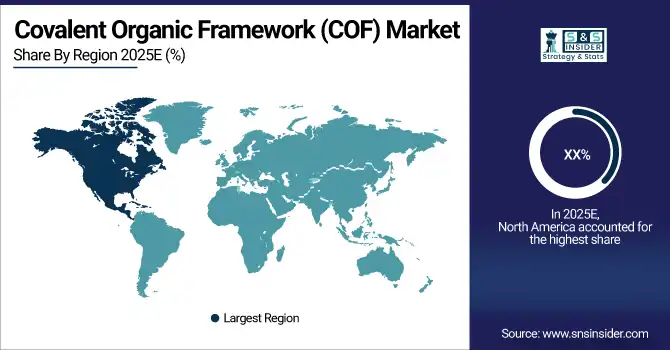
North America is a key region in the Covalent Organic Framework (COF) market, driven by strong research and development activities, advanced material manufacturing capabilities, and collaborations between universities and industry. The region benefits from high adoption of COFs in energy storage, catalysis, and gas separation applications. The United States leads in commercialization and pilot-scale production, while Canada focuses on clean energy research and environmental applications. Continuous innovation and government support are fueling market growth across the region.
Get Customized Report as per Your Business Requirement - Enquiry Now
Europe Covalent Organic Framework (COF) Market Insights:
Europe is a significant player in the Covalent Organic Framework (COF) market, driven by sustainability initiatives, stringent environmental regulations, and growing adoption of COFs in carbon capture, gas separation, and energy storage applications. The region emphasizes research collaboration between universities and industrial manufacturers to advance COF synthesis and commercialization. Countries such as Germany, France, and the UK are leading innovation in advanced porous materials, focusing on scalable production, functionalization, and integration of COFs into industrial and clean energy processes.
Asia-Pacific Covalent Organic Framework (COF) Market Insights:
In 2025, Asia-Pacific holds the largest market share of approximately 42%, making it both the dominant and fastest-growing region in the Covalent Organic Framework (COF) market, with an expected CAGR of 35.43% during 2026-2035. The region’s leadership is supported by strong academic research, government funding, and early industrial adoption across China, Japan, and South Korea. It is also the fastest-growing region, driven by rapid commercialization, pilot-scale production expansion, and increasing demand for COFs in energy storage, gas separation, and environmental applications.
Latin America Covalent Organic Framework (COF) Market Insights:
Latin America is an emerging COF market, driven by research in environmental remediation, gas separation, and clean energy. Brazil and Mexico lead pilot-scale production and collaborations, focusing on energy storage and catalysis. Growing awareness of sustainable materials and government support are expected to boost regional COF adoption.
Middle East & Africa Covalent Organic Framework (COF) Market Insights:
The Middle East & Africa COF market is at a nascent stage, with growing interest in energy, gas separation, and environmental applications. Countries like UAE, Saudi Arabia, and South Africa are investing in research collaborations and pilot projects. Increasing focus on sustainable materials and industrial adoption is expected to drive market growth in the region.
Covalent Organic Framework (COF) Market Competitive Landscape:
BASF SE, headquartered in Ludwigshafen, Germany, is a prominent player in the Covalent Organic Framework (COF) market, leveraging its extensive expertise in advanced materials, catalysis, and chemical synthesis. BASF focuses on developing high-performance porous organic materials, including COFs, for applications in gas separation, catalysis, energy storage, and environmental technologies. Its strong R&D infrastructure and integration of COFs into sustainable chemical processes support industrial-scale innovation and commercialization.
-
In April 2025: BASF SE strengthened its advanced porous materials portfolio by advancing COF-based solutions for carbon capture and gas separation applications, emphasizing improved chemical stability, scalable synthesis routes, and integration into industrial separation systems.
Arkema Group, headquartered in Colombes, France, is an active participant in the COF market through its focus on specialty materials, functional polymers, and sustainable chemistry solutions. The company explores COFs for use in energy storage, membranes, and advanced filtration systems, aligning with its strategy to develop lightweight, high-performance, and environmentally responsible materials for industrial and clean energy applications.
-
In May 2025: Arkema Group expanded its research initiatives in covalent organic frameworks by developing COF-enhanced membrane materials aimed at improving gas selectivity and permeability, targeting applications in hydrogen purification and carbon dioxide separation.
Covalent Organic Framework (COF) Market Key Players
-
BASF SE
-
Merck KGaA (Sigma-Aldrich)
-
Evonik Industries AG
-
DuPont de Nemours, Inc.
-
Mitsubishi Chemical Group
-
Sumitomo Chemical Co., Ltd.
-
LG Chem Ltd.
-
Toray Industries, Inc.
-
Solvay S.A.
-
W. R. Grace & Co.
-
Kuraray Co., Ltd.
-
AGC Inc.
-
Clariant AG
-
Nanografi Nano Technology
-
ACS Material, LLC
-
Tokyo Chemical Industry (TCI)
-
Strem Chemicals (Ascensus Specialties)
-
Jiangsu XFNANO Materials Tech Co., Ltd.
| Report Attributes | Details |
|---|---|
| Market Size in 2025 | USD 169.53 Million |
| Market Size by 2035 | USD 2786.18 Million |
| CAGR | CAGR of 32.32% From 2026 to 2035 |
| Base Year | 2025 |
| Forecast Period | 2026-2035 |
| Historical Data | 2022-2024 |
| Report Scope & Coverage | Market Size, Segments Analysis, Competitive Landscape, Regional Analysis, DROC & SWOT Analysis, Forecast Outlook |
| Key Segments | • By Type: (2D COFs, 3D COFs) • By Linkage Chemistry: (Boron-based COFs, Imine-based COFs, Hydrazone-based COFs, Triazine-based COFs, β-Ketoenamine COFs) • By Application: (Gas storage & separation, Energy storage (batteries, supercapacitors), Catalysis, Drug delivery & biomedical applications, Environmental remediation, Optoelectronics & sensors) • By End User: (Research institutes & universities , Chemical & material manufacturers, Energy & environmental companies, Pharmaceutical & biotechnology companies ) |
| Regional Analysis/Coverage | North America (US, Canada), Europe (Germany, UK, France, Italy, Spain, Russia, Poland, Rest of Europe), Asia Pacific (China, India, Japan, South Korea, Australia, ASEAN Countries, Rest of Asia Pacific), Middle East & Africa (UAE, Saudi Arabia, Qatar, South Africa, Rest of Middle East & Africa), Latin America (Brazil, Argentina, Mexico, Colombia, Rest of Latin America). |
| Company Profiles | BASF SE, Arkema Group, Merck KGaA (Sigma-Aldrich), Evonik Industries AG, DuPont de Nemours Inc., Cabot Corporation, Mitsubishi Chemical Group, Sumitomo Chemical Co., Ltd., LG Chem Ltd., Toray Industries Inc., Solvay S.A., W. R. Grace & Co., Kuraray Co., Ltd., AGC Inc., Clariant AG, Nanografi Nano Technology, ACS Material LLC, Tokyo Chemical Industry (TCI), Strem Chemicals (Ascensus Specialties), Jiangsu XFNANO Materials Tech Co., Ltd. |
Frequently Asked Questions
Asia-Pacific dominated the Covalent Organic Framework (COF) Market in 2025.
The “2D COFs” segment dominated during the projected period.
The key drivers of the Covalent Organic Framework (COF) Market include rising use in energy storage, gas separation, and catalysis, growing R&D investments, demand for sustainable materials, and advancements in scalable synthesis.
The market was valued at USD 169.53 Million in 2025 and is projected to reach USD 2786.18 Million by 2035.
The Covalent Organic Framework (COF) Market is expected to grow at a CAGR of 32.32% during 2026–2035.
