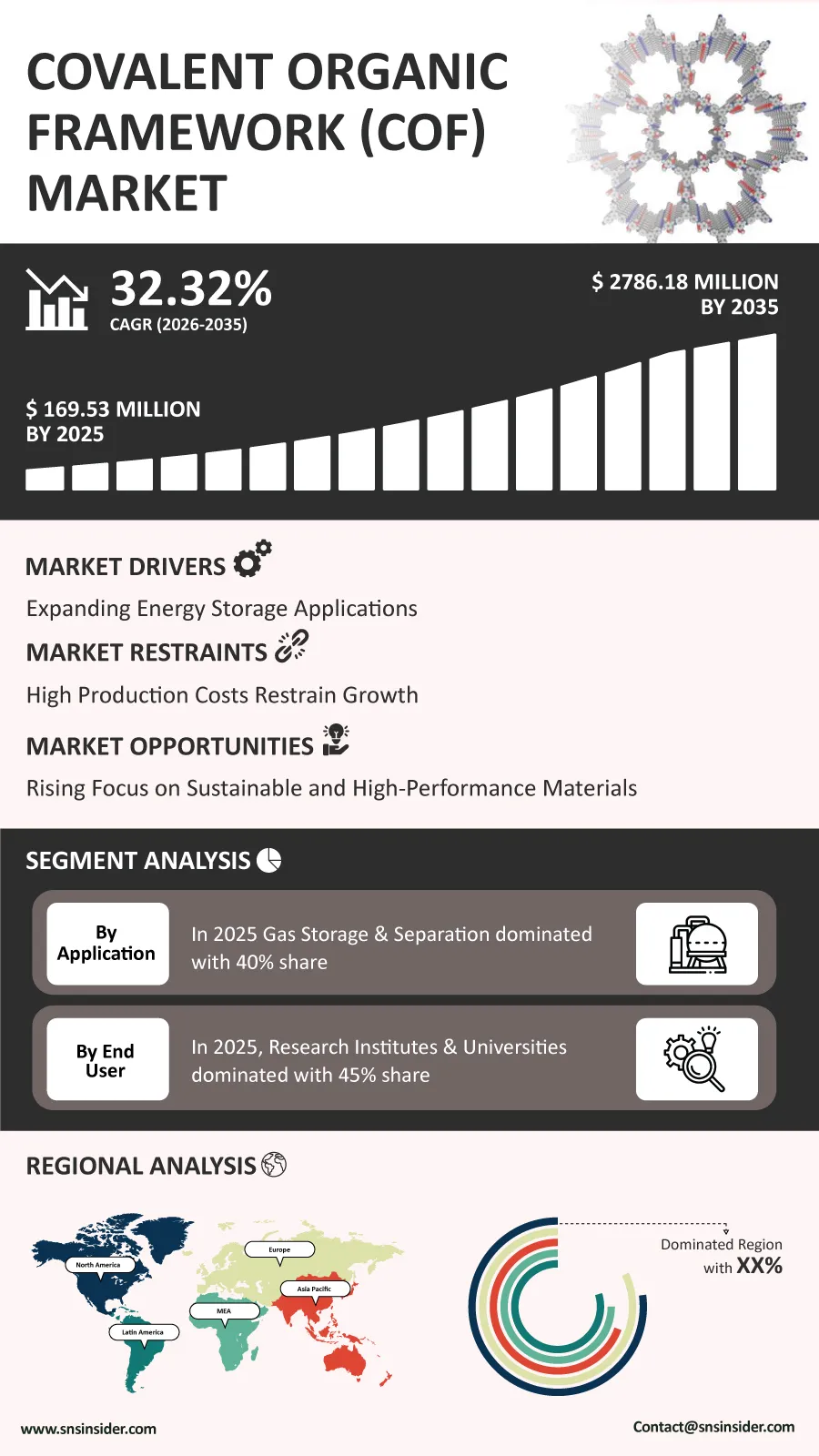
The global Covalent Organic Framework (COF) Market is entering a period of rapid expansion as industries seek advanced porous materials capable of improving efficiency across energy, environmental, and chemical applications. “According to a recent study by SNS Insider, the global Covalent Organic Framework Market size valued at USD 169.53 Million in 2025, is anticipated to grow to USD 2786.18 Million by 2035, registering a CAGR of 32.32% over the 2026–2035 forecast period.”
The growing demands for materials that have very high surface area, flexibility, and stability due to their unique molecular structure are driving more commercial interests in covalent organic frameworks. They can be used in various industries for applications such as storing gases, capturing carbon, catalysis, sensing, and energy systems.
Growing levels of cooperation between scientific institutions, specialty chemical firms, and producers of advanced materials are giving an additional boost to market dynamics. Ongoing advances in synthesis processes, functionalization of materials, and manufacturing techniques are enabling COFs to move out of scientific laboratories and into various application markets.
To Get Detailed Insights on the Covalent Organic Framework Market – Request a Sample Report
Expanding Clean Energy and Industrial Applications Create Long-Term Growth Opportunities
The increasing trend of switching to clean energy sources worldwide is providing numerous possibilities for COF producers. Modern batteries, supercapacitors, hydrogen storage, and carbon capture systems are now looking for materials that can provide a high level of efficiency combined with sustainability goals.
Furthermore, various industries are considering using COFs for gas purification, separation, catalysis, and pollution cleanup processes. The ability of COFs to provide a tailor-made pore structure gives many opportunities for application in diverse chemical and environmental processes compared to traditional porous materials.
At the same time, commercialization is moving forward due to investment in pilot-scale production, process optimization, and partnership programs. It is expected to increase efficiency and reduce the cost of production in the following years.
Key Market Insights Highlight Rapid Technology Adoption
Based on type, the 2D COFs category generated nearly 65% revenue share from the global market in 2025 thanks to its established synthetic routes, high crystallinity, and widespread use in applications such as gas separation, sensing, and optoelectronics. The fastest growing type is predicted to be 3D COFs due to their interconnectivity and higher performances in energy storage and catalysis.
By linkage chemistry, imine-based COFs were responsible for 35% share of the global market in 2025 because of their easy and inexpensive synthesis along with compatibility with different monomers. β-Ketoenamine based COFs are forecasted to grow at the highest rate due to increasing industry need for stable compounds that can work in adverse conditions.
In terms of application, gas storage and separation accounted for nearly 40% revenue in the global COFs market in 2025 due to rising spending on hydrogen storage, carbon capturing, and purification of industrial gases. Energy storage application is likely to lead the market with the highest growth rate until 2035 due to increasing use of advanced porous materials in batteries and supercapacitors.
Advanced Materials Innovation Accelerates Commercial Development
The fast developments in the field of materials science are revolutionizing the COF sector by developing frameworks that have better electrical conductivity, stability and tailored functionalities for particular uses.
Scalability in production process while ensuring material quality is another aspect being worked upon by manufacturers of COFs. With the use of technologies such as artificial intelligence, digital simulation and computational material design, development of COFs is now faster and better tailored towards industrial use.
With sustainability becoming an increasingly important consideration in all industries, porous and recyclable materials having lesser environmental footprint will become more acceptable in commercial use and COFs provide an excellent opportunity in that regard.
Regional Markets Demonstrate Strong Commercial Potential
The Asia Pacific region is forecasted to hold almost 42% of the total market revenue share in 2025 and will continue to be the fastest-growing region during the forecast period, with a compound annual growth rate of 35.43%. High government spending, academic research, rising manufacturing capabilities in pilot scale, and commercialization of industries in China, Japan, and South Korea make the region the leader.
The North American region holds a notable share in the global market due to advanced research facilities, good coordination between universities and industries, and growing commercialization of COFs in energy storage applications, catalysis, and gas separation. Future innovations in clean energy will help in sustaining the region’s growth.
The Europe region is a major source of innovation due to sustainability initiatives, carbon reduction strategies, and high collaboration between universities and specialty chemicals manufacturers. On the other hand, Latin America and the Middle East & Africa regions are gaining a foothold due to investments in environmental technology, clean energy research, and pilot industries.
Industry Participants Focus on Commercialization and Advanced Materials Innovation
Market competition is set to increase in the Covalent Organic Framework industry as top firms focus on developing research abilities, enhancing their materials portfolio and deploying scalable manufacturing solutions. Collaboration among specialty chemical producers, research institutions, and end-users is likely to speed up adoption in various application segments.
Key companies operating in the global Covalent Organic Framework (COF) Market include BASF SE, Arkema Group, Merck KGaA (Sigma-Aldrich), Evonik Industries AG, DuPont de Nemours, Inc., Cabot Corporation, Mitsubishi Chemical Group, Sumitomo Chemical Co., Ltd., LG Chem Ltd., Toray Industries, Inc., Solvay S.A., W. R. Grace & Co., Kuraray Co., Ltd., AGC Inc., Clariant AG, Nanografi Nano Technology, ACS Material, LLC, Tokyo Chemical Industry (TCI), Strem Chemicals (Ascensus Specialties), and Jiangsu XFNANO Materials Tech Co., Ltd.
An SNS Insider analyst Himanshu Sharma commented, “The convergence of clean energy development, advanced materials research, and industrial sustainability initiatives is creating exceptional opportunities for covalent organic frameworks. Companies investing in scalable manufacturing, application-specific functionalization, and strategic commercialization partnerships are expected to play a pivotal role in shaping the next generation of high-performance porous materials.”
About the Author

Get in touch