
Cruise Missile Market Report Scope & Overview:
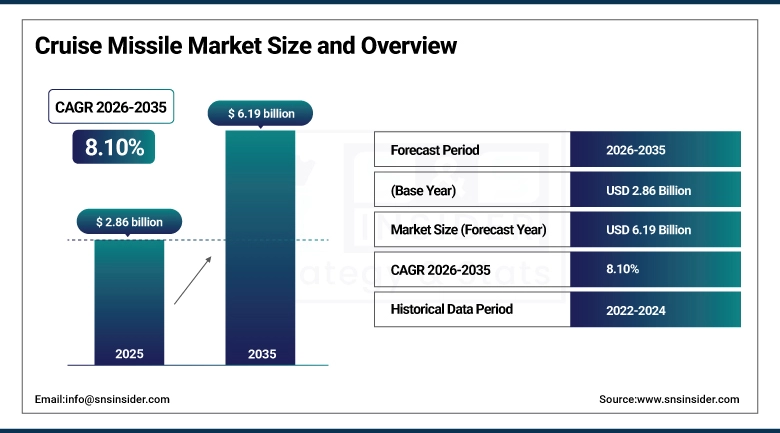
The Cruise Missile Market size was estimated at USD 2.86 Billion in 2025 and is expected to reach USD 6.19 Billion by 2035 and grow at a CAGR of 8.10% over the forecast period of 2026-2035.
The Cruise Missile Market analysis report provides a thorough examination of market dynamics, technological advancements, and defense applications. The market is experiencing significant expansion from 2026 to 2035, fueled by escalating geopolitical tensions, defense modernization initiatives, the need for precision strike capabilities, and increased military expenditures.
In 2025, the cruise missile market saw the deployment of over 20,000 active systems, a result of defense modernization efforts within naval and air forces, alongside the advancement of hypersonic propulsion technologies.
To Get more information on Cruise Missile Market - Request Free Sample Report
Cruise Missile Market Trends:
-
Rise in demand for hypersonic cruise missiles is changing procurement strategies, and scramjet propulsion is driving the fastest-growing market.
-
Air-launched missiles are still dominant, but submarine-launched missiles are growing fast due to stealth and survivability advantages.
-
Focus on precision strike capabilities with advanced guidance systems such as GPS, TERCOM, and DSMAC to counter defense shields.
-
Integration of AI and digital technologies into guidance and targeting systems is becoming a defining innovation trend.
-
Indigenous production programs in emerging countries such as India, China, and the Middle East are reducing imports and driving indigenous defense capabilities.
-
Rise in importance of multi-domain operations (air, sea, and land) is driving demand for versatile missile systems.
-
Budget constraints and the substantial investment required for hypersonic technology are putting pressure on smaller defense budgets.
-
Naval force modernization is fueling demand for ship-launched and anti-ship cruise missiles.
U.S. Cruise Missile Market Insights:
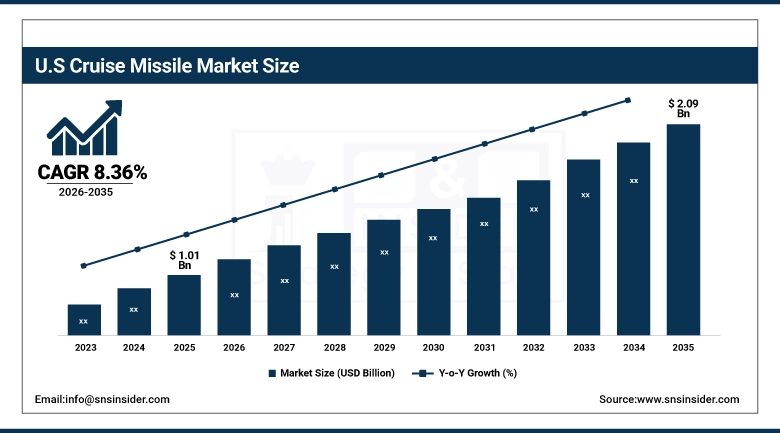
The U.S. Cruise Missile Market is projected to grow from USD 1.01 Billion in 2025 to USD 2.09 Billion in 2035, at a CAGR of 8.36%. The key drivers for this growth are increasing geopolitical tensions, modernization of defense capabilities, high adoption rates for advanced precision strike capabilities, and investments in next-generation hypersonic, stealth, and multi-platform missile systems for air, naval, and ground forces.
Growth Drivers:
-
Rising geopolitical tensions and the increase in defense modernization projects are key growth factors in the Cruise Missile Market.
Military branches are increasingly deploying advanced missile technologies, including hypersonic systems, stealth features, and AI‑driven guidance, to strengthen overall combat capabilities. The integration of cutting‑edge innovations in propulsion, guidance, and platform compatibility has further accelerated the adoption of next‑generation cruise missiles. These advancements are enhancing precision, survivability, and operational flexibility, making modern cruise missile systems a central element of evolving defense strategies.
More than 62% of the U.S. military platforms such as aircraft, submarines, and naval vessels deployed advanced cruise missiles in 2025 to boost the capabilities of the military.
Restraints:
-
Rising geopolitical tensions and the increase in defense modernization projects are key growth factors in the Cruise Missile Market.
The air force, navy, and ground forces are increasingly using advanced missile technologies such as hypersonic, stealth technology, and AI-guided technologies to boost the capabilities of the military. The use of advanced technologies in the propulsion system, guidance system, and integration of the platform has further increased the adoption of advanced technologies in the Cruise Missile Market.
More than 62% of the U.S. military platforms such as aircraft, submarines, and naval vessels deployed advanced cruise missiles in 2025 to boost the capabilities of the military.
Opportunities:
-
Expansion of defense spending in emerging countries and demand for indigenous missile development are opportunities for significant growth in the Cruise Missile Market.
Countries are investing heavily in advanced technology for cruise missiles, such as hypersonic technology, stealth technology, and artificial intelligence-guided technology, for deterrence purposes. There are opportunities for growth in terms of integration capability for cruise missiles, which can be launched from aircraft, ships, submarines, and ground platforms. There are opportunities for growth in terms of collaboration between defense agencies and private industry players and joint ventures between countries.
In 2025, more than 36% of new defense contracts were for cruise missile development and hypersonic technology development, providing opportunities for continuous growth in the market.
Cruise Missile Market Segmentation Analysis:
-
By Type, Subsonic Cruise Missiles held the largest market share of 41.26% in 2025, while Hypersonic Cruise Missiles are expected to grow at the fastest CAGR of 10.89% during 2026–2035.
-
By Launch Platform, Air-Launched dominated with 38.55% market share in 2025, whereas Submarine-Launched are projected to record the fastest CAGR of 9.06% through 2026–2035.
-
By Range, Long-Range (>1500 km) accounted for the highest market share of 51.06% in 2025, while they are also expected to grow at the fastest CAGR of 8.68% during the forecast period.
-
By Guidance System, GPS Guidance dominated with a 30.86% share in 2025, while DSMAC (Digital Scene Matching Area Correlation) are anticipated to expand at the fastest CAGR of 7.82% through 2026–2035.
-
By Propulsion System, Turbojet Engines held the largest share of 51.06% in 2025, while Scramjet Engines are expected to grow a t the fastest CAGR of 10.34% during the forecast period.
By Type, Subsonic Cruise Missiles dominate while Hypersonic Cruise Missiles grow rapidly:
Subsonic Cruise Missiles has been the dominant segment in the market for quite some time due to the reliability and cost-effectiveness of the system. The system has been deployed in large numbers in the year 2025, reflecting the high acceptance of the system by the defense forces across the world.
Hypersonic Cruise Missiles has been the fastest-growing segment in the market. The segment has seen significant uptake in recent times due to the increase in investments in the system. The system has the capability to evade the missile defense systems. The system has seen significant uptake in the recent past.
By Launch Platform, Air‑Launched dominate while Submarine‑Launched grow rapidly:
Air Launched Cruise Missiles has traditionally been the dominant segment in the market due to the flexibility and rapid deployment capabilities of these systems. The deployment count in the year 2025 has crossed several thousand systems, indicating the high preference for these systems from the armed forces due to their flexibility and effectiveness in warfare scenarios.
Submarine Launched Cruise Missiles has been the fastest-growing segment in the market due to the increased focus on stealth technologies. The adoption of this segment has seen significant growth in recent times as several navies in the world have been adding more submarines to their fleets.
By Range, long‑Range (>1500 km) dominate while also expanding rapidly:
Long Range Cruise Missiles segment had the dominant share in terms of deployment due to their effectiveness in delivering precise strikes over long ranges. The deployment count was above several thousand active units, indicating the high reliance of the defense forces on the long-range systems for conventional and strategic warfare.
This segment is growing at a fastets rate due to the increase in investments in extended range propulsion systems, stealth technologies, and guidance systems. The adoption of long-range systems has seen a sharp increase in recent times due to the focus on long range strike capabilities in the face of changing threats.
By Guidance System, GPS Guidance dominate while DSMAC grow rapidly:
GPS Guidance systems have traditionally been the dominant segment in the market due to their accuracy and reliability. These systems have been integrated into most advanced Cruise Missile technologies. The number of active systems deployed in the year 2025 was in the range of thousands. This shows the high level of dependency of the defense forces on the use of GPS technology for accurate targeting capabilities in varied topographies.
DSMAC (Digital Scene Matching Area) Correlation systems are the fastest-growing segment in the market. These systems have seen a significant increase in adoption in recent times due to the benefits they provide in terms of survivability in the absence of GPS.
By Propulsion System, Turbojet Engines dominate while Scramjet Engines grow rapidly:
Turbojet Engines segment has been dominated the market over the years due to their reliability and cost-effectiveness, and their extensive use in subsonic and supersonic cruise missiles. In 2025, the number of active deployment units was measured in thousands, indicating high dependence by defense organizations on turbojet engines for established strike missiles with consistent performance.
Scramjet Engines is the fastest-growing segment due to increasing investment in hypersonic missiles to penetrate through defense systems. This type of engine is witnessing high adoption rates over the last few years, with various countries accelerating their research and development to achieve consistent hypersonic flight.
Cruise Missile Market Regional Analysis:
North America Cruise Missile Market Insights:
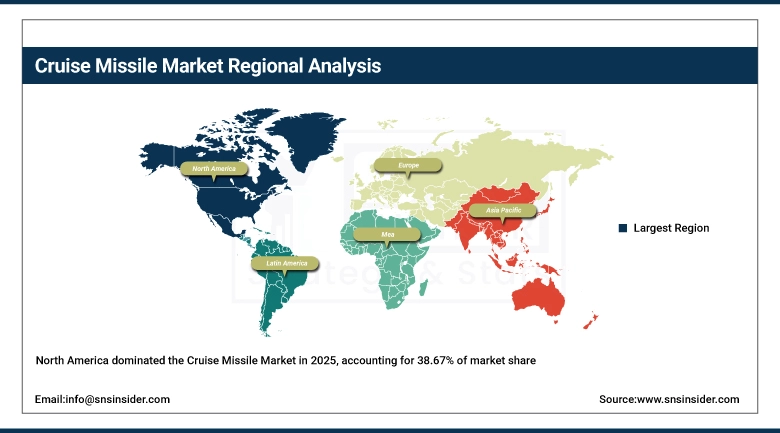
The North America Cruise Missile Market dominated with market share of 38.67% has already achieved the status of being dominant in the world. The region has seen an increase in military spending, R&D capabilities, and the level of modernization in the U.S. and Canadian military. The region has already seen the extensive use of precision strike systems. The integration of hypersonic propulsion systems has already been seen in the region. The constant innovation in stealth technology has further cemented the position of the region in the already mature Cruise Missile Market.
Get Customized Report as per Your Business Requirement - Enquiry Now
U.S. Insights:
The driving force for the U.S. Cruise Missile Market is the high volume of defense modernization initiatives, deployment size, and investments in new generation cruise missiles. The increase in geopolitical conflicts, submarine fleet size, and incorporation of new technology in cruise missile guidance systems have placed the U.S. market as the largest in North America. The frequent development and testing of hypersonic cruise missile prototypes and AI-based targeting systems are examples of the country's focus on technology development.
Asia Pacific Cruise Missile Market Insights:
The Asia Pacific Cruise Missile Market is expanding rapidly with CAGR of 9.82%, driven by rising defense budgets, regional security tensions, and strong investments in indigenous missile development programs. Countries across the region are prioritizing long‑range precision strike capabilities and hypersonic propulsion technologies to enhance deterrence. Expanding naval fleets, modernization of air forces, and growing emphasis on stealth and survivability reinforce Asia Pacific’s position as the fastest‑growing market.
China Market Insights:
China’s Cruise Missile Market is driven by significant investments in R&D, indigenous manufacturing capability, and strategic focus on hypersonic and long-range cruise missiles. China’s focus on self-reliance in defense technology, coupled with its rapidly modernizing naval and air force fleets, presents a high potential for cruise missile technology. China’s continuous testing of advanced propulsion systems and guidance technologies underscores its desire for technology leadership in the cruise missile market.
Europe Market Insights:
The Europe Cruise Missile Market has been supplemented by collaborative defense projects, modernization initiatives for NATO forces, and robust investments in multi-platform missile systems. Widespread adoption of precision strike capabilities by naval and air forces, coupled with collaborative ventures and R&D initiatives, further reinforces the position of the Europe Cruise Missile Market as a developed and evolving market. Increasing initiatives on hypersonic technologies and interoperability with other forces will further boost the growth prospects.
Germany Market Insights:
The Cruise Missile Market in Germany is largely driven by defense modernization programs, the inclusion of advanced cruise missile guidance systems, and involvement in international cruise missile technology development programs. A high emphasis on precision-guided cruise missiles, accompanied by naval and air force technology advancements, is driving the cruise missile market in Germany. Germany is part of international defense projects in Europe, ensuring continuous advancements in cruise missile technology.
Latin America Market Insights:
Latin America's Cruise Missile Market is in the developing phase. The growth of the market is driven by the modernization of the defense sector. The region has seen an increase in the number of investments in the air force and navy. The use of Cruise Missile systems in the region is low compared to other countries. The focus of the region on security has led to the expansion of the Cruise Missile Market. The opportunity in the region lies in the partnerships with the world's top defense suppliers.
Middle East & Africa Market Insights:
The Middle East & Africa Cruise Missile Market is fueled by the increase in geopolitical tensions, the increase in the defense budget, and the high demand for advanced technologies in deterring enemies. The countries in the region are investing heavily in long-range precision strike systems, naval modernization, and the integration of advanced technologies. Strategic procurement from suppliers and the rising interest in indigenous production further emphasize the region's position as a growth market.
Cruise Missile Market Competitive Landscape:
Lockheed Martin is one of the leading defense companies in the United States. The company has a significant presence in the cruise missile segment. Some of the key projects undertaken by the company include the Long-Range Anti-Ship Missile program and the Joint Air-to-Surface Standoff Missile program. The company has been focusing on the development of precise strike capabilities, survivability in the face of advanced threats, and integration with multiple platforms such as aircraft, ships, and submarines. The company has been investing in the development of hypersonic missiles and has partnered with the U.S. Department of Defense.
-
In February 2025, Lockheed Martin advanced testing of its Hypersonic Conventional Strike Weapon (HCSW), strengthening its position in next-generation missile systems.
Raytheon Technologies is a leading aerospace and defense company based in the U.S. and has a considerable share in the cruise missile industry. However, the company’s most popular and successful cruise missile program is the Tomahawk Land Attack Missile (TLAM). Raytheon's cruise missile offerings are lauded for their extended reach, adaptability for land and sea engagements, and a solid track record in actual combat. The company's work on modernizing and improving the Tomahawk program, along with its strides in hypersonic technology, has solidified its position in the market.
-
In June 2026, Raytheon secured a major U.S. Navy contract to upgrade Tomahawk Block V missiles, enhancing range and survivability against modern air defenses.
Northrop Grumman, a major player in American defense technology, plays a key role in the cruise missile sector. Although it is not as prominent in the cruise missile business as Lockheed Martin and Raytheon, it is still a crucial company in the development of cruise missile technology. Northrop Grumman has made significant investments in the development of next-generation cruise missile technology, especially in stealth technology and hypersonic propulsion systems. It has also joined forces with the US Air Force and Navy on cruise missile technology.
-
In May 2025, Northrop Grumman expanded its role in hypersonic missile propulsion development, supporting U.S. Department of Defense initiatives for rapid strike capabilities.
Cruise Missile Market Key Players:
-
Lockheed Martin
-
Raytheon Technologies
-
Northrop Grumman
-
Boeing Defense
-
Tactical Missiles Corporation (KTRV)
-
Almaz-Antey
-
MBDA Missile Systems
-
BAE Systems
-
Leonardo
-
Thales Group
-
Saab AB
-
China Aerospace Science and Industry Corporation (CASIC)
-
China Aerospace Science and Technology Corporation (CASC)
-
Defence Research and Development Organisation (DRDO – India)
-
Kongsberg Gruppen
-
Mitsubishi Heavy Industries
-
Hanwha Defense
-
Israel Aerospace Industries (IAI)
-
Rafael Advanced Defense Systems
-
General Dynamics
Cruise Missile Market Report Scope:
| Report Attributes | Details |
|---|---|
| Market Size in 2025 | USD 2.86 Billion |
| Market Size by 2035 | USD 6.19 Billion |
| CAGR | CAGR of 8.10% From 2026 to 2035 |
| Base Year | 2025 |
| Forecast Period | 2026-2035 |
| Historical Data | 2022-2024 |
| Report Scope & Coverage | Market Size, Segments Analysis, Competitive Landscape, Regional Analysis, DROC & SWOT Analysis, Forecast Outlook |
| Key Segments | • By Type (Subsonic Cruise Missiles, Supersonic Cruise Missiles, Hypersonic Cruise Missiles, Anti-Ship Cruise Missiles, Others) • By Launch Platform (Air-Launched, Ship-Launched, Submarine-Launched, Ground-Launched, Others) • By Range (Long-Range (>1500 km), Medium-Range (500–1500 km), Short-Range (<500 km, Others) • By Guidance System (GPS Guidance, Inertial Guidance, TERCOM (Terrain Contour Matching), DSMAC (Digital Scene Matching Area Correlation), Astro-Inertial Guidance, Others) • By Propulsion System (Turbojet Engines, Turbofan Engines, Ramjet Engines, Scramjet Engines, Others) |
| Regional Analysis/Coverage | North America (US, Canada, Mexico), Europe (Eastern Europe [Poland, Romania, Hungary, Turkey, Rest of Eastern Europe] Western Europe] Germany, France, UK, Italy, Spain, Netherlands, Switzerland, Austria, Rest of Western Europe]), Asia Pacific (China, India, Japan, South Korea, Vietnam, Singapore, Australia, Rest of Asia Pacific), Middle East & Africa (Middle East [UAE, Egypt, Saudi Arabia, Qatar, Rest of Middle East], Africa [Nigeria, South Africa, Rest of Africa], Latin America (Brazil, Argentina, Colombia, Rest of Latin America) |
| Company Profiles | Lockheed Martin, Raytheon Technologies, Northrop Grumman, Boeing Defense, Tactical Missiles Corporation (KTRV), Almaz-Antey, MBDA Missile Systems, BAE Systems, Leonardo, Thales Group, Saab AB, China Aerospace Science and Industry Corporation (CASIC), China Aerospace Science and Technology Corporation (CASC), Defence Research and Development Organisation (DRDO – India), Kongsberg Gruppen, Mitsubishi Heavy Industries, Hanwha Defense, Israel Aerospace Industries (IAI), Rafael Advanced Defense Systems, General Dynamics. |

Frequently Asked Questions
Major drivers include hypersonic propulsion R&D, modernization of naval and air forces, rising geopolitical tensions, and increased demand for precision strike capabilities.
Air-launched platforms lead (38.55% share), offering flexibility and rapid deployment, while submarine-launched missiles are expanding fastest due to stealth advantages.
Subsonic cruise missiles currently dominate (41.26% share) due to cost-effectiveness and widespread deployment, but hypersonic missiles are the fastest-growing segment.
Asia-Pacific is the fastest-growing region, with a CAGR of 9.82%, fueled by rising defense budgets and indigenous missile development in countries such as India, China, and Japan.
North America holds the largest share, driven by high defense spending and advanced R&D programs, accounting for 38.67% of the market.
