
Fixed Wing Turbine Aircraft Market Report Scope & Overview:
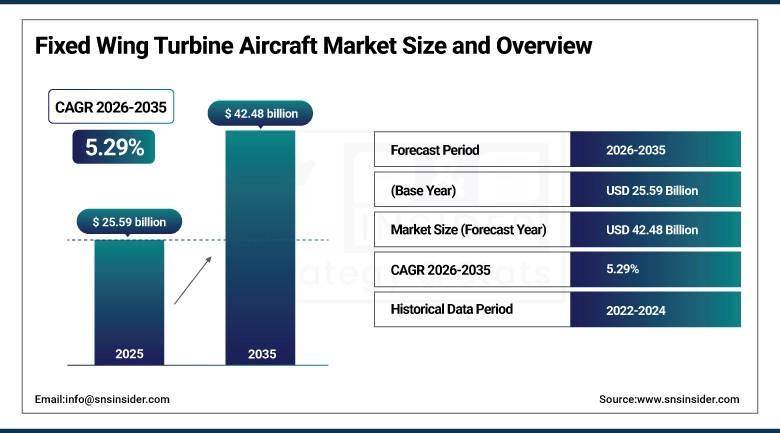
The Fixed Wing Turbine Aircraft Market size is valued at USD 25.59 Billion in 2025 and is projected to reach USD 42.48 Billion by 2035, growing at a CAGR of 5.29% during the forecast period 2026–2035.
The Fixed Wing Turbine Aircraft Market analysis report includes a detailed analysis of market dynamics, technological advancements, and operational uses. Factors such as increased air travel, military modernization, use of cargo aircraft for e-commerce, and expansion of aviation infrastructure are contributing to a healthy growth rate during 2026-2035.
Turbine aircraft use surpassed 52,000 active aircraft in 2025, largely due to commercial fleet renewal, expansion of regional connectivity, and military procurement activities.
To Get more information on Fixed Wing Turbine Aircraft Market - Request Free Sample Report
Fixed Wing Turbine Aircraft Market Trends:
-
Passenger traffic growth has resulted in a steady demand for commercial turbine aircraft, especially for long-haul and regional connectivity.
-
Cargo aircraft are also growing rapidly, especially for cargo transport, due to e-commerce and logistics.
-
Turbofans continue to be the most popular, but turboprops and hybrid turbines are also gaining traction.
-
Defense forces are also upgrading, and this has resulted in steady demand for military aircraft.
-
New models and lease options are changing the ownership structure, and this has made turbine aircraft more accessible.
-
Technologies such as digitalization and predictive maintenance are also changing the way aircraft are used.
-
Geographical differences in growth are also evident, with emerging markets growing rapidly and developed markets focusing on sustainability.
U.S. Fixed Wing Turbine Aircraft Market Insights:
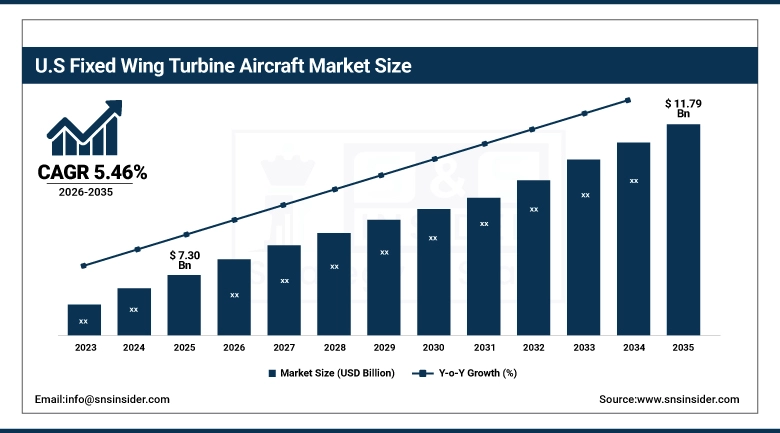
The U.S. fixed-wing turbine aircraft market is expected to grow at a steady rate from USD 7.30 Billion in 2025 to USD 11.79 Billion in 2035, at a CAGR of 5.46%. The market is fueled by an increase in organ transplantation procedures, autoimmune and inflammatory conditions, high adoption rates for advanced biologics and targeted therapy, and investments in innovative oral, injectable, and intravenous formulations in hospitals and clinics.
Fixed Wing Turbine Aircraft Market Growth Drivers:
-
Rising passenger traffic, increasing defense modernization programs, expanding cargo demand from e-commerce, and growing investments in sustainable aviation technologies are key drivers of Fixed Wing Turbine Aircraft Market growth.
Commercial airlines, cargo operators, and defense organizations are increasingly utilizing advanced technology-based turbine aircraft, such as turbofan, turboprop, and hybrid propulsion aircraft, to improve performance and minimize emissions, and to meet growing demands for these aircraft. Advancements in hybrid propulsion technology, sustainable aviation fuel, and digital predictive maintenance are also driving the use of these aircraft, improving performance results, and fueling further growth for this market.
More than 58% of commercial airlines, cargo operators, and defense organizations are utilizing advanced technology-based Fixed Wing Turbine Aircraft in 2025.
Fixed Wing Turbine Aircraft Market Restraints:
-
High fuel costs, stringent environmental regulations, supply chain disruptions, and geopolitical uncertainties are key restraints impacting Fixed Wing Turbine Aircraft Market growth.
Air transport, cargo, and military organizations are also witnessing a rise in operational costs due to fuel price volatility and compliance costs for reducing emissions. Production delays, lack of critical components such as aircraft engines and avionics, and trade wars are also posing a challenge to aircraft delivery and fleet upgrade strategies. Furthermore, limitations in terms of infrastructure in developing countries and capital costs are also hindering the growth of this market.
More than 42% of operators faced operational challenges in 2025 due to fuel price volatility, compliance costs, and supply chain issues, depicting the influence of these restrains on the overall market performance.
Fixed Wing Turbine Aircraft Market Opportunities:
-
Expanding passenger traffic in emerging economies, rising demand for cargo transport fueled by e-commerce, increasing defense procurement programs, and accelerating investments.
Growing servies in sustainable aviation technologies are significant opportunities that are creating growth prospects for the Fixed Wing Turbine Aircraft Market. Airlines, cargo services, and defense organizations are utilizing advanced turbine aircraft to boost efficiency and reduce environmental impacts. Advances in hybrid propulsion, sustainable aviation fuel, and digital predictive maintenance are creating growth opportunities and boosting the competitiveness of the market.
In 2025, more than 61% of operators have identified sustainability-driven fleet modernization as an opportunity, indicating the growth and shift toward greener and more efficient turbine aircraft solutions.
Fixed Wing Turbine Aircraft Market Segmentation Analysis:
-
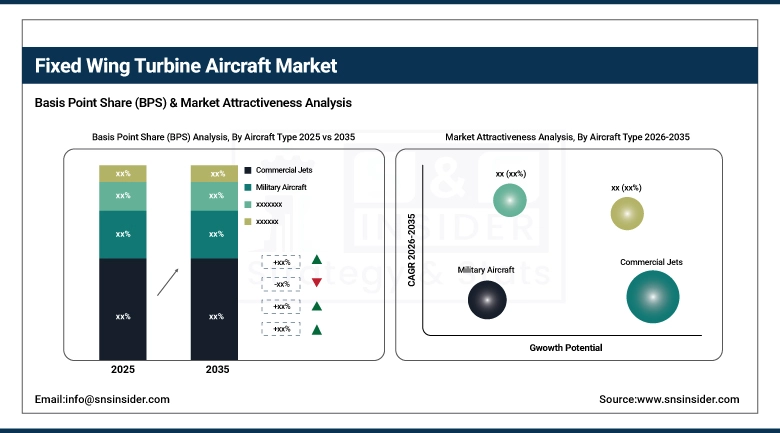
By Aircraft Type, Commercial Jets held the largest market share of 41.08% in 2025, while Cargo Aircraft are expected to grow at the fastest CAGR of 4.03% during 2026–2035.
-
By Engine Type, Turbofan dominated with 54.45% market share in 2025, whereas Turboprop are projected to record the fastest CAGR of 4.21% through 2026–2035.
-
By Aircraft Size, Heavy Aircraft accounted for the highest market share of 60.76% in 2025, while Medium Aircraft are expected to grow at the fastest CAGR of 4.08% during the forecast period.
-
By Application, Passenger Transport dominated with a 42.68% share in 2025, while Freight Transport are anticipated to expand at the fastest CAGR of 4.24% through 2026–2035.
-
By End Use, Commercial Aviation held the largest share of 44.32% in 2025, while Government & Defense are expected to grow at the fastest CAGR of 3.84% during the forecast period.
By Aircraft Type, Commercial Jets Dominate While Cargo Aircraft Grow Rapidly:
Commercial Jets had the dominant market share due to the significant contribution of commercial jets to the world's air travel. The high need to upgrade the fleet, increasing passenger traffic, and the development of regional routes contributed to the segment having the largest market share. Commercial jets are the backbone of the turbine aircraft industry, with continuous innovation in fuel efficiency and sustainability.
Cargo Aircraft is the segment with the fastest growth rate, with an increasing need to expand. This is due to the rise in e-commerce and logistics demands, with the need to develop solutions to transport cargo. Cargo operators are increasingly using turbine-powered aircraft to increase payload and reduce delivery times.
By Engine Type, Turbofan Dominate While Turboprop Grow Rapidly:
The Turbofan segment held a dminant share in the market in 2025, due to its widespread use in commercial jets and long-haul aircraft. This type of aircraft engine has been favored for its efficiency during high-speed travel, reliability, and ability to fly large numbers of passengers and cargo.
The Turboprop segment has been predicted to experience the highest growth,during 2026-2035. This type of aircraft has been gaining traction for its use in regional connectivity and short-haul flights, especially in emerging markets. Their lower operating costs and efficiency on shorter routes make them highly attractive for regional airlines and governments investing in aviation infrastructure.
By Aircraft Size, Heavy Aircraft Dominate While Medium Aircraft Grow Rapidly:
The Heavy Aircraft segment has shown the dominant market share, indicating their importance in long-haul passenger transportation and cargo operations around the world. Heavy aircraft are preferred for operations due to their capacity, operational range, and international route connectivity, making them the backbone of aviation operations.
The Medium Aircraft segment has been identified as having the fastest growth rate. Medium aircraft are being increasingly preferred for operations due to their efficiency, cost savings, and flexibility in adapting to various types of airport infrastructure, making them extremely popular options for developing regional connectivity.
By Application, Passenger Transport Dominates While Freight Transport Grows Rapidly:
The Passenger Transport segment has been dominating the market, with a share in 2025, and this is a reflection of its importance in aviation. The segment has seen increased demand due to improved passenger traffic, regional connectivity, and fleet upgrade initiatives.
The Freight Transport segment is to experience the fastest growth. This segment has seen increased demand due to growing e-commerce, expansion of logistics networks, and increased use of air cargo transport for time-sensitive shipments. Cargo transport companies are increasingly using turbine aircraft to improve payload, reduce transportation time, and meet growing international trade needs.
By End Use, Commercial Aviation Dominates While Government & Defense Grow Rapidly:
Commercial Aviation segment accounted for the highest share in 2025, which is a testament to the importance of the segment in the transportation of both passengers and cargo. With the growth of passenger traffic and the enhancement of regional connectivity, the dominance of the Commercial Aviation segment has further strengthened.
Government & Defense segment is expected to record the highest growth among the segments. This segment is expected to record significant growth due to the enhancement of defense infrastructure and the procurement of sophisticated fighter jets, surveillance aircraft, and transport planes. Rising geopolitical tensions are boosting investments in turbine-powered defense aircraft around the world.
Fixed Wing Turbine Aircraft Market Regional Analysis:
North America Fixed Wing Turbine Aircraft Market Insights:
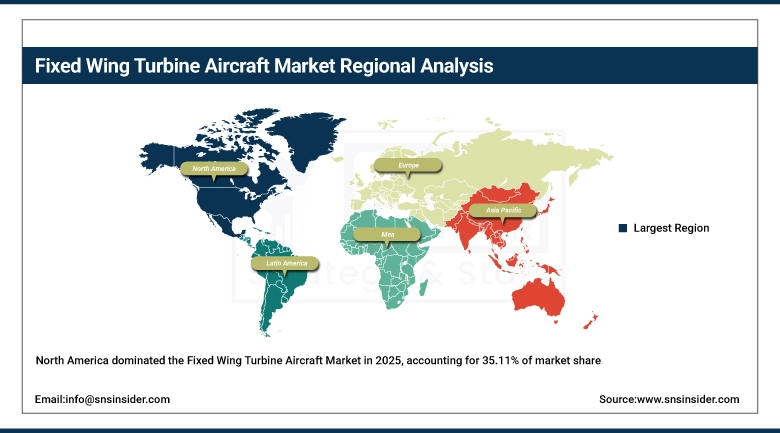
The North America Fixed Wing Turbine Aircraft Market dominated with a 35.11% share in 2025, driven by strong passenger traffic, robust cargo demand, and extensive defense procurement programs across the U.S. and Canada. Well-established aviation infrastructure, advanced manufacturing capabilities, and supportive regulatory frameworks reinforce the region’s leadership. Continuous investments in hybrid propulsion, sustainable aviation fuel (SAF), and digital maintenance technologies further strengthen North America’s competitive position in this mature market.
Get Customized Report as per Your Business Requirement - Enquiry Now
U.S. Fixed Wing Turbine Aircraft Market Insights:
The U.S. market leads North America, supported by its large commercial fleet, strong cargo operations, and extensive defense modernization initiatives. Rising passenger volumes, expansion of regional connectivity, and adoption of advanced turbine aircraft across both civilian and military sectors drive growth. The U.S. benefits from cutting-edge R&D, a strong supply chain, and supportive government policies, positioning it as the largest and most influential market in the region.
Asia-Pacific Fixed Wing Turbine Aircraft Market Insights:
The Asia-Pacific market is projected to record the fastest CAGR of 6.47% driven by rising passenger traffic, expanding middle-class populations, and growing cargo demand. Significant infrastructure investments in airports and aviation hubs across China, India, and Southeast Asia are fueling adoption. Regional airlines are increasingly modernizing fleets with turbine-powered aircraft to meet connectivity needs, while defense procurement programs further strengthen growth.
China Fixed Wing Turbine Aircraft Market Insights:
The China market leads Asia-Pacific, supported by rapid fleet expansion, strong domestic passenger demand, and growing cargo operations. Government-backed aviation infrastructure projects and defense modernization initiatives are accelerating adoption of turbine aircraft. China’s focus on sustainability and hybrid propulsion technologies positions it as a key innovator in the regional market.
Europe Fixed Wing Turbine Aircraft Market Insights:
The Europe market accounted for a significant share in 2025, driven by strong commercial aviation demand, regional connectivity programs, and sustainability initiatives. European operators are at the forefront of adopting hybrid propulsion and sustainable aviation fuel (SAF), supported by stringent environmental regulations. Defense procurement, particularly in fighter jets and surveillance aircraft, also contributes to growth.
Germany Fixed Wing Turbine Aircraft Market Insights:
The Germany market is a major contributor within Europe, supported by its advanced aerospace manufacturing base and strong defense sector. Rising passenger traffic, cargo demand, and investments in sustainable aviation technologies reinforce Germany’s leadership. Regulatory emphasis on emissions reduction and innovation in hybrid propulsion further strengthen its role in shaping Europe’s aviation future.
Latin America Fixed Wing Turbine Aircraft Market Insights:
The Latin America market is expanding steadily, driven by rising passenger traffic, regional connectivity, and growing cargo demand. Countries such as Brazil and Mexico are investing in fleet modernization and aviation infrastructure. Challenges such as economic volatility and infrastructure gaps remain, but opportunities in regional travel and freight transport support long-term growth.
Middle East & Africa Fixed Wing Turbine Aircraft Market Insights:
The Middle East & Africa market is projected to grow steadily, supported by strong investments in aviation hubs, cargo operations, and defense procurement. The Middle East benefits from its role as a transit hub, while Africa’s growth is driven by rising passenger demand and regional connectivity initiatives. Infrastructure development and government-backed aviation programs are key enablers of market expansion.
Fixed Wing Turbine Aircraft Market Competitive Landscape:
Boeing is a leading aerospace company based in the United States and one of the largest manufacturers of commercial airplanes, defense, space, and security systems in the world. It holds a leading position in the market for fixed-wing turbine aircraft with its range of commercial airplanes, including its best-selling 737 MAX, 777, and 787 Dreamliner series, along with its cargo planes and military aircraft such as fighters, bombers, and surveillance planes. It focuses on innovating, safe, and sustainable solutions.
-
In February 2025, Boeing reported revenues of USD 89.5 billion, with production output of 600 commercial aircraft and 127 military aircraft, underscoring its scale and dominance.
Airbus, the continent's aerospace behemoth, is also a leader in sustainable aviation. The company operates across a wide spectrum, encompassing commercial aircraft, helicopters, defense applications, and space ventures. It commands a substantial presence in the Fixed Wing Turbine Aircraft sector, particularly with its A320neo, A350, and A380 families. Military aircraft, including the A400M, also contribute to its portfolio. Sustainability is a central priority for Airbus; the company dedicates considerable resources to developing fuel-efficient designs, hybrid propulsion systems, and the adoption of sustainable aviation fuel (SAF).
-
In June 2025, Airbus advanced its clean aerospace initiatives, including projects to mitigate contrails and reduce non-CO₂ emissions, reinforcing its leadership in eco-friendly aviation.
Lockheed Martin is a U.S. defense and aerospace giant, specializing in advanced military aircraft and defense systems. In the Fixed Wing Turbine Aircraft market, it is best known for the F-35 Lightning II, F-22 Raptor, and other fighter jets, and surveillance and transport aircraft. Its Aeronautics division, including the renowned Skunk Works, drives innovation in stealth, hypersonics, and multi-domain defense systems. Lockheed Martin’s focus is on delivering cutting-edge defense technologies, ensuring mission readiness, and supporting allies.
-
By May 2025, Lockheed Martin employed 123,000 people across 340+ facilities, highlighting its scale and commitment to defense innovation.
Fixed Wing Turbine Aircraft Market Key Players:
Some of the Fixed Wing Turbine Aircraft Market Companies are:
-
Boeing
-
Airbus
-
Lockheed Martin
-
Northrop Grumman
-
Raytheon Technologies
-
General Dynamics
-
Embraer
-
Bombardier
-
Dassault Aviation
-
Textron Aviation
-
Mitsubishi Aircraft Corporation
-
COMAC (Commercial Aircraft Corporation of China)
-
Sukhoi
-
United Aircraft Corporation
-
Saab AB
-
Leonardo S.p.A
-
Gulfstream Aerospace
-
Pilatus Aircraft
-
De Havilland Canada
-
ATR Aircraft
| Report Attributes | Details |
|---|---|
| Market Size in 2025 | USD 25.59 Billion |
| Market Size by 2035 | USD 42.48 Billion |
| CAGR | CAGR of 5.29% From 2026 to 2035 |
| Base Year | 2025 |
| Forecast Period | 2026-2035 |
| Historical Data | 2022-2024 |
| Report Scope & Coverage | Market Size, Segments Analysis, Competitive Landscape, Regional Analysis, DROC & SWOT Analysis, Forecast Outlook |
| Key Segments | • By Aircraft Type (Commercial Jets, Military Aircraft, Cargo Aircraft, Business Jets, Training Aircraft, Others), • By Engine Type (Turbofan, Turboprop, Helicopters, Turbojet, Hybrid Engines, Others), • By Aircraft Size (Heavy Aircraft, Medium Aircraft, Light Aircraft, Others), • By Application (Passenger Transport, Freight Transport, Military Operations, Training & Education, Others), • By End Use (Commercial Aviation, Government & Defense, Private Aviation, Others) |
| Regional Analysis/Coverage | North America (US, Canada), Europe (Germany, UK, France, Italy, Spain, Russia, Poland, Rest of Europe), Asia Pacific (China, India, Japan, South Korea, Australia, ASEAN Countries, Rest of Asia Pacific), Middle East & Africa (UAE, Saudi Arabia, Qatar, South Africa, Rest of Middle East & Africa), Latin America (Brazil, Argentina, Mexico, Colombia, Rest of Latin America). |
| Company Profiles | Boeing, Airbus, Lockheed Martin, Northrop Grumman, Raytheon Technologies, General Dynamics, Embraer, Bombardier, Dassault Aviation, Textron Aviation, Mitsubishi Aircraft Corporation, COMAC (Commercial Aircraft Corporation of China), Sukhoi, United Aircraft Corporation, Saab AB, Leonardo S.p.A, Gulfstream Aerospace, Pilatus Aircraft, De Havilland Canada, ATR Aircraft. |

Frequently Asked Questions
The Asia-Pacific region is expected to record the highest CAGR of 6.47%, driven by rising passenger demand, regional connectivity, and cargo expansion.
Turboprop engines are projected to grow at the fastest CAGR of 4.21%, supported by sustainability initiatives and environmental regulations.
Turbofan engines dominate with market share of 54.45%, due to their efficiency in long-haul and high-speed operations, accounting for the majority of market share.
The cargo aircraft segment is expanding at the highest CAGR of 4.03%, fueled by e-commerce and logistics demand.
The commercial aviation segment holds the largest share of 44.32% in 2025, driven by passenger traffic growth and fleet modernization programs.
