
Data Center Microgrid Market Report Scope and Overview:
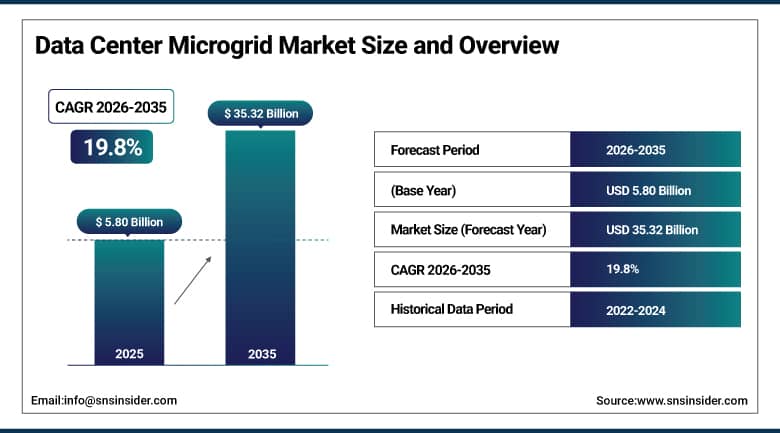
The Data Center Microgrid Market was valued at USD 5.80 Billion in 2025 and is projected to reach USD 35.32 Billion by 2035, registering a CAGR of 19.8% from 2026 to 2035.
The Data Center Microgrid Market is revolutionizing AI-enabled power systems using solid oxide fuel cells, natural gas-powered generators, energy storage batteries, and advanced control systems that enable the creation of onsite power production as opposed to waiting for many years to connect to the utility grid. It is marked by the increasing demand from hyperscalers for gigawatts of onsite power production, increased utility interconnection backlogs as a result of AI computing capacity installations, adoption of islandable and primary power microgrids, and the use of microgrids for backup and resilience, load reduction, and interconnection deferment for critical compute centers.
In 2026, PowerSecure entered into a contract with Keel Infrastructure to supply services to the Moses Lake Data Center Campus, marking increased use of on-site microgrid and distributed energy solutions in data centers.
To Get More Information On Data Center Microgrid Market - Request Free Sample Report
Data Center Microgrid Market Trends
-
Expanding gigawatt-scale fuel cell procurement continues shifting onsite generation from backup power to primary infrastructure for AI data centers.
-
Growing utility-vendor offtake agreements continue accelerating fuel cell deployment for interconnection-constrained data center campuses.
-
Rising AI compute demand continues expanding the addressable base for islandable microgrid architectures at hyperscale facilities.
-
Increasing interconnection queue congestion continues strengthening demand for behind-the-meter generation as an alternative to grid connection delays.
-
Growing adoption of hybrid natural gas and battery storage configurations continues improving data center power reliability and emissions performance.
U.S. Data Center Microgrid Market Outlook
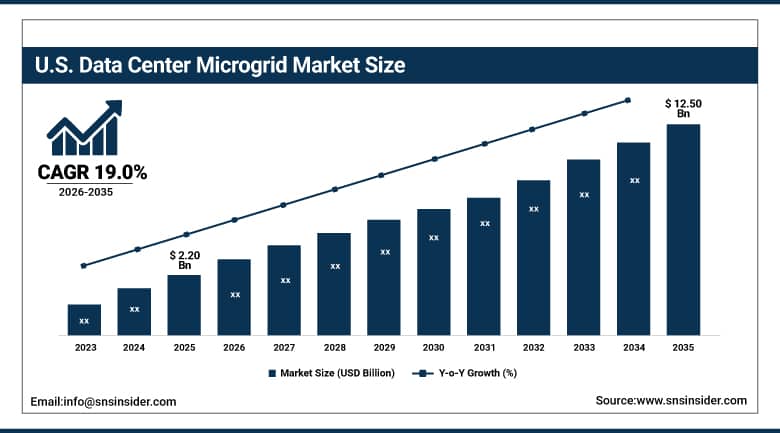
The U.S. Data Center Microgrid Market was valued at approximately USD 2.20 Billion in 2025 and is projected to reach approximately USD 12.50 Billion by 2035, registering a CAGR of approximately 19.0% from 2026 to 2035.
The U.S. market for microgrids has also been fueled by the heavy investments made by hyperscalers in on-site power generation to avoid waiting years for interconnection by the utilities, exponential increase in the electricity requirements of AI data centers surpassing that of the grid capacity and heavy demand for islandable fuel cell and natural gas microgrid systems from operators looking for gigawatt-level certainty in electricity supply. The use of solid oxide fuel cells as well as hybrid microgrids in various hyperscale and colocation data centers has greatly contributed to the establishment of America as the biggest market for data center microgrids globally.
In 2026, FuelCell Energy signed their first capacity reservation contract with a leading data center company in support of their 75 MW project being installed in Texas. This fuel cell system uses modular technology to deliver scalable power behind the meter and lessen dependency on grid infrastructure.
Data Center Microgrid Market Segment Analysis
-
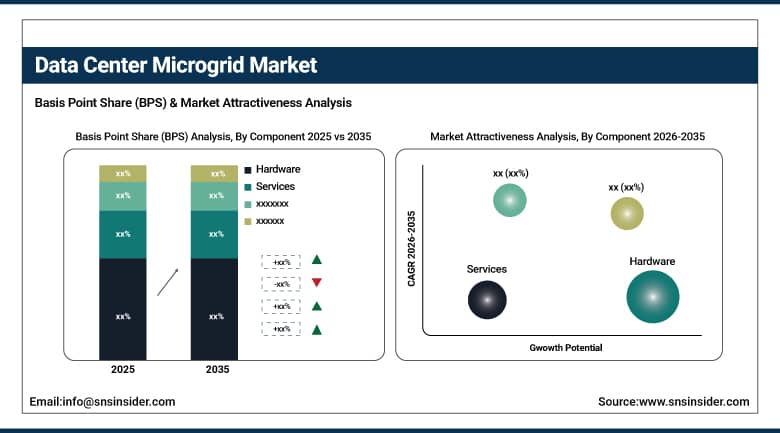
By Component, Hardware segment dominated the Data Center Microgrid Market in 2025 with 71.01% share; Services segment is the fastest growing segment, registering a CAGR of 22.1% from 2026 to 2035.
-
By Power Source, Natural Gas Generators segment dominated the market in 2025 with 38.67% share; Solid Oxide Fuel Cells segment is the fastest growing segment, registering a CAGR of 23.4% from 2026 to 2035.
-
By Grid Type, Hybrid segment dominated the market in 2025 with 47.12% share; Off-Grid segment is the fastest growing segment, registering a CAGR of 22.8% from 2026 to 2035.
-
By Application, Backup Power & Resiliency segment dominated the market in 2025 with 41.09% share; Primary Power Supply segment is the fastest growing segment, registering a CAGR of 22.5% from 2026 to 2035.
-
By End User, Hyperscale Data Centers segment dominated the market in 2025 with 54.11% share; Edge Data Centers segment is the fastest growing segment, registering a CAGR of 23.1% from 2026 to 2035.
By Component, Hardware Leads, While Services Grow Fastest
Hardware represented the largest segment of the Data Center Microgrid Market in 2025 due to the capital-intensive nature of generation hardware, fuel cell stacks, batteries, and power conditioning hardware required in large-scale deployments. The Energy Servers platform of Bloom Energy, which represents roughly 1.4 GW of deployment with expansion to 2 GW in capacity, highlights how the procurement of hardware represents the biggest spend for Data Center Microgrids.
The Services category is forecasted to have the fastest growth rate in the Data Center Microgrid Market due to the growing dependence of Data Centers on system integration, commissioning, and operations and maintenance of multi-technology microgrids. Partnerships between utilities and vendors that leverage their capabilities for offtake and service provisions such as that between American Electric Power and Fuel Cells for Data Center offtakes demonstrate the importance of services in turning hardware procurement into gigawatt scale power generation.
By Power Source, Natural Gas Generators Lead, While Solid Oxide Fuel Cells Grow Fastest
Natural Gas Generators led the Data Center Microgrid Market in 2025 owing to their existing position as the standard backup and resiliency power for colocation and enterprise data centers. The natural gas-based microgrid solutions offered by Enchanted Rock, which is designed exclusively for nonstop backup power at mission-critical facilities, such as data centers, is one such example which highlights the importance of this power source segment and its largest market share in terms of microgrid capacity installations across North America.
Solid Oxide Fuel Cells are projected to witness the highest growth rate during the forecast period with increasing use of fuel cells as the primary power infrastructure in lieu of backup power infrastructure by hyperscalers. This shift can be exemplified with the master services agreement signed between Bloom Energy and Oracle for solid oxide fuel cells of 2.8 GW for Oracle's Project Jupiter AI data center campus, which will make it an integral part of the AI infrastructure.
By Grid Type, Hybrid Dominates, Off-Grid Deployment Grows Fastest
Hybrid grid-connected microgrid configurations accounted for the dominant share of the Data Center Microgrid Market in 2025 as most data center operators are retaining their connections to utility power along with generation on site to ensure cost, reliability, and regulatory balance. The partnership between Schneider Electric, NVIDIA, and ETAP to create digital twins of their AI data centers is an example of the optimization of hybrid systems that allow for a mix of grid and onsite power generation.
Off-grid deployment is anticipated to be the fastest-growing grid type as hyperscalers increasingly bypass multi-year utility interconnection queues entirely in favor of standalone onsite generation. Bloom Energy's landmark 900 MW islandable project in Wyoming, selected specifically for its ability to serve a single large-scale data center campus independent of grid constraints, illustrates the growing viability of fully islanded power architectures for gigawatt-scale AI compute facilities.
By Application, Backup Power & Resiliency Leads, Primary Power Supply Grows Fastest
Backup Power & Resiliency was the dominant application segment in the Data Center Microgrid Market in 2025, owing to the existing and longstanding need of the data centers to keep up operations without any interruption in the event of a utility power outage. The application segment enjoys decades-old engineering experience, making it the most funded microgrid initiative in the market.
Primary Power Supply is the fastest growing application segment since data center operators are seeing their power generation as an integral part of the infrastructure, not just as a backup system. In a 2025 Data Center Power Report conducted by Bloom Energy, data centers are increasingly considering their own power generation as a primary source of power and not as a backup, a trend further reinforced by Brookfield Asset Management's USD 5 billion investment into power AI factories globally.
By End User, Hyperscale Data Centers Dominate, Edge Data Centers Gain Fastest Traction
The Hyperscale Data Centers emerged as the most dominant end-user in the Data Center Microgrid Market in 2025 due to high exposure to interconnection queue delays and high financial capabilities of large-scale AI compute companies to finance onsite generation in the range of gigawatts. The largest microgrid implementations led by hyperscalers such as Oracle with its 2.8 GW fuel cell project and AEP with 1 GW utility offtake agreement show how hyperscalers incorporate microgrids into the long-term development plans for their AI infrastructure.
The Edge Data Centers is expected to be the fastest growing end-user as edge compute projects in geographically remote areas are becoming more dependent on microgrids as primary sources of energy. The increasing implementation of small scale modular fuel cells and battery storage systems that fit the footprint of edge data centers show that the use of microgrids becomes common practice for edge infrastructure, which results in higher growth rate compared to traditional data center investments.
Regional Analysis:
|
Region |
Major Country |
Share within Region, 2025 (%) |
|---|---|---|
|
North America |
United States |
86.00% |
|
Europe |
Germany |
22.90% |
|
Asia Pacific |
China |
35.60% |
|
Middle East and Africa |
UAE |
31.20% |
|
Latin America |
Brazil |
30.40% |
North America Data Center Microgrid Market Insights
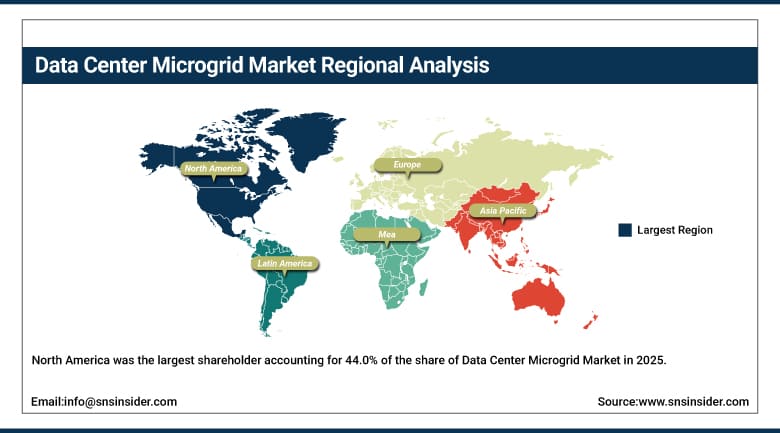
North America was the largest shareholder accounting for 44.0% of the share of Data Center Microgrid Market in 2025. This was due to the presence of unprecedented growth of data centers powered by AI, congested utility interconnection queues, and presence of top-tier vendors of microgrids and fuel cells located within the region. Furthermore, the collaboration of the hyperscale companies and developers of the domestic onsite energy production helped establish the dominance of North America in the market of microgrids.
The United States accounted for larger share of North America owing to the widespread adoption of fuel cells manufactured by Bloom Energy, agreements of up to gigawatts made by American Electric Power, and increasing demand of islandable power in the form of Oracle's 2.8 GW Project Jupiter. The development of data centers in Canada also contributed towards the overall dominance of North America in the market.
Get Customized Report as Per Your Business Requirement - Enquiry Now
Europe Data Center Microgrid Market Insights
Europe retained its sustainable share of revenue generated globally from the Data Center Microgrid Market owing to the presence of decarbonization goals, robust investments in resilient AI and Cloud Infrastructure, and increased usage of hybrid microgrids that use natural gas and batteries as their sources of power. The increased adoption of digital twins and energy management software has also encouraged operators to adopt vendor-neutral microgrids.
Germany was the country with the highest market demand among the European nations on account of the presence of Frankfurt as a leading data center hub in Europe and increasing utility interconnection limits. The UK has been an important contributor to the regional market demand due to increased investments in resilient AI Infrastructure by the hyperscalers.
Asia Pacific Data Center Microgrid Market Insights
The Asia-Pacific region boasts the highest growth rate among all the regions covered in the market with a CAGR of 23.5%, owing to the fast pace of digitalization, investment in cloud and AI infrastructure, and government efforts towards improving energy security of data centers in China, India, and Southeast Asia. In combination, the increased construction of data centers and increased utility grid challenges have guaranteed the fastest microgrid growth in any region covered in this report.
China was leading the region due to substantial investments in hyperscale data center construction and increased capacity of local microgrid manufacturers. Other important countries include India, in which cloud providers utilize microgrids in order to solve issues with utility grids, and Japan, in which data center providers increase on-site generation capacities in pursuit of renewable energy goals.
MEA and Latin America Data Center Microgrid Market Insights
The Middle East and Africa and Latin America both showed steady growth in the Data Center Microgrid Market increased investments in artificial intelligence and cloud infrastructure, diversification of the digital economy initiatives led by governments, and increased partnerships between local developers of data centers and foreign companies of microgrids technology. Onsite reliable and resilient power has been a growing requirement in these regions due to the fact that data center development is taking place at a pace much faster than the grid's capacity enhancement.
In ME&A, the UAE was the largest country market on account of the country being one of the leaders in developing cloud and AI infrastructure and significant investments in resilient power generation in data centers in the region. The region of ME&A also saw contribution from the development of data centers in Saudi Arabia. In LATAM, Brazil had the highest revenue among countries because of the growing cloud services market in the country.
Market Dynamics:
Growth Drivers: Rising AI Power Demand and Expanding Interconnection Constraints
Market drivers include an unprecedented level of energy demand from AI compute, utility interconnection queue congestion delaying interconnection for years, hyperscaler increasing interest in financing gigawatt-scale onsite generation, and the expansion of applications from backup resiliency through primary power to interconnection deferral. The fact that the number of hyperscaler announcements of their intentions to generate onsite based on timelines for constructing AI facilities implies sustained demand for fuel cell and hybrid microgrids going forward.
The increasing number of utility/vendor offtake agreements, along with hyperscalers' increasing interest in constructing an islandable power architecture ahead of interconnection queue delays, adds further weight to this trend. Institutional capital investment, such as Brookfield Asset Management investing in power for AI factories for USD 5 billion, is yet another factor leading to increased baseline deployment capacity.
Restraints: High Capital Costs and Fuel Supply Chain Constraints
The costly nature of the installation of fuel cells and hybrid microgrids at the gigawatt scale is an actual constraint towards the faster adoption of this technology since only highly capitalized hyperscalers and utilities have been able to commit hundreds of millions of dollars to fund the deployment of such installations. This has seen the most advanced generation technologies be deployed by the biggest AI infrastructure players.
Constraints in the natural gas and fuel cell supply chain are ongoing problems for fuel cell companies due to rising orders from data centers that are driving the industry. The solution to this problem involves more manufacturing capacity and alternative suppliers, a dynamic that requires many resources from the fuel cell companies and data center builders.
Opportunities: Islandable Architecture Expansion and Utility Partnership Models
The growth of full islandable microgrid system presents a huge potential as hyperscalers continue to ignore any interconnection with the grid altogether and seek development locations within capacity constrained territories. Suppliers that can provide a validated and gigawatt-scale islandable solution, such as Bloom Energy's 900MW Wyoming plant, stand to benefit immensely as data centers opt for quicker power solutions instead of using grid-based location strategies.
A further key opportunity is the increasing number of partnerships between utilities and vendors, as utilities recognize fuel cells and on-site generation facilities as a legitimate solution for addressing industrial loads that cannot be addressed by the grid system. The USD 2.65 billion, 20-year offtake deal between American Electric Power and Bloom Energy highlights the changing dynamics, which see utilities taking up an active role in deploying microgrids for data centers instead of merely functioning as a grid operator.
Recent Developments:
-
2026: Bloom Energy signed a master services agreement with Oracle for up to 2.8 GW of solid oxide fuel cell systems to power its Project Jupiter AI data center campus, establishing fuel cells as core infrastructure rather than backup power.
-
2026: American Electric Power finalized a USD 2.65 billion, 20-year offtake agreement with Bloom Energy for up to 1 GW of fuel cell capacity to serve data center customers including AWS and Cologix in Ohio.
-
2026: The alliance between Caterpillar and American Intelligence & Power along with Boyd CAT resulted in 2 GW of natural gas power generation capacity being allocated for the Monarch Hyperscale AI campus in West Virginia.
Data Center Microgrid Market key players are:
-
Bloom Energy Corporation
-
Schneider Electric SE
-
Siemens AG
-
ABB Ltd
-
Eaton Corporation plc
-
Honeywell International Inc.
-
GE Vernova Inc.
-
Caterpillar Inc.
-
Cummins Inc.
-
FuelCell Energy, Inc.
-
Enchanted Rock, LLC
-
PowerSecure, Inc.
-
Mitsubishi Power Ltd.
-
Ballard Power Systems Inc.
-
Plug Power Inc.
-
S&C Electric Company
-
Wärtsilä Corporation
-
Generac Power Systems, Inc.
-
AVK-SEG
-
ENGIE SA
Data Center Microgrid Market Report Scope:
| Report Attributes | Details |
|---|---|
| Market Size in 2025 | USD 5.80 Billion |
| Market Size by 2035 | USD 35.32 Billion |
| CAGR | 19.8% from 2026 to 2035 |
| Base Year | 2025 |
| Forecast Period | 2026-2035 |
| Historical Data | 2022-2024 |
| Report Scope & Coverage | Market Size, Segments Analysis, Competitive Landscape, Regional Analysis, DROC & SWOT Analysis, Forecast Outlook |
| Key Segments |
•By Component (Hardware, Software, Services) •By Power Source (Natural Gas Generators, Solid Oxide Fuel Cells, Combined Heat and Power, Solar PV, Battery Energy Storage, Others) •By Grid Type (Hybrid, Off-Grid, On-Grid) •By Application (Backup Power & Resiliency, Primary Power Supply, Peak Shaving & Load Shifting, Grid Interconnection Deferral) •By End User (Hyperscale Data Centers, Edge Data Centers, Colocation Data Centers, Enterprise Data Centers)
|
| Regional Analysis/Coverage | North America (US, Canada), Europe (Germany, UK, France, Italy, Spain, Russia, Poland, Rest of Europe), Asia Pacific (China, India, Japan, South Korea, Australia, ASEAN Countries, Rest of Asia Pacific), Middle East & Africa (UAE, Saudi Arabia, Qatar, South Africa, Rest of Middle East & Africa), Latin America (Brazil, Argentina, Mexico, Colombia, Rest of Latin America). |
| Company Profiles | Bloom Energy Corporation, Schneider Electric SE, Siemens AG, ABB Ltd, Eaton Corporation plc, Honeywell International Inc., GE Vernova Inc., Caterpillar Inc., Cummins Inc., FuelCell Energy, Inc., Enchanted Rock, LLC, PowerSecure, Inc., Mitsubishi Power Ltd., Ballard Power Systems Inc., Plug Power Inc., S&C Electric Company, Wärtsilä Corporation, Generac Power Systems, Inc., AVK-SEG, and ENGIE SA. |

Frequently Asked Questions
Key players include Bloom Energy Corporation, Schneider Electric SE, Siemens AG, ABB Ltd, and Eaton Corporation plc, among others.
Key opportunities include rapid data center expansion, rising AI-driven power demand, renewable energy integration, grid resilience requirements, and increasing deployment of distributed energy resources and energy storage.
The major growth factor is unprecedented AI compute-driven electricity demand growth, expanding utility interconnection queue congestion, and rising hyperscaler investment in gigawatt-scale onsite fuel cell and hybrid generation infrastructure.
The Hardware segment dominated the Data Center Microgrid Market by component, representing the largest share of revenue in 2025.
North America was the largest shareholder accounting for 44.0% of the share of Data Center Microgrid Market in 2025.
