
Data Center Semiconductor Market Report Scope & Overview:
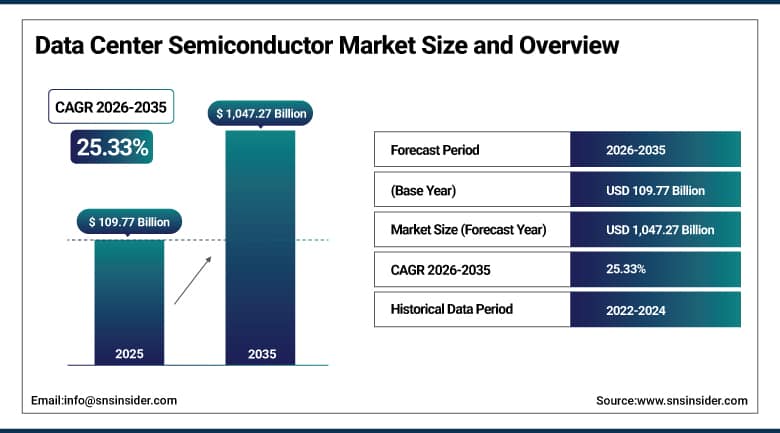
The global Data Center Semiconductor Market size was valued at USD 109.77 Billion in 2025 and is expected to reach USD 1,047.27 Billion by 2035, growing at a CAGR of 25.33% from 2026 to 2035.
The Data Center Semiconductor Market is experiencing remarkable growth fueled by robust hyperscale data centres expansion, accelerating AI workloads, cloud computing adoption and high-performance computing (HPC) deployments. Investment in data centre infrastructure globally is growing, particularly in advanced processors, memory chips, networking semiconductors, and power management ICs. The growing need for AI accelerators, GPUs, ASICs, high-bandwidth memory, and high-speed interconnect technologies are also contributing to the semiconductor innovation. Hyperscale cloud providers and semiconductor manufacturers continue to invest in next generation chip architectures to allow for higher computing performance, energy efficiency and scalable data centre operations.
In 2025, TSMC expanded its partnership with NVIDIA by integrating CUDA-X, cuLitho, and Blackwell accelerated computing to enhance computational lithography, semiconductor simulation, and the efficiency of advanced chip manufacturing.
To Get More Information On Data Center Semiconductor Market - Request Free Sample Report
Data Center Semiconductor Market Trends:
-
Increasing adoption of AI, generative AI, and HPC is driving demand for advanced GPUs, TPUs, ASICs, and custom AI accelerators.
-
Growing investments in hyperscale data centers are boosting deployment of high-bandwidth memory, networking semiconductors, and power-efficient processors.
-
Rising focus on energy-efficient data centers is accelerating adoption of power management ICs, advanced sensors, and next-generation semiconductor technologies.
-
Expanding deployment of high-speed Ethernet, interconnects, and switching chips is improving data center performance, scalability, and connectivity.
-
Strategic partnerships between semiconductor companies and cloud providers are accelerating innovation in AI processors, memory, and integrated data center platforms.
U.S. Data Center Semiconductor Market Size Outlook:
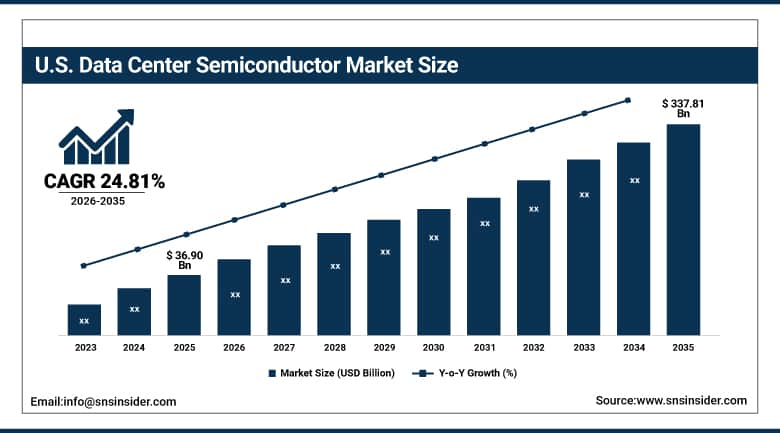
The U.S. Data Center Semiconductor Market was valued at USD 36.90 Billion in 2025 and is expected to reach USD 337.81 Billion by 2035, growing at a CAGR of 24.81% from 2026 to 2035.
The growth of the United States Data Centre Semiconductor Market is attributed to the rapid growth of artificial intelligence infrastructure, hyperscale data centres, cloud computing platforms and high performance computing applications. Demand for advanced GPUs, AI accelerators, ASICs, memory semiconductors, networking chips and power management solutions is being fuelled by major technology companies, semiconductor manufacturers and data centre operators investing heavily. Demand for high-speed data processing, low-latency connectivity and energy-efficient computing infrastructure in U.S. data centres is increasing, and advanced semiconductor components are increasingly being used in them.
In 2026, the US Department of Commerce under the CHIPS initiative announced that it awarded GlobalFoundries US$300 million to accelerate the development of silicon photonics and co-packaged optical interconnect technology for AI data centres.
Data Center Semiconductor Market Segment Analysis:
-
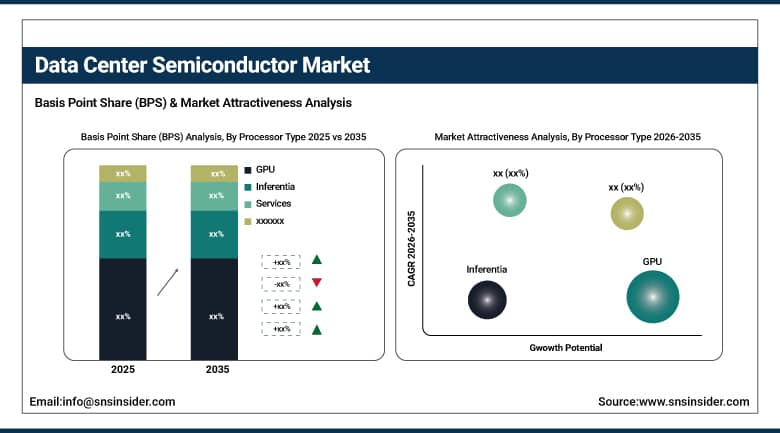
By Processor Type, GPU dominated the Data Center Semiconductor Market with a 42.86% share in 2025, while Inferentia is the fastest-growing processor type segment with a CAGR of 27.87% from 2026–2035.
-
By Memory Type, DRAM dominated the Data Center Semiconductor Market with a 71.34% share in 2025, while NAND is the fastest-growing memory type segment with a CAGR of 26.61% from 2026–2035.
-
By Connectivity & Infrastructure, NIC/Ethernet Adapters dominated the Data Center Semiconductor Market with a 24.82% share in 2025, while Interconnects is the fastest-growing connectivity segment with a CAGR of 27.63% from 2026–2035.
-
By Application, Artificial Intelligence & Machine Learning dominated the Data Center Semiconductor Market with a 44.28% share in 2025, while Artificial Intelligence & Machine Learning is also the fastest-growing application segment with a CAGR of 27.02% from 2026–2035.
By Processor Type, GPU dominated the Data Center Semiconductor Market, while Inferentia is expected to register the fastest growth.
The GPU segment dominated the Data Center Semiconductor Market with a 42.86% revenue share in 2025. Segment leadership is enabled by the wide adoption of GPUs for artificial intelligence workloads, machine learning model training, high performance computing and large-scale data processing applications. Data centre operators and cloud service providers are increasingly deploying GPU-based accelerator solutions to accelerate generative AI, deep learning and advanced analytics workloads. The adoption of GPUs in hyperscale and enterprise data centres is being driven by the need for AI infrastructure and accelerated computing platforms.
The Inferentia segment is expected to register the fastest CAGR of 27.87% during the forecast period 2026 to 2035. This growth is being driven by increasing adoption of AI inference workloads and the need for cost and energy efficient semiconductor solutions in data centres The growing use of AI applications, cloud AI services and custom accelerator architectures is leading organisations to use dedicated inference processors for better performance.
By Connectivity & Infrastructure, NIC/Ethernet Adapters dominated the Data Center Semiconductor Market, while Interconnects is expected to register the fastest growth.
The NIC/Ethernet Adapters segment dominated the Data Center Semiconductor Market with a 24.82% revenue share in 2025. The growth is fueled by the rising need for high-speed networking solutions for data centre communication, cloud services and AI workloads. Network Interface Cards (NICs) and Ethernet adapters enable efficient data transfer between servers, storage systems and networking infrastructure and are therefore integral to today’s data centres.
The Interconnects segment is anticipated to witness the fastest CAGR of 27.63% over the forecast period of 2026-2035. The growth is fueled by increasing deployment of AI infrastructure, increasing bandwidth requirements and the need for low latency communication between accelerated computing systems. The need for advanced interconnect technologies to connect GPUs, AI processors, memory systems and high-performance computing platforms is still increasing.
By Application, Artificial Intelligence & Machine Learning dominated the Data Center Semiconductor Market and is expected to maintain strong growth.
The Artificial Intelligence & Machine Learning segment dominated the Data Center Semiconductor Market with a 44.28% revenue share in 2025. The segment is being driven by the rapid adoption of generative AI, machine learning models, large language models, and accelerated computing applications. The demand for semiconductor technologies is strong due to the soaring demand for advanced processors, memory solutions, and networking components in data centres to support intensive AI workloads.
The Artificial Intelligence & Machine Learning segment is projected to record the fastest CAGR of 27.02% during the forecast period 2026-2035. The growth is driven by the rising adoption of AI across industries, increasing investments in AI data centres and increasing demand for specialised semiconductor architectures. Cloud providers, technology companies and enterprises developing AI infrastructure are likely to drive global demand for advanced data centre semiconductor solutions.
Regional Analysis:
|
Region |
Major Country |
Share within Region, 2025 (%) |
|---|---|---|
|
North America |
United States |
84.38% |
|
Europe |
Germany |
32.60% |
|
Asia Pacific |
China |
54.80% |
|
Middle East & Africa |
UAE |
31.40% |
|
Latin America |
Brazil |
43.20% |
North America Data Center Semiconductor Market Insights
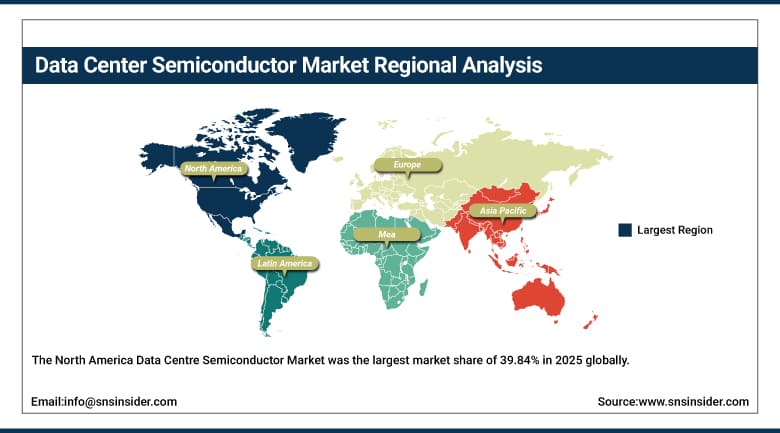
The North America Data Centre Semiconductor Market was the largest market share of 39.84% in 2025 globally. The region’s dominance in the market is due to the presence of semiconductor manufacturers, hyperscale data centre players, cloud players, and AI technology players in the region. Investments in AI infrastructure, processors, memory, connectivity solutions and power management semiconductors are contributing towards the growth of the market.
North America Data Centre Semiconductor Market was the major contributor in the North America Data Centre Semiconductor Market and accounted for 84.38% market share in 2025. The US dominance in the market is attributed to massive investments in AI data centres, semiconductor innovations, cloud infrastructures and chip developments in the country. The proliferation of technology and semiconductor players, and efforts towards the manufacturing of semiconductors in-house is aiding the adoption of GPUs, AI accelerators, memory, networking and connectivit.
Get Customized Report as Per Your Business Requirement - Enquiry Now
Europe Data Center Semiconductor Market Insights
The Europe Data Centre Semiconductor Market is growing steadily, driven by investments in digital infrastructure development, cloud computing centres, and the rising adoption of artificial intelligence solutions. The Europe region is developing its own semiconductor technologies through initiatives, research and investments in advanced semiconductor solutions. The rising demand for energy-efficient processors, memory chips, and networking solutions for data centres is anticipated to drive the market growth in European countries.
Germany is a dominant country in Europe Data Centre Semiconductor Market due to well-developed industrial base, semiconductor research centres, and investment in advanced computing infrastructure. The demand for data centre semiconductors in Germany is driven by industrial digitalisation efforts, adoption of artificial intelligence technology and semiconductor self-sufficiency. Other European countries such as the Netherlands, France, UK and Italy are also participating in the market development with semiconductor innovation, data centre growth and investments in cloud and artificial intelligence infrastructure.
Asia Pacific Data Center Semiconductor Market Insights
The Asia Pacific Data Center Semiconductor Market will witness the fastest CAGR of 26.73% over the forecast period. This market is driven by the presence of key semiconductor manufacturing locations, rapid expansion in data centers, and rising investments in AI, cloud computing, and HPC infrastructure. Various countries within the region are experiencing rising demands for processors, memories, and connectivity components for digital processing workloads.
The Asia Pacific Data Center Semiconductor Market is mainly fueled by increasing adoption of AI, semiconductor manufacturing growth, and rising investments made by technology players and cloud service providers. China continues to contribute significantly to the market growth because of its large semiconductor ecosystem, rising AI infrastructure deployments, and increasing data centers. Japan, South Korea, Taiwan, and India continue to contribute to the market growth in the region through investments in semiconductor manufacturing, advanced packaging, memory, and digital infrastructure expansion.
Middle East & Africa and Latin America Data Center Semiconductor Market Insights
The Middle East & Africa and Latin America Data Centre Semiconductor Market can be expected to grow steadily owing to increasing investments in transformation towards digitalisation, development of cloud infrastructure and data centres. Growing demand for artificial intelligence services, computing solutions for enterprises and regional data storage capabilities encourage semiconductor investment. The evolution of telecommunications networks, smart cities and digitalisation opens up opportunities for sophisticated processors, memory, networking solutions and power management.Brazil is a key driver of the Latin America Data Centre Semiconductor Market, with technology investment, cloud adoption and digital infrastructure expansion driving growth. Countries in this region try to enhance their data centres capabilities.
In the Middle East & Africa region, the growth will be driven by investments in AI infrastructure, cloud computing infrastructure and technology modernisation in UAE and Saudi Arabia countries. Government initiatives for digital transformation and a growing need for localised data processing capabilities are fueling investments in semiconductors. There is still room for growth, though the investments are not as large as in the developed regions.
Market Dynamics:
Growth Drivers: Rising AI infrastructure expansion and increasing demand for high-performance semiconductor solutions driving market growth
The global Data Centre Semiconductor market is expected to record significant growth over the forecast period due to the exponential growth in artificial intelligence-based workloads, investments in hyperscale data centres, and the growing demand for high-end semiconductor components. For semiconductors like GPUs, AI accelerators, memory chips, networking semiconductors, and power management integrated circuits, high-performance computing, cloud services, and AI-based operations are now indispensable. Growing use of generative AI, machine learning platforms and accelerated computing solutions is driving demand for advanced processors and high speed connectivity solutions in data centres.
The data centre infrastructure is transforming at a faster pace with the developments in AI-powered computing platforms, advanced semiconductor architectures and next-gen networking solutions. Rising investments by cloud service providers, hyperscale data centre providers, semiconductor companies and technology companies are creating lucrative opportunities for players operating in data centre semiconductors. The collaboration between processor companies, memory solution makers, networking companies and infrastructure providers is playing a major role in developing energy-efficient, high-performance and scalable semiconductor solutions for the future requirements of data centres.
Restraints: High semiconductor development costs and supply chain complexities limiting market expansion
The market’s growth could be hampered by the high cost of developing next generation semiconductors for data centres. Developing and producing highly efficient processors, AI chips, memory elements and connectivity semiconductor solutions demands considerable investments in research and development processes, semiconductor manufacturing, advanced packaging and testing infrastructure. The large capital expenditure required and lack of access to advanced semiconductor production facilities can make it difficult for small scale semiconductor firms to compete.
That said, another big challenge the industry faces is the complexity of the semiconductor supply chain and its dependence on advanced fabrication processes. Supply chain risks can be related to the requirement for advanced foundries, materials and semiconductor manufacturing equipment for advanced semiconductor production. Moreover, factors such as chip availability, geopolitical risk, energy consumption, and regular technological upgrades can hinder the growth of the market. Also, data centre architectures that include complex processors, memory, networking elements and power management chips can be technically challenging to integrate.
Opportunities: Expansion of AI data centers and advanced computing infrastructure creating new growth avenues
The Data Centre Semiconductor Market is anticipated to experience lucrative growth opportunities with the rising investments in AI-centric data centres, cloud computing infrastructure and high-performance computing facilities. The adoption of advanced GPUs, TPUs, ASICs and AI-specific processors is being driven by the growing demand for AI training and inference workloads, large language models, machine learning applications and accelerated computing. Data centre operators are increasingly deploying high-performance semiconductor solutions to enhance processing efficiency, reduce latency and improve computational capabilities.
North America, Europe and Asia Pacific are seeing new opportunities emerging as a result of government semiconductor initiatives, expansion of domestic chip manufacturing capabilities and increased investment in next generation data centre infrastructure. Chiplet architectures, silicon photonics, high-bandwidth memory (HBM), advanced packaging and energy-efficient semiconductor technologies will help to further grow the market. Strategic alliances between semiconductor companies, cloud providers and data centre technology companies will enable development of scalable, powerful and efficient semiconductor solutions for future AI and cloud computing ecosystems.
Recent Developments:
-
2025: NVIDIA unveiled the Blackwell Ultra AI Factory Platform featuring the GB300 NVL72 rack-scale system, Spectrum-X 800G networking, and Blackwell Ultra GPUs, with major cloud providers adopting the platform for AI data centers.
-
2025: Micron Technology announced shipments of HBM3E 12-high memory and SOCAMM LPDDR5X modules developed with NVIDIA for GB300 Grace Blackwell AI servers, enhancing high-performance data center memory capabilities.
-
2026: AMD announced production ramp-up of its 6th Gen EPYC “Venice” processors based on TSMC’s 2nm process technology, targeting cloud computing, AI infrastructure, enterprise servers, and high-performance computing applications.
-
2026: Google expanded deployment of custom Tensor Processing Units (TPUs) as hyperscale providers increased AI infrastructure investments, with global cloud capital expenditure projected to surpass US$710 billion driven by AI workloads.
Data Center Semiconductor Companies are:
-
NVIDIA Corporation
-
Intel Corporation
-
Advanced Micro Devices, Inc. (AMD)
-
Micron Technology, Inc.
-
Samsung Electronics Co., Ltd.
-
SK hynix Inc.
-
Taiwan Semiconductor Manufacturing Company Limited (TSMC)
-
Qualcomm Technologies, Inc.
-
Arm Holdings plc
-
IBM Corporation
-
Google LLC
-
Amazon Web Services, Inc. (AWS)
-
Microsoft Corporation
-
Oracle Corporation
-
Huawei Technologies Co., Ltd.
-
Cisco Systems, Inc.
-
Applied Materials, Inc.
-
Kioxia Corporation
Data Center Semiconductor Market Report Scope:
| Report Attributes | Details |
|---|---|
| Market Size in 2025 | USD 109.77 Billion |
| Market Size by 2035 | USD 1,047.27 Billion |
| CAGR | CAGR of 25.33% From 2026 to 2035 |
| Base Year | 2025 |
| Forecast Period | 2026-2035 |
| Historical Data | 2022-2024 |
| Report Scope & Coverage | Market Size, Segments Analysis, Competitive Landscape, Regional Analysis, DROC & SWOT Analysis, Forecast Outlook |
| Key Segments | • By Processor Type (GPU, TPU, Trainium, Inferentia, Biren, ASIC, CPU) • By Memory Type (DRAM, NAND) • By Connectivity & Infrastructure (NIC/Ethernet Adapters, Switches, Interconnects, Temperature Sensors, Humidity Sensors, Airflow Sensors, Power Management ICs) • By Application (Artificial Intelligence & Machine Learning, Cloud Computing, High-Performance Computing (HPC), Storage & Networking) |
| Regional Analysis/Coverage | North America (US, Canada), Europe (Germany, UK, France, Italy, Spain, Russia, Poland, Rest of Europe), Asia Pacific (China, India, Japan, South Korea, Australia, ASEAN Countries, Rest of Asia Pacific), Middle East & Africa (UAE, Saudi Arabia, Qatar, South Africa, Rest of Middle East & Africa), Latin America (Brazil, Argentina, Mexico, Colombia, Rest of Latin America). |
| Company Profiles | NVIDIA Corporation, Intel Corporation, Advanced Micro Devices, Inc. (AMD), Broadcom Inc., Micron Technology, Inc., Samsung Electronics Co., Ltd., SK hynix Inc., Taiwan Semiconductor Manufacturing Company Limited (TSMC), Qualcomm Technologies, Inc., Marvell Technology, Inc., Arm Holdings plc, IBM Corporation, Google LLC, Amazon Web Services, Inc. (AWS), Microsoft Corporation, Oracle Corporation, Huawei Technologies Co., Ltd., Cisco Systems, Inc., Applied Materials, Inc., Kioxia Corporation. |
Frequently Asked Questions
The Data Center Semiconductor Market is expected to grow at a CAGR of 25.33% from 2026 to 2035.
The Data Center Semiconductor Market was valued at USD 109.77 Billion in 2025.
The market is driven by increasing AI workloads, expansion of hyperscale data centers, rising demand for high-performance computing, and adoption of advanced semiconductor technologies.
The GPU segment dominated the Data Center Semiconductor Market in 2025, accounting for approximately 42.86% market share.
The North America region dominated the Data Center Semiconductor Market in 2025, accounting for approximately 39.84% market share.
