
AI Data Center Power Infrastructure Market Report Scope and Overview:
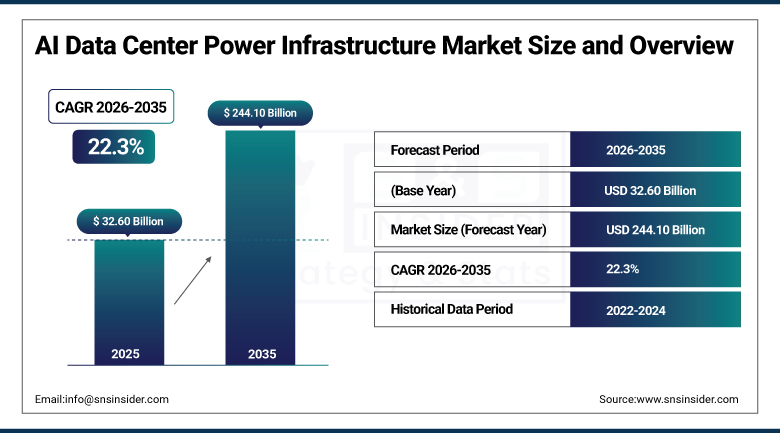
The AI Data Center Power Infrastructure Market was valued at USD 32.60 Billion in 2025 and is projected to reach USD 244.10 Billion by 2035, registering a CAGR of 22.3% from 2026 to 2035.
The AI Data Center Power Infrastructure Market is revolutionizing the way in which digital infrastructure companies provide reliable, dense electrical power to compute racks containing GPUs, which consume anywhere from 60 kW to 130 kW of power per rack. The existence of such a market could be gauged by looking at the increasing number of hyperscale campus developments with greater than 100 MW of committed critical loads, increasing use of 800-volt DC power architecture, greater use of local power generation through solid oxide fuel cells and gas turbines, and increasing utilities building dedicated transmission lines for powering AI-driven data center campuses.
In May 2026, Hitachi and X LABS have collaborated for developing energy parks of GW scale which would provide power-as-a-service for AI data centers in North America.
To Get more information On AI Data Center Power Infrastructure Market - Request Free Sample Report
AI Data Center Power Infrastructure Market Trends:
-
Expanding hyperscale AI campus construction continues accelerating demand for high-capacity UPS and switchgear systems.
-
Growing adoption of 800-volt DC power architecture continues improving rack-level power delivery efficiency.
-
Rising deployment of on-site fuel cells and gas turbines continues easing grid interconnection bottlenecks.
-
Increasing utility transmission investment continues expanding dedicated power capacity for AI data center clusters.
-
Growing vendor collaboration around unified reference architectures continues standardizing facility-to-chip power delivery.
U.S. AI Data Center Power Infrastructure Market Size Outlook
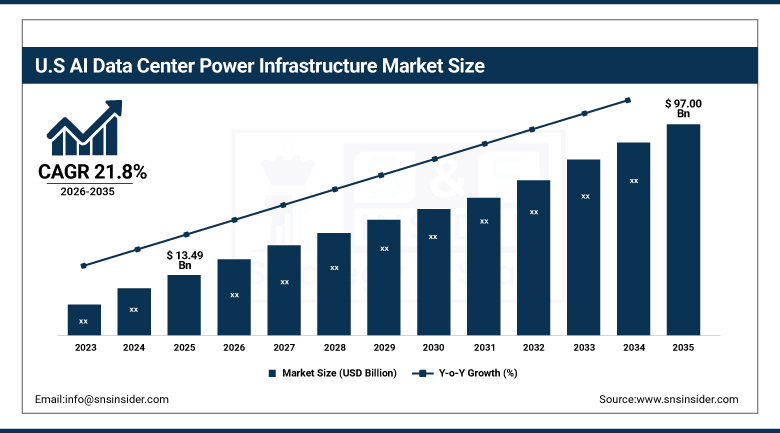
The U.S. AI Data Center Power Infrastructure Market was valued at approximately USD 13.49 Billion in 2025 and is projected to reach approximately USD 97.00 Billion by 2035, registering a CAGR of approximately 21.8% from 2026 to 2035.
The demand for the AI Data Center Power Infrastructure in the U.S. was notably affected due to the fact that hyperscale campus development projects were focused in Virginia, Texas, and Ohio, a favorable utility investment environment fueled by government loan guarantees for transmission system enhancement projects, and ongoing localization of the manufacturing of switchgears, transformers, and other equipment needed for power distribution by equipment power suppliers.
In April 2026, Vertiv partnered with CPower in the U.S. to integrate battery energy storage with virtual power-plant capabilities, helping data centers accelerate grid interconnection, improve resilience, and manage power demand.
AI Data Center Power Infrastructure Market Segment Analysis:
-
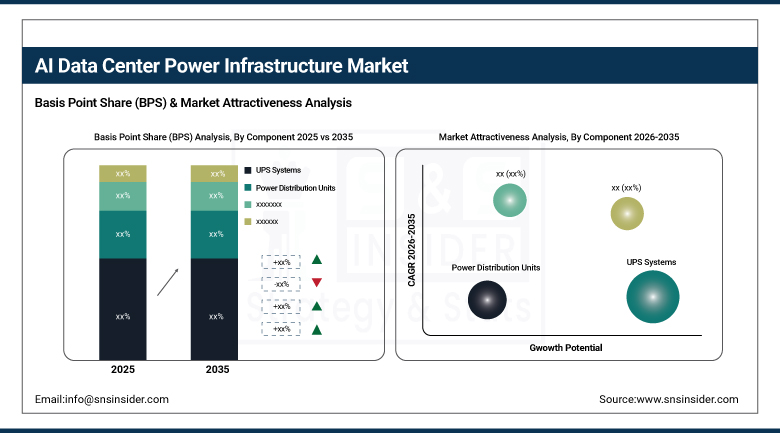
By Component, UPS Systems segment dominated the AI Data Center Power Infrastructure Market in 2025 with 29% share; Power Distribution Units segment is the fastest growing segment, registering a CAGR of 23.8% from 2026 to 2035.
-
By Power Capacity, Above 20 MW segment dominated the market in 2025 with 41% share; 10-20 MW segment is also the fastest growing segment, registering a CAGR of 24.1% from 2026 to 2035.
-
By Data Center Type, Hyperscale segment dominated the market in 2025 with 55% share; Colocation segment is the fastest growing segment, registering a CAGR of 23.5% from 2026 to 2035.
-
By End User, Cloud Service Providers & Hyperscalers segment dominated the market in 2025 with 59% share; Government & Defense segment is the fastest growing segment, registering a CAGR of 24.3% from 2026 to 2035.
By Component: UPS Systems Lead, Power Distribution Units Grow Fastest
UPS Systems dominated the AI Data Center Power Infrastructure Market in 2025 on account of their well-established reputation in offering N+1 and 2N redundancies in order to ensure GPU training clusters of protection against even millisecond power interruptions. Other vendors like Schneider Electric, Vertiv, and Eaton have introduced modularity-based UPS systems that feature lithium-ion batteries and that have been specifically developed for handling load step transients generated by AI training loads. The segment has seen decades of operational data, service networks, and software integrations with DCIMs, all of which are continuing to make the segment dominant by virtue of having a very reliable solution.
Power Distribution Units are expected to witness the fastest rate of growth in the AI Data Center Power Infrastructure Market on the back of increased rack densities prompting the use of remotely-monitored and intelligent distribution at rack level. Vendors, such as Legrand (Server Technology and Raritan) and Delta Electronics and Vertiv have offered highly-current-carrying PDUs to manage power transfer through densely-packed GPU racks. Increasing usage of 800V DC architecture has been driving the need for newer generation PDUs that will be able to handle high-voltage conversions right at the rack level.
By Power Capacity: Above 20 MW Facilities Dominate, 10-20 MW Segment Grows Fastest
Above 20 MW facilities held the largest market share of the AI Data Center Power Infrastructure Market in 2025, owing to the commitment by hyperscalers, such as Amazon Web Services, Microsoft, Google, and Meta to building gigawatt-scale AI campuses in North America and the Asia Pacific regions. These high-capacity facilities demand substation installations, power generation plants, and multi-hundred-megawatts switchgear systems which only a few power equipment manufacturing companies can provide. The above factors have further fueled the market's leadership as funds continue to flow into the most prominent AI training and inference campuses developed by the leading cloud services firms worldwide.
The 10-20 MW capacity range is anticipated to be the fastest-growing market segment of the AI Data Center Power Infrastructure Market, facilitated by colocation services providers including Equinix, Digital Realty, and NTT Global Data Centers building up AI-capable halls for enterprise and neocloud users who are unable to support gigawatt-scale AI campuses. The mid-capacity category is experiencing benefits arising out of the availability of modular and prefabricated power skids that have helped reduce the time-to-market period for colocation companies to get AI-optimized capacities installed in supply-limited geographies where land and grid connectivity constitute the main constraints to growth.
By Data Center Type: Hyperscale Facilities Lead, Colocation Grows Fastest
The Hyperscale facilities accounted for the largest share of the AI Data Center Power Infrastructure Market, attributed to consistent capital spending plans made by cloud service providers, who are establishing purpose-built AI training and inference facilities. Cloud service providers such as AWS, Microsoft Azure, and Google Cloud are further standardizing the power architecture for their global fleet of facilities by partnering directly with Schneider Electric, Vertiv, and Eaton, which enables the procurement of switchgear, UPS, and busways under long-term supply contracts.
Colocation facilities are expected to grow at the highest CAGR among all types of data centers in the AI Data Center Power Infrastructure Market. Enterprises and mid-sized AI developers have been opting for colocation services, as a cheaper alternative to establishing their own dedicated facility for AI. Providers of colocation services such as Equinix, Digital Realty, and Vantage Data Centers are making improvements to their existing facilities and also building new facilities with optimized halls for AI, with increased power density allowances.
By End User: Cloud Service Providers & Hyperscalers Dominate, Government & Defense Grows Fastest
Cloud Service Providers & Hyperscalers occupied the major market share in the AI Data Center Power Infrastructure Market in 2025, owing to the large portion of global AI computing capability in hands of select few technology giants. Such players keep entering into long-term power offtake or supply contracts with power equipment providers, including on-site generation providers, such as Bloom Energy, in order to acquire their power capacity well before actual demand arises, avoiding delays arising due to long waiting period involved in grid interconnection process for deployment of AI infrastructure in their portfolio of global data centers.
Government & Defense will grow at the fastest pace among all end-user segments of AI Data Center Power Infrastructure Market in the coming years, supported by sovereign AI projects by governments of the United States, member countries of European Union, and Gulf Cooperation Council countries who intend to establish domestically located AI compute capability as a matter of national security and competitiveness. Increased procurement of robust microgrids and on-site generation capacity is being seen by the government departments, as they give priority to power independence and supply chain security over grid capability alone.
Regional Analysis:
|
Region |
Major Country |
Share within Region, 2025 (%) |
|---|---|---|
|
North America |
United States |
88.40% |
|
Europe |
Germany |
24.60% |
|
Asia Pacific |
China |
33.50% |
|
Middle East and Africa |
Saudi Arabia |
29.80% |
|
Latin America |
Brazil |
30.90% |
North America AI Data Center Power Infrastructure Market Insights
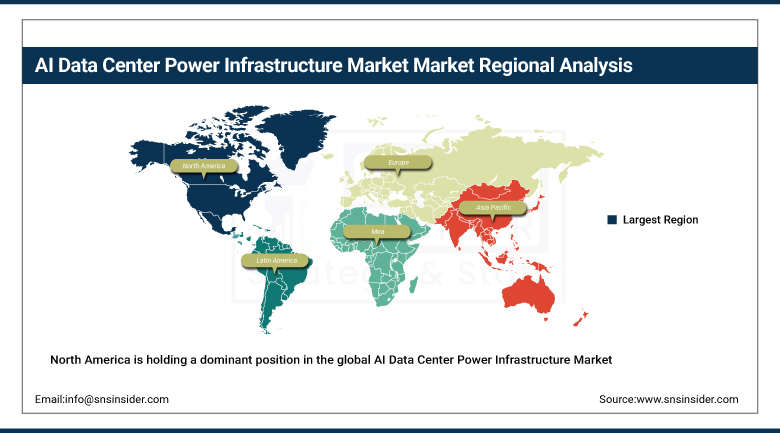
North America is holding a dominant position in the global AI Data Center Power Infrastructure Market with approximate share of 46.80% in the market, as this region is witnessing significant revenue growth in the segment of hyperscale AI campus construction and also having power infrastructure companies, such as Schneider Electric, Vertiv, Eaton, and Bloom Energy. The continued investment of utilities in transmission and substation capacity, along with the support of the government in form of federal loan guarantees in improving the grid modernization, as well as the investment done by cloud service providers in the AI infrastructure, have helped North America gain a dominant position in deployed and pipeline power capacity for AI data centers in the region.
The U.S. is holding a prominent position in North America, due to the concentrated hyperscale campus construction in Virginia, Texas, and Ohio, along with an extensive utility transmission upgrading supported by DOE loan guarantees, and easy availability of domestic switchgear and UPS solutions. Canada is contributing to the dominance of the region, as there has been significant hydroelectric-based data center development in Quebec and Ontario, in addition to the involvement of Canadian utilities in cross-border grid capacity planning for AI infrastructure projects.
Get Customized Report as per Your Business Requirement - Enquiry Now
Europe AI Data Center Power Infrastructure Market Insights
One of the significant regions possessing a huge market share of the global AI Data Center Power Infrastructure Market in 2025 was Europe due to the highly developed power grid infrastructure in Western Europe, the favorable pathway for renewable energy-powered data centers in accordance with sustainability directives of the European Union, and regional efforts aimed at expanding the grid capacity, such as coordinated grid planning by the European Network of Transmission System Operators. Tighter grid interconnection conditions have not become an obstacle for the parallel growth of the investment in AI data center power infrastructure in Europe and North America due to the close cooperation of national utilities, power equipment manufacturers, and hyperscale operators.
The German market stood out among the other European countries because it accounted for major shares of revenue in Europe in 2025 due to a highly developed industry of manufacturing of power equipment in Germany (Siemens) and expansion of hyperscale data centers in Frankfurt. French and UK markets additionally created the demand for power infrastructure owing to the grid capacity powered by nuclear energy and sovereignty of clouds in Europe.
Asia Pacific AI Data Center Power Infrastructure Market Insights
Asia Pacific is predicted to witness the highest growth rate (CAGR) of 26.90% during the forecast period 2026-2035, attributable to growing spending by governments towards construction of AI infrastructure, growing investments towards expansion of power equipment manufacturing capacity, and growing announcements of hyperscale campuses in the expanding network infrastructure of the region. As a result of growing requirement of AI computing capacity in China, India, and Southeast Asia, along with growing manufacture of switchgear and transformers in the region, Asia Pacific is predicted to see the highest growth rate in the market.
China has been the leading nation in the region owing to joint efforts made by state-owned electricity companies and technology firms to construct dedicated AI data center power infrastructure. Significant contribution from the Asia Pacific region has been seen from India and South Korea because of growing announcements of hyperscale campuses and growing investments towards domestic manufacturing of power equipment in order to be less dependent on imported switchgear and UPS systems.
MEA and Latin America AI Data Center Power Infrastructure Market Insights
The Middle East & Africa and Latin America regions, the AI Data Center Power Infrastructure Market continued to grow steadily due to better grid infrastructure, investments in AI computing capabilities from sovereign wealth funds, and collaborations between utility companies and power equipment manufacturers in the field of power planning for data centers. The increasing awareness of the importance of developing AI data centers as an economic priority in Gulf Cooperation Council countries and underdeveloped in terms of grid infrastructure Latin American economies contributed to market development.
In the Middle East & Africa region, Saudi Arabia became the biggest contributor to the market due to AI infrastructure investment programs and power planning connected with diversification of national economy. In Latin America, the biggest market was Brazil, holding major share of regional revenue due to growing hyperscale investment in Sao Paolo.
Market Dynamics:
Growth Drivers: Expanding Hyperscale AI Campus Buildout and Rising On-Site Power Adoption Boost Growth Globally
Market growth is expected to be boosted by increasing pipeline for hyperscale AI campus construction with more than 100 MW of committed critical load, increasing awareness amongst data center owners of 800 volts DC power architecture for lower conversions in GPU-dense racks, and increasing need for power delivery systems which can offer more reliable and quick deployments as compared to traditional AC power systems. The need for continuous and high-capacity power supply, along with scalable and pre-fabricated power equipment, is likely to emerge as one of the key drivers for investment in the targeted market, considering increasing hyperscale and colocation investments in gigawatts-scale AI campuses in grid-constrained locations globally.
The additional growth impetus for the ongoing trend will emerge from the increasing number of long-term off-take agreements which are being signed between power equipment vendors, utilities, and on-site generators to offer power delivery capabilities in anticipation of AI compute demand. Growing federal and state-level loan guarantee program in support of transmission modernization, along with growing capital expenditure from the utilities, is likely to fuel investments in this area, and all these factors put together are going to boost interest in the AI Data Center Power Infrastructure Market.
Restraints: Grid Interconnection Bottlenecks and Complex Power Equipment Manufacturing Lead Times
The continuous shortage of available interconnection capacity is another issue impeding the development of the market owing to the continuous reliance on several regional transmission operators and utilities that have no capability to quickly approve new large-load connections. Hyperscale and colocation providers might struggle in obtaining adequate power capacity to make committed AI campuses operational according to schedule, even though procurement of power equipment has been made well before the intended start dates of construction.
The complex process of manufacturing and transporting large switchgears, transformers, and generators is another issue hindering the growth of the market owing to long lead times for the procurement of components, limited production capacity of high voltage equipment globally, and rising costs for the inputs of copper and specialized steel necessary for power equipment. The process of ordering long lead switchgears and medium voltage transformers takes years of advance booking and is highly costly and difficult for smaller players entering the AI infrastructure industry.
Opportunities: Expanding On-Site Generation Adoption and Decentralized Power Architecture Innovation
The extension of the use of on-site power generation for AI data centers is another significant opportunity, especially with many of the hyperscale companies beginning to use solid oxide fuel cells, gas turbines, and modular nuclear power to avoid being tied into the grid connection queue, which would take years to get their AI data centers built. The power equipment and power generation companies that can develop and demonstrate a reliable and bankable solution in on-site power will be able to seize the first mover advantage in the market that keeps growing larger every year as the number of AI compute installations increases.
Looking to the future, there is also a significant opportunity for the creation of a decentralized, high voltage direct current power system architecture and modular production capabilities. Companies that are able to establish large-scale pre-fabrication and fast deployment capabilities should find it easier to provide commercial-scale power infrastructure for new AI data center campuses as they get built. Power equipment suppliers that make early investments in expanding 800-volt DC and solid-state transformer production capacity are expected to capture a large share of this market in the future as it evolves from an emerging architectural shift into a standard industry requirement.
Recent Developments:
-
2026: Bloom Energy signed a master services agreement with Oracle for up to 2.8 gigawatts of solid oxide fuel cell capacity to power AI data center campuses, expanding significantly on an earlier 1.2-gigawatt agreement between the two companies.
-
2026: Eaton disclosed nearly 20 pilot programs for its medium-voltage solid-state transformer technology enabling 800-volt DC power distribution, with hyperscaler customer orders expected in the second half of 2026 and shipments beginning in late 2027.
-
2026: Schneider Electric, Vertiv, and Eaton contributed power and cooling infrastructure to NVIDIA's DSX (Data Center System eXtended) reference architecture unveiled at GTC 2026, standardizing facility-to-chip power delivery for AI factories.
AI Data Center Power Infrastructure Companies are:
-
Schneider Electric SE
-
Vertiv Holdings Co.
-
ABB Ltd
-
Delta Electronics, Inc.
-
Legrand SA
-
Siemens AG
-
Caterpillar Inc.
-
Cummins Inc.
-
Generac Holdings Inc.
-
Rolls-Royce Power Systems AG
-
Toshiba International Corporation
-
Mitsubishi Electric Corporation
-
Socomec Group
-
Piller Power Systems Inc.
-
Rittal GmbH & Co. KG
-
Huawei Digital Power Technologies Co., Ltd.
-
Bloom Energy Corporation
-
EnerSys
AI Data Center Power Infrastructure Market Report Scope:
| Report Attributes | Details |
|---|---|
| Market Size in 2025 | USD 32.60 Billion |
| Market Size by 2035 | USD 244.10 Billion |
| CAGR | 22.3% from 2026 to 2035 |
| Base Year | 2025 |
| Forecast Period | 2026-2035 |
| Historical Data | 2022-2024 |
| Report Scope & Coverage | Market Size, Segments Analysis, Competitive Landscape, Regional Analysis, DROC & SWOT Analysis, Forecast Outlook |
| Key Segments |
• By Component (UPS Systems, Power Distribution Units, Switchgear & Circuit Breakers, Generators & On-Site Power Systems, Busway & Rack Power Distribution, Others) • By Power Capacity (Above 20 MW, 10-20 MW, Below 5 MW, 5-10 MW) • By Data Center Type (Hyperscale, Colocation, Enterprise, Edge) • By End User (Cloud Service Providers & Hyperscalers, Government & Defense, IT & Telecommunications, BFSI, Others)
|
| Regional Analysis/Coverage | North America (US, Canada), Europe (Germany, UK, France, Italy, Spain, Russia, Poland, Rest of Europe), Asia Pacific (China, India, Japan, South Korea, Australia, ASEAN Countries, Rest of Asia Pacific), Latin America (Brazil, Argentina, Mexico, Colombia, Rest of Latin America), Middle East & Africa (UAE, Saudi Arabia, Qatar, South Africa, Rest of Middle East & Africa). |
| Company Profiles | Schneider Electric SE, Vertiv Holdings Co., Eaton Corporation plc, ABB Ltd, Delta Electronics, Inc., Legrand SA, Siemens AG, Hitachi Energy Ltd, Caterpillar Inc., Cummins Inc., Generac Holdings Inc., Rolls-Royce Power Systems AG, Toshiba, International Corporation, Mitsubishi Electric, Corporation, Socomec Group, Piller Power Systems Inc., Rittal GmbH & Co. KG, Huawei Digital Power, Technologies Co., Ltd., Bloom Energy Corporation, and EnerSys. |

Frequently Asked Questions
Key players include Schneider Electric SE, Vertiv Holdings Co., Eaton Corporation plc, ABB Ltd, and Delta Electronics, Inc., among others.
Key opportunities include surging AI workloads, rapid data center expansion, rising power-density requirements, liquid cooling integration, and increasing demand for reliable, scalable power infrastructure.
The major growth factor is the expanding hyperscale AI campus buildout, rising adoption of 800-volt DC power distribution architecture, and growing deployment of on-site generation to bypass grid interconnection bottlenecks.
The UPS Systems segment dominated the AI Data Center Power Infrastructure Market by component, representing the largest share of revenue in 2025.
North America dominated the AI Data Center Power Infrastructure Market in 2025, holding an estimated 46.80% share of total global market revenue.
