
AI Data Center Interconnect Market Report Scope & Overview:
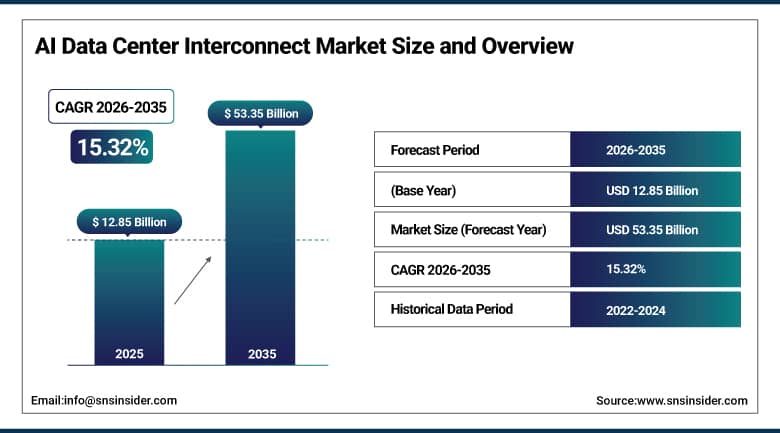
The AI Data Center Interconnect Market was valued at USD 12.85 Billion in 2025 and is expected to reach USD 53.35 Billion by 2035, growing at a CAGR of 15.32% from 2026–2035.
The AI data center interconnect market is experiencing consistent growth due to the growing need for high-speed, low-latency connectivity and efficient data transfer across AI data centers and computing clusters. The increased adoption of artificial intelligence, generative AI, machine learning, and high-performance computing has led to rising demand for AI infrastructure, thereby driving the growth of the market. Investments in advanced networking technologies for AI data centers, including high-speed Ethernet, InfiniBand, optical interconnects, coherent optical technologies, and next-generation data center networking solutions, have increased the capacity and efficiency of AI workloads. The focus of companies has been on bandwidth scalability, low latency, network efficiency, interoperability, and reliable connectivity for distributed AI workloads.
⮞In August 2026, Zayo announced an expansion of its long-haul fiber infrastructure to support growing AI data center connectivity requirements, including more than 8,000 miles of new fiber across emerging AI corridors with NVIDIA as an anchor customer. The expansion is expected to increase high-capacity connectivity between AI data centers and support the growing demand for dedicated interconnect infrastructure as AI workloads and distributed computing clusters scale.
To Get More Information On AI Data Center Interconnect Market - Request Free Sample Report
AI Data Center Interconnect Market Trends
-
Growing adoption of AI, generative AI, and machine learning is driving demand for high-speed, low-latency data center interconnect solutions.
-
Rising deployment of AI data centers and GPU clusters is increasing demand for high-bandwidth networking and advanced interconnect technologies.
-
Increasing adoption of AI Ethernet, InfiniBand, optical interconnects, and coherent technologies is supporting market growth.
-
Growing focus on bandwidth, scalability, latency, reliability, and energy efficiency is creating opportunities for interconnect technology providers.
-
Advancements in optical networking and AI-optimized network architectures are improving connectivity performance and supporting market adoption.
U.S. AI Data Center Interconnect Market Outlook
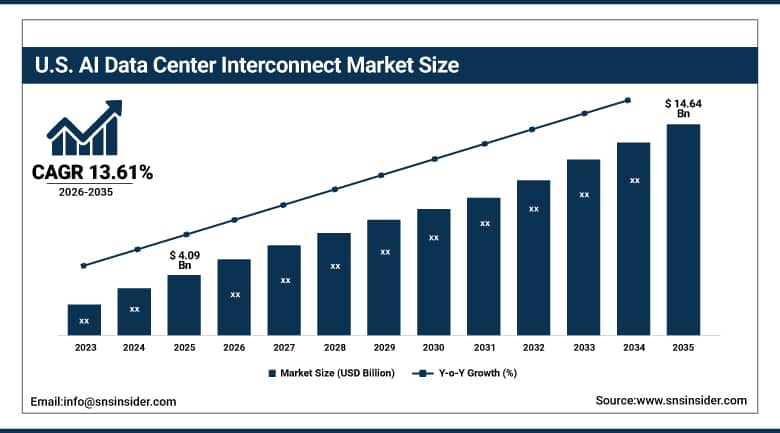
The U.S. AI Data Center Interconnect Market was valued at USD 4.09 Billion in 2025 and is expected to reach around USD 14.64 Billion by 2035, growing at a CAGR of 13.61% from 2026–2035.
The U.S. market for AI data center interconnect is growing steadily due to rising demand for high-speed, low-latency connectivity for AI workloads and advanced computing infrastructure. The increasing deployment of AI data centers, GPU clusters, generative AI, and machine learning applications is driving higher data transfer requirements and demand for advanced interconnect technologies. Growing investments in AI infrastructure and next-generation networking are supporting the adoption of high-bandwidth Ethernet, InfiniBand, optical interconnects, and coherent optical technologies. The expansion of hyperscale and enterprise AI data centers in the country is expected to further drive demand for advanced data center interconnect solutions. Manufacturers are focusing on higher bandwidth, lower latency, improved network efficiency, scalability, reliability, and energy-efficient interconnect technologies.
⮞In August 2026, the U.S. government moved toward restricting the use and import of Chinese-made optical transceivers used in data centers, citing national-security concerns. The proposed restrictions are particularly relevant to AI infrastructure because optical transceivers are critical for high-speed data transmission within and between data centers. The move is expected to encourage greater adoption of U.S.-based and allied suppliers of optical connectivity components and support investment in secure, high-capacity AI data center interconnect infrastructure.
AI Data Center Interconnect Market Segment Analysis
-
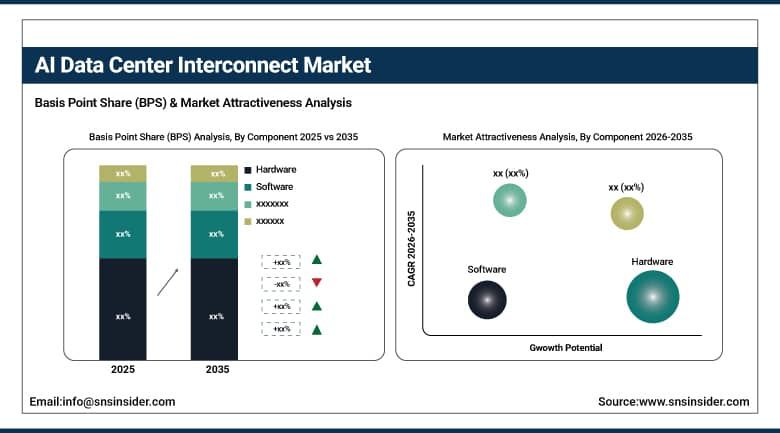
By Component, hardware dominated the AI data center interconnect market with a 54.37% share in 2025, while software is projected to be the fastest-growing segment, registering a 18.65% CAGR during 2026–2035.
-
By Technology, AI ethernet dominated the AI data center interconnect market with a 31.84% share in 2025, while coherent optical technology is projected to be the fastest-growing segment, registering a 18.22% CAGR during 2026–2035.
-
By Interconnect Type, optical DCI dominated the AI data center interconnect market with a 56.23% share in 2025, while hybrid DCI is projected to be the fastest-growing segment, registering a 19.17% CAGR during 2026–2035.
-
By Deployment Model, cloud-based dominated the AI data center interconnect market with a 49.52% share in 2025, while hybrid is projected to be the fastest-growing segment, registering a 16.79% CAGR during 2026–2035.
-
By Application, ai workload & data mobility dominated the AI data center interconnect market with a 35.72% share in 2025, while distributed ai training is projected to be the fastest-growing segment, registering a 19.12% CAGR during 2026–2035.
-
By End User, hyperscale cloud service providers dominated the AI data center interconnect market with a 38.42% share in 2025, while internet content providers & carrier-neutral providers are projected to be the fastest-growing segment, registering a 18.67% CAGR during 2026–2035.
By Component, hardware dominated the AI Data Center Interconnect Market, while software is expected to grow fastest.
Hardware will lead the market during 2025 due to its significant role in enabling high-speed, low-latency connectivity across AI data centers and computing clusters. The increasing deployment of AI infrastructure, GPU clusters, and high-performance computing systems is boosting demand for switches, optical transceivers, optical transport equipment, cables, and other interconnect hardware. Advancements in high-speed networking and optical technologies are likely to further improve connectivity capacity, efficiency, and performance.
Software is anticipated to grow with the highest CAGR throughout the forecast period of 2026 to 2035. The rising demand for efficient management of increasingly complex AI networks, along with the growing adoption of software-defined networking, network analytics, automation, and network optimization solutions, is supporting the development of advanced interconnect software.
⮞In March 2025, Arista Networks introduced its EOS Smart AI Suite, including Cluster Load Balancing and CloudVision Universal Network Observability enhancements, enabling AI workload monitoring, network optimization, and improved troubleshooting across large-scale AI computing clusters
By Interconnect Type, optical DCI dominated the AI Data Center Interconnect Market, while hybrid DCI is expected to grow fastest.
Optical DCI was the dominating type of the market in 2025 due to its ability to provide high bandwidth, low latency, and reliable connectivity across data centers. The growing need to transfer large volumes of data generated by AI workloads and distributed computing environments is encouraging the deployment of optical interconnect infrastructure.
Hybrid DCI is projected to exhibit the highest growth rate over the forecast period 2026–2035. The growing demand for flexible network architectures that combine optical transport with packet-based connectivity is encouraging the adoption of hybrid DCI solutions for increasingly distributed AI infrastructure.
⮞In March 2025, Coherent announced the general availability of its 800G ZR/ZR+ QSFP-DD transceiver, supporting IP-over-DWDM architectures that integrate coherent optical transmission directly into Ethernet switches and routers for high-capacity data center interconnection.
By Technology, ai ethernet dominated the AI Data Center Interconnect Market, while coherent optical technology is expected to grow fastest.
Ai ethernet held a dominant position in the market in 2025 due to its scalability, interoperability, and suitability for high-bandwidth AI workloads. The increasing deployment of large-scale AI clusters and the need for efficient data movement between computing resources are supporting demand for AI ethernet-based connectivity.
Coherent optical technology is likely to have the highest CAGR during the forecast period of 2026–2035. The growing demand for higher-capacity and longer-distance connectivity between AI data centers is accelerating the adoption of advanced coherent optical technologies, while continued improvements in optical transmission efficiency and bandwidth are supporting market growth.
⮞In October 2025, Nokia introduced its 1830 Photonic Service Switch-High Capacity shelves, delivering up to three times greater equipment density and 60% lower power consumption per bit, with support for advanced coherent optical engines serving AI-driven bandwidth requirements.
Regional Insights
|
Region |
Major Country |
Share within Region, 2025(%) |
|---|---|---|
|
North America |
United States |
82.74% |
|
Europe |
Germany |
34.30% |
|
Asia Pacific |
China |
48.54% |
|
Middle East & Africa |
Saudi Arabia |
23.50% |
|
Latin America |
Brazil |
23.00% |
North America AI Data Center Interconnect Market Insights
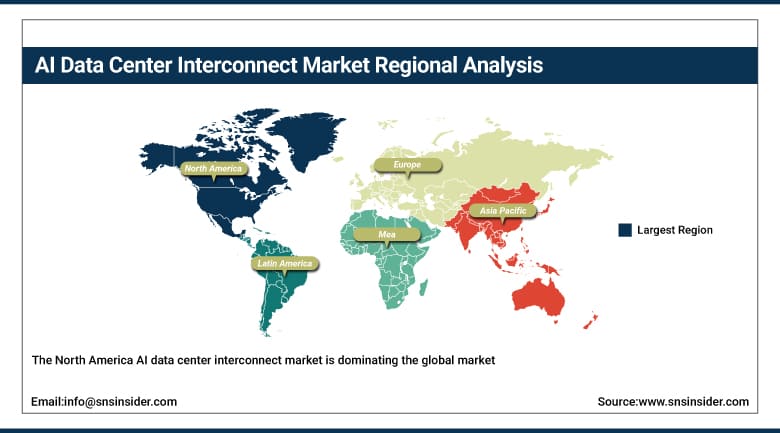
The North America AI data center interconnect market is dominating the global market and is expected to maintain its leading position during 2026–2035, driven by increasing demand for high-speed, low-latency connectivity, expansion of AI data centers, deployment of large-scale GPU clusters, and growing investments in advanced networking infrastructure. North America dominated the AI data center interconnect market in 2025, accounting for a 38.47% market share, and is expected to retain its leading position throughout the forecast period. The region is benefiting from investments in AI infrastructure, hyperscale data centers, high-speed Ethernet, InfiniBand, optical interconnects, coherent optical technologies, and advanced network management solutions that support the growing connectivity requirements of AI workloads.
The United States is expected to dominate the regional market of the North America market share in 2025. The country’s dominance is supported by strong data center infrastructure, widespread adoption of AI and cloud platforms, large-scale deployment of GPU clusters, and significant investments in hyperscale and enterprise AI infrastructure. Canada is also expected to contribute to regional growth, supported by increasing adoption of AI, cloud computing, data centers, and high-performance networking technologies.
⮞In March 2025, Coherent announced its collaboration with NVIDIA on silicon-photonics networking switches using co-packaged optics, supporting the development of optical connectivity infrastructure designed to interconnect large GPU clusters in next-generation AI data centers.
Get Customized Report as Per Your Business Requirement - Enquiry Now
Europe AI Data Center Interconnect Market Insights
The Europe ai data center interconnect market will experience steady growth over the forecast period due to increasing AI adoption, expansion of cloud and data center infrastructure, rising demand for high-bandwidth connectivity, and investments in advanced networking technologies. Growing deployment of AI workloads and distributed computing infrastructure is driving demand for high-speed optical interconnects, AI Ethernet, InfiniBand, and coherent optical technologies.
Germany is anticipated to continue being one of the key national markets in Europe, fueled by its strong industrial sector, expanding data center infrastructure, increasing adoption of AI and cloud computing, and investments in digital transformation. In addition, countries such as the UK, France, Italy, and others will contribute to regional demand through the expansion of AI infrastructure, cloud platforms, telecommunications networks, and enterprise data centers.
⮞In July 2025, Zayo Europe deployed Ciena's WaveLogic 6 Extreme and Reconfigurable Line System across a 3,500-kilometer German fiber network, enabling 400G optical services across major metropolitan hubs with future scalability to 800G and 1.6 Tbps.
Asia Pacific AI Data Center Interconnect Market Insights
The Asia Pacific AI data center interconnect market is the fastest-growing region with CAGR 17.30% during 2026–2035, supported by rapid AI adoption, expanding data center capacity, increasing cloud deployment, and growing demand for high-speed connectivity. The region is also benefiting from the expansion of hyperscale data centers, AI computing clusters, telecommunications infrastructure, and advanced optical networking technologies.
China will continue to be a major market in the Asia Pacific region due to its large digital technology ecosystem, extensive deployment of AI and cloud platforms, expanding data center infrastructure, and growing investments in high-performance computing. Japan and South Korea will continue to play significant roles due to their established technology, electronics, telecommunications, and data center industries, while India is expected to witness increasing demand with the growth of AI adoption, digital services, cloud infrastructure, and enterprise technology investments.
⮞In September 2025, Huawei introduced its UnifiedBus 2.0 interconnect protocol at HUAWEI CONNECT in Shanghai, alongside Atlas 950 and Atlas 960 SuperPoD architectures, designed to connect thousands of AI accelerators through high-bandwidth, low-latency networking.
Middle East & Africa and Latin America AI Data Center Interconnect Market Insights
There will be consistent growth within the AI data center interconnect markets in the Middle East & Africa and Latin America from 2026 to 2035, driven by expanding data center infrastructure, increasing AI and cloud adoption, telecommunications development, and investments in high-speed connectivity networks. There will be increasing opportunities in the regions for advanced optical interconnects, high-bandwidth networking, and AI-optimized connectivity solutions owing to the growing development of digital infrastructure and data-intensive computing environments.
Saudi Arabia will continue to be an important market in the Middle East & Africa due to investments in digital infrastructure, AI, cloud computing, data centers, and economic diversification initiatives. In Latin America, Brazil will continue to be an important country-level market due to its growing digital economy, data center expansion, cloud adoption, telecommunications infrastructure, and increasing deployment of AI technologies. Other Latin American countries will also contribute to the growth of the region, supported by increasing cloud adoption, digital transformation, data center investments, and demand for high-speed connectivity.
⮞In January 2025, Nokia and Saudi Arabia's stc Group completed a 1 Tbps coherent optical transmission trial across 850 kilometers using Nokia's PSE-6s technology, demonstrating high-capacity data center interconnect capabilities for AI and cloud services.
⮞In September 2025, Cirion Technologies expanded its DC Connect network in Brazil, including new fiber routes connecting data centers in Rio de Janeiro and Minas Gerais, using Ciena's WaveLogic 6 technology to support AI workloads.
Market Dynamics
Growth Driver: Increasing demand for efficient battery recycling and critical material recovery is driving market growth
One of the driving forces behind the rise in the global AI Data Center Interconnect Market is the growing need for lithium-ion battery recycling in an efficient way. The use of electric vehicles, consumer electronics, and power systems has seen an exponential rise, which has led to a large number of lithium-ion batteries that have reached the end of their lives and, thus, producing more black mass. There is a need for effective methods of separation that can recover graphite, cathode active materials, nickel, cobalt, and lithium from them.
In addition, developments in the fields of flotation chemistry, reagent chemistry, black-mass treatment, and separation processes are driving the growth of the market. Investments in the recycling facilities and domestic critical minerals supplies are encouraging the use of advanced flotation reagents.
⮞In August 2025, NVIDIA introduced Spectrum-XGS Ethernet, incorporating scale-across networking technology to connect geographically distributed data centers into unified AI computing environments, with CoreWeave identified as a deployment partner for the new interconnect platform.
Restraint: Complex black-mass composition and separation challenges can limit market adoption
The complicated and changing nature of the composition of black mass from lithium-ion batteries poses a huge problem for any form of flotation processes. There is variation that may be observed due to differences in the type of battery being processed, differences in size and surface characteristics of particles, and differences in the composition of the particles themselves, which will affect the effectiveness of the flotation process.
Moreover, there is a need for high-quality recovery, which will necessitate control over the amount of reagents, the slurrying process, the properties of the particles, the pH of the process, and other flotation factors. Also, the high cost of implementation, the need for special equipment, and varying quality of the feedstock can pose problems for smaller recycling facilities.
Opportunity: Growing electric vehicle battery recycling and critical mineral demand creates new market opportunities
The proliferation of electric vehicles presents substantial prospects for the manufacturers of lithium-ion black-mass flotation reagents. With an increase in the volume of dead electric vehicle batteries, the abundance of black mass increases, along with a demand for the development of innovative technologies that would help to extract valuable battery materials. Advanced flotation reagents can assist in the extraction of graphite, cathode active materials, nickel, cobalt, and other valuable elements.
Further, the proliferation of energy storage facilities and demand for critical battery minerals also presents opportunities for the development of more advanced recycling methods. In addition to that, increasing investments in battery recycling plants and domestic supplies of battery materials present yet another prospect for advanced flotation reagents and recycling technologies.
⮞In October 2025, NVIDIA announced that Meta and Oracle would adopt Spectrum-X Ethernet switches for AI data center networking, supporting Meta's open switching architecture and Oracle's giga-scale AI supercomputers through high-performance Ethernet interconnect infrastructure.
Recent Developments
-
2026: Ciena Corporation continued expanding high-capacity optical networking and data center interconnect solutions to support increasing bandwidth and connectivity requirements associated with AI data centers and distributed AI workloads.
-
2026: Cisco Systems, Inc. continued advancing AI-ready networking infrastructure, including high-speed Ethernet and data center networking solutions, to support large-scale AI computing clusters and increasing east-west traffic.
-
2026: NVIDIA Corporation continued advancing AI networking platforms and high-speed interconnect technologies to support GPU clusters, distributed AI workloads, and next-generation AI data center infrastructure.
-
2026: Broadcom Inc. continued developing high-speed Ethernet switching, optical connectivity, and networking technologies to support the rapid expansion of AI data centers and large-scale AI clusters.
-
2026: Nokia Corporation continued expanding optical networking and data center interconnect technologies to enable higher-capacity, low-latency connectivity between AI data centers and distributed computing infrastructure.
AI Data Center Interconnect Market Key Players are:
-
Ciena Corporation
-
Cisco Systems, Inc.
-
Nokia Corporation
-
Huawei Technologies Co., Ltd.
-
Arista Networks, Inc.
-
Broadcom Inc.
-
NVIDIA Corporation
-
Infinera Corporation
-
Fujitsu Limited
-
ZTE Corporation
-
Extreme Networks, Inc.
-
Corning Incorporated
-
Coherent Corp.
-
Lumentum Holdings Inc.
-
Ekinops S.A.
-
ADTRAN Holdings, Inc.
-
PacketLight Networks Ltd.
-
Marvell Technology, Inc.
AI Data Center Interconnect Market Report Scope:
| Report Attributes | Details |
|---|---|
| Market Size in 2025 | USD 12.85 Billion |
| Market Size by 2035 | USD 53.35 Billion |
| CAGR | CAGR of 15.32% From 2026 to 2035 |
| Base Year | 2025 |
| Forecast Period | 2026-2035 |
| Historical Data | 2022-2024 |
| Report Scope & Coverage | Market Size, Segments Analysis, Competitive Landscape, Regional Analysis, DROC & SWOT Analysis, Forecast Outlook |
| Key Segments | • By Component (Hardware, Software, Services) • By Technology (InfiniBand, AI Ethernet, DWDM, Coherent Optical Technology, OTN, Others) • By Interconnect Type (Optical DCI, Packet-Switched DCI, Hybrid DCI, Others) • By Deployment Model (On-Premises, Cloud-Based, Hybrid) • By Application (AI Workload & Data Mobility, Distributed AI Training, Disaster Recovery & Business Continuity, Data Backup & Replication, Real-Time Data Synchronization, Shared Data & Resources, Others) • By End User (Hyperscale Cloud Service Providers, Internet Content Providers & Carrier-Neutral Providers, Telecommunications & Communication Service Providers, Colocation Providers, Government & Research Institutions, Others) |
| Regional Analysis/Coverage | North America (US, Canada), Europe (Germany, UK, France, Italy, Spain, Russia, Poland, Rest of Europe), Asia Pacific (China, India, Japan, South Korea, Australia, ASEAN Countries, Rest of Asia Pacific), Middle East & Africa (UAE, Saudi Arabia, Qatar, South Africa, Rest of Middle East & Africa), Latin America (Brazil, Argentina, Mexico, Colombia, Rest of Latin America) |
| Company Profiles | Ciena Corporation, Cisco Systems, Inc., Nokia Corporation, Huawei Technologies Co., Ltd., Juniper Networks, Inc., Arista Networks, Inc., Broadcom Inc., NVIDIA Corporation, Infinera Corporation, Fujitsu Limited, ZTE Corporation, Extreme Networks, Inc., Corning Incorporated, Coherent Corp., Lumentum Holdings Inc., Ribbon Communications Inc., Ekinops S.A., ADTRAN Holdings, Inc., PacketLight Networks Ltd., Marvell Technology, Inc. |

Frequently Asked Questions
The AI Data Center Interconnect Market was valued at approximately USD 12.85 billion in 2025.
The market is primarily driven by the increasing adoption of artificial intelligence, generative AI, expansion of AI data centers and GPU clusters, rising demand for high-bandwidth and low-latency connectivity, and growing investments in advanced optical and high-speed networking infrastructure.
AI Ethernet dominated the AI Data Center Interconnect Market in 2025, accounting for a 31.84% share.
North America dominated the AI Data Center Interconnect Market in 2025, accounting for a 38.47% share.
