
Data Converter Market Report Scope & Overview:
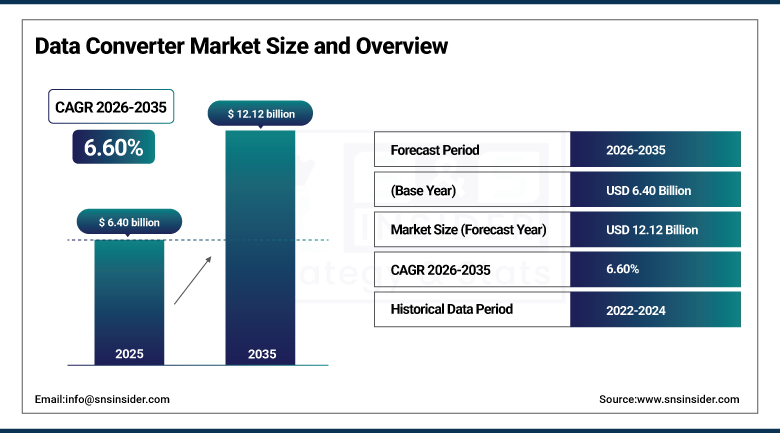
The Data Converter Market was valued at USD 6.40 Billion in 2025 and is expected to reach USD 12.12 Billion by 2035, growing at a CAGR of 6.60% from 2026 to 2035.
The Data Converter Market is experiencing steady growth owing to the rising implementation of fast data acquisition technologies in telecoms, automotive, industrial automation, healthcare, and consumer electronics applications. The rise in the implementation of 5G technology, Internet of Things devices, electric vehicles, and AI-based edge computing is leading to increased demands for highly efficient analog-to-digital and digital-to-analog converters. Moreover, the developments in semiconductor technology, increasing use of sensors, and requirement for precise signal processing in applications such as medical imaging, radar technologies, and factory automation are further fueling the market growth.
According to the U.S. Energy Information Administration (EIA), 37 GW of utility-scale solar capacity was scheduled for deployment during 2025, increasing the requirement for advanced signal conversion, monitoring, and control electronics used in renewable energy systems. Furthermore, according to the European Commission Digital Decade, more than 45% of EU enterprises use cloud computing services, while the EU targets 75% enterprise adoption of cloud computing, artificial intelligence, and big data technologies by 2030, accelerating demand for AI servers, high-performance computing infrastructure, and advanced data converters.
To Get more information on Data Converter Market - Request Free Sample Report
Data Converter Market Trends:
-
Rising adoption of high-speed data acquisition systems driving demand for advanced data converters with higher resolution and faster sampling rates
-
Growing integration of AI, IoT, and edge computing devices increasing the need for high-performance analog-to-digital (ADC) and digital-to-analog (DAC) converters
-
Increasing demand from automotive electronics and advanced driver assistance systems (ADAS) supporting deployment of precision data conversion technologies
-
Expanding use of high-speed data converters in 5G infrastructure, industrial automation, and medical imaging applications requiring accurate signal processing
-
Continuous advancements in semiconductor process technologies improving power efficiency, conversion accuracy, miniaturization, and overall performance of data converter solutions
U.S. Data Converter Market Outlook:
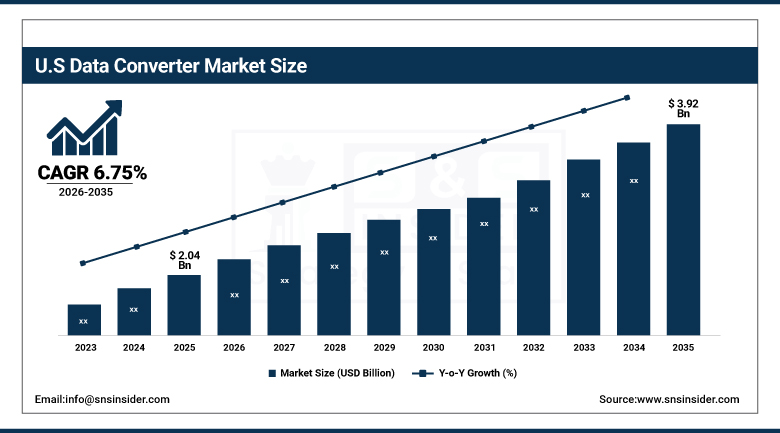
The U.S. Data Converter Market was valued at approximately USD 2.04 Billion in 2025 and is expected to reach approximately USD 3.92 Billion by 2035, growing at a CAGR of approximately 6.75%.
The United States is the world's largest national data converter market within the dominant North American region, anchored by the domestic headquarters and primary design operations of Analog Devices, Texas Instruments, and Maxim Integrated whose combined ADC and DAC product portfolios define the global performance frontier across multiple converter speed and resolution categories. U.S. government investment in semiconductor research and development through DARPA's Electronics Resurgence Initiative has created advanced data converter technology including direct RF-sampling wideband ADC technology whose performance capabilities sustain U.S. technology leadership in electronic warfare, radar, and communication system applications where converter specifications directly determine mission capability.
Texas Instruments revealed a breakthrough in low-power, high-accuracy ADC design in September 2025 targeting extended battery life in portable medical devices, demonstrating an ultra-low-power successive approximation register ADC whose conversion energy of sub-5 femtojoules per conversion step enables continuous glucose monitoring and cardiac rhythm monitoring applications to extend device operating life from weeks to months without battery replacement.
Data Converter Market Segment Analysis:
-
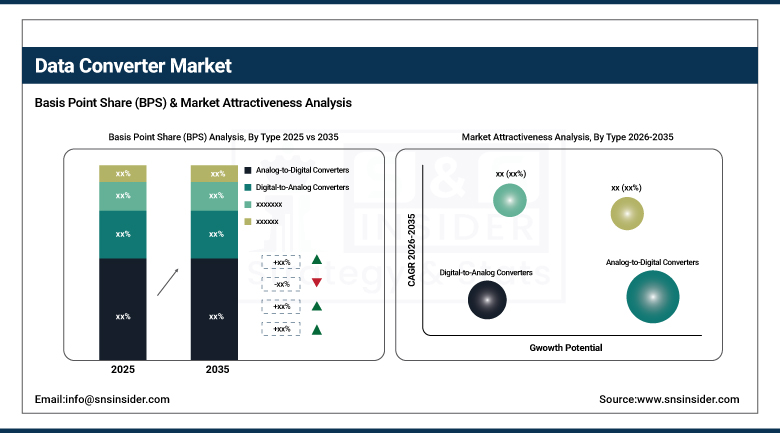
By Type, Analog-to-Digital Converters (ADC) segment dominated the Data Converter Market in 2025 with 64% share; Digital-to-Analog Converters (DAC) segment is the fastest growing segment.
-
By Sampling Rate, General-Purpose Data Converters segment dominated the market in 2025 with 58% share; High-Speed Data Converters segment is the fastest growing segment.
-
By Application, Consumer Electronics segment dominated the Data Converter Market in 2025 with 31% share; Automotive segment is the fastest growing segment.
By Type, Analog-to-Digital Converters (ADC) segment dominates the Data Converter Market, Digital-to-Analog Converters (DAC) segment expected to grow fastest
The Analog-to-Digital Converters (ADC) segment dominated the Data Converter Market in 2025 owing to the wide application of ADCs in consumer electronics, industrial automation, health care devices, and communication systems. The Analog-to-Digital Converter (ADC) is a device that converts the analog input signal into a digital output signal. It has seen rapid growth with the proliferation of IoT devices, smart sensors, and digital signal processors. Improvements in terms of performance and technology have added to its leadership position.
The Digital-to-Analog Converters (DAC) segment is the fastest growing owing to the rising demand for audio, video, and communication systems. These converters help in converting digital information into analog output for speaker and display outputs. Infotainment systems, 5G infrastructures, medical devices, and automation in industries are some examples of areas of rising demand for DACs. Continuous improvements in terms of performance parameters are expected to fuel growth in this segment.
By Sampling Rate, General-Purpose Data Converters segment dominates the Data Converter Market, High-Speed Data Converters segment expected to grow fastest
The General-Purpose Data Converters segment dominated the Data Converter Market in 2025 owing to their wide use in consumer electronics, industrial equipment, medical devices, and communication systems. General-purpose data converters offer a good blend of performance, cost-efficiency, and power consumption. Their versatility has led to increased usage in a variety of applications. Additionally, increasing popularity of connected electronic devices is further fueling the dominance of the category.
The High-Speed Data Converters segment is the fastest growing due to the growing demand for fast and precise signal processing in order to facilitate advanced applications. Increasing use of 5G technology, software defined radios, aerospace technology, autonomous cars, and high performance test equipment is resulting in the growing need for high speed conversion technologies. There is constant innovation in the development of data converters which have faster sampling rates, low latency, and increased efficiency.
By Application, Consumer Electronics segment dominates the Data Converter Market, Automotive segment expected to grow fastest
The Consumer Electronics segment dominated the Data Converter Market in 2025 because of extensive application of data converter in smartphones, tablets, TVs, wearables, gaming consoles, and smart home appliances. The growing requirement of signal conversions due to rising consumer preferences for high-quality digital gadgets has increased the requirement of data converter. Innovation in multimedia processing, wireless connectivity, and miniaturization of electronic components has contributed to the increase in usage rate. The growing production rate and constant developments in the technology have reinforced the dominance of the segment in the market.
The Automotive segment is the fastest growing in the Data Converter Market because of the increasing deployment of sophisticated electronic equipment in modern automobiles. Some of the applications that utilize data converters in the automotive industry include advanced driver assistance systems (ADAS), electric vehicle power management, infotainment system, battery monitoring system, and sensors. Growing production of electric vehicles and connected vehicles along with the increasing demand for autonomous driving solutions has propelled the segment growth rate.
Regional Analysis:
|
Region |
Major Country |
Share within Region, 2025 (%) |
|---|---|---|
|
North America |
United States |
84.73% |
|
Europe |
Germany |
27.84% |
|
Asia Pacific |
China |
42.84% |
|
Middle East & Africa |
Israel |
22.84% |
|
Latin America |
Brazil |
43.84% |
North America Data Converter Market Insights
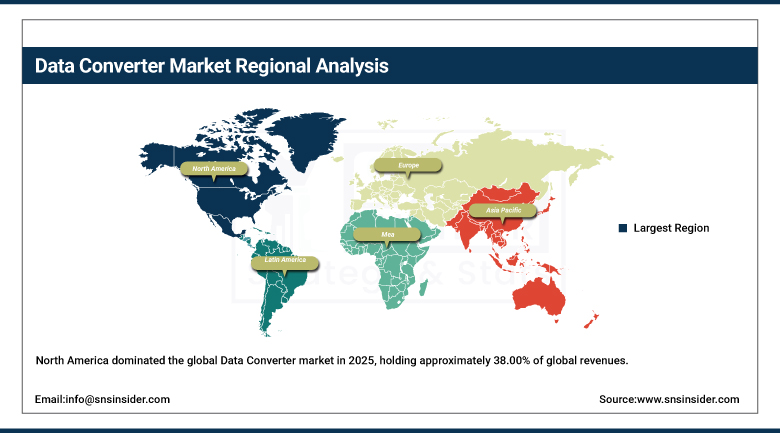
North America dominated the global Data Converter market in 2025, holding approximately 38.00% of global revenues. The United States accounts for approximately 84.73% of regional revenue through the domestic headquarters of Analog Devices and Texas Instruments whose combined data converter portfolio breadth and technical leadership sustain North American market leadership, the world's largest aerospace and defence electronics procurement budget creating high-value military-grade converter demand, and the most advanced 5G wireless infrastructure deployment creating commercial data converter procurement at hyperscaler scale. The CHIPS Act's domestic semiconductor manufacturing investment supports the analog specialty foundry capacity that ADC and DAC products require.
Get Customized Report as per Your Business Requirement - Enquiry Now
Europe Data Converter Market Insights
Europe held approximately 22.00% of global Data Converter revenues in 2025. Germany accounts for approximately 27.84% of European revenues through its automotive electronics industry's ADAS and infotainment converter demand at BMW, Mercedes-Benz, and Volkswagen OEM supply chain tiers, and STMicroelectronics' European presence serving automotive and industrial converter applications. The UK, France, and the Netherlands contribute meaningful European demand through their aerospace, defence, and industrial electronics sectors whose precision converter requirements sustain above-average revenue per application relative to consumer electronics.
Asia Pacific Data Converter Market Insights
Asia Pacific held approximately 32.00% of global Data Converter revenues in 2025 and is the fastest-growing region at a CAGR of approximately 7.00% through 2035. China accounts for approximately 42.84% of Asia Pacific revenues through its massive consumer electronics manufacturing base, rapidly expanding automotive electronics production, and 5G infrastructure deployment creating large-volume ADC and DAC procurement. Japan contributes precision industrial and medical imaging converter demand. South Korea and Taiwan contribute through consumer electronics and semiconductor manufacturing sectors. The Chinese government's investment in domestic semiconductor capability is creating developing domestic data converter design companies.
MEA & Latin America Data Converter Market Insights
Middle East and Latin America represent growing Data Converter markets where telecommunications infrastructure investment, defence electronics procurement, and industrial automation create expanding converter demand. Israel leads MEA revenues at approximately 22.84% of the regional total through its world-class defence electronics industry whose radar, electronic warfare, and signal intelligence systems create concentrated high-performance converter procurement at Elbit Systems, Rafael, and IAI. Saudi Arabia and UAE contribute growing MEA demand through their 5G infrastructure rollout. Brazil leads Latin American revenues through its telecommunications and automotive electronics sectors.
Market Dynamics:
Growth Drivers: Expanding 5G and 6G infrastructure and automotive ADAS adoption are accelerating demand for high-speed, multi-channel data converters
The 5G massive MIMO antenna architecture's requirement for ADC and DAC functional blocks at each of 32 to 256 active antenna elements per base station creates per-site converter content that is 32 to 256 times greater than the single converter channel of the previous 4G radio architecture, creating a step-function increase in total conversion capacity deployed per base station installation that is multiplied by the global 5G base station installation count.
The combination of expanded converter channel count per base station and the more demanding bandwidth, resolution, and linearity specifications of 5G active antenna unit radio heads creates both unit volume growth and per-unit revenue growth that compound to produce above-industry-average data converter demand growth in the infrastructure segment. Automotive ADAS sensor fusion creates growing converter demand as each autonomous driving capable vehicle's radar, camera, and LiDAR sensors each require dedicated ADC channels whose aggregate per-vehicle converter content scales with the number of sensors implemented in each system design.
Restraints: High development costs and limited specialist semiconductor suppliers create significant barriers for new market entrants
High-speed data converter design at multi-gigahertz sampling rates requires specialised analog design expertise in areas including clock distribution, jitter minimisation, thermal noise management, and layout techniques for high-frequency signal paths whose combined complexity creates development programmes requiring teams of experienced analog integrated circuit designers whose global supply is constrained by the specialised nature of the discipline.
The development cycle for a competitive high-speed converter from design initiation through tape-out, silicon characterisation, specification compliance validation, and product release can span 18 to 36 months at development cost exceeding USD 10 million for complex multi-channel products, creating capital investment barriers that sustain the competitive advantage of established players who have accumulated converter design intellectual property libraries over decades of product generation investment.
Opportunities: Ultra-low-power IoT converters and radiation-tolerant space-grade solutions offer premium growth opportunities across emerging applications
The IoT sensor market's projected growth to tens of billions of connected devices through 2030 creates an enormous aggregate ADC demand opportunity whose per-unit value is modest but whose combined volume creates commercial scale for ultra-low-power converter designs optimised for energy harvesting and miniaturised battery operation.
Wearable medical devices including continuous glucose monitors, ambulatory cardiac monitors, and implantable neurostimulators each require ADC designs whose combination of sub-microwatt conversion power, diagnostic-grade measurement accuracy, and miniaturised silicon area enables clinical-quality physiological monitoring within the form factor and battery life constraints that patient wearability requires. Space-qualified radiation-tolerant data converters for satellite communication and earth observation payloads represent a high-value premium market whose demand is growing with commercial space industry expansion at launch rates and constellation scales that were not commercially sustainable a decade ago.
Recent Developments:
-
2025: Analog Devices Inc. launched a high-performance data converter series for 5G infrastructure and autonomous vehicle applications featuring multi-channel ADC and DAC devices operating at up to 6 gigasamples per second with integrated digital conversion for direct RF sampling architectures eliminating the intermediate frequency stage in radio signal chains.
-
2025: Texas Instruments revealed an ultra-low-power SAR ADC breakthrough achieving sub-5 femtojoules per conversion step for portable medical device applications, targeting extended battery life in continuous glucose monitors and cardiac rhythm monitoring systems through dynamic bias scaling.
-
2026: Broadcom unveiled its BroadPeak BCM85021 radio SoC for 5G Advanced and 6G networks featuring high-linearity ADC/DAC blocks sampling up to 19.6 gigasamples per second built on 5nm CMOS, supporting wideband RF, massive MIMO, and digital predistortion while reducing power by approximately 40 percent.
Data Converter Market Key Players are:
-
Analog Devices
-
Texas Instruments
-
STMicroelectronics
-
Microchip Technology
-
NXP Semiconductors
-
Infineon Technologies
-
Renesas Electronics
-
onsemi
-
ROHM
-
Cirrus Logic
-
Skyworks Solutions
-
Asahi Kasei Microdevices
-
Teledyne Technologies
-
Synopsys
-
MaxLinear
-
Data Device Corporation
-
DATEL
-
Avia Semiconductor
-
IQ-Analog
-
Silicon Laboratories
Data Converter Market Report Scope:
| Report Attributes | Details |
|---|---|
| Market Size in 2025 | USD 6.40 Billion |
| Market Size by 2035 | USD 12.12 Billion |
| CAGR | CAGR of 6.60% From 2026 to 2035 |
| Base Year | 2025 |
| Forecast Period | 2026-2035 |
| Historical Data | 2022-2024 |
| Report Scope & Coverage | Market Size, Segments Analysis, Competitive Landscape, Regional Analysis, DROC & SWOT Analysis, Forecast Outlook |
| Key Segments | • By Type (Analog-to-Digital Converters (ADC), Digital-to-Analog Converters (DAC)) • By Sampling Rate (High-Speed Data Converters, General-Purpose Data Converters) • By Application (Communication, Consumer Electronics, Industrial, Healthcare & Life Sciences, Automotive, Others) |
| Regional Analysis/Coverage | North America (US, Canada), Europe (Germany, UK, France, Italy, Spain, Russia, Poland, Rest of Europe), Asia Pacific (China, India, Japan, South Korea, Australia, ASEAN Countries, Rest of Asia Pacific), Middle East & Africa (UAE, Saudi Arabia, Qatar, South Africa, Rest of Middle East & Africa), Latin America (Brazil, Argentina, Mexico, Colombia, Rest of Latin America). |
| Company Profiles | Analog Devices, Texas Instruments, STMicroelectronics, Microchip Technology, NXP Semiconductors, Infineon Technologies, Renesas Electronics, onsemi, ROHM, Cirrus Logic, Skyworks Solutions, Asahi Kasei Microdevices, Teledyne Technologies, Synopsys, MaxLinear, Data Device Corporation, DATEL, Avia Semiconductor, IQ-Analog, Silicon Laboratories |
Frequently Asked Questions
The Data Converter Market is expected to grow at a CAGR of 6.60% from 2026 to 2035.
The Data Converter Market was valued at USD 6.40 Billion in 2025.
Expanding 5G/6G networks, automotive ADAS, IoT devices, AI edge computing, and advanced healthcare imaging are driving high-performance data converter demand.
The ADC segment dominated the Data Converter Market in 2025.
North America dominated the Data Converter Market in 2025.
