
Disposable Syringes Market Report Scope & Overview:
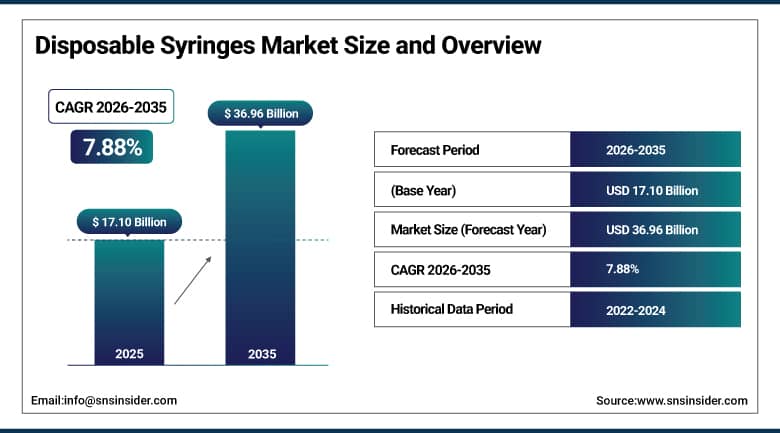
The Disposable Syringes Market was valued at USD 17.10 Billion in 2025 and is expected to reach USD 36.96 Billion by 2035, growing at a CAGR of 7.88% from 2026 to 2035.
The global disposable syringes market is experiencing robust and sustained growth. The market is propelled by the extraordinary scale of chronic disease prevalence whose injectable treatment requirements create consistent high-volume syringe demand, the global immunization programme expansion creating structured public health procurement, regulatory mandates from CDC, FDA, and WHO promoting safety-engineered syringe adoption, and the rapidly growing home healthcare and self-administration segment creating new distribution channel procurement. Globally, over 20 billion disposable syringes were used, with an estimated 15 to 16 billion injections administered annually, underscoring the irreplaceable role of disposable syringes in routine healthcare delivery.
In February 2025, Becton Dickinson enhanced its prefilled syringe production capacity in Nebraska to meet growing vaccination programme demand across North America and Europe. This manufacturing investment reflects the commercial priority of prefillable syringe platform development as biologics manufacturers increasingly specify prefilled syringe packaging for vaccines, monoclonal antibodies, and injectable specialty medicines whose precise dosing, reduced preparation time, and reduced contamination risk relative to vial-and-syringe systems create structured transition procurement.
To Get More Information On Disposable Syringes Market - Request Free Sample Report
Disposable Syringes Market Trends
-
Safety-engineered syringes are gaining widespread adoption due to regulatory mandates and needlestick injury prevention initiatives.
-
Prefilled syringes are witnessing strong demand as biologics and vaccine manufacturers prioritize accurate, convenient drug delivery.
-
Sustainable and biodegradable syringe materials are emerging to address growing healthcare waste management concerns.
-
Auto-disable syringes are expanding across immunization programs to improve injection safety and prevent syringe reuse.
-
Needle-free injection technologies are advancing as alternatives that enhance patient comfort and support mass vaccination initiatives.
The U.S. Disposable Syringes Market Outlook
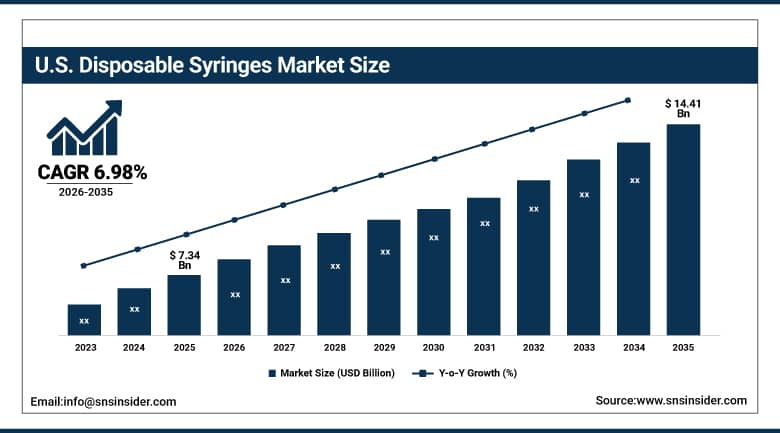
The U.S. disposable syringes market was valued at approximately USD 7.34 Billion in 2025 and is expected to reach approximately USD 14.41 Billion by 2035, growing at a CAGR of approximately 6.98%.
The U.S. Disposable Syringes Market was a major contributor to North America's dominant global market share in 2025, reflecting advanced healthcare infrastructure, heightened sensitivity toward infection management, and strong regulatory push for single-use medical devices. The United States accounts for the largest individual country revenue within North American disposable syringe procurement through Becton Dickinson, Terumo, B. Braun Melsungen, Retractable Technologies, and Hindustan Syringes & Medical Devices’ commercial operations. The extraordinary scale of U.S. chronic disease prevalence including 37.3 million Americans with diabetes, rising cancer treatment requiring injectable biologics, and flu and pediatric vaccination programmes collectively create the most commercially intensive disposable syringe demand of any individual market globally.
In March 2025, Becton Dickinson and Company launched advanced prefilled syringes with reduced dead space designed to enhance biologics delivery, patient safety, and dosing accuracy globally, targeting hospitals, vaccination programmes, and high-demand emerging markets. The reduced dead space design minimizes residual volume left in the syringe hub and needle after injection, reducing drug wastage that is particularly significant for high-cost biologics and oncology medications where even small volume losses per injection create substantial aggregate cost implications across large patient populations.
Disposable Syringes Market Segment Analysis
-
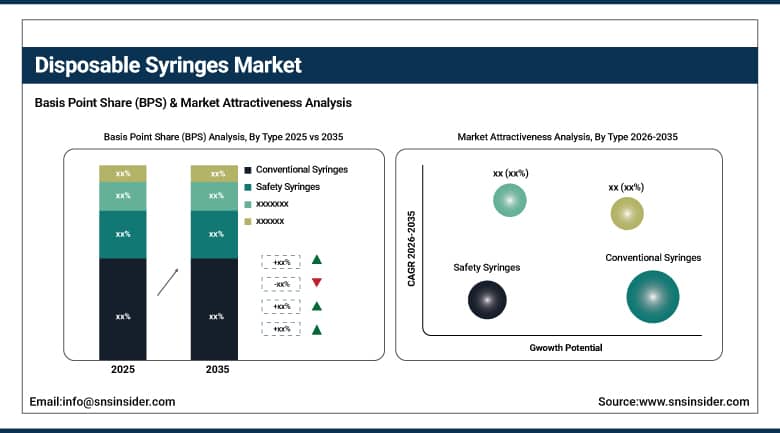
By Type, the conventional syringes segment dominated the disposable syringes market with approximately 54% share in 2025, while the safety syringes segment is the fastest growing segment with CAGR of 8.9% during 2026 to 2035.
-
By Capacity, the 1 ml to 5 ml segment dominated the disposable syringes market with approximately 35.3% share in 2025, while the up to 1 ml segment is the fastest growing segment with CAGR of 8.4% during 2026 to 2035.
-
By Application, the vaccines and immunization segment dominated the disposable syringes market with approximately 40.80% share in 2025, while the diabetes management segment is the fastest growing segment with CAGR of 9.2% during 2026 to 2035.
-
By End User, the hospitals segment dominated the disposable syringes market with approximately 51% share in 2025, while the home healthcare and clinics segment is the fastest growing segment with CAGR of 8.7% during 2026 to 2035.
By Type, conventional syringes dominate, safety syringes grow fastest
Conventional syringes retained the dominant type position with approximately 54% of the disposable syringes market in 2025. Their commercial primacy reflects the combination of cost-effectiveness that makes them viable for mass deployment across all healthcare resource levels, the clinical familiarity of their straightforward barrel-plunger-needle design that requires no additional training for safe use, and their suitability for the full range of general injection, medication preparation, blood sampling, and intravenous access applications that comprise the majority of global injection volume. In low-resource settings where the cost premium of safety syringes creates procurement barriers and where budget-constrained healthcare systems must maximize affordable injection capability per unit expenditure, conventional syringes remain the only commercially viable option for population-scale injection programmes.
Safety syringes are the fastest growing type because the convergence of regulatory mandate, occupational safety enforcement, and hospital infection control programme investment is progressively converting conventional syringe procurement toward safety-engineered alternatives across developed market healthcare systems. Each needlestick injury that creates HIV, hepatitis B, or hepatitis C transmission risk in healthcare workers creates liability, treatment cost, and workforce wellbeing motivation for employer healthcare systems to adopt mandated safety-engineered injection devices.
By Application, vaccines dominate, diabetes grows fastest
Vaccines and immunization retained the dominant application position with approximately 40.80% of the disposable syringes market in 2025. The extraordinary scale of global immunization programme injection volumes creates the most commercially concentrated single-application syringe demand category. The WHO estimates that immunization programmes prevent 3.5 to 5 million deaths annually through vaccine-preventable disease protection, creating public health mandate that sustains government procurement investment independent of healthcare budget cycles.
Diabetes management is the fastest growing application because the extraordinary pace of global diabetes prevalence increase creates proportional growth in insulin injection and GLP-1 receptor agonist injection frequency that compounds with the growing number of diagnosed patients receiving injectable treatment. The International Diabetes Federation's projection of 783 million adults with diabetes by 2045 from 537 million in 2021 creates a structural growth driver for insulin syringe, pen needle, and insulin delivery device procurement whose commercial aggregate expands with each additional diagnosed patient initiating injectable therapy.
By End User, hospitals dominate, home healthcare grows fastest
Hospitals retained the dominant end-user position with approximately 51% of the disposable syringes market in 2025. The extraordinary concentration of injection volume in hospital settings reflects hospitals’ role as the primary setting for intravenous medication administration, parenteral nutrition, anesthesia induction, blood collection, and the most acute and complex injection procedures whose clinical setting requirements cannot be replicated in ambulatory or home settings. Each hospital inpatient whose treatment protocol requires multiple daily injections for anticoagulation, pain management, antibiotic therapy, or parenteral nutrition creates concentrated per-patient syringe procurement that sustains hospitals’ dominant market position.
Home healthcare and clinics are the fastest growing end user because the fundamental shift toward decentralized care delivery, the growing adoption of self-administered injectable biologics for chronic conditions, and the expanding home infusion therapy market create structured syringe demand growth outside hospital procurement channels. Each patient with rheumatoid arthritis, psoriasis, or inflammatory bowel disease who transitions from hospital-administered biologic infusion to home self-administered subcutaneous injection creates a shift in syringe procurement from hospital to homecare distribution channels. The GLP-1 receptor agonist market's extraordinary patient population growth in both diabetes and obesity management creates a self-administration syringe and injection device procurement category whose scale compounds with the drugs’ commercial expansion.
By Capacity, 1 mL to 5 mL dominates, sub-1 mL grows fastest
The 1 mL to 5 mL capacity segment retained the dominant position with approximately 35.3% of the disposable syringes market in 2025. This capacity range's commercial dominance reflects its exceptional versatility across the most commonly administered injectable medications and vaccines. Standard dose influenza vaccine administration at 0.5 mL, antibiotic injection at 1 to 2 mL, standard insulin doses at 0.5 to 1 mL requiring 1 mL syringes, and most outpatient medication injections fall within the 1 to 5 mL range that creates the broadest clinical procurement base. Healthcare providers favor this capacity range for its dose accuracy, ease of handling, and reduced drug wastage that collectively create specification preference across institutional and ambulatory care procurement.
The sub-1 mL capacity segment is the fastest growing because the precision dose requirements of insulin pen systems, tuberculin skin testing, allergy immunotherapy, neonatal medication administration, and high-potency biologic injections create growing demand for sub-milliliter accuracy capability. The insulin management market's growing adoption of pen needles and insulin syringes specifically designed for U-100 and U-200 insulin concentration precise dosing, combined with GLP-1 receptor agonist formulations requiring 0.5 mL or less injection volumes, creates structural sub-1 mL capacity demand growth.
Regional Analysis
|
Region |
Major Country |
Share within Region, 2025 (%) |
|---|---|---|
|
North America |
United States |
87.4% |
|
Europe |
Germany |
22.3% |
|
Asia Pacific |
China |
44.8% |
|
Middle East & Africa |
Saudi Arabia |
31.2% |
|
Latin America |
Brazil |
44.2% |
North America Disposable Syringes Market Insights
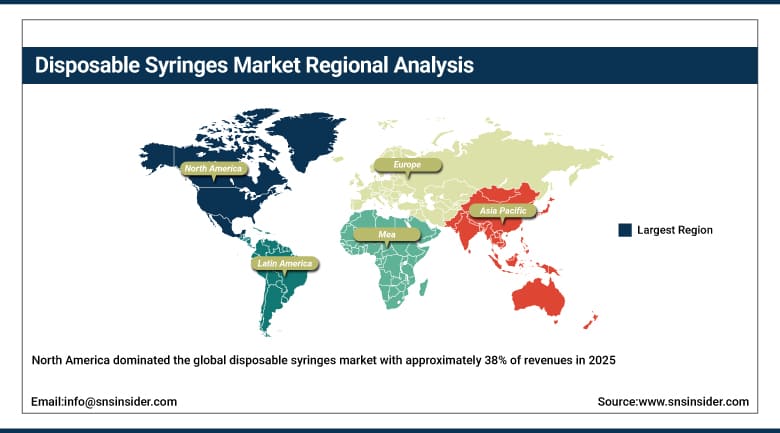
North America dominated the global disposable syringes market with approximately 38% of revenues in 2025, driven by sophisticated healthcare infrastructure, high sensitivity toward infection management, and strong regulatory push for single-use medical devices. The United States accounts for approximately 87.4% of North American revenues through Becton Dickinson, Terumo, B. Braun Melsungen, and Retractable Technologies’ commercial operations combined with the extraordinary scale of U.S. chronic disease prevalence creating consistent high-volume injection requirements.
Canada contributes approximately 12.6% of North American revenues through its publicly funded provincial healthcare system's vaccination programme procurement, hospital injection requirements, and the growing home healthcare sector's self-administration syringe demand.
Get Customized Report as Per Your Business Requirement - Enquiry Now
Europe Disposable Syringes Market Insights
Europe is a technically sophisticated and regulatory rigorous disposable syringes market where the EU Medical Device Regulation's quality standards, EU Occupational Safety Directive mandating safety-engineered injection devices, and the pharmaceutical industry's biologics manufacturing sector collectively create consistent institutional demand. Germany accounts for approximately 22.3% of European revenues through B. Braun Melsungen's headquartered commercial operations, the hospital sector's procurement, and the pharmaceutical manufacturing sector's prefillable syringe demand.
The United Kingdom, France, and the Netherlands are significant secondary markets where NHS procurement, Sanofi's French operations, and the European biologics manufacturing sector's syringe component demand create consistent procurement. B. Braun's biodegradable syringe European launch demonstrates the sustainability innovation direction of European market development.
Asia Pacific Disposable Syringes Market Insights
Asia Pacific is the fastest growing regional disposable syringes market growing at 8.8% CAGR, driven by increasing disposable income, greater access to primary care, and public health initiatives including mass vaccination rollouts that have significantly increased disposable syringe demand. China accounts for approximately 44.8% of Asia Pacific revenues through its extraordinary domestic manufacturing scale, the government's national immunization programme procurement, and the rapidly expanding hospital network’s injection requirements.
India represents the most commercially dynamic emerging market within Asia Pacific where Hindustan Syringes & Medical Devices’ domestic manufacturing scale, the government's Universal Immunization Programme procurement, Nipro Corporation's new India manufacturing unit launched in January 2025, and the growing private hospital sector's infection control investment create above-average disposable syringe market growth from both domestic production and import procurement.
MEA & Latin America Disposable Syringes Market Insights
Saudi Arabia leads MEA revenues at approximately through its government hospital network's procurement, Vision 2030's healthcare infrastructure investment, and the national immunization programme. The UAE's private hospital network and Egypt's public health programme add complementary regional demand.
Brazil leads Latin American revenues at approximately 44.2% through the SUS public health system's vaccination and treatment injection procurement, the expanding private hospital network, and the growing diabetes management market. Mexico's IMSS healthcare system and Colombia's vaccination programme collectively sustain regional market growth through 2035.
Market Dynamics
Growth Drivers: Chronic disease prevalence creating injectable treatment demand and global immunization programme expansion
The rising global prevalence of injectable-dependent chronic diseases is the disposable syringes market's most commercially certain structural growth driver. Diabetes alone, with over 530 million adults currently living with the condition and 783 million projected by 2045, creates insulin injection requirement that compounds with each additional diagnosed patient initiating injectable therapy. Cancer treatment requiring injectable chemotherapy, biologic immunotherapy, and supportive care medications creates additional structured injection procurement whose commercial aggregate grows with cancer incidence. Rheumatoid arthritis, psoriasis, inflammatory bowel disease, and multiple sclerosis patient populations transitioning to injectable biologic therapy create further injection procurement that sustains above-average syringe demand growth across chronic disease specialties.
Global immunization programme expansion, driven by GAVI's vaccine investment, UNICEF's immunization procurement, and national government vaccination commitments, creates consistent high-volume syringe procurement whose public health mandate sustains government investment independent of healthcare budget pressures. Each new vaccine added to national immunization schedules creates incremental per-child dose injection procurement that sustains long-term market growth through childhood population scale multiplied by multi-dose schedule requirements.
Restraints: Environmental concerns over medical waste and raw material cost volatility
The extraordinary volume of disposable syringes generating medical waste creates growing environmental concern from healthcare sustainability advocates and regulatory bodies whose medical waste management standards impose disposal cost on healthcare systems. Each initiative that promotes syringe reuse or biodegradable alternatives in contexts where infection control standards permit creates commercial pressure on conventional single-use syringe procurement. The challenge of balancing infection control necessity against environmental sustainability creates regulatory complexity that moderates the pace of sustainable syringe innovation adoption.
Raw material cost volatility, particularly for medical-grade polypropylene and polyethylene whose pricing follows petrochemical market cycles, creates manufacturing cost uncertainty that limits syringe manufacturer margin stability and creates procurement cost increases during raw material price elevation periods. Each petrochemical price spike that elevates polypropylene cost creates margin pressure for syringe manufacturers whose long-term supply contracts limit immediate price pass-through capability.
Opportunities: Safety syringe regulatory mandate expansion and self-administration biologics market growth
Safety syringe regulatory mandate expansion into emerging markets represents the most commercially certain volume growth opportunity whose WHO injection safety programme adoption creates structured government procurement transition from conventional to auto-disable and safety-engineered syringes across developing country national immunization programme procurement. Each country whose national injection safety policy update mandates auto-disable syringe use in government immunization campaigns creates procurement volume transition that sustains above-average safety syringe demand growth from emerging market procurement channels.
Self-administration biologics market growth represents the most commercially premium near-term opportunity whose subcutaneous injectable format preference for GLP-1 receptor agonists, adalimumab biosimilars, and next-generation insulin formulations creates structured demand for convenience-optimized injection devices including prefillable syringes, autoinjectors, and pen systems whose per-unit commercial value substantially exceeds conventional syringe alternatives.
Recent Developments:
-
2025: Becton Dickinson launched advanced prefilled syringes with reduced dead space in March 2025, enhancing biologics delivery, patient safety, and dosing accuracy globally, targeting hospitals, vaccination programmes, and high-demand emerging markets.
-
2025: B. Braun Melsungen AG introduced eco-friendly biodegradable syringes in January 2025 in European markets, minimizing medical waste while maintaining dosing accuracy and supporting healthcare sustainability initiatives across hospitals and vaccination campaigns.
-
2025: Becton Dickinson enhanced its prefilled syringe production capacity in Nebraska in February 2025 to meet growing vaccination programme demand across North America and Europe, reflecting strategic manufacturing investment in the rapidly growing prefillable syringe platform.
-
2025: Nipro Corporation established a new manufacturing unit in India in January 2025 to strengthen its Asia Pacific market foothold and serve high-volume injectable drug demand from the rapidly growing Indian hospital network and national immunization programme.
Disposable Syringes Market key players are:
-
Becton, Dickinson and Company (BD)
-
B. Braun Melsungen AG
-
Terumo Corporation
-
Nipro Corporation
-
Hindustan Syringes & Medical Devices Ltd.
-
Retractable Technologies, Inc.
-
Fresenius Kabi AG
-
Baxter International Inc.
-
Cardinal Health, Inc.
-
Merit Medical Systems, Inc.
-
Medline Industries, LP
-
SCHOTT Pharma AG & Co. KGaA
-
Stevanato Group
-
Shandong Weigao Group Medical Polymer Company Limited
-
Shanghai Kindly Medical Instruments Co., Ltd.
-
Jiangsu Jichun Medical Devices Co., Ltd.
-
JMI Syringes & Medical Devices Ltd.
-
Henke-Sass, Wolf GmbH
-
B. Braun Avitum AG
-
Rays S.p.A.
Disposable Syringes Market Report Scope:
| Report Attributes | Details |
|---|---|
| Market Size in 2025 | USD 17.10 Billion |
| Market Size by 2035 | USD 36.96 Billion |
| CAGR | CAGR of 7.88% From 2026 to 2035 |
| Base Year | 2025 |
| Forecast Period | 2026-2035 |
| Historical Data | 2022-2024 |
| Report Scope & Coverage | Market Size, Segments Analysis, Competitive Landscape, Regional Analysis, DROC & SWOT Analysis, Forecast Outlook |
| Key Segments | • By Type (Conventional Syringes, Safety Syringes, Insulin Syringes, Prefillable Syringes, Others) • By Capacity (Up to 1 mL, 1 mL to 5 mL, 6 mL to 10 mL, 11 mL to 20 mL, Above 20 mL) • By Application (Vaccines and Immunization, Drug Delivery, Diagnostics and Blood Sampling, Diabetes Management, Others) • By End User (Hospitals, Home Healthcare and Clinics, Ambulatory Surgical Centers, Research Institutions, Others) |
| Regional Analysis/Coverage | North America (US, Canada), Europe (Germany, UK, France, Italy, Spain, Russia, Poland, Rest of Europe), Asia Pacific (China, India, Japan, South Korea, Australia, ASEAN Countries, Rest of Asia Pacific), Middle East & Africa (UAE, Saudi Arabia, Qatar, South Africa, Rest of Middle East & Africa), Latin America (Brazil, Argentina, Mexico, Colombia, Rest of Latin America). |
| Company Profiles | Becton, Dickinson and Company (BD), B. Braun Melsungen AG, Terumo Corporation, Nipro Corporation, Hindustan Syringes & Medical Devices Ltd., Retractable Technologies, Inc., Fresenius Kabi AG, Baxter International Inc., Cardinal Health, Inc., Merit Medical Systems, Inc., Medline Industries, LP, SCHOTT Pharma AG & Co. KGaA, Stevanato Group, Shandong Weigao Group Medical Polymer Company Limited, Shanghai Kindly Medical Instruments Co., Ltd., Jiangsu Jichun Medical Devices Co., Ltd., JMI Syringes & Medical Devices Ltd., Henke-Sass, Wolf GmbH, B. Braun Avitum AG, Rays S.p.A. |
Frequently Asked Questions
The market is expected to grow at a CAGR of 7.88% from 2026 to 2035.
The market was valued at USD 17.10 Billion in 2025.
Rising global prevalence of injectable-dependent chronic diseases including diabetes, cancer, and autoimmune conditions creating consistent high-volume injection requirements.
Conventional Syringes dominated with approximately 54% share in 2025.
North America dominated the market with approximately 38% of revenues in 2025.
