
Electric Fence Market Report Scope & Overview:
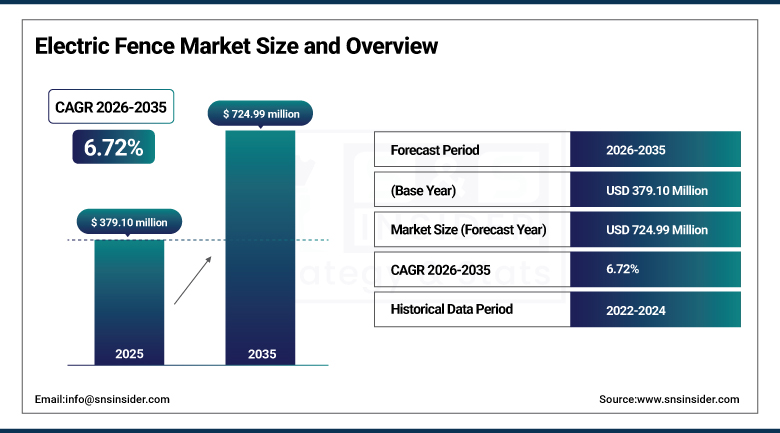
The Electric Fence Market was valued at USD 379.10 million in 2025 and is expected to reach USD 724.99 million by 2035, growing at a CAGR of 6.72% from 2026–2035.
The electric fence market is witnessing steady growth in the global market owing to increasing demand for livestock protection and farm security. Expanding agricultural infrastructure is driving strong adoption of perimeter security solutions. Growing deployment of solar powered fencing systems is improving operational efficiency. Rising investments in rural electrification and smart farming are supporting market expansion. Increasing demand for portable fencing solutions is accelerating technological innovation. Governments are focusing on wildlife control and farm protection systems, further boosting market growth.
According to the Food and Agriculture Organization of the United Nations and World Bank livestock 2025, global livestock production supports over 1.5 billion cattle and more than 1.2 billion sheep and goats, driving widespread use of fencing systems for grazing management. As per FAO pasture management indicators, controlled grazing systems can improve land productivity by up to 20–30% and reduce overgrazing in regulated zones. The International Energy Agency IEA rural electrification datasets also indicate that over 770 million people still lack reliable grid access, supporting increased adoption of solar-powered electric fencing systems in off-grid agricultural regions for livestock protection and land management.
To Get more information on Electric Fence Market - Request Free Sample Report
Electric Fence Market Trends
-
-
The utilization of solar powered electric fences is becoming prevalent owing to the economic operation costs and applicability of the electric fences in rural agriculture areas that do not have electricity.
-
Electric fencing equipment for rotational grazing purposes is being widely used in modern farming practices.
-
The use of smart monitoring technology is adding value to the efficiency of the electric fences in real-time monitoring.
-
There is a growing need for the preservation of wildlife, and therefore, there is an increased demand for electric fencing along forests and protected wildlife areas.
-
Increased development around rural and forest areas is raising the need for electric fences in order to protect against human-wildlife conflict.
-
Lightweight materials and easy installation have made electric fences affordable and accessible to rural users.
-
U.S. Electric Fence Market Outlook.
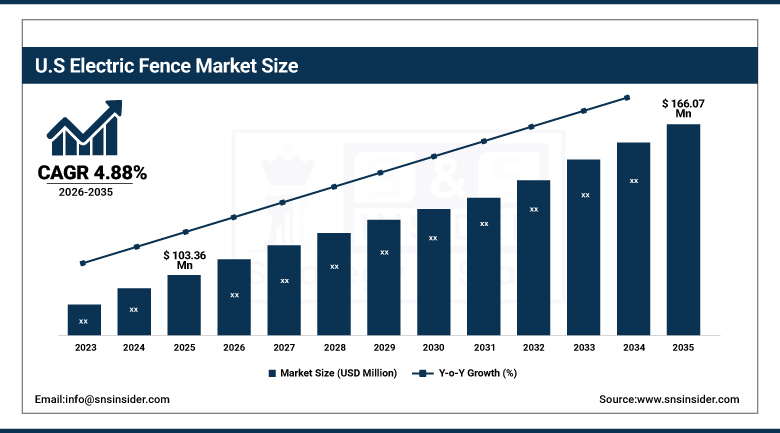
The U.S. Electric Fence Market was valued at USD 103.36 million in 2025 and is expected to reach around USD 166.07 million by 2035, growing at a CAGR of 4.88% from 2026–2035.
The U.S. electric fence market is growing steadily owing to rising demand for livestock management and farm security. Increasing adoption of advanced perimeter protection systems is enhancing agricultural safety and efficiency. Expansion of smart farming practices is supporting strong demand for electric fencing solutions. Strong uptake of solar powered fencing systems is improving operational flexibility across rural areas. Growing investments in wildlife protection and property security are accelerating market expansion nationwide. Technological advancements in portable and monitoring based fencing systems are further driving adoption across end users.
According to the U.S. Department of Agriculture Census of Agriculture updates, over 880 million acres of farmland are managed in the United States, with livestock operations representing about 29% of total agricultural establishments. As per USDA Natural Resources Conservation Service fencing conservation practice standards, perimeter and rotational grazing systems increasingly incorporate electrified fencing to improve pasture utilization efficiency by up to 40% compared with open grazing systems. The U.S. Forest Service and state wildlife agencies also report expanding use of electric fencing in over 60% of livestock–wildlife conflict mitigation programs, particularly in predator-prone regions across western states.
Electric Fence Market Segment Analysis
-
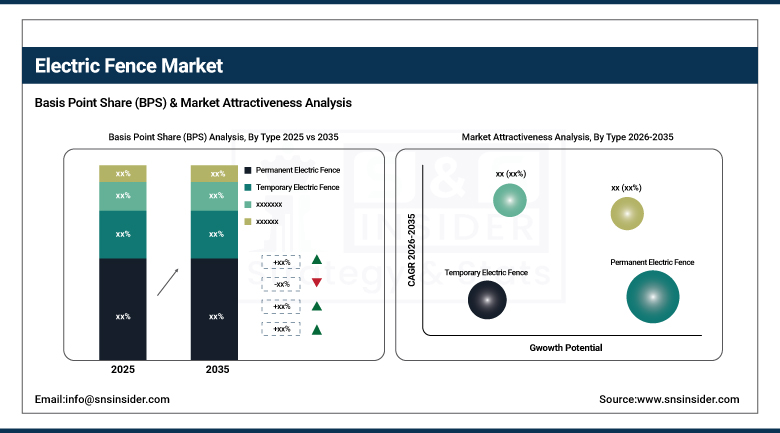
By Type, permanent electric fence dominated the market with 62.40% share in 2025; while portable electric fence is the fastest growing segment with CAGR of 9.46% during 2026 to 2035.
-
By Material, steel dominated the market with 48.60% share in 2025; while composite is the fastest growing segment with CAGR of 8.68% during 2026 to 2035.
-
By Application, agriculture dominated the market with 55.30% share in 2025; while residential are the fastest growing segment with CAGR of 9.83% during 2026 to 2035.
-
By Power Source, mains power dominated the market with 51.10% share in 2025; while solar are the fastest growing segment with CAGR of 10.33% during 2026 to 2035.
-
By Functionality, deterrent dominated the market with 58.20% share in 2025; while monitoring is the fastest growing segment with CAGR of 10.47% during 2026 to 2035.
By Type, permanent electric fence dominated the electric fence market in 2025, while portable electric fence is the fastest growing segment.
The steel segment has been dominant in the electric fence market with maximum revenue share in 2025. The reason behind the domination is the presence of high strength, durability, and long-lasting capability of steel products when exposed to tough outdoor conditions. Steel is extensively used in the construction of agricultural fences as it offers better resilience against physical damage and weathering. The cost-effectiveness and availability of steel are other contributing factors to its large-scale use. Continued high demand from the segment of livestock protection applications ensures the continued dominance of the steel segment.
The composite segment is likely to have the fastest CAGR during 2026–2035 because of growing demand for light weight, corrosion-resistant, and low-maintenance fencing products. Composite materials provide higher flexibility and longer life than traditional metals. Higher usage of composites in modern smart fence systems and portable systems is fueling growth. Suitability to harsh environments and lower installation costs are additional contributing factors to growing demand for composite materials.
By Material, steel dominated the electric fence market in 2025, while composite is the fastest growing segment.
Steel segment dominated the electric fence market with the highest revenue share in 2025. This dominance is driven by high strength, durability, and long operational life under harsh outdoor conditions. Steel is widely used in agricultural fencing due to its superior resistance to physical damage and weather impact. Its cost effectiveness and easy availability further support large scale adoption. Strong demand from livestock protection applications continues to reinforce steel segment leadership across global rural and farm infrastructure systems.
Composite segment is expected to grow at the fastest CAGR from 2026–2035 due to increasing demand for lightweight, corrosion resistant, and low maintenance fencing materials. Composite materials offer improved flexibility and longer lifespan compared to traditional metals. Rising adoption in modern smart fencing systems and portable installations is accelerating growth. Their suitability for harsh environmental conditions and reduced installation costs is further boosting demand. Growing focus on sustainable and advanced fencing solutions is driving strong adoption of composite materials globally.
By Application, agriculture dominated the electric fence market in 2025, while residential is the fastest growing segment.
Agriculture was the largest electric fence market share holder in terms of revenue in 2025 because of its wide application in livestock protection, crop protection and security of farm boundaries in rural areas. The requirement of preventing animal entry and protecting crops from damage is another reason for this. Increasing modernization of agriculture techniques and increasing government initiative for agricultural security is adding fuel to the demand for electric fences all over the world.
Residential segment is expected to be the fastest growing segment from 2026-2035 because of increasing security issues and urban safety concerns. Increasing adoption of smart security systems and low maintenance fencing products is contributing towards increasing demand. Increasing development of suburbs is yet another factor which is propelling the market. Increasing trend of using cost-effective and easy to install fencing products is encouraging people to go for electric fences.
By Power Source, mains power dominated the electric fence market in 2025, while solar is the fastest growing segment.
Mains power segment held the dominated share of revenue in the electric fence market in 2025. the reasons behind such a high market share can be attributed to its ability to provide a constant power source. Mains power sources are commonly used in larger-scale agricultural farms and industrial security systems. Low operational disruptions and presence of established infrastructure have led to increased utilization. Increased longevity and consistent performance have made it a favored choice in permanent applications.
Solar segment will experience the fastest CAGR during the period from 2026 to 2035. The rapid growth in this segment is due to increased use of energy efficient fencing methods that require no grid connection. Increased usage in remote agricultural farms has led to the expansion of this segment. Government regulations to promote the use of renewables have helped in increasing the utilization. Reduced operational costs and ease of installation have added to its popularity.
By Functionality, deterrent dominated the electric fence market in 2025, while monitoring is the fastest growing segment.
The deterrent product segment had the dominated revenue share in the electric fence market in 2025 due to its extensive use in protecting livestock and farm boundaries from animal intrusions. Such electric fences also help reduce the risk of any damage to crops. The increasing agricultural activities and growing requirement for effective perimeter control solutions are also contributing to the dominance of the segment. Its high reliability and easy maintenance attributes are also helping it dominate the market in rural and semi-urban areas across the globe.
The monitoring product segment is likely to witness the fastest CAGR during 2026–2035 owing to increasing demand for smart and integrated security solutions. The integration of sensors and IoT enabled security solutions is enabling better real-time monitoring. The increased concerns regarding thefts and animal intrusions are further encouraging the adoption of such solutions. Improvements in remote monitoring and mobile alerts technology are also contributing to the growth of this product segment.
Regional Analysis
|
Region |
Major Country |
Share within Region, 2025(%) |
|---|---|---|
|
North America |
United States |
78.35% |
|
Europe |
Germany |
28.60% |
|
Asia Pacific |
China |
44.20% |
|
Middle East & Africa |
UAE |
19.30% |
|
Latin America |
Brazil |
48.70% |
North America Electric Fence Market Insights.
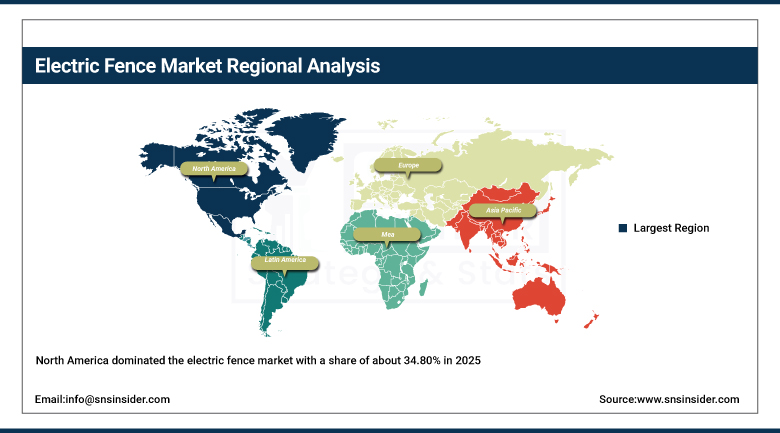
North America dominated the electric fence market with a share of about 34.80% in 2025 owing to strong agricultural fencing demand. The region benefits from advanced livestock management systems and large-scale farmland operations. Increasing adoption of solar powered fencing solutions is improving efficiency. Rising concerns for wildlife control and property protection are driving installations. Government support for farm safety and rural security infrastructure is further strengthening market growth across key applications.
According to the U.S. Department of Agriculture National Agricultural Statistics Service Census of Agriculture, over 1.9 million U.S. farms account for livestock production, with cattle inventories exceeding 87 million head, supporting widespread use of perimeter containment systems such as electric fencing. As per Statistics Canada agricultural profile data, approximately 68% of Canadian farms report livestock operations requiring controlled grazing systems
Get Customized Report as per Your Business Requirement - Enquiry Now
Europe Electric Fence Market Insights.
Europe electric fence market is characterized by steady growth in 2025 owing to strict livestock welfare and agricultural protection regulations. Key countries include Germany, France, United Kingdom, and Italy. Rising focus on sustainable farming practices is driving adoption of modern fencing systems. Increasing need for wildlife management and crop protection is supporting installations. Expansion of smart farming technologies is further enhancing market growth across agricultural and rural regions.
As indicated in the European Commission Common Agricultural Policy implementation framework and indicators from Eurostat agricultural structure survey 2025, there are about 9.1 million agricultural holdings in the European Union, of which the livestock subsector accounts for more than 40% of the total value of farm production in various member states. Moreover, FAO livestock data indicates that there are about 70 million cattle and 60 million sheep and goats in Europe.
Asia Pacific Electric Fence Market Insights.
Asia Pacific is expected to register the fastest CAGR of about 9.10% during 2026–2035 in the electric fence market due to expanding agricultural modernization. Increasing rural electrification and farm automation are driving strong demand across China, India, Japan, and Southeast Asia. Rising livestock farming activities and food security initiatives are accelerating adoption. Government subsidies for solar fencing solutions are further supporting rapid market expansion across developing economies in the region.
According to the Food and Agriculture Organization of the United Nations, livestock accounts for about 40% of agricultural GDP in some of the Asia Pacific countries, hence increasing the usage of fencing systems in managing herds and protecting crops. According to the indicators from FAO on agricultural infrastructure and data from the World Bank on rural development, more than 55% of small-scale farmers in Southeast Asia depend on traditional or semi-modern fencing systems.
Middle East & Africa and Latin America Electric Fence Market Insights.
The Middle East & Africa along with Latin America regions are experiencing steady growth due to increasing agricultural expansion and security investments. Key contributing countries include Brazil, Mexico, UAE, Saudi Arabia, and South Africa. Rising demand for livestock protection and farm boundary management is driving adoption. Expanding irrigation and agricultural development projects are supporting market growth. Increasing use of solar powered fencing systems is further boosting demand across rural regions.
As per the Food and Agriculture Organization of the United Nations, the livestock production systems of Africa and Latin America make up more than 30% of the world’s cattle inventory combined, with the extensive grazing systems being predominant in more than 60% of the rangeland utilization in sub-Saharan Africa. According to the World Bank rural development indicators, there is agricultural land occupying more than 35% of the total landmass in Latin America and almost 43% in Sub-Saharan Africa. It is here that livestock predation and crop protection become the main reason for the implementation of perimeter security systems.
Market Dynamics
Growth Drivers: Increasing adoption of solar powered and portable electric fencing systems in rural regions
Increasing tendency towards utilizing renewable energy in fencing products is playing an important role in boosting the market in developing regions. The use of solar-powered electric fences is becoming popular because of their low operating costs and suitability for off-grid rural locations. The usage of portable fence systems is on the rise as they find use in rotating grazing and temporary fencing of livestock. Difficulties associated with electrification of remote farms are contributing towards growing the adoption rate. The development in the area of lightweight material and easy installation is also making fencing easier.
According to the Food and Agriculture Organization of the United Nations Livestock and Environment data, livestock production systems occupy about 26% of the Earth’s terrestrial surface, with over 1.3 billion people dependent on livestock for livelihood, driving demand for grazing management solutions. The World Bank rural development indicators also show that over 60% of agricultural land in Sub-Saharan Africa remains unfenced or poorly managed, increasing demand for portable electric fencing technologies.
Restraints: Risk of technical failures and safety concerns affecting reliability of electric fencing systems
Electric fences have challenges in their operation including power instability, poor grounding, and mechanical failure of the systems. The above technical difficulties may hinder the effectiveness of the system in both animal containment and security purposes. Safety challenges due to electric shock to human beings and animals may limit their usage in some areas. Poor installation and maintenance may further lead to system failure. Extreme weather conditions may destroy the system making them less efficient. Lack of standardization and knowledge in some rural areas is another challenge.
Opportunities: Growing demand for wildlife conservation and land protection boosting electric fencing deployment
The growing interest in the protection of wildlife and habitats is making electric fences more popular along the boundaries of forests and rural areas. The governments and environment agencies are using electric fences in order to cut down the number of human-wildlife interactions. With the increase in infrastructure development work around the forest areas, the need for protection systems is rising. Growing interest in biodiversity protection is also facilitating the use of electric fences. Electric fences are also being installed in protected zones and national parks.
As per the Food and Agriculture Organization of the United Nations, around 26% of the world’s land area is utilized for livestock grazing, thus resulting in boundary management needs of the crop-livestock separation system. According to Convention on Biological Diversity 2025 wildlife conflict mitigation indicators, human-wildlife conflict impacts more than 1,000 species worldwide, with increasing occurrences of such conflicts in Africa and Asia.
Recent Developments
-
2026: Woodstream Corporation increased production of residential and pet-focused electric fencing energizers, focusing on simplified installation, durability, and improved consumer usability features.
-
2025: Nemtek Group strengthened global distribution networks and upgraded high-voltage energizer systems, focusing on improved livestock containment efficiency and enhanced perimeter security applications worldwide.
-
2025: Gallagher Group Ltd completed full ownership consolidation of Gallagher Europe, strengthening global animal management and electric fencing integration capabilities across European agricultural markets.
-
2024: Woodstream Corporation advanced its North American fencing portfolio through continued product line optimization and retail distribution strengthening across agricultural and residential electric fencing segments.
Electric Fence Market Key Players are:
-
Gallagher Group Ltd
-
Datamars SA
-
Woodstream Corporation
-
Nemtek Group
-
Horizont Group GmbH
-
VOSS.farming GmbH
-
Rutland Electric Fencing
-
Premier1Supplies
-
Kencove Farm Fence Supplies
-
Agrifence
-
JVA Technologies
-
DARE Products, Inc.
-
Hotline
-
LACME
-
Patura KG
-
Farmer Mate
-
Red Snap’r
-
Fi-Shock
-
Zareba Systems
-
Parmak Electric Fence
Electric Fence Market Report Scope:
| Report Attributes | Details |
|---|---|
| Market Size in 2025 | USD 379.10 Million |
| Market Size by 2035 | USD 724.99 Million |
| CAGR | CAGR of 6.72% From 2026 to 2035 |
| Base Year | 2025 |
| Forecast Period | 2026-2035 |
| Historical Data | 2022-2024 |
| Report Scope & Coverage | Market Size, Segments Analysis, Competitive Landscape, Regional Analysis, DROC & SWOT Analysis, Forecast Outlook |
| Key Segments | • By Type (Permanent Electric Fence, Temporary Electric Fence, Portable Electric Fence) • By Material (Steel, Aluminum, Plastic, Composite) • By Application (Agriculture, Residential, Commercial, Industrial) • By Power Source (Battery, Solar, Mains Power) • By Functionality (Deterrent, Containment, Monitoring) |
| Regional Analysis/Coverage | North America (US, Canada), Europe (Germany, UK, France, Italy, Spain, Russia, Poland, Rest of Europe), Asia Pacific (China, India, Japan, South Korea, Australia, ASEAN Countries, Rest of Asia Pacific), Middle East & Africa (UAE, Saudi Arabia, Qatar, South Africa, Rest of Middle East & Africa), Latin America (Brazil, Argentina, Mexico, Colombia, Rest of Latin America). |
| Company Profiles | Gallagher Group Ltd, Datamars SA, Woodstream Corporation, Nemtek Group, Horizont Group GmbH, VOSS.farming GmbH, Rutland Electric Fencing, Premier1Supplies, Kencove Farm Fence Supplies, Agrifence, JVA Technologies, DARE Products, Inc., Hotline, LACME, Patura KG, Farmer Mate, Red Snap’r, Fi-Shock, Zareba Systems, Parmak Electric Fence |
Frequently Asked Questions
The electric fence market is expected to grow at a CAGR of 6.72% from 2026 to 2035.
The key growth factors include livestock protection demand, farm security expansion, solar fencing adoption, wildlife conflict management, rural electrification challenges, and increasing use of smart portable electric fencing systems.
The electric fence market was valued at USD 379.10 million in 2025.
