
ESource Solutions Market Report Scope & Overview:
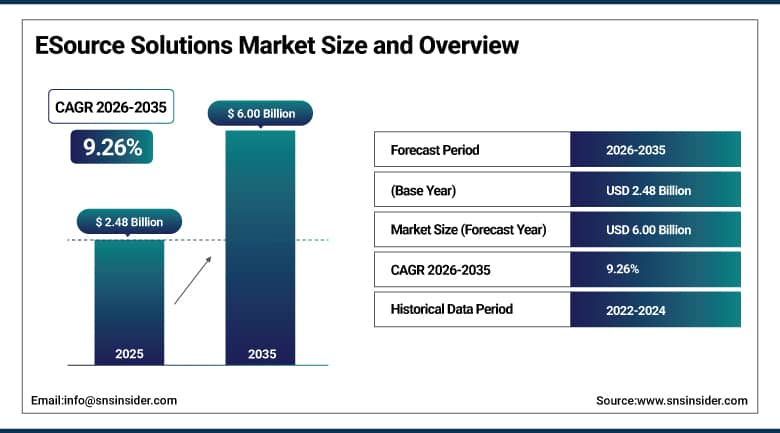
The ESource Solutions Market was valued at USD 2.48 Billion in 2025 and is projected to reach USD 6.00 Billion by 2035, expanding at a CAGR of 9.26% during the forecast period 2026–2035.
There has been significant expansion in the global eSource solution market owing to increased efforts by sponsors, contract research organizations, and research institutions to make the move from paper documentation to digitalized clinical research ecosystems. Through the use of eSource solutions, there has been easy collection of source data from patients, researchers, electronic health records, mobile devices, and healthcare systems, thus enhancing the quality and efficiency of clinical research data. The adoption of decentralized clinical trials, data validation using AI, cloud-based research infrastructure, and continuous study monitoring is facilitating the adoption of eSource solutions globally in clinical research programs.
In the period 2025-2026, vendors of clinical technologies have continued to enhance AI-assisted eSource solutions that automate source data verification, protocol compliance monitoring, audit trail management, and integration between electronic health records, clinical trial management systems, and electronic data capture solutions.
To Get More Information On ESource Solutions Market - Request Free Sample Report
ESource Solutions Market Trends:
-
Increasing adoption of AI-enabled eSource platforms for automated clinical data capture and validation.
-
Rising implementation of decentralized and hybrid clinical trial models across global research programs.
-
Growing integration of electronic health records with eSource and EDC environments.
-
Expansion of cloud-based clinical research infrastructure supporting real-time study monitoring.
-
Increasing deployment of wearable-connected data collection systems for continuous patient data acquisition.
U.S. ESource Solutions Market Size Outlook:
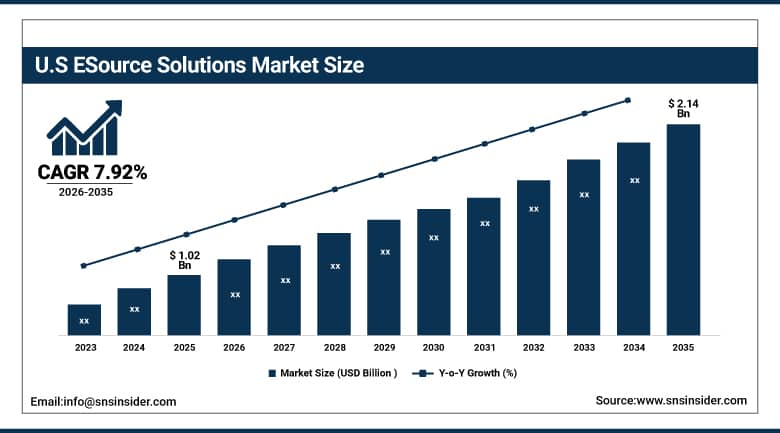
The U.S. ESource Solutions Market was valued at USD 1.02 billion in 2025 and is expected to reach approximately USD 2.14 billion by 2035, expanding at a CAGR of 7.92% during 2026–2035.
The U.S. still remains the largest market for eSource solutions owing to the existence of well-developed infrastructure for clinical research, high level of trials’ activity, prevalence of digital health and investments into trial management platforms enabled by technology. In particular, pharmaceutical companies, biotech organizations, research facilities, and CROs speed up the adoption of cloud-based eSource solutions for greater availability of patient data, decreased need in documentation, better preparation for regulations, and efficient execution of decentralized trials. The development of artificial intelligence technologies, real-time analytics, EHRs, and automated quality checks contributes to positive market environment for future growth.
In 2025–2026, several providers of clinical technologies based in the U.S. launched sophisticated eSource solutions with features such as automated AI-powered data quality control, discrepancy detection, cloud-based interoperability solutions, and advanced compliance functionality for more complicated global clinical trials.
ESource Solutions Market Segment Analysis:
-
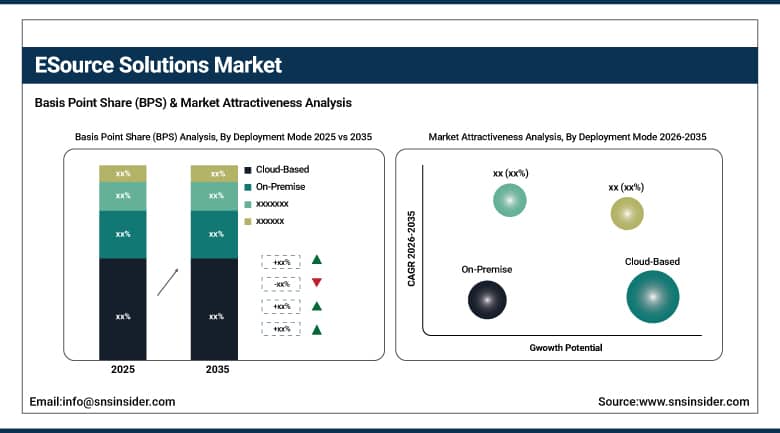
By Deployment Mode, cloud-based solutions dominated the market with 67.00% share in 2025 and are projected to witness the fastest growth with 10.93% CAGR during the forecast period.By Solution Type, direct data capture (DDC) solutions dominated the market with 41.00% share in 2025, while wearable & sensor-based esource solutions are projected to witness the fastest growth with 12.26% CAGR during the forecast period.
-
By Delivery Model, software platforms dominated the market with 64.00% share in 2025 and are projected to witness the fastest growth with 10.08% CAGR during the forecast period.
-
By End User, pharmaceutical & biotechnology companies dominated the market with 48.00% share in 2025, while contract research organizations (CROs) are projected to witness the fastest growth with 10.24% CAGR during the forecast period.
By Deployment Mode, cloud-based solutions dominated and are the fastest-growing segment.
The cloud-based segment accounted for the largest market share of 67.00% in 2025 due to the rising demand for scalable infrastructure for clinical research, centralization of the studies management process, and interoperable clinical trial management systems. Cloud hosting allows sponsor and CRO companies to gain real-time information, enhance collaboration among remotely located research teams, and cut IT infrastructure expenses. The shift towards decentralized clinical trials and connected clinical research ecosystem keeps driving the adoption of cloud hosting globally.
Besides, the cloud-based segment is expected to show the fastest CAGR of 10.93% during the forecast period. The rising interest in SaaS solutions for clinical research technology, remote monitoring, and real-time study management systems drives the rapid adoption of cloud hosting solutions. The preference for cloud hosting among research organizations is explained by its better scalability, faster update of the system, and global study management possibilities.
By Solution Type, direct data capture (DDC) solutions dominated, while wearable & sensor-based esource solutions are the fastest-growing.
DDC Solutions is anticipated to hold the highest revenue market share of 41.00% during 2025 because of increasing adoption of investigator-driven e-source documentation, capability to integrate EHR directly into systems, and efficient clinical workflow management. Increasing deployment of DDC technologies to eliminate transcription errors, increase the integrity of source data, accelerate monitoring, and ensure regulatory compliance is leading sponsors and research organizations to deploy such solutions. During 2025–2026, various eclinical software vendors have introduced capabilities for direct EHR to eSource integration that enables automating source verification, improving audit-readiness, and providing real-time access to clinical data in global research programs.
Wearable & sensor-based esource solutions segment is expected to witness highest CAGR of 12.26% during 2026–2035 because of increasing usage of connected wearable, remote patient monitoring tools, digital biomarkers, and decentralized clinical trials methodology. Sponsors are adopting sensor-generated data streams for better patient engagement, real-world evidence generation, and efficient collection of endpoints. Increased use of remote methodologies of clinical research is creating significant potential for wearable-enabled eSource solutions ecosystem. During 2025-2026, numerous clinical research technology companies have launched advanced wearable integration platforms that enable continuous physiological monitoring and patient data collection through AI-assisted analytics in decentralized trials.
Regional Analysis:
|
Region |
Major Country |
Share within Region, 2025 (%) |
|---|---|---|
|
North America |
United States |
94.00% |
|
Europe |
Germany |
27.00% |
|
Asia Pacific |
China |
21.00% |
|
Middle East & Africa |
UAE |
4.00% |
|
Latin America |
Brazil |
4.00% |
North America ESource Solutions Market Insights
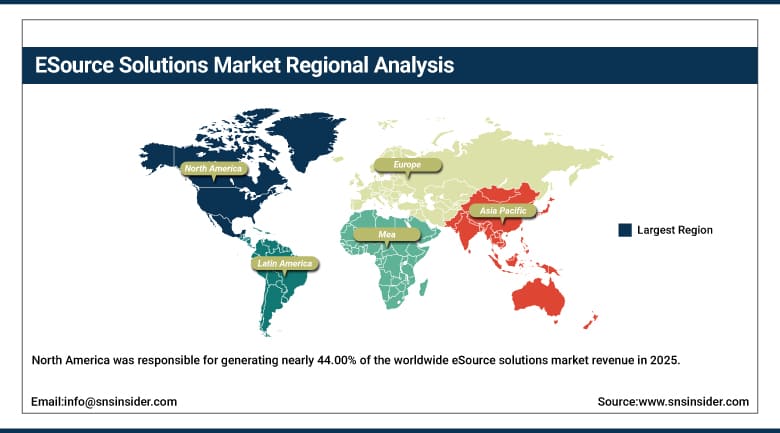
North America was responsible for generating nearly 44.00% of the worldwide eSource solutions market revenue in 2025, continuing to lead the regional markets. Driving growth factors in the region include advanced research infrastructure, extensive development of pharmaceutical R&D operations, and rapid adoption of clinical trial digitalization technologies. Cloud-based eSource technologies along with EHRs, AI-driven data verification technologies, and centralized monitoring capabilities are increasingly adopted by pharmaceutical companies, biotech firms, CROs, and academic medical centers in the region. Clinical technology providers in the region and investment in decentralized clinical trials further enhance the dominance of the regional market.
From 2025-2026, various clinical technology providers from North America continued to introduce AI-driven eSource solutions featuring source data verification and monitoring capabilities for large clinical research programs.
Get Customized Report as Per Your Business Requirement - Enquiry Now
Europe ESource Solutions Market Insights
The market share of Europe was estimated at about 27.00% of total market revenue in 2025. The market is receiving growth on account of increasing digital transformation programs in clinical research organizations, the increasing use of electronic medical records, and the rise in the demand for digital trial management solutions that adhere to regulatory compliance requirements. Cloud eSource solutions are being implemented by pharmaceutical sponsors and CROs in Germany, the UK, France, Italy, and other prominent clinical research hubs to increase efficiency and improve data quality management for multicentre clinical trials.
Several clinical research networks in Europe have increased the adoption of eSource ecosystem solutions during 2025–2026 to increase patient data access and remote monitoring ability.
Asia Pacific ESource Solutions Market Insights
The Asia Pacific region is expected to have the highest CAGR of 13.22% in the period between 2026 and 2035. Fast-growing clinical trials, outsourcing of pharmaceuticals, digital transformation in the healthcare industry, and increased investment in clinical research facilities are major factors boosting the adoption in China, Japan, India, South Korea, Singapore, and Australia. Cloud-based eSource software solutions are being adopted by research organizations for enhancing clinical trial operations and making the process of patient recruitment faster. Increasing demand for decentralized clinical trials and mobile patient engagement solutions is creating significant opportunities for the future in this region.
In 2026, many clinical technology vendors in the Asia Pacific region released their artificial intelligence-based eSource software solutions along with remote patient monitoring and electronic consent facilities.
Middle East & Africa and Latin America ESource Solutions Market Insights
The Middle East & Africa market constituted about 4.00% of the total global revenue generated in 2025. The market is growing at a moderate pace due to increased healthcare modernization activities, higher clinical research infrastructure development investments, and the usage of digital health technologies. The research organizations and healthcare companies in UAE, Saudi Arabia, and South Africa are considering the use of cloud-based clinical data management systems in order to make research more efficient and allow participating in global clinical trials.
The Latin American region constituted about 4.00% of the total global market revenue in 2025. Market growth is due to an increase in the number of pharmaceutical clinical trials conducted in the region, adoption of digital research technologies, and healthcare IT infrastructure development in Brazil, Mexico, Argentina, and Chile. The research organizations deploy eSource technology in order to improve the quality of collected data, comply with regulations, and simplify the process of documentation. In 2025–2026, there was an increased investment in clinical trial technologies that were connected to cloud computing in the regions, as well as in AI-assisted data management systems and remote monitoring options.
Market Dynamics:
Growth Drivers: Decentralized Clinical Trials and Digital Clinical Research Infrastructure.
The growing trend toward decentralized/hybrid clinical trials acts as an important growth driver for the global market for eSource solutions. Companies opt for digital clinical research solutions that facilitate the collection of source data, remote communication with patients, and the ability to monitor trials in real-time. With the help of the technologies in question, sponsors can avoid transcription errors, enhance data integrity, increase efficiency of monitoring processes and make better clinical decisions. With growing complexity and geographic dispersion of clinical trials, companies have been developing their cloud-based clinical research infrastructure to ensure compatibility of EHR, wearable’s, econsent system, and clinical data management systems.
In 2025-2026, some of the players in the market of clinical technologies presented their AI-powered eSource platforms with automated source verification, predictive quality monitoring, and high interoperability features.
Restraints: Issues of Data Privacy, System Integration, and Regulatory Challenges.
While having good traction, however, concerns about data security, difficulties of integration, and changes in regulatory environment remain important obstacles. Healthcare facilities tend to have disparate IT environments that need to be extensively customized to facilitate integration of their eSource, EHR, EDC, and CTMS systems. Moreover, the need to ensure compliance with privacy regulations and clinical data governance standards may further complicate the process of implementation, especially for small research organizations and individual clinical sites.
In 2026, there was a number of regulatory bodies and industry associations developing relevant guidelines on electronic record management, digital monitoring, cyber security, and data integrity in technology-supported research settings.
Opportunities: AI-Based Data Automation in Clinical Studies and Research Analytics.
Some of the promising future prospects are likely to arise through the incorporation of artificial intelligence, machine learning, and analytics capabilities in eSource environments. With the increasing number of requests for solutions that can identify data discrepancies, require less manual review, optimize monitoring efforts, and speed up studies, clinical research organizations are looking for solutions enabled by AI technology. AI-based eSource solutions bring real-time insights about study performance and help increase data quality and make decisions based on operations within the research environment. There are expectations that more and more adoption of predictive analytics and intelligent automation in workflows will bring many commercial opportunities for vendors of such platforms during the forecast period.
In 2025-2026, there have been launches of AI-based eSource solutions by several eClinical technology vendors.
Recent Developments:
-
2026: Medidata expanded AI-enabled eSource capabilities within its clinical trial platform ecosystem, enhancing automated source data verification, remote monitoring workflows, and interoperability with electronic health record systems.
-
2026: Oracle Health Sciences introduced advanced cloud-native eSource functionalities supporting real-time clinical documentation, automated quality checks, and decentralized clinical trial management capabilities.
-
2025: Veeva Systems expanded integration between eSource, EDC, and site management applications to improve clinical workflow efficiency and accelerate digital trial adoption across global research programs.
-
2025: Florence Healthcare enhanced its electronic source documentation platform with AI-assisted workflow automation, centralized monitoring tools, and expanded EHR connectivity capabilities for research sites.
ESource Solutions Market Key Players are:
-
Veeva Systems Inc.
-
Medidata Solutions, Inc.
-
Oracle Corporation
-
Florence Healthcare
-
Castor EDC
-
CRF Health
-
Clinical Ink
-
IQVIA Holdings Inc.
-
Signant Health
-
ICON plc
-
Parexel International Corporation
-
Medable Inc.
-
OpenClinica LLC
-
Anju Software Inc.
-
Datatrak International, Inc.
-
Clario
-
eClinical Solutions LLC
-
Advarra, Inc.
-
IBM Corporation
-
ArisGlobal LLC
ESource Solutions Market Report Scope:
| Report Attributes | Details |
|---|---|
| Market Size in 2025 | USD 2.48 Billion |
| Market Size by 2035 | USD 6.00 Billion |
| CAGR | CAGR of 9.26% From 2026 to 2035 |
| Base Year | 2025 |
| Forecast Period | 2026-2035 |
| Historical Data | 2022-2024 |
| Report Scope & Coverage | Market Size, Segments Analysis, Competitive Landscape, Regional Analysis, DROC & SWOT Analysis, Forecast Outlook |
| Key Segments | • By Solution Type (ePRO/eCOA Solutions, Direct Data Capture (DDC) Solutions, Wearable & Sensor-Based eSource Solutions) • By Deployment Mode (Cloud-Based, On-Premise, Hybrid) • By Delivery Model (Software Platforms, Services (Implementation, Integration, Support & Training)) • By End User (Pharmaceutical & Biotechnology Companies, Contract Research Organizations (CROs), Others) |
| Regional Analysis/Coverage | North America (US, Canada), Europe (Germany, UK, France, Italy, Spain, Russia, Poland, Rest of Europe), Asia Pacific (China, India, Japan, South Korea, Australia, ASEAN Countries, Rest of Asia Pacific), Middle East & Africa (UAE, Saudi Arabia, Qatar, South Africa, Rest of Middle East & Africa), Latin America (Brazil, Argentina, Mexico, Colombia, Rest of Latin America). |
| Company Profiles | Veeva Systems Inc., Medidata Solutions, Inc., Oracle Corporation, Florence Healthcare, Castor EDC, CRF Health, Clinical Ink, IQVIA Holdings Inc., Signant Health, ICON plc, Parexel International Corporation, Medable Inc., OpenClinica LLC, Anju Software Inc., Datatrak International, Inc., Clario, eClinical Solutions LLC, Advarra, Inc., IBM Corporation, ArisGlobal LLC. |

Frequently Asked Questions
The eSource Solutions Market was valued at USD 2.48 billion in 2025.
The market is expected to expand at a CAGR of 9.26% during the forecast period.
North America dominated the global market owing to its advanced clinical research infrastructure, high concentration of pharmaceutical R&D activity, and rapid adoption of digital clinical trial technologies.
Asia Pacific is projected to witness the fastest growth, expanding at a CAGR of 13.22% during 2026–2035.
The market is projected to reach USD 6.00 billion by 2035.
