
Fast Food Market Report Scope & Overview:
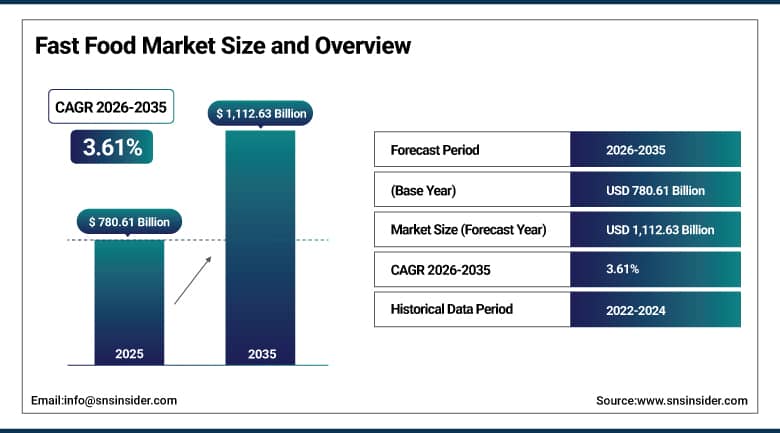
The global Fast Food Market was valued at USD 780.61 Billion in 2025 and is expected to reach USD 1,112.63 Billion by 2035, growing at a CAGR of 3.61% from 2026 to 2035.
The growth of the global Fast Food Market is driven by growing urbanization, changes in lifestyle, and the increasing consumer inclination towards convenient and affordable food. The increase in working professionals and time-limited consumers has increased demand for the food served by fast food restaurants. Fast food chains are expanding their presence in emerging economies through franchising and other modes of order placement online. The adoption of food delivery apps, online order placements, and contactless payment has added to the accessibility of these foods. Moreover, product innovation through the offering of healthier meals, plant-based products, premium products, and cuisines from around the world has been gaining more consumers.
McDonald's unveiled ArchIQ, an AI-powered operating system including a voice-based drive-thru assistant nicknamed "Archy," at its 2026 Worldwide Convention in Las Vegas, part of a broader initiative called McDonald's Next designed to reimagine the company's menu, restaurant design, customer engagement, and staffing, reflecting the scale of technology investment reshaping drive-thru operations given that drive-thrus account for roughly 70% of U.S. sales across more than 40,000 locations worldwide.
To Get More Information On Fast Food Market - Request Free Sample Report
Fast Food Market Trends
-
Growing AI-powered drive-thru ordering adoption is widening across major fast-food chains, with roughly 26% of restaurant operators now using AI in some form.
-
Rising protein-rich menu options are surging onto fast food menus as consumers increasingly watch macros and use GLP-1 medications.
-
Expanding digital kiosks, loyalty apps, and mobile ordering continue enhancing customer retention, with 58% of U.S. consumers using branded apps for faster service.
-
Increasing adoption of plant-based and sustainable menu options continues to broaden fast food beyond traditional burgers and fries offerings.
-
Growing consumer demand for authentic, diverse, and spice-forward cuisines is accelerating growth in Asian and Latin American food segments.
U.S. Fast Food Market Outlook
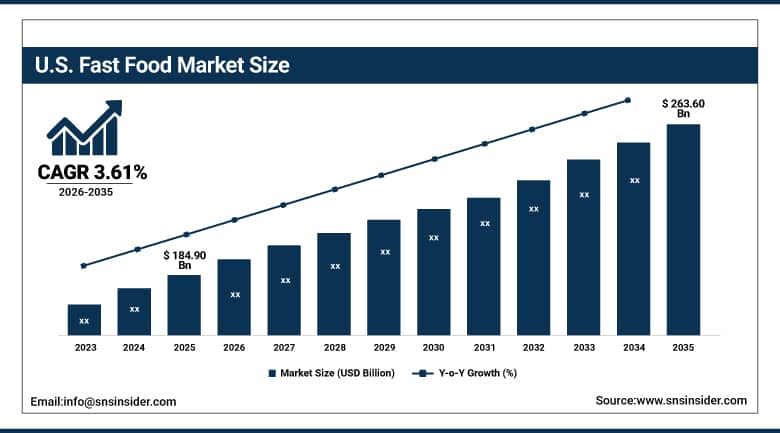
The U.S. Fast Food Market was valued at USD 184.90 Billion in 2025 and is projected to reach USD 263.60 Billion by 2035, growing at a CAGR of 3.61% during 2026-2035.
The U.S. Fast Food Market is owing to the high demand from customers for convenient, cost-effective, and quick foods. Lifestyle changes like hectic routines, more work hours, and urbanization are making customers depend more on the offerings from the fast-food restaurant. Expansion of existing chain stores and franchises is making these restaurants easily accessible to consumers all over the country. Convenience is also being made easy by the rise in the use of food delivery through the Internet, mobile ordering, drive-thru services, and digital payment methods. Also, menu innovation and variety, such as healthy, vegan, premium and custom meals, is drawing different types of customers.
McDonald's launched a 2026 overhaul including new restaurant openings, revamped drive-thrus, new menu items, and expanded digital, AI, and loyalty tools, focusing on value leadership and consistency while growth targets high-traffic and emerging markets, with AI tools developed through a Google Cloud partnership expected to support faster drive-thru ordering and reduce errors that take pressure off crew members.
Fast Food Market Segment Analysis
-
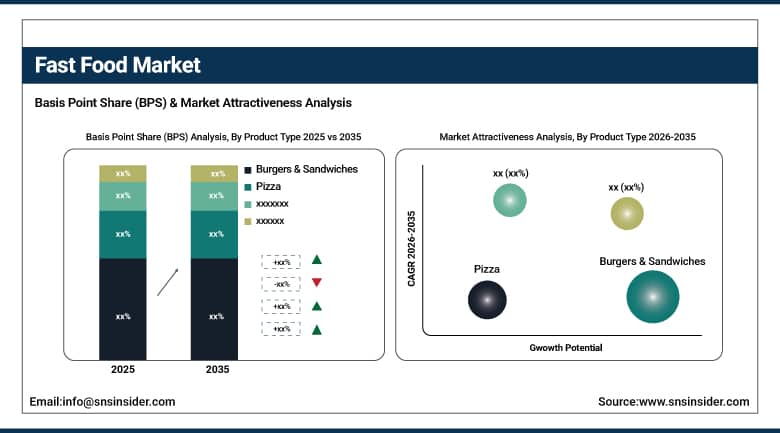
By Product Type, Burgers & Sandwiches led the Fast Food Market with a 38.75% share in 2025, while Pizza is the fastest-growing product type segment with a CAGR of 8.18% from 2026-2035.
-
By Restaurant/Service Type, Quick Service Restaurants led the Fast Food Market with a 58.17% share in 2025, while Fast-Casual is the fastest-growing restaurant/service type segment with a CAGR of 8.24% from 2026-2035.
-
By Cuisine Type, American led the Fast Food Market with a 42.54% share in 2025, while Asian is the fastest-growing cuisine type segment with a CAGR of 9.58% from 2026-2035.
-
By Ordering Channel, Dine-In led the Fast Food Market with a 48.65% share in 2025, while Delivery/Online is the fastest-growing ordering channel segment with a CAGR of 8.51% from 2026-2035.
By Product Type, Burgers & Sandwiches Dominate the Fast Food Market While Pizza Registers the Fastest Growth
Burgers & Sandwiches dominated the Fast Food Market in 2025 because of their popularity among consumers, easy-to-eat nature, reasonable prices, and wide availability in fast-food chains. High customer demand for tasty, custom-made, and portable foods ensures their high sales volume. Moreover, leading restaurants have a vast assortment of burgers and sandwiches because of numerous product innovations, promotion campaigns, and value meals. They are also suitable for various types of food consumption and are popular across all countries.
Pizza is projected to be the fastest-growing product type segment because of rising consumer demand for convenient, customizable, and shareable foods. Wide appeal of this food category to people of all ages, many toppings, crusts, and flavors ensure its high demand. Growth in takeaway and online food delivery services makes this food type more accessible, and expansion of international restaurant chains and domestic brands increases their availability. Innovative flavors and healthy ingredients are making pizzas more popular.
By Restaurant/Service Type, Quick Service Restaurants Dominate the Fast Food Market While Fast-Casual Experiences the Fastest Growth
Quick Service Restaurants dominated the Fast Food Market in 2025 due to their focus on speed, cost-effectiveness, convenience, and standardization. Customers tend to prefer quick options of eating, especially in urban areas and among working people. The presence of many outlets, drive-thrus, value-based menu, and efficient process of food preparation help this segment dominate the market. In addition, top fast food chains have the benefits of brand awareness, promotional pricing, and wide geographical distribution which allows maintaining the level of customers' attendance and sales volume.
Fast-Casual is expected to be the fastest-growing restaurant/service type segment as customers want to receive better food quality at less waiting time and at lower costs compared to full-service restaurants. Freshness of ingredients used in the food preparation, customized food menu, improved dining experience and convenient ways of service delivery help this segment grow. Health consciousness of the customers and desire for premium fast food contribute to the development of this segment.
By Cuisine Type, American Cuisine Dominates the Fast Food Market While Asian Cuisine Emerges as the Fastest-Growing Segment
American cuisine dominated the Fast Food Market in 2025, due to the worldwide popularity of burgers, sandwiches, fried chicken, fries, and other common foods. Their integration into consumer eating practices through the international spread of restaurant chains cannot be overlooked. Moreover, the popularity of fast food can be explained by high brand awareness, standardized menu, active marketing, and wide distribution channels. Finally, American fast food is easily adaptable and allows introducing local tastes while preserving core products.
Asian cuisine is projected to be the fastest-growing cuisine type segment because of increasing consumer interest in various tastes, spices, ingredients, and foreign food products. Globalization and intercultural contacts are promoting consumers' desire to try out Asian cuisine beyond the scope of regular dining. Expansion of Asian fast food concepts, as well as their increased availability via restaurant chains and online delivery platforms, makes it possible to expand the presence of such foods in the market. Noodles, rice, sushi, Asian fried chicken, and fusion products attract young customers to try new types of fast food.
By Ordering Channel, Dine-In Dominates the Fast Food Market While Delivery/Online Registers the Fastest Growth
Dine-In dominated the Fast Food Market in 2025 as restaurants provide readily available and convenient venues where consumers can have their meals at affordable prices in social or casual environments. The demand for dine-in service comes from family meals, group events, and consumers' desire for on-the-spot food consumption. Besides, fast food chains have focused on comfortable interiors, self-service kiosks, electronic menus, and better restaurant experiences to attract consumers. Furthermore, well-established networks of restaurants and the high level of consumer awareness of traditional in-store ordering support the dominance of the channel.
Delivery/Online is expected to be the fastest-growing ordering channel as there is a high number of smartphone owners, the availability of internet connections, and consumers' desire to order their food more conveniently from home or office places. Consumers have an opportunity to use digital platforms that offer a wide choice of restaurants and their menus, track the order and get discounts. Besides, fast food chains work on developing their own proprietary applications, online ordering platforms, and partnering with food delivery companies.
Regional Analysis
|
Region |
Country |
Share (2025) |
|---|---|---|
|
North America |
United States |
84.60% |
|
Europe |
United Kingdom |
22.80% |
|
Asia Pacific |
China |
34.60% |
|
Middle East & Africa |
Saudi Arabia |
20.60% |
|
Latin America |
Brazil |
26.40% |
North America Fast Food Market Insights
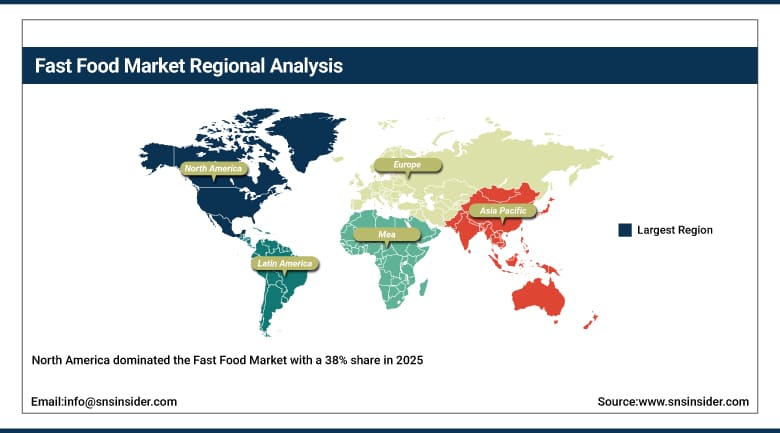
North America dominated the Fast Food Market with a 38% share in 2025, owing to hectic schedules, strong requirement for fast food, and a robust quick service restaurant base in the region. The region has advantages in terms of extensive restaurants' network, high consumer expenditure, use of drive-thru, takeaways, deliveries, and online food ordering systems. The availability of major fast food brands along with continuous updates in their menus is also propelling market growth. Furthermore, promotions, loyalty programs, and delivery platforms are also boosting purchase frequency.
The United States accounted for approximately 84.60% of the North American market in 2025, reflecting its large fast food consumer base and concentration of leading global chains including McDonald's, Yum! Brands, and Starbucks. Canada is contributing to regional growth through steady quick-service restaurant expansion and growing consumer interest in digital ordering and delivery integration.
Get Customized Report as Per Your Business Requirement - Enquiry Now
Europe Fast Food Market Insights
Europe accounted for a significant share of the global Fast Food Market in 2025, due to high demands from urban regions, well-established fast-food restaurants networks, and presence of large chain operators internationally and regionally. Changes in the lifestyle of consumers and their preference towards ready meals contribute to the market demand. Increased demand for healthy and sustainable foods is also promoting diversification in the menus of the restaurants. Furthermore, online orders and deliveries are improving consumer access and engagement.
The United Kingdom led the European market with a 22.80% regional share in 2025, supported by its strong quick-service restaurant retail infrastructure and consumer familiarity with global fast food brands. Germany, France, and Spain are also contributing meaningfully to regional growth, supported by expanding fast-casual and digital ordering adoption across major European urban centers.
Asia Pacific Fast Food Market Insights
Asia Pacific is expected to register the highest CAGR during the forecast period, owing to the high rate of urbanization, higher disposable income, and increasing quick service restaurant chain networks in countries like China, India, and Southeast Asia. Factors such as increasing workforce population, lifestyle changes, and growing preference for affordable and convenient food are resulting in increased consumption of fast foods. Increased investment in fast food restaurants by foreign and regional players, along with increasing use of online food delivery services and food ordering apps, are also contributing towards the expansion of the market.
China accounted for approximately 34.60% of the Asia Pacific market in 2025, supported by its rapidly expanding urban consumer base and growing domestic and international quick-service restaurant investment. India, Japan, and South Korea are also contributing meaningfully to regional growth, with India benefiting from rapidly expanding quick-service restaurant network penetration.
Middle East & Africa and Latin America Fast Food Market Insights
The Middle East & Africa region is exhibiting steady growth as urban fast food consumption and modern retail infrastructure investment continue expanding across the Gulf states. Latin America is similarly benefiting from expanding quick-service restaurant network penetration and growing consumer interest in affordable, convenient meal options across major regional economies.
Saudi Arabia led the Middle East & Africa market with a 20.60% regional share in 2025, supported by growing urban fast food consumption and expanding modern retail penetration. Brazil represented 26.40% of the Latin American market in 2025, driven by expanding quick-service restaurant network growth, with Mexico also contributing to regional growth through rising demand for convenient, affordable meal options.
Market Dynamics
Growth Drivers: Convenience-Driven Consumption and Digital Ordering Innovation Driving Market Growth
The Fast Food Market is being driven primarily by the growing inclination towards faster and convenient food options due to busy lifestyles, increasing adoption of online distribution channels, and rising consumer preference for quick, portable meal solutions. City life speeds up, so more people grab fast meals on the go, and because schedules get tighter, quick bites fit better than long cooking times, while delivery apps continue spreading fast, making burgers and fries show up at doors within minutes.
Growing AI-powered drive-thru ordering adoption continues to widen across major fast-food chains, with roughly 26% of restaurant operators now using AI in some form. Rising protein-rich menu options are surging onto fast food menus as consumers increasingly watch macros and use GLP-1 medications. Expanding digital kiosks, loyalty apps, and mobile ordering continue enhancing customer retention, reinforcing sustained industry investment in technology-driven customer experience improvements.
Restraints: Health Concerns and Rising Input Cost Pressures Limiting Market Expansion
Despite favorable underlying demand, the market faces meaningful restraints related to fast food's comparatively lower nutritional value relative to other food products, given high sodium, sugar, and fat content that continues to cause health-related problems and contribute to obesity concerns among frequent consumers. Rising commodity and labor input costs continue to compress restaurant margins, requiring careful pricing strategy balancing profitability against increasingly cost-conscious consumer spending patterns.
AI ordering technology implementation continues to face real-world accuracy challenges, as lab-tested demos often underperform when handling diverse customer accents and complex orders under real operating conditions. Growing competitive intensity among an expanding roster of chains, particularly amid aggressive value-menu competition, also continues to compress margins across mainstream fast food categories, adding pricing pressure for established operators.
Opportunities: AI Technology Integration and Health-Conscious Menu Innovation Creating New Growth Avenues
Substantial opportunity exists in continued development of AI-powered ordering and kitchen automation technology capable of delivering measurable speed and accuracy improvements across drive-thru and in-restaurant operations. Companies that successfully commercialize reliable, accurate voice ordering and menu board technology stand to capture significant share of category growth as the industry continues investing billions in technology transformation.
Growing protein-rich and health-conscious menu innovation presents a further significant growth avenue, as chains increasingly introduce protein-focused options addressing consumer interest in macro tracking and GLP-1 medication compatibility. Expanding Asian and Latin American cuisine offerings across emerging markets in Asia Pacific and Latin America also represent meaningful untapped opportunity for fast food chains seeking diversified menu positioning.
Recent Developments:
-
2026: Wendy's expanded its FreshAI drive-thru ordering system after partnering with Google.
-
2026: Yum! Brands CEO Chris Turner announced Taco Bell's plans for a broader AI ordering technology rollout.
-
2026: Papa John's introduced AI text and voice ordering, including its 'Intelligent Deal Wizard' feature to help customers find deals.
-
2026: Chipotle introduced an entire protein-focused menu addressing consumer interest in macro tracking and GLP-1 medication compatibility.
Fast Food Market key players are:
-
McDonald’s Corporation
-
Yum! Brands, Inc.
-
Restaurant Brands International Inc.
-
Starbucks Corporation
-
Domino’s Pizza, Inc.
-
Subway
-
The Wendy’s Company
-
Chick-fil-A, Inc.
-
Chipotle Mexican Grill, Inc.
-
Inspire Brands, Inc.
-
Jollibee Foods Corporation
-
Papa John’s International, Inc.
-
Little Caesars Pizza
-
Jack in the Box Inc.
-
Five Guys Enterprises, LLC
-
Darden Restaurants, Inc.
-
Culver Franchising System, Inc.
-
Panda Restaurant Group, Inc.
-
Greggs plc
-
CKE Restaurants Holdings, Inc.
Fast Food Market Report Scope:
| Report Attributes | Details |
|---|---|
| Market Size in 2025 | USD 780.61 Billion |
| Market Size by 2035 | USD 1,112.63 Billion |
| CAGR | CAGR of 3.61% From 2026 to 2035 |
| Base Year | 2025 |
| Forecast Period | 2026-2035 |
| Historical Data | 2022-2024 |
| Report Scope & Coverage | Market Size, Segments Analysis, Competitive Landscape, Regional Analysis, DROC & SWOT Analysis, Forecast Outlook |
| Key Segments | • By Product Type (Burgers & Sandwiches, Pizza, Chicken, Seafood, Asian/Latin American Food) • By Restaurant/Service Type (Quick Service Restaurants, Fast-Casual, Full-Service) • By Cuisine Type (American, Asian, Others) • By Ordering Channel (Dine-In, Drive-Thru/Takeaway, Delivery/Online) |
| Regional Analysis/Coverage | North America (US, Canada), Europe (Germany, UK, France, Italy, Spain, Russia, Poland, Rest of Europe), Asia Pacific (China, India, Japan, South Korea, Australia, ASEAN Countries, Rest of Asia Pacific), Middle East & Africa (UAE, Saudi Arabia, Qatar, South Africa, Rest of Middle East & Africa), Latin America (Brazil, Argentina, Mexico, Colombia, Rest of Latin America). |
| Company Profiles | McDonald’s Corporation, Yum! Brands, Inc., Restaurant Brands International Inc., Starbucks Corporation, Domino’s Pizza, Inc., Subway, The Wendy’s Company, Chick-fil-A, Inc., Chipotle Mexican Grill, Inc., Inspire Brands, Inc., Jollibee Foods Corporation, Papa John’s International, Inc., Little Caesars Pizza, Jack in the Box Inc., Five Guys Enterprises, LLC, Darden Restaurants, Inc., Culver Franchising System, Inc., Panda Restaurant Group, Inc., Greggs plc, CKE Restaurants Holdings, Inc. |

Frequently Asked Questions
The Fast Food Market is expected to grow at a CAGR of 3.61% from 2026 to 2035.
The Fast Food Market was valued at USD 780.61 Billion in 2025.
The market is driven by the growing inclination towards faster and convenient food options due to busy lifestyles and increasing adoption of online distribution channels.
The Burgers & Sandwiches segment dominated the Fast Food Market in 2025, accounting for approximately 38.75% market share.
The North America region dominated the Fast Food Market in 2025, accounting for approximately 38% market share.
