
Canned Seafood Market Report Scope & Overview:
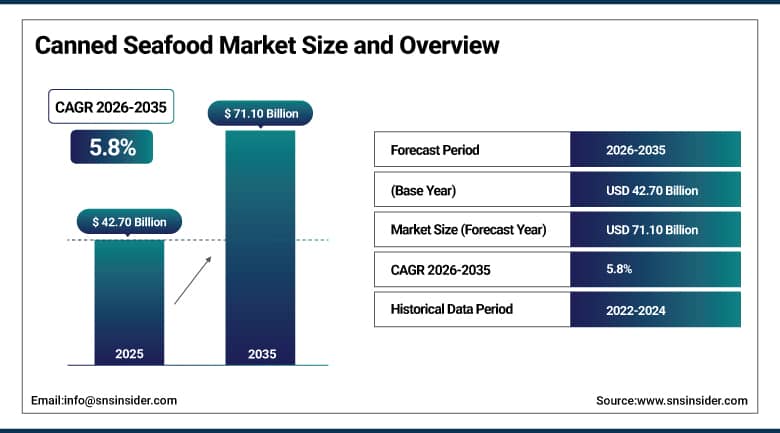
The Canned Seafood Market was valued at USD 42.70 Billion in 2025 and is expected to reach USD 71.10 Billion by 2035, growing at a CAGR of 5.8% from 2026 to 2035.
The Canned Seafood Market is witnessing constant growth owing to increasing consumer demand for easy-to-use, budget-friendly, and shelf-stable sources of protein. Urbanization, hectic lifestyles, and preference for convenient food products are motivating consumers to opt for canned seafood as an easy-meal solution. Awareness regarding the health benefits associated with eating seafood such as high protein content, omega-3 fatty acids, vitamins, and minerals is further driving the demand for the market. Advances in canning technology, packaging solutions, product quality, and shelf life are increasing the accessibility of the product. Moreover, increased availability through modern retail stores, supermarkets, convenience stores, and e-commerce is adding fuel to the growth of the market.
Thai Union launched an industry-first shelf-stable tuna product in a recyclable mono-material pouch in July 2026, providing up to 46 grams of protein per two-serving pouch, contributing to the company's SeaChange 2030 commitment to have 100% of branded products use sustainable packaging across all formats, having reached 91% progress by the end of 2025, with the technology continuing to roll out across Thai Union's branded portfolio through 2026 and additional launches planned for 2027.
To Get More Information On Canned Seafood Market - Request Free Sample Report
Canned Seafood Market Trends
-
Growing responsibly sourced tuna and premium sardines demand continues to reinforce traceability and sustainability claims that aid retailer trust and exports.
-
Rising ready-to-eat meal positioning, low-sodium options, and easy-open can innovation continue to broaden canned seafood's consumer appeal.
-
Expanding retort pouch and flexible packaging adoption continues to benefit from enhanced portability and reduced storage requirements relative to traditional cans.
-
Increasing QR code traceability features on premium packaging continue transforming traditional canned seafood into an interactive consumer experience.
-
Growing upscale restaurant adoption of conservas-style canned seafood spreads, often paired with curated wine selections, continues elevating the category's premium positioning.
U.S. Canned Seafood Market Outlook
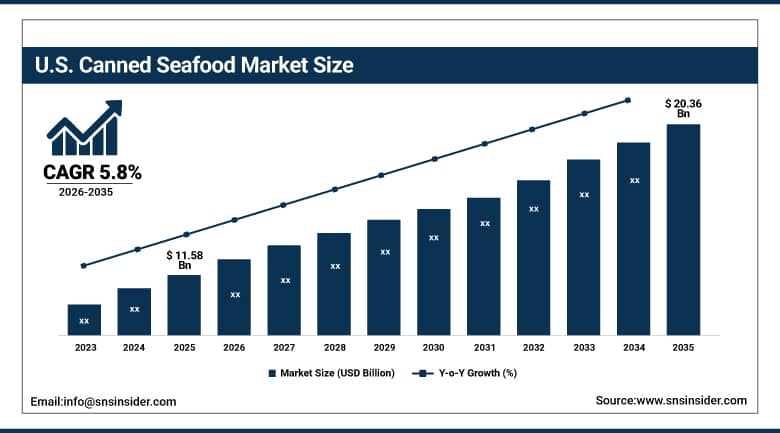
The U.S. Canned Seafood Market was valued at USD 11.58 Billion in 2025 and is projected to reach USD 20.36 Billion by 2035, growing at a CAGR of 5.8% during 2026-2035.
The U.S. Canned Seafood Market is witnessing growth owing to the rise in consumer demand for easy-to-carry and affordable sources of proteins. Consumers are becoming more inclined towards buying canned seafood for its convenient nature and prolonged shelf life. Awareness about the nutritional value of seafood in terms of protein content and omega-3 fatty acids is fueling its consumption. Distribution channels such as supermarkets, hypermarkets, convenience stores, and online stores are making these products easily available to consumers. Apart from that, innovations in the product, such as flavored, low sodium, sustainable, and high-end canned seafood are also helping in boosting the market.
StarKist Co. continued expanding flavored tuna pouches and sustainably sourced product lines to meet rising American consumer demand for premium, convenient tuna offerings, competing directly with Thai Union's John West and Chicken of the Sea brands amid Bumble Bee Foods' ongoing restructuring, which has opened meaningful North American market share opportunities for competitors investing in innovation and distribution expansion.
Canned Seafood Market Segment Analysis
-
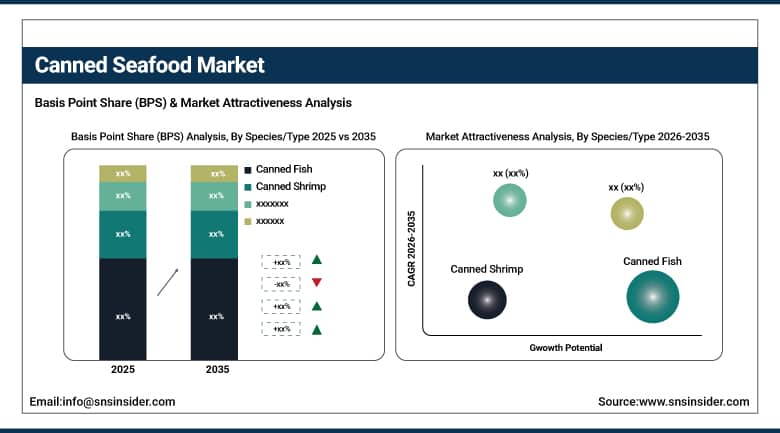
By Species/Type, Canned Fish segment dominated the Canned Seafood Market in 2025 with 72% share; Canned Shrimp segment is the fastest-growing segment.
-
By Packaging Material, Steel Cans segment dominated the Canned Seafood Market in 2025 with 68% share; Retort Pouches segment is the fastest-growing segment.
-
By Product Form, Chunks/Pieces segment dominated the Canned Seafood Market in 2025 with 64% share; Whole segment is the fastest-growing segment.
-
By Distribution Channel, Off-Trade segment dominated the Canned Seafood Market in 2025 with 86% share; On-Trade segment is the fastest-growing segment.
By Species/Type, Canned Fish dominated by species/type, while Canned Shrimp is the fastest-growing segment.
Canned Fish dominated the Canned Seafood Market in 2025 with a 72% share, supported by familiarity, cost-effectiveness, and wide availability of canned seafood among consumers globally. The tuna, salmon, sardines, and mackerels have gained popularity as they are rich sources of proteins, are durable, and easy to prepare. Furthermore, the availability of robust infrastructure, efficient supply chain, and varied product options keeps their demand sustained. The consumption of canned fish is common in home cooking as well as salads, sandwiches, and other ready-to-eat dishes.
Canned Shrimp is the fastest-growing segment, owing to growing consumer inclination towards convenient seafood products that are high in protein content and unique flavor. Consumers have shown increasing interest in having their diet based on seafood and also in preparing easy meals. Furthermore, canned shrimps offer a longer shelf life compared to fresh seafood and innovations in product offerings are making it more available in varied flavors and preparations. Higher disposable income, consumption of seafood, and increased availability via supermarkets and online grocery portals are driving the growth of this segment.
By Packaging Material, Steel Cans dominated by packaging material, while Retort Pouches are the fastest-growing segment.
Steel Cans dominated the Canned Seafood Market in 2025 with a 68% share, owing to its durability, barrier performance, and capability to protect seafood from exposure to light, oxygen, and any kind of external contamination. The steel cans have a long shelf life and are highly durable enough to withstand high temperature sterilization process used in the canned seafood manufacturing process. Other factors supporting the popularity of the material include existing manufacturing facilities, stacking capability, and transportation. Consumer awareness, cost effectiveness, and recyclability are among the other factors driving the adoption of the material.
Retort Pouches are the fastest-growing packaging material, owing to growing demand for portable and efficient seafood packaging material. The lightweight nature of the material allows using less amount of packaging material compared to traditional cans along with providing high barrier performance and a long shelf life. The lightweight material is expected to lower down the need of transportation. Other factors supporting the growth of retort pouches include easy opening feature and portion control.
By Product Form, Chunks/Pieces dominated by product form, while Whole Seafood is the fastest-growing segment.
Chunks/Pieces dominated the Canned Seafood Market in 2025 with a 64% share, due to the convenience, versatility and wide usage of the product format in meal preparations. The chunked seafood can be added to salads, sandwiches, pasta, pizzas, soups and meals and is highly popular with consumers due to its versatility and easy application in daily life. Chunked seafood provides easy portioning and even distribution of the product in cans. High demand for the products like tuna along with the existing processing technologies and wide availability makes the segment leader in the market.
Whole seafood is the fastest-growing product form, driven by growing customer interest in premium, attractive, and less processed seafood products. Whole fish and other seafood products can convey an idea of authenticity and naturalness of the products in question. Growing interest in traditional seafood meals and premium experiences also fosters demand. Manufacturers are adding whole products to their line-up to cater to consumers' desire for unique seafood products. Increasing disposable incomes and experimentation with seafood cuisine contribute to the development of the category.
By Distribution Channel, Off-Trade dominated by distribution channel, while On-Trade is the fastest-growing segment.
Off-Trade dominated the Canned Seafood Market in 2025 with an 86% share, because the canned seafood is mainly bought for private use in supermarkets, hypermarkets, grocery stores, convenience stores, and online. Long storage period makes such products well suited for the retail trade and household storage. The consumers have an advantage of convenient storage, various discounts, extensive choice of products, and easy accessibility. The presence of retail distribution channels and the high demand for cheap, protein-filled, and convenient products also helps to dominate the Off-Trade sector.
On-Trade is the fastest-growing distribution channel, due to the increase in restaurants, cafes, hotels, catering companies, and other food service organizations using the canned seafood as an ingredient for cooked meals. The canned seafood is better in terms of stable quality, convenient storage, small number of preparations required, and decreased risk of spoiling in comparison with some of the fresh products. The growing demand for seafood salads, sandwiches, pasta, pizza, and pre-made dishes contributes to its consumption.
Regional Insights
|
Region |
Country |
Regional Share (2025) |
|---|---|---|
|
Asia Pacific |
China |
34.60% |
|
North America |
United States |
84.60% |
|
Europe |
Germany |
22.80% |
|
Middle East & Africa |
UAE |
20.60% |
|
Latin America |
Brazil |
24.60% |
Asia Pacific Canned Seafood Market Insights
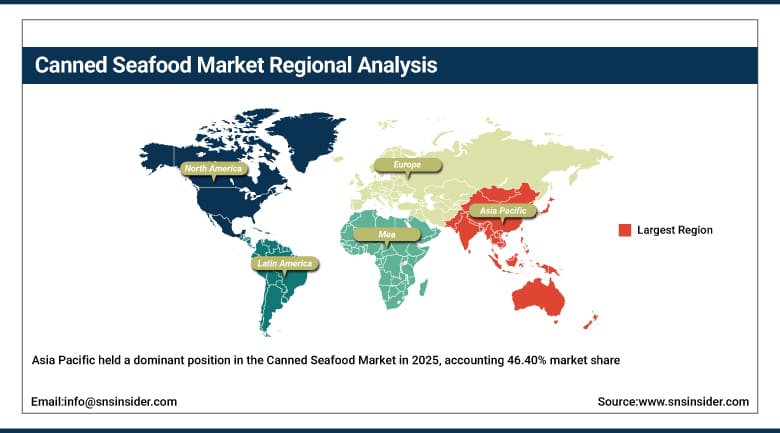
Asia Pacific held a dominant position in the Canned Seafood Market in 2025, accounting 46.40% market share, owing to evolving consumer preferences, increased urbanization, and high disposable income levels. Increasing demand for convenient and affordable sources of protein foods is aiding the growth of the market. Moreover, the region is also expected to witness high growth, fueled by an increasing middle class population and consumption of seafood in Indonesia, Vietnam, and Philippines, especially among urban consumers.
In 2025, China was responsible for about 34.60% of the Asia Pacific market. This can be attributed to the increasing urban population and developed retail network in the country. Other countries, including Japan, India, and South Korea, are also contributing towards growth in the region. Japan is witnessing growth in its tuna industry through its artisanal packaging and partnering with the Global Tuna Alliance.
Get Customized Report as Per Your Business Requirement - Enquiry Now
North America Canned Seafood Market Insights
In 2025, North America accounted for a considerable portion of the global Canned Seafood Market driven by the increased preference for easy, budget-friendly, and shelf-stable products in busy families. Increased preference for meal preparation and protein consumption will continue to drive consumption trends. Innovations such as flavors in pouches and convenient packing will further enhance market attractiveness. In addition, the leading brands will expand their sustainable product lines, making North America increasingly important in the global canned seafood industry.
In 2025, the United States was responsible for about 84.60% of the North American market due to its sizable health-conscious consumer population and presence of leading canned seafood producers such as StarKist, Bumble Bee, and American brands of Thai Union. Canada has been adding to regional growth through increased adoption of canned seafood and interest in sustainable sources.
Europe Canned Seafood Market Insights
The Europe region held a significant market share of the global Canned Seafood Market in 2025, backed by increased investment in EU fisheries and aquaculture, along with growing consumer preference for canned tuna, sardines, salmon, and mackerel. Falling sales of fresh fish is driving consumers towards looking for easier options with increased shelf-life. Moreover, the EU Packaging Regulation, which will be enforced from February 2025, is pushing for recyclable packaging solutions, thereby aiding in increasing demand for sustainable canned seafood.
Germany emerged as the leader of the European market, capturing 22.80% market share in 2025, driven by the well-developed retail network in the country and consumer demand for shelf stable protein food items. Spain, Italy, and Portugal are some of the other regions adding value to regional growth, backed by leading canned seafood producers such as Grupo Calvo and Conservas Garavilla, among others.
Middle East & Africa and Latin America Canned Seafood Market Insights
The Middle East & Africa region has witnessed consistent growth in the Canned Seafood Market on account of investment in advanced retail infrastructure and growing consumer inclination towards easy-to-cook protein products in Gulf nations. Growing urbanization and changing dietary habits have resulted in an increased consumption of ready-to-eat seafood. On the other hand, Latin America has been benefited by changing preferences of food items in households, where consumers have been opting for leaner marine proteins as compared to heavy proteins.
UAE dominated the Middle East & Africa market with a regional share of 20.60% in 2025 owing to consistent modern retail growth and increasing consumption of proteins in diets. Brazil was 24.60% of the Latin American market in 2025 owing to growing affordability as compared to fresh & refrigerated fish products, with contribution of Mexico towards regional growth in terms of growing consumption of canned seafood.
Growth Drivers: Convenience Consumption and Sustainable Sourcing Innovation Driving Market Growth
The drivers behind The Canned Seafood Market include increasing demand for convenient foods, with consumers opting for ready-made and quick-to-prepare foods in view of an ever-faster lifestyle. The demand is more prevalent in working-class people and young generation who choose convenience in their diets because of lack of time, but at the same time the health benefits of canned seafood products contribute greatly to their popularity.
Responsibly sourced tuna and premium sardines demands are continuously growing, supporting the traceability and sustainability claims which are helping to increase retailer confidence and exports. Increasing ready-to-eat meals positioning, low sodium alternatives, and innovations in easy-open cans are continuously increasing consumer appeal. Increasing adoption of retort pouches and flexible packaging is benefitting from portability.
Restraints: Overfishing Concerns and Regulatory Sustainability Requirements Limiting Market Expansion
Given the favorable underlying demand, the industry is however characterized by some notable barriers linked to overfishing and consumer demands, which necessitate the strategic positioning by the major industry players around sustainable fishing and certifications. Compliance with regulations such as EU's Packaging Regulation aimed at recyclable materials still remains a continuous burden to the industry players in terms of investment towards packaging reformulation.
The increasing competitive pressures within the market due to more brands of canned seafood available especially given the ongoing restructuring in the market amongst the major players, giving chances to other brands, have increasingly become evident within the wider market of canned seafood. Increasing raw material prices linked to fish stocks have also been seen in the industry.
Opportunities: Premium Sardines and Mackerel Innovation and Sustainable Packaging Expansion Creating New Growth Avenues
There is huge potential in the development of premium sardines and mackerels, taking advantage of the growing trend of canned sardines and mackerels sweeping through specialty retailers in Europe and North America. Companies that can market responsibly-sourced, traceable, and sustainable packaged canned seafood will benefit from a huge share of the category growth as retail confidence and exports continue to increase.
The development of premium canned seafood brands via direct-to-consumer channels is another promising growth opportunity, especially since e-commerce distribution is becoming more popular among discerning consumers. Another growth opportunity lies in the development of upscale restaurants that use conservas-type products and QR code traceability in Asia Pacific markets.
Recent Developments:
-
2026: Thai Union's mono-material pouch technology, providing up to 46 grams of protein per two-serving pouch, is rolling out across its branded portfolio through 2026, with additional launches planned for 2027.
-
2020-2026: Bumble Bee Seafood Company committed USD 40 million over five years toward ocean restoration and protection efforts through a dedicated Accelerator Fund.
-
2020-2026: Bumble Bee partnered with FCF Fishery Company and Ocean Outcomes to launch a longline albacore Fishery Improvement Project in the Indian Ocean, working toward Marine Stewardship Council certification.
-
2026: StarKist Co. continued expanding flavored tuna pouches and sustainably sourced product lines to meet rising consumer demand for premium, convenient tuna offerings.
Canned Seafood Companies are:
-
Thai Union Group PCL
-
Bolton Group S.p.A.
-
Dongwon Industries Co., Ltd. (StarKist)
-
Bumble Bee Foods, LLC
-
Maruha Nichiro Corporation
-
Century Pacific Food Inc.
-
Trident Seafoods Corporation
-
Tri Marine Group
-
Wild Planet Foods Inc.
-
Grupo Calvo / Nauterra
-
Nueva Pescanova S.L.
-
Royal Greenland A/S
-
Sajo Industries Co., Ltd.
-
Universal Canning Incorporated
-
Mowi ASA
-
Princes Group
-
Clover Leaf Seafoods
-
Alimentos Prosalud S.A.
Canned Seafood Market Report Scope:
| Report Attributes | Details |
|---|---|
| Market Size in 2025 | USD 42.70 Billion |
| Market Size by 2035 | USD 71.10 Billion |
| CAGR | CAGR of 5.8% From 2026 to 2035 |
| Base Year | 2025 |
| Forecast Period | 2026-2035 |
| Historical Data | 2022-2024 |
| Report Scope & Coverage | Market Size, Segments Analysis, Competitive Landscape, Regional Analysis, DROC & SWOT Analysis, Forecast Outlook |
| Key Segments | • By Species/Type (Canned Fish, Canned Shrimp, Canned Prawns, Other Types) • By Packaging Material (Steel Cans, Aluminum Cans, Retort Pouches, Other Packaging Material) • By Product Form (Whole, Chunks/Pieces) • By Distribution Channel (On-Trade, Off-Trade) |
| Regional Analysis/Coverage | North America (US, Canada), Europe (Germany, UK, France, Italy, Spain, Russia, Poland, Rest of Europe), Asia Pacific (China, India, Japan, South Korea, Australia, ASEAN Countries, Rest of Asia Pacific), Middle East & Africa (UAE, Saudi Arabia, Qatar, South Africa, Rest of Middle East & Africa), Latin America (Brazil, Argentina, Mexico, Colombia, Rest of Latin America). |
| Company Profiles | Thai Union Group PCL, Bolton Group S.p.A., Dongwon Industries Co., Ltd. (StarKist), Bumble Bee Foods, LLC, Maruha Nichiro Corporation, Nissui Corporation, Century Pacific Food Inc., Trident Seafoods Corporation, Tri Marine Group, Wild Planet Foods Inc., Grupo Calvo / Nauterra, Nueva Pescanova S.L., Royal Greenland A/S, Sajo Industries Co., Ltd., American Tuna Inc., Universal Canning Incorporated, Mowi ASA, Princes Group, Clover Leaf Seafoods, Alimentos Prosalud S.A. |
Frequently Asked Questions
The Canned Seafood Market is expected to grow at a CAGR of 5.8% from 2026 to 2035.
The Canned Seafood Market was valued at USD 42.70 Billion in 2025.
The market is driven by rising demand for convenience foods, portion control, protein content, affordability, and no refrigeration requirement.
The Canned Fish segment dominated the Canned Seafood Market in 2025.
The Asia Pacific region dominated the Canned Seafood Market in 2025, accounting for approximately 46.40% market share.
