
Infant Nutrition Market Report Scope & Overview:
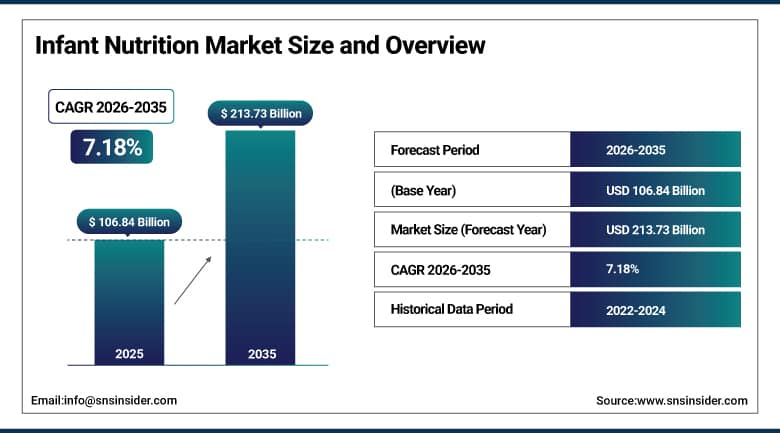
The Infant Nutrition Market was valued at USD 106.84 Billion in 2025 and is expected to reach USD 213.73 Billion by 2035, growing at a CAGR of 7.18% from 2026-2035.
The Infant Nutrition Market is represented by an increasing number of working mothers, expanding urban populations, and greater parental awareness of the importance of proper nutrition in infancy for immunity, cognition, and overall health. Parents spend more on high-quality infant formulas, organic foods, products dealing with allergy, reflux, and digestive sensitivity problems, and growing disposable incomes in Asia Pacific, Latin America, and the Middle East are increasing the consumer base. The rapid expansion of toddler milks and growing-up formulas is extending brand loyalty well past the first year of life. Manufacturers have increased investments in developing formulas that mimic natural breast milk composition through the addition of human milk oligosaccharides, milk fat globule membrane, probiotics, and DHA.
In June 2025, The Nestlé group widened the coverage of NAN Sinergity, which is said to be the first baby formula that incorporates the combination of six human milk oligosaccharides together with B. infantis probiotic.
To Get More Information On Infant Nutrition Market - Request Free Sample Report
Infant Nutrition Market Trends
-
Rising use of multi-HMO, probiotic, and MFGM-enriched formulas designed to mirror breast milk.
-
Growing demand for organic, whole-milk, and grass-fed infant formulas with clean-label positioning.
-
Expanding availability of plant-based and dairy-plant blend formulas for allergy-conscious and vegan families.
-
Increasing adoption of ready-to-feed liquid formats for convenience among working parents.
-
Stricter heavy-metal and pathogen testing programs reshaping supplier quality standards and retailer sourcing.
-
Rapid growth of online and subscription-based infant nutrition sales across North America and Asia Pacific.
U.S. Infant Nutrition Market Outlook
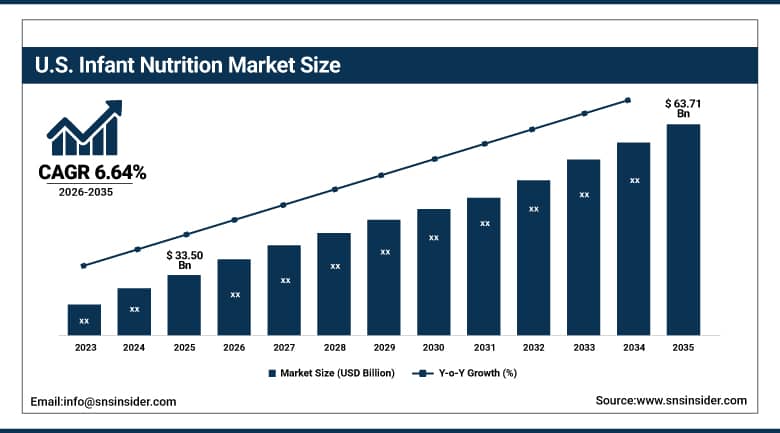
The U.S. Infant Nutrition Market was valued at USD 33.50 Billion in 2025 and is expected to reach USD 63.71 Billion by 2035, growing at a CAGR of 6.64% from 2026-2035.
Infant nutrition market growth in the United States continues to benefit from high formula consumption by working parents, robust retail and pharmacy distribution networks, and the participation of prominent manufacturers like Abbott, Reckitt's Mead Johnson, Nestlé's Gerber, and Perrigo. The level of safety regulation is also being stepped up; on April 29, 2026, the Food and Drug Administration in the United States issued the findings of its expanded test of contaminants in infant formula under Operation Stork Speed and its Closer to Zero program. Challengers such as Bobbie and Kendamil also continue to make headway with their products through emphasis on organic, whole milk, and European-style formulas.
In August 2026, The Abbott Company introduced the Similac 360 Total Care Made With Whole Milk formula, which was claimed to be the only ready-to-feed liquid formula made from whole milk. It became available in the US, catering to the demands of parents.
Infant Nutrition Market Segment Analysis
-
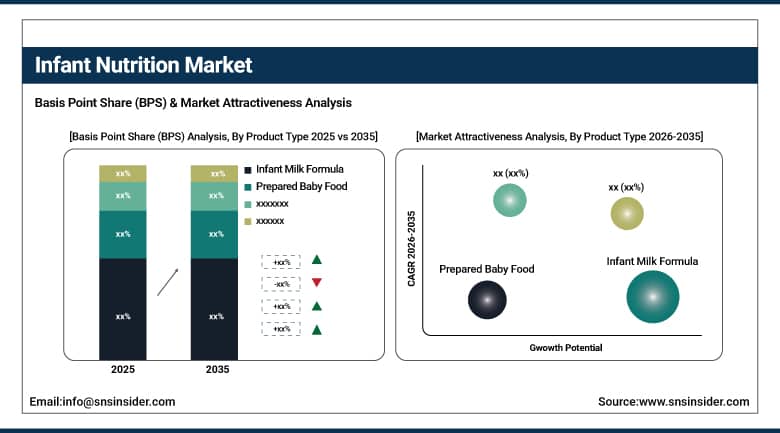
By Product Type, the Infant Milk Formula segment dominated the Infant Nutrition Market with approximately 41.36% share in 2025, while the Prepared Baby Food segment is the fastest growing with a CAGR of approximately 8.12%.
-
By Form, the Solid segment dominated the Infant Nutrition Market with approximately 61.84% share in 2025, while the Liquid segment is the fastest growing with a CAGR of approximately 8.06%.
-
By Age Group, the 0–6 Months segment dominated the Infant Nutrition Market with approximately 42.18% share in 2025, while the 12 Months & Above segment is the fastest growing with a CAGR of approximately 8.24%.
-
By Distribution Channel, the Hypermarkets/Supermarkets segment dominated the Infant Nutrition Market with approximately 38.94% share in 2025, while the Online segment is the fastest growing with a CAGR of approximately 10.36%.
By Product Type, Infant Milk Formula Dominates the Infant Nutrition Market and Prepared Baby Food Grows Fastest
Infant Milk Formula held the leadership in 2025 owing to the fact that formula serves as the main source of nourishment or as an additional supplement for a number of infants whose mothers fail to breastfeed exclusively owing to their work, health, or other issues. Formula represents a non-discretionary and repetitive purchase. Thus, demand will not change in case of economic downturns. Infant formula continues to increase its value with the addition of human milk oligosaccharides, probiotics, DHA, and milk fat globule membrane. Moreover, new formulas are being launched in order to cater to colic, reflux, and cow's milk protein allergy.
The fastest growing category in the industry is that of Prepared Baby Food. The reason for this is that due to parents being very busy, they now prefer ready-to-eat foods like baby food purees, pouches, meals, and finger foods, which allow them to save time but do not affect the quality of the nutrition. Organic, low sugar, vegetable-based and allergen introduction food options have been added by companies which are attracting millennial and Gen Z parents who are health conscious. Squeeze pouches and portion-controlled packaging has made these products easy to consume and direct-to-consumer delivery options of fresh baby food meals have further added to the convenience factor.
By Form, Solid Dominates the Infant Nutrition Market and Liquid Grows Fastest
Solid segment dominated the market in 2025 due to the dominance of powdered infant formula, infant cereals, dried baby food, and snacks, which make up the majority of the infant nutrition volume worldwide. Powdered infant formula provides a lower price per feed, a longer shelf life, and ease of storage and transportation, making it the preferred option for most consumers and emerging markets. Cereals and dried baby foods are the initial complementary baby food types used at about six months of age. The manufacturers’ preference for powder baby foods is attributed to ease of processing, fortification, and vitamin addition, hence retaining its leading market share globally.
Liquids are expected to be the fastest growing form, driven by increasing demand for ready-to-feed and liquid concentrates from working parents and caregivers. Ready-to-feed forms avoid the step of mixing and measuring the formula, thereby reducing the chances of preparation mistakes and enabling usage while traveling or at nighttime. The recent introduction of superior liquids formulated using whole milk and novel ingredients is further contributing to the growth in demand for this category. Despite the relatively high cost and heavier packaging associated with liquid forms, an increase in dual income families across North America, Europe, and urban Asia Pacific, coupled with better safety positioning compared to powders, continues to fuel growth in the liquids category.
By Age Group, 0–6 Months Dominates the Infant Nutrition Market and 12 Months & Above Grows Fastest
0-6 Months Age Segment held the major market share in 2025 due to infants being solely dependent on breast milk or infant formula, hence making formula intake per child the highest in this age group. Caregivers and doctors are also most careful in this age group and this increases the demand for high-quality starter formula that is clinically proven and recommended by hospitals. Starter formula brands that are introduced through hospital and maternity ward sampling programs usually become regular products for families. Stringent control over the composition of first infant formula ensures product quality and price remains high. Innovation of HMO and easily digestible starter formula ensures dominance of 0-6 Months age segment.
Twelve Months & Over is the fastest-growing age group because there are a growing number of growing-up milk products, toddler formulas, and highly nutritious snacks that cater to the requirements of parents who want to continue providing nutritional support to their children after one year. There are new products being developed for toddlers which contain DHA, iron, probiotics, and organic and plant-based ingredients, which helps the brand extend its customer base beyond infancy. In addition, toddler products have less regulations regarding marketing when compared with infant formula in several countries, which makes them an important avenue for growth for leading brands.
By Distribution Channel, Hypermarkets/Supermarkets Dominate the Infant Nutrition Market and Online Grows Fastest
Hypermarkets/Supermarkets were the leading market segment for infant formulas, cereals, purées, and baby snacks since these types of outlets provide large-format stores where customers can obtain the products. They provide a broad range of product choices among regular and premium brand names, attractive prices, and promotions suitable for the repetitive nature of purchases of infant food products. Mothers appreciate the option to purchase formula in the same store with diapers, wipes, and other goods needed at home. The expansion of baby aisle sections by companies such as Walmart, Target, Kroger, Carrefour, and Tesco will further support the channel of distribution.
The fastest-growing channel is the online channel, because more and more parents are purchasing infant formula and baby food via e-commerce sites, branded websites, and subscription services, which deliver regular orders right to their door. The advantage of the online channel is the variety of specialty, imported, organic, and hypoallergenic products that may not be available locally. Subscription-based ordering prevents a shortage of formula and also offers savings that increase customer loyalty. The leading e-commerce channel countries include China, where cross-border e-commerce is used to purchase imported formula, and North America, where Bobbie has gained popularity using online launch.
Regional Analysis
|
Region |
Major Country |
Share within Region, 2025 (%) |
|
North America |
United States |
86.42% |
|
Asia Pacific |
China |
38.74% |
|
Europe |
Germany |
22.68% |
|
Latin America |
Brazil |
44.86% |
|
Middle East & Africa |
Saudi Arabia |
29.42% |
North America Infant Nutrition Market Insights
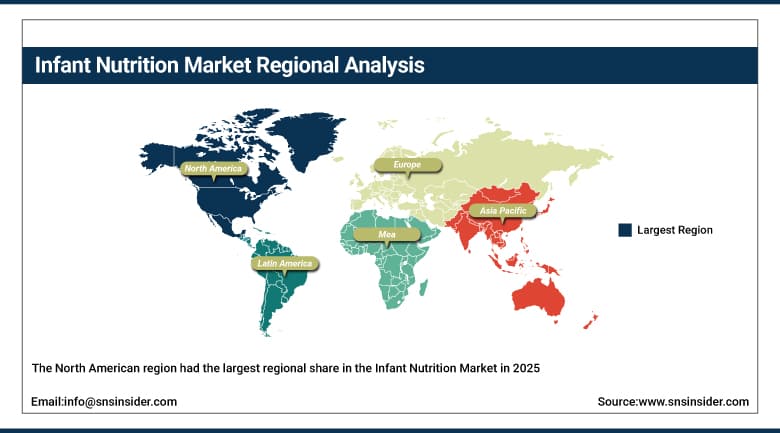
The North American region had the largest regional share in the Infant Nutrition Market in 2025, accounting for about 36.28% of the global market, backed by high formula consumption, high income levels, and top companies such as Abbott, Mead Johnson, Gerber, and Perrigo. High proportion of working moms and premium products preferences are boosting the demand in the region. Wide distribution through mass merchandisers, grocery stores, pharmacies, and e-commerce is available in the region and the government-funded WIC program facilitates access to formula for poor families. Parents are upgrading to organic, whole milk and HMO formula brands and clean label baby food brands.
North America is led by strong demand from the US, bolstered by a sizable formula market, an emerging challenger brands segment, and increased regulation on formula safety and security post-2022 shortage. Operation Stork Speed and increased contamination tests by the FDA have raised quality standards for all producers. Canadian growth is fueled by growing demand for European-style infant formulas and organic baby food imports, whereas Mexico is boosted by its expanding retail presence. Investments into domestic production capacities, introduction of new product lines in liquid and specialty forms, and expansion of subscription-based sales are forecast to continue driving North America's dominance throughout the forecast period.
Get Customized Report as Per Your Business Requirement - Enquiry Now
Asia Pacific Infant Nutrition Market Insights
Asia Pacific is expected to grow with the highest CAGR of around 8.94% between 2026 and 2035. This is due to the large population of infants, higher income levels, urbanization, and increasing workforce participation of women in the country. The parents in China, India, Indonesia, and Vietnam have become more willing to purchase premium, imported, and organic products of infant formula and baby foods. There is a huge demand for formulas having HMOs, probiotics, or A2 or goat milk proteins.
China remains an important factor in regional demand in that it is the biggest infant formula market in the world with local manufacturers like Feihe and Yili competing with international manufacturers, along with a recipe registration system influencing market entry. Even with low birth rates, market value will be sustained due to premiumization trends and a move towards more value-added formulas. The fast-growing markets will be India, with its big birth cohort, rising incomes and increasing modern retail presence. In Japan and South Korea, emphasis will be placed on quality and specialization, while Australia and New Zealand will become important exporters of premium dairy formula.
Europe Infant Nutrition Market Insights
Europe represents an important market share in the Global Infant Nutrition Market due to stringent regulations in terms of formulation, labeling, and marketing of formulas, as well as consumers’ preference towards organic and scientifically proven products. Among the major companies that dominate the market are Nestlé, Danone, FrieslandCampina, Arla, HiPP, Lactalis, and Kendal Nutricare, some of which export expensive formulas to other parts of the world. There is great reputation for the quality of formulas that is driving demand from other regions, including Asia, the Middle East, and North America. Increased focus on food safety after ingredient recalls in 2026 has led to better supplier audits and testing.
The Germany region plays an important role in terms of demand for the market because of its high consumer awareness about organic and biodynamic baby foods as well as the presence of brands like HiPP and Holle. France has been contributing to the regional demand through the significant number of manufacturers in the dairy industry as well as infant formula industry, along with higher parental expenditure on premium nutrition products. The United Kingdom is witnessing the increasing demand for whole-milk and goat milk formulas due to local brands. Formula production and export from Netherlands and Ireland regions would be an important aspect.
MEA & Latin America Infant Nutrition Market Insights
The Middle East and Africa region continues to be one of smaller markets in terms of size but its growth is being driven by higher birth rates, urbanization trends, and increasing disposable incomes. In Saudi Arabia and UAE, there is higher demand for premium imported formulas from Europe and Australia thanks to modern retail and pharmacy channel networks in addition to health policies as a part of Vision 2030. Nigeria and South Africa continue to be emerging markets in Africa due to improved affordability of formula products and increased presence of supermarket stores.
The Latin American market will grow due to increasing participation of women in the workforce, urbanization, and increased retail activity in modern formats, which will increase the availability of infant formula and baby food products in the region. The main driver of demand in Latin America is Brazil, where the market has the most developed infrastructure for production of infant formula products from leading multinationals, as well as a growing middle class, which is switching to premium formulas. Mexico is demonstrating high growth potential due to expanding modern retail chains and pharmacies and increasing knowledge about fortified infant nutrition. In Argentina, Colombia, and Chile, there is a stable demand for infant cereals and milk.
Market Dynamics
Growth Drivers: Rising Working Mothers and Demand for Breast Milk-Like Premium Nutrition
Growing number of working mothers is considered to be the key factor for Infant Nutrition Market growth, due to increased tendency of mothers returning back to work within a month or two after giving birth, using infant formula and baby food for convenience. Urbanization, two-income households, lack of time for cooking are all factors that contribute to increased sales of ready-to-feed formula, ready-to-use baby food in pouches and finger foods. Higher disposable income allows families to purchase premium products. Emerging markets in APAC, Latin America, and the Middle East show strong growth potential, due to the growing number of working mothers.
The second main growth catalyst is the rising demand for premium nutrition that is close to breast milk because more and more parents look for formula types that can provide the same composition and properties as human milk. Producers are enriching their products with ingredients like human milk oligosaccharides, B. infantis probiotics, milk fat globule membrane, lactoferrin, and DHA, which are aimed at boosting the baby's immune system, digestive tract, and brain development. Higher price levels and differentiation are the key features of these new innovations. Also, clean label, organic, whole milk, and grass-fed are additional factors attracting more parents to choose premium formula types.
Restraints: Product Safety Recalls and Declining Birth Rates in Key Markets
Product safety recalls pose a considerable limitation on market expansion since food contamination cases can easily cause consumers to lose trust in their products and affect the supply chain. Recent cases of botulism that resulted from contaminated organic whole milk powder formulas in the United States and product recalls due to contamination of ARA oil globally in 2026 demonstrate the risks that exist within the ingredient supply chain. Recalls, legal actions, and changes in brands by parents become some of the outcomes of these events that affect the cost structure of companies.
Decreasing birth rates in important markets would be another restriction because lower fertility rates in China, Japan, South Korea, and most of Europe and North America are constantly decreasing the number of babies who use formula and baby foods. China, which is the biggest market for infant formulas, has experienced a decrease in annual births in the past ten years, and therefore, competition between various local and foreign brands has become more intense. Promotion of breast-feeding by the authorities and restrictions on infant formulas according to WHO International Code would also be a growth barrier in certain countries.
Opportunities: Plant-Based and Specialty Formulas and Emerging Market Expansion
Formula made from plants and specialty formula present an opportunity because increasingly parents are looking for alternate products for babies who suffer from cow's milk protein allergy or lactose intolerance or because they follow a vegetarian/vegan lifestyle. Formula is being developed using protein derived from pea, rice, almond, buckwheat and soy, and even formulas using a combination of dairy and plant protein, hydrolyzed formula and amino acid formulas. The goat milk formula and the A2 milk formula have started making headway too as they are gentler formulations.
Emerging market extension is another means through which this growth can be achieved as there are emerging markets such as India, Indonesia, Vietnam, the Philippines, Nigeria, as well as some Latin American countries that have high birth cohorts and growing incomes and yet their consumption levels are very low when it comes to packaged infant nutritional products. The emergence of modern shopping malls, pharmacy chains, as well as e-commerce websites is increasing access to infant formulas and baby foods outside the main urban centers. Through local manufacturing alliances and affordable product lines, corporations can target price-sensitive consumers while imported premium products can target richer urban households.
Recent Developments:
-
February 2026: Munchkin entered the infant formula category with the launch of Munchkin Infant Formula, offering Original and Made with Organic Milk variants to expand beyond its feeding accessories portfolio.
-
July 2025: Bobbie launched its organic infant formulas on Costco's online platform, where sales reached twice the company's initial goal immediately after launch.
-
June 2025: Kendamil expanded the availability of its European-made whole-milk infant formulas across Canada to meet growing demand from Canadian families.
-
April 2024: Else Nutrition launched its almond- and buckwheat-based Follow-On formula for infants aged 6 to 12 months and its Toddler Drink in Australia, marking its entry into Asia Pacific.
-
March 2023: Danone North America introduced Pepticate, a hypoallergenic infant formula brand, in the U.S. to support families managing cow's milk protein allergy.
Infant Nutrition Market Key Players
-
Nestlé S.A.
-
Danone S.A.
-
Abbott Laboratories
-
Reckitt Benckiser Group plc (Mead Johnson Nutrition)
-
Perrigo Company plc
-
Royal FrieslandCampina N.V.
-
Arla Foods amba
-
Heilongjiang Feihe Dairy Co., Ltd.
-
Inner Mongolia Yili Industrial Group Co., Ltd.
-
HiPP GmbH & Co. Vertrieb KG
-
Hero Group
-
Kendal Nutricare Ltd. (Kendamil)
-
Bobbie Baby, Inc.
-
Else Nutrition Holdings Inc.
-
Meiji Holdings Co., Ltd.
-
Morinaga Milk Industry Co., Ltd.
-
Lactalis Group
-
The a2 Milk Company Limited
-
Ausnutria Dairy Corporation Ltd.
-
Bellamy's Organic
Infant Nutrition Market Report Scope:
| Report Attributes | Details |
|---|---|
| Market Size in 2025 | USD 106.84 Billion |
| Market Size by 2035 | USD 213.73 Billion |
| CAGR | 7.18% from 2026 to 2035 |
| Base Year | 2025 |
| Forecast Period | 2026-2035 |
| Historical Data | 2022-2024 |
| Report Scope & Coverage | Market Size, Segments Analysis, Competitive Landscape, Regional Analysis, DROC & SWOT Analysis, Forecast Outlook |
| Key Segments | • By Product Type (Infant Milk Formula, Dried Baby Food, Prepared Baby Food, and Others) • By Form (Solid and Liquid) • By Age Group (0–6 Months, 6–12 Months, and 12 Months & Above) • By Distribution Channel (Hypermarkets/Supermarkets, Pharmacies/Drug Stores, Online, and Others) |
| Regional Analysis/Coverage | North America (US, Canada), Europe (Germany, UK, France, Italy, Spain, Russia, Poland, Rest of Europe), Asia Pacific (China, India, Japan, South Korea, Australia, ASEAN Countries, Rest of Asia Pacific), Middle East & Africa (UAE, Saudi Arabia, Qatar, South Africa, Rest of Middle East & Africa), Latin America (Brazil, Argentina, Mexico, Colombia, Rest of Latin America). |
| Company Profiles | Nestlé S.A., Danone S.A., Abbott Laboratories, Reckitt Benckiser Group plc (Mead Johnson Nutrition), Perrigo Company plc, Royal FrieslandCampina N.V., Arla Foods amba, Heilongjiang Feihe Dairy Co., Ltd., Inner Mongolia Yili Industrial Group Co., Ltd., HiPP GmbH & Co. Vertrieb KG, Hero Group, Kendal Nutricare Ltd. (Kendamil), Bobbie Baby, Inc., Else Nutrition Holdings Inc., Meiji Holdings Co., Ltd., Morinaga Milk Industry Co., Ltd., Lactalis Group, The a2 Milk Company Limited, Ausnutria Dairy Corporation Ltd., Bellamy's Organic |
Frequently Asked Questions
Key players include Nestlé S.A., Danone S.A., Abbott Laboratories, Reckitt Benckiser Group plc (Mead Johnson Nutrition), Perrigo Company plc, Royal FrieslandCampina N.V., and Feihe, among other global infant nutrition manufacturers.
Plant-based and specialty formulas, along with expansion into high-birth-rate emerging markets across Asia Pacific, Africa, and Latin America, represent the primary opportunities.
Growth is primarily driven by the rising number of working mothers combined with growing demand for premium, breast milk-like infant nutrition.
By Product Type, Infant Milk Formula dominated the market with approximately 41.36% share in 2025, reflecting its essential, recurring role in infant feeding.
North America dominated the market with approximately 36.28% share in 2025, driven by high formula usage, strong purchasing power, and leading manufacturers.
