
Tomato Processing Market Report Scope & Overview:
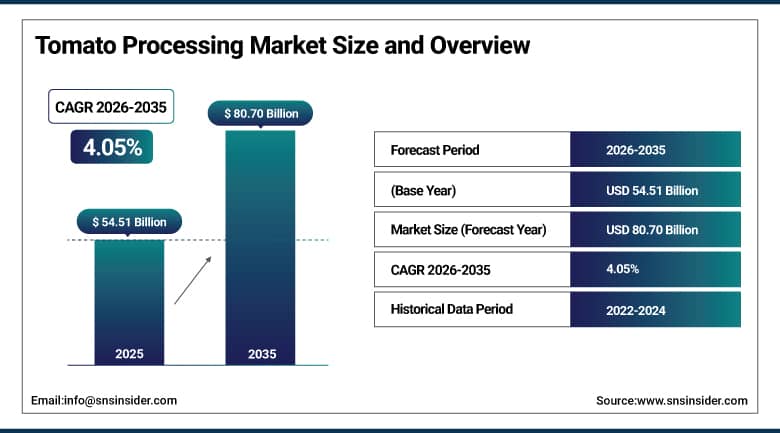
Tomato Processing Market was valued at USD 54.51 billion in 2025 and is expected to reach USD 80.70 billion by 2035, growing at a CAGR of 4.05% from 2026-2035.
The Tomato Processing Market is witnessing steady growth owing to growing demand for tomato products in the foodservice, retail and food manufacturing industries. Increasing consumption of tomato sauces, pastes, purees, canned tomatoes, juices, and other convenience foods is boosting the demand for efficient tomato processing technology. Urbanization, changes in eating habits, and rising consumption of ready-to-use food ingredients are some other factors contributing to market growth. Apart from that, innovations in processing technology, preservation technology, packaging, and cold chains are enhancing the quality of products. In addition, increasing use of tomato products as an ingredient in pizzas, pastas, soups, snacks, and prepared meals is opening new avenues for growth.
The World Processing Tomato Council reports that about 40 million tonnes of tomatoes are processed annually, with tomatoes representing the leading vegetable crop for processing.
To Get More Information On Tomato Processing Market - Request Free Sample Report
Tomato Processing Market Trends
-
Rising consumption of processed foods is driving demand for tomato sauces, pastes, purees, juices, and canned products.
-
Increasing demand for convenience foods is expanding applications of processed tomatoes across ready-to-eat and packaged food products.
-
Growing consumer preference for natural ingredients is supporting demand for tomato-based products with clean-label formulations.
-
Advancements in processing technologies are improving product quality, shelf life, efficiency, and resource utilization.
-
Increasing adoption of aseptic packaging is enhancing preservation and distribution of processed tomato products.
U.S. Tomato Processing Market Outlook
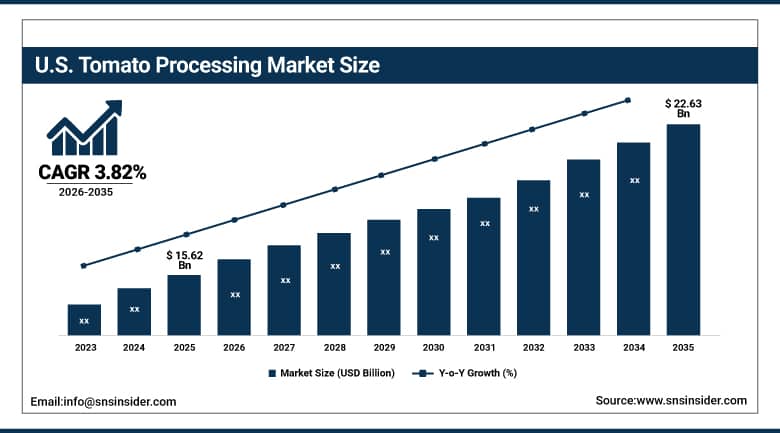
U.S. Tomato Processing Market was valued at USD 15.62 billion in 2025 and is expected to reach USD 22.63 billion by 2035, growing at a CAGR of 3.82% from 2026-2035.
The U.S. Tomato Processing Market is witnessing steady growth due to the rising demands for tomato products that have been processed. The increase in the consumption of tomato sauce, paste, puree, canned tomatoes, juice, and other foods containing tomatoes is fueling the growth of demand for processing solutions. The increasing demand for ready-to-use and shelf-stable food products from consumers is further adding to the market development. The improvement in the processing techniques, preservation techniques, packing, and cold chain in the processing of tomatoes is helping to make these products better. The increasing use of tomatoes for making ingredients such as pizzas, pasta, soups, and snacks is helping in generating more demand. The increasing investments in food processing and concern for quality and processing efficiency is helping the market to grow in the US.
The U.S. exported 666.5 million pounds of tomato paste to 75 countries in 2025, equivalent to 3.62 billion pounds on a fresh-weight basis.
Tomato Processing Market Segment Analysis
-
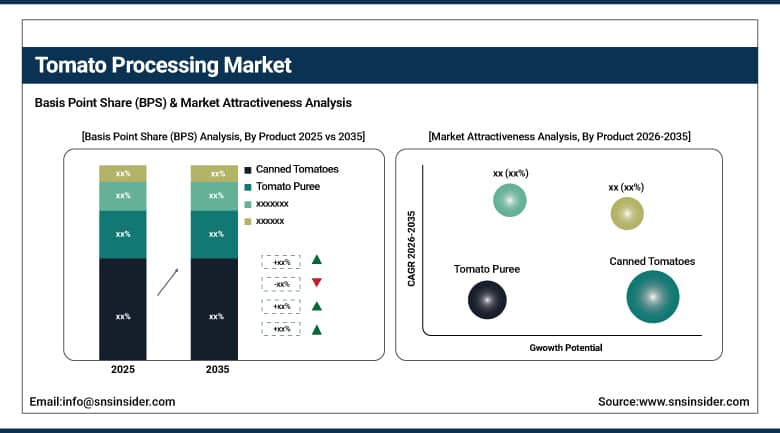
By Product, Canned Tomatoes dominate the Tomato Processing Market with 24% share in 2025; Dried Tomatoes & Powder are expected to grow at the fastest CAGR of 11.11% from 2026–2035.
-
By Processing Method, Canning dominates the Tomato Processing Market with 36% share in 2025; Drying is expected to grow at the fastest CAGR of 8.88% from 2026–2035.
-
By End Use, Household Consumers dominate the Tomato Processing Market with 46% share in 2025; Industrial Food Processors are expected to grow at the fastest CAGR of 5.24% from 2026–2035.
-
By Distribution Channel, Hypermarkets & Supermarkets dominate the Tomato Processing Market with 38% share in 2025; Online/E-commerce is expected to grow at the fastest CAGR of 6.39% from 2026–2035.
By Product, Canned Tomatoes dominate the Tomato Processing Market, Dried Tomatoes & Powder grow fastest.
Canned Tomatoes dominated the Tomato Processing Market with the highest revenue share of about 24% in 2025, Driven by the factors such as their longevity on the shelf, ease of use and widespread usage in food preparation at home. Canned tomatoes offer a consistent supply and quality of product all year round, as they are used in sauces, soups, stews and ready-made dishes.
Dried Tomatoes & Powder are expected to grow at the fastest CAGR of 11.11% from 2026–2035, backed by growing need for tomato components in sauces, flavors, snacks, ready meals, and processed foods. The benefits of their long shelf-life, ease of storage, strong taste, and ability to be easily included in formulations make them appealing to both food companies and consumers.
By Processing Method, Canning dominates the Tomato Processing Market, Drying grows fastest.
Canning dominated the Tomato Processing Market with the highest revenue share of about 36% in 2025, backed by its effectiveness in preserving tomatoes for long durations without compromising their taste, texture, and nutrition. The technology has been extensively used in industrial operations and leads to the production of shelf-stable products like canned tomatoes, tomato sauces, and tomato pastes.
Drying is expected to grow at the fastest CAGR of 8.88% from 2026–2035, As the demand for shelf-stable and concentrated tomato products increases. Drying helps in reducing the moisture content of the products, making them more shelf-stable and versatile enough to be used in snacks, seasoning, sauces, soups, and even other ready-to-eat products.
By End Use, Household Consumers dominate the Tomato Processing Market, Industrial Food Processors grow fastest.
Household Consumers dominated the Tomato Processing Market with the highest revenue share of about 46% in 2025, due to the extensive use of processed tomato products for cooking. This includes canned tomatoes, tomato sauce, tomato paste, tomato puree, and tomato powder. Increasing preference for cooking ingredients that are easy to use is another factor contributing to domestic consumption of tomato products.
Industrial Food Processors are expected to grow at the fastest CAGR of 5.24% from 2026–2035, backed by growing demand for tomato ingredients used in sauces, ready meals, soups, snacks, drinks, and prepared foods. Manufacturers are depending on standardized tomato ingredients for quality and taste consistency. Growth in processed food manufacture and the use of convenience foods is boosting industrial demand.
By Distribution Channel, Hypermarkets & Supermarkets dominate the Tomato Processing Market, Online/E-commerce grows fastest.
Hypermarkets & Supermarkets dominated the Tomato Processing Market with the highest revenue share of about 38% in 2025, due to their wide range of products, easy availability, reasonable prices, and well-developed distribution channels. In such stores, consumers can find a wide variety of processed tomatoes in one place. The strength of the market position of these stores is also attributed to promotions and household purchases.
Online/E-commerce is expected to grow at the fastest CAGR of 6.39% from 2026–2035, driven by the growth in the use of digital shopping, convenience of home delivery, and increasing online grocery channels. Comparison of brands, types of product, price and packaging is made easy by digital means. Increased internet penetration, changing buying patterns and availability of processed foods online have contributed to the growth of the distribution channels.
Regional Analysis
|
Region |
Major Country |
Share within Region, 2025 (%) |
|---|---|---|
|
North America |
United States |
91.0% |
|
Europe |
Germany |
25.0% |
|
Asia Pacific |
China |
30.0% |
|
Middle East & Africa |
UAE |
18.0% |
|
Latin America |
Brazil |
35.0% |
North America Tomato Processing Market Insights
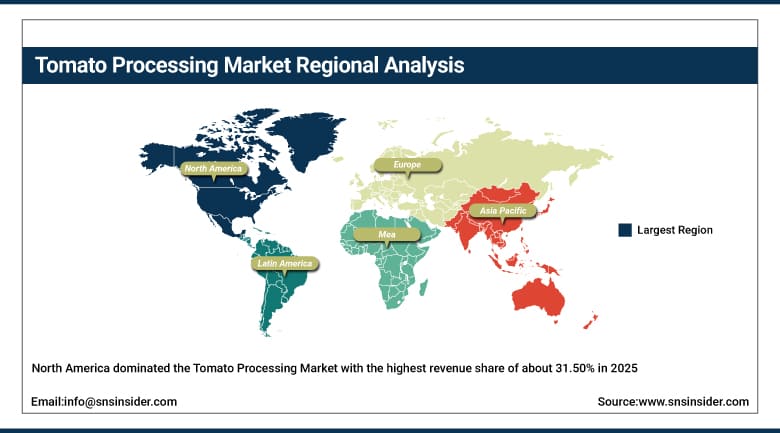
North America dominated the Tomato Processing Market with the highest revenue share of about 31.50% in 2025, backed up by high consumption of tomato-based sauces, pastes, canned food items, and processed products. Food processing facilities, efficient processing technology, vast cultivation of tomatoes, powerful retail and food service industry, and consumer inclination towards shelf-stable convenience food products contribute to market development in the region.
The U.S. Tomato Processing Market accounted for a market share of 91.0%, Backed by the consumption of tomato-based sauces, pastes, canned tomatoes, and processed tomato products. There is established food-processing infrastructure along with large scale tomato production, advanced food processing techniques, and efficient distribution channels that drive the market. The growing demand for shelf-stable, ready-to-eat tomatoes is another driving force behind the market.
Get Customized Report as Per Your Business Requirement - Enquiry Now
Europe Tomato Processing Market Insights
Europe is expected to grow at the fastest CAGR of about 4.87% from 2026–2035, Due to increasing demand for tomato-based products like sauce, paste, puree, and canned foods. Increasing preference for convenience foods, expertise in food manufacturing, advanced processing technologies, sustainable production practices, and increasing application of tomato products across foodservice and retail sectors are also boosting the growth of the market in this region.
The Germany Tomato Processing Market accounted for a market share of 25.0%, Backed by existing food processing industries and high demand for tomato sauce, paste, puree, and cans. Increasing demand for convenient foods, new processing techniques, sustainability efforts, and effective distribution of foods will continue to drive market growth. Demand from retail, foodservice, and packaged food industries is driving processing.
Asia Pacific Tomato Processing Market Insights
Asia Pacific is witnessing increasing demand for processed tomato products, supported by urbanization, changing dietary preferences, and expanding foodservice and packaged food industries. The consumption of tomato pastes, sauces, purees, canned tomato products, and ready to use ingredients is driving the processes. Increasing disposable income, developments in the cold chain, modern retail, and technology have been propelling market growth.
The China Tomato Processing Market accounted for a market share of 30.0%, Backed by a significant consumer base, increasing consumption of processed foods, and higher demand for sauce, pastes, purees, and canned tomatoes. Other drivers include urbanization, increasing disposable incomes, development of food services, modern retailing, and developments in food processing and preservation technologies.
Middle East & Africa and Latin America Tomato Processing Market Insights
Middle East & Africa and Latin America are witnessing growing tomato processing activities, supported by increasing demand for sauces, pastes, purees, and convenience foods. Growing production and processing of food products, urbanization, better infrastructure for processing, and increased consumer preference for packaged products are aiding in market development. Investments in advanced processing technology, preservation technology, and logistics are further enabling regional growth prospects.
The UAE Tomato Processing Market accounted for a market share of 18.0%, This is backed up by the increasing demand for condiments, pastes, canned tomatoes, and ready-to-eat products. Increasing consumption of processed foods, growth in the hospitality and food service industry, advancements in food processing technologies, and improvements in the food distribution system have been adding further impetus to the market's growth.
Market Dynamics
Growth Drivers: Growing demand for processed foods is accelerating adoption of tomato-based products worldwide.
Higher levels of consumption of sauces, ketchup, paste, canned tomatoes, juices, and other convenience foods are driving demand for tomato processing. Processed tomatoes have advantages over fresh tomatoes in terms of shelf life, storage ability, consistency, and convenience, which are some of the reasons why they are being used in ready-to-eat meals and food service products. Increased demand for processed tomato products and changing dietary preferences are identified by market research to be among the key growth drivers. Higher urbanization, rising disposable incomes, and increased consumption in quick-service restaurants are also contributing to higher levels of demand.
Restraints: Volatile tomato prices can increase processing costs and pressure manufacturer profit margins.
There is still an element of uncertainty faced by tomato processors in relation to the variations in raw tomato prices resulting from climatic conditions, yields, diseases, seasons, and costs of inputs in agriculture. The perishable nature of tomatoes coupled with the need for tomato processors to procure them immediately implies that poor harvest seasons may result in high costs of sourcing raw materials and therefore lower profit margins. High costs of raw materials may also have an effect on the pricing of the processed tomatoes in the market. Seasonal price variation is one of the problems in the industry identified through research.
Opportunities: Growing demand for value-added tomato products creates opportunities for premium processing formats.
Consumer preference for differentiated food items presents a potential avenue for processors to move out of traditional paste, ketchup, and canned tomatoes to include organic, specialty, premium, dehydrated, and application-specific tomato products. Dried tomatoes and tomato powder are a rapidly growing item category according to Global Market Insights, attributed to their high solid content, shelf stability, and suitability for seasonings, soups, snacks, bakery items, and ready-to-eat meals. Value can further be created in the form of premium sauces and specialty tomato products through product formulations, packing, branding, and positioning strategies.
Recent Developments:
-
2026 : The Morning Star Company collaborated with Kanematsu to evaluate EF Polymer technology in California tomato production, supporting water-use efficiency and agricultural productivity.
-
2026 : The Campbell’s Company completed its acquisition of a 49% interest in La Regina, strengthening its position in processed tomato products and Italian sourcing.
-
2026 : Mutti Group reported €777 million in revenue for 2025, up 10% from 2024, while continuing investments in tomato processing and sustainability initiatives.
-
2025 : Kagome Co., Ltd. announced the acquisition of UK-based Silbury Marketing Ltd., expanding its European processed-tomato distribution and ingredients business.
Tomato Processing Market key players are:
-
The Morning Star Company
-
CONESA Group
-
COFCO Tunhe Tomato Co., Ltd.
-
Sugal Group
-
Ingomar Packing Co.
-
J.G. Boswell Tomato Company
-
Neil Jones Food Company (Toma-Tek)
-
Los Gatos Tomato Products
-
Kagome Co., Ltd.
-
Del Monte Foods, Inc.
-
ConAgra Brands, Inc.
-
The Kraft Heinz Company
-
The Campbell's Company
-
Stanislaus Food Products
-
Xinjiang Chalkis Company Ltd.
-
Xinjiang Guannong Tomato Products Co., Ltd.
-
Casalasco Società Agricola S.p.A.
-
Mutti S.p.A.
-
Pacific Coast Producers
-
Olam Group
Tomato Processing Market Report Scope:
| Report Attributes | Details |
|---|---|
| Market Size in 2025 | USD 54.51 Billion |
| Market Size by 2035 | USD 80.70 Billion |
| CAGR | CAGR of 4.05% From 2026 to 2035 |
| Base Year | 2025 |
| Forecast Period | 2026-2035 |
| Historical Data | 2022-2024 |
| Report Scope & Coverage | Market Size, Segments Analysis, Competitive Landscape, Regional Analysis, DROC & SWOT Analysis, Forecast Outlook |
| Key Segments | • By Product (Tomato Paste, Tomato Puree, Canned Tomatoes, Tomato Sauces, Tomato Ketchup, Tomato Juice & Concentrate, Dried Tomatoes & Powder, Others) • By Processing Method (Canning, Sauce Production, Juice Extraction, Concentration, Drying, Freezing, Fermentation, Others) • By End Use (Household Consumers, Industrial Food Processors, Restaurants & Foodservice, Beverage Industry) • By Distribution Channel (Hypermarkets & Supermarkets, Food Specialty Stores, Convenience Stores, Online/E-commerce, Direct Sales) |
| Regional Analysis/Coverage | North America (US, Canada), Europe (Germany, UK, France, Italy, Spain, Russia, Poland, Rest of Europe), Asia Pacific (China, India, Japan, South Korea, Australia, ASEAN Countries, Rest of Asia Pacific), Middle East & Africa (UAE, Saudi Arabia, Qatar, South Africa, Rest of Middle East & Africa), Latin America (Brazil, Argentina, Mexico, Colombia, Rest of Latin America). |
| Company Profiles | The Morning Star Company, CONESA Group, COFCO Tunhe Tomato Co., Ltd., Sugal Group, Ingomar Packing Co., J.G. Boswell Tomato Company, Neil Jones Food Company (Toma-Tek), Los Gatos Tomato Products, Kagome Co., Ltd., Del Monte Foods, Inc., ConAgra Brands, Inc., The Kraft Heinz Company, The Campbell's Company, Stanislaus Food Products, Xinjiang Chalkis Company Ltd., Xinjiang Guannong Tomato Products Co., Ltd., Casalasco Società Agricola S.p.A., Mutti S.p.A., Pacific Coast Producers, and Olam Group. |
Frequently Asked Questions
Key players in the Tomato Processing Market include The Morning Star Company, COFCO Tunhe Tomato Co., Ltd., Sugal Group, CONESA Group, and Kagome Co., Ltd., among others.
Key opportunities in the Tomato Processing Market include growing demand for processed tomato products, expansion of foodservice and convenience foods, and increasing adoption of value-added tomato products.
The market is driven by increasing consumption of processed foods, rising demand for tomato sauces and pastes, and growing use of processed tomatoes across foodservice and industrial applications.
The Canned Tomatoes segment dominated the Tomato Processing Market, accounting for approximately 23.90% market share.
The North America region dominated the Tomato Processing Market in 2025 with a 31.50% share, driven by strong demand for processed tomato products and expanding food processing activities.
