
Marine Active Ingredients Market Report Scope & Overview:
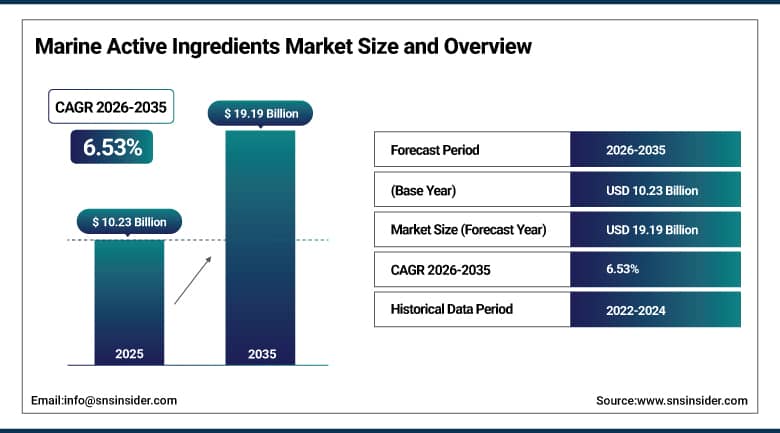
The Marine Active Ingredients Market was valued at USD 10.23 billion in 2025 and is expected to reach USD 19.19 billion by 2035, growing at a CAGR of 6.53% from 2026-2035.
The Marine Active Ingredients Market is witnessing steady growth as a result of rising need for ingredients obtained from marine sources for use in food and beverages, nutraceuticals, pharmaceuticals, cosmetics, and personal care products. Increasing consumer awareness and preference for natural, functional, and sustainably obtained ingredients is leading to the use of marine lipids, proteins and peptides, carbohydrates, pigments, and other biologically active components. Consumer awareness regarding the health and functional benefits linked with omega-3 fatty acids, marine proteins, antioxidants, and other marine-based ingredients is helping to support growth in the market. In addition to that, the emergence of advances in marine biotechnology, extraction, purification, and stabilization technologies of ingredients is facilitating the production of higher-value products with better functionality.
⮞The European Commission's 2025 sustainable-algae study identifies macroalgae and microalgae as sources of diverse products and highlights opportunities to scale algae production.
To Get More Information On Marine Active Ingredients Market - Request Free Sample Report
Marine Active Ingredients Market Trends
-
Rising demand for natural and functional ingredients is driving marine active ingredient adoption across food, nutraceutical, pharmaceutical, and cosmetic applications.
-
Increasing consumer preference for omega-3s, marine proteins, peptides, and antioxidants is expanding demand for marine-derived ingredients.
-
Growing interest in sustainable and traceable sourcing is encouraging development of responsibly harvested and environmentally friendly marine ingredients.
-
Advancements in extraction and purification technologies are improving ingredient quality, bioavailability, stability, and functional performance.
U.S. Marine Active Ingredients Market Outlook
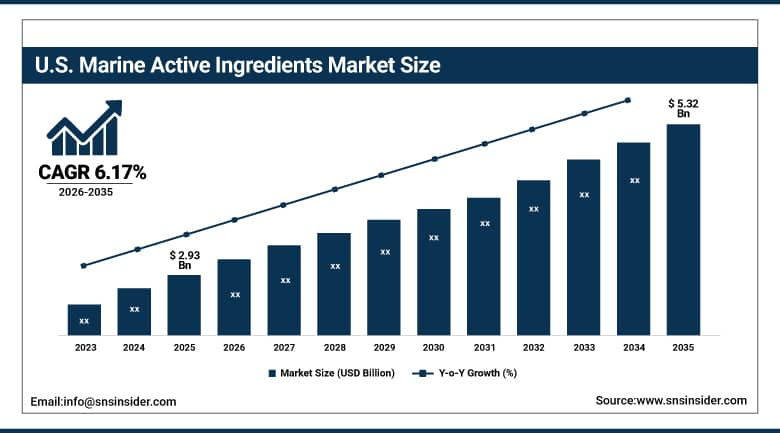
The U.S. Marine Active Ingredients Market was valued at USD 2.93 billion in 2025 and is expected to reach USD 5.32 billion by 2035, growing at a CAGR of 6.17% from 2026-2035.
The U.S. Marine Active Ingredients Market is witnessing steady growth as a result of growing demands for marine-derived ingredients in the segments of food and beverages, nutraceuticals, pharmaceuticals, cosmetics, and personal care. The increasing demand for natural, functional, and sustainable ingredients has been the key factor behind the growing trend of using marine lipids, proteins, peptides, carbohydrates, and other bioactive compounds. The growing awareness regarding the nutritional and functional attributes of omega-3 fatty acids, marine proteins, antioxidants, and other marine-derived ingredients has been another major factor driving the market growth. Moreover, technological innovations related to marine biotechnology, extraction technology, purification technology, and stabilization of marine-derived ingredients have been providing opportunities for creating high value-added products.
⮞The National Aquaculture Economic Development Plan outlines federal actions to support the domestic aquaculture sector, while Executive Order 14276 seeks to strengthen U.S. seafood competitiveness and aquaculture.
Marine Active Ingredients Market Segment Analysis
-
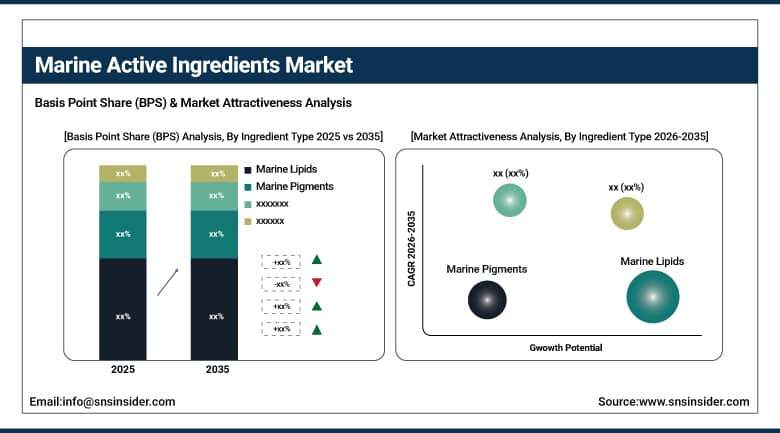
By Ingredient Type, Marine Lipids dominate the Marine Active Ingredients Market with 35% share in 2025; Marine Proteins and Peptides are expected to grow at the fastest CAGR of 7.44% from 2026–2035.
-
By Source, Fish dominates the Marine Active Ingredients Market with 39% share in 2025; Seaweed and Algae are expected to grow at the fastest CAGR of 7.29% from 2026–2035.
-
By Form, Powder dominates the Marine Active Ingredients Market with 40% share in 2025; Capsules and Softgels are expected to grow at the fastest CAGR of 7.17% from 2026–2035.
-
By Application, Nutraceuticals and Dietary Supplements dominate the Marine Active Ingredients Market with 40% share in 2025; Pharmaceuticals are expected to grow at the fastest CAGR of 7.74% from 2026–2035.
By Ingredient Type, Marine Lipids dominate the Marine Active Ingredients Market, Marine Proteins and Peptides grow fastest.
Marine Lipids dominated the Marine Active Ingredients Market with the highest revenue share of about 35% in 2025, Driven by high demands for omega-3 fatty acids, phospholipids, and other lipid components derived from the sea. Their applications in cardiovascular, cognitive and nutritional supplements ensure their popularity. Consumer recognition of the health benefits of marine lipids adds to their success in the market place.
Marine Proteins and Peptides are expected to grow at the fastest CAGR of 7.44% from 2026–2035, due to an increased demand for marine collagen, bioactive peptides, and protein ingredients in foods, nutritional supplements, cosmetics, and health care products. Their well-known properties, along with the development of new marine bioactives, contribute to the popularity of these ingredients.
⮞In February 2025, Symrise announced a strategic partnership with Norway-based HBC to expand its portfolio of salmon-derived marine proteins, collagen, and oils for human health and animal nutrition applications.
By Source, Fish dominates the Marine Active Ingredients Market, Seaweed and Algae grow fastest.
Fish dominated the Marine Active Ingredients Market with the highest revenue share of about 39% in 2025, supported by the ample availability and wide use as a supplier of omega-3 fatty acids, proteins, peptides, collagen, and other active substances. The existing infrastructure of processing, commercial availability, and wide usage in various industries such as nutraceuticals, foods, pharmaceuticals, and cosmetics create high demand for fish-based products.
Seaweed and Algae are expected to grow at the fastest CAGR of 7.29% from 2026–2035, motivated by the rising demand for sustainable sources of marine organisms with unique bioactive compounds such as polysaccharides, pigments, proteins, and antioxidants. The emerging uses of these components in nutraceuticals, functional foods, cosmetics, and pharmaceutical products, along with ongoing research on algae-derived ingredients, are facilitating commercialization.
⮞In May 2026, Fermentalg launched OMEGA ΩRIGINS™, a microalgae-derived omega-3 oil containing 40% EPA and 20% DHA, using a patented fermentation process to deliver a concentrated alternative to conventional fish oil.
By Form, Powder dominates the Marine Active Ingredients Market, Capsules and Softgels grow fastest.
Powder dominated the Marine Active Ingredients Market with the highest revenue share of about 40% in 2025, motivated by ease of handling and storage, versatile formulations, and suitability for industrial processing on a large scale. The powdered form of marine ingredients is increasingly used in health supplements, functional foods, beverages, and animal nutrition products.
Capsules and Softgels are expected to grow at the fastest CAGR of 7.17% from 2026–2035, backed by rising consumer inclination towards convenient, precise and portable delivery systems for supplements. Such systems will be well suited to deliver marine oils, omega-3 compounds and concentrated biologically active ingredients. Increasing consumer demand for convenient nutraceuticals and wider availability in retail stores is another driving force behind this trend.
⮞In June 2025, Dabur India launched Siens, a direct-to-consumer wellness brand featuring marine collagen products and omega-3 softgels, expanding the availability of marine-derived ingredients through convenient supplement formats.
By Application, Nutraceuticals and Dietary Supplements dominate the Marine Active Ingredients Market, Pharmaceuticals grow fastest.
Nutraceuticals and Dietary Supplements dominated the Marine Active Ingredients Market with the highest revenue share of about 40% in 2025, stimulated by growing consumer interest in prevention, wellness, and functionality. The marine-based omega-3 fatty acids, proteins, peptides, and antioxidants have been used in supplements for the purpose of promoting cardiovascular, cognitive, joint, and overall well-being, hence the continued demand worldwide.
Pharmaceuticals are expected to grow at the fastest CAGR of 7.74% from 2026–2035, backed by growing studies on bioactive substances from marine sources that have medical uses. Marine proteins, peptides, polysaccharides, and other marine substances are being studied for use in drugs and specific treatments. Growing research in pharmaceuticals, advancements in extraction processes, and identification of new marine substances are aiding in commercialization.
⮞In August 2026, Rohto Pharmaceutical acquired OP Biofactory as a subsidiary, strengthening its research and commercialization capabilities involving marine biological resources and microalgae for potential health and biotechnology applications.
Regional Analysis
|
Region |
Major Country |
Share within Region, 2025 (%) |
|---|---|---|
|
North America |
United States |
91.0% |
|
Europe |
Germany |
21.0% |
|
Asia Pacific |
China |
38.0% |
|
Middle East & Africa |
UAE |
18.0% |
|
Latin America |
Brazil |
35.0% |
North America Marine Active Ingredients Market Insights
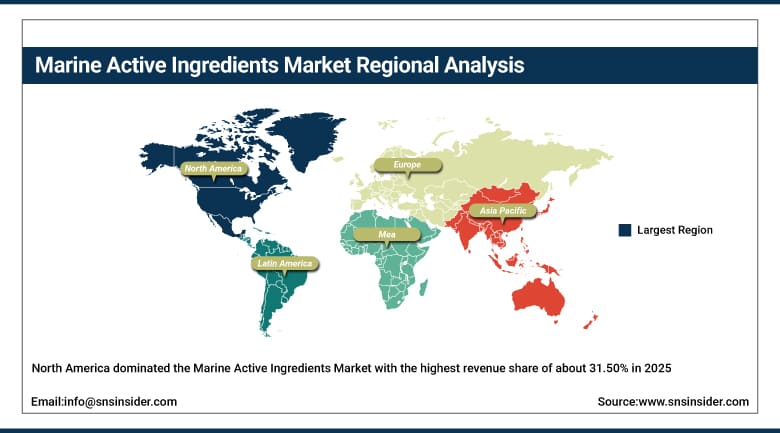
North America dominated the Marine Active Ingredients Market with the highest revenue share of about 31.50% in 2025, backed by robust demand for nutraceuticals, functional ingredients, pharmaceuticals, cosmetics, and animal nutrition products from the marine environment. Marine biotechnology expertise, innovative processing, robust research facilities, and rising consumer inclination towards sustainable and natural ingredients also contribute to regional market development and commercialization.
The U.S. Marine Active Ingredients Market accounted for a market share of 91.0%, driven by an overwhelming market demand for marine-based nutraceuticals, medicines, cosmetics, functional food products, and animal nutrition products. Future market growth will be aided by marine biotechnology innovation, R&D capability, innovative extraction methods, and consumers' preference for natural and bioactive products.
⮞In December 2025, Alfa Laval highlighted its evaporation technology at Veramaris's Nebraska facility, supporting production of microalgae-derived omega-3 oil containing 65% EPA and DHA for aquaculture feed applications.
Get Customized Report as Per Your Business Requirement - Enquiry Now
Europe Marine Active Ingredients Market Insights
Europe is witnessing steady growth in the marine active ingredients market, driven by rising demand for sustainable, natural, and bioactive ingredients across nutraceutical, pharmaceutical, cosmetic, and functional food applications. The increased funding in marine biotechnology, circular bioeconomy concepts, advanced extraction technologies, and sustainable sourcing practices is fueling product innovation. The heightened awareness among consumers of marine-based health and wellness products adds another dimension to regional demand.
The Germany Marine Active Ingredients Market accounted for a market share of 21.0%, fueled by increased interest in organic and sustainable components in nutraceuticals, pharmaceuticals, cosmetics, and functional foods. Expansion in the market is also being fueled by advances in biotechnology studies, sustainable use of marine resources, quality standards, and increased use of marine-based proteins, peptides, lipids, and bioactive compounds.
⮞In April 2026, Germany's BLUU and Dutch biotechnology company Cultivate at Scale established an industrial platform for cell-cultured marine ingredients, targeting personal-care applications initially, with potential expansion into healthcare and food markets.
Asia Pacific Marine Active Ingredients Market Insights
Asia Pacific is expected to grow at the fastest CAGR of about 7.82% from 2026–2035, Due to growing nutraceuticals and functional foods industry, high health consciousness, and availability of rich biological marine resources. Growth in the pharmaceutical and cosmetics industry, increased investment in marine biotechnology, advanced extraction techniques, and aquaculture activities are also contributing to the commercial exploitation of marine bio-proteins, peptides, lipids, pigments, and bioactive compounds.
The China Marine Active Ingredients Market accounted for a market share of 38.0%, backed up by rich marine resources, growth of nutraceuticals and functional foods industry, and the increasing use in pharmaceutical and cosmetic applications. Future growth will be boosted by increasing health consciousness, investments in marine biotechnology, aquaculture developments, extraction techniques, and demands for marine protein, peptides, lipids, pigments, and other bioactive compounds.
⮞In March 2026, Qingdao authorities announced the commercialization of alginate oligosaccharide as a newly approved food ingredient after Qingdao Dakang Marine Biotechnology obtained China's first production license for the ingredient, opening an additional food-application pathway for marine-derived compounds.
Middle East & Africa and Latin America Marine Active Ingredients Market Insights
Middle East & Africa and Latin America are witnessing increasing demand for marine active ingredients, supported by expanding nutraceutical, functional food, cosmetic, and pharmaceutical industries. More use of marine products, advancements in processing techniques, increased health consciousness, and the interest in using natural ingredients have been creating new opportunities. Sustainable marine biotechnology and aquaculture operations have added to the growth prospects of the regional markets.
The UAE Marine Active Ingredients Market accounted for a market share of 18.0%, backed up by rising demand for natural ingredients for use in nutraceuticals, cosmetics, pharmaceuticals, and functional foods. Further expansion of the market is fueled by increasing health consciousness, food and wellness industry, utilization of marine resources, biotechnology programs, and sustainable marine ingredients.
⮞In October 2025, King Abdullah University of Science and Technology highlighted Saudi Arabia's applied algal biotechnology facilities, which were producing up to 100 tonnes of dry algal biomass annually to support domestic feed development and reduce reliance on imported ingredients.
⮞In November 2025, Brazil announced its participation in the United Nations Global Seaweed Initiative at COP30, emphasizing seaweed cultivation as an opportunity for sustainable aquatic food systems, coastal economic development, and the expansion of its blue bioeconomy.
Market Dynamics
Growth Drivers: Growing demand for functional nutrition is increasing adoption of marine-derived bioactive ingredients worldwide.
The growing consumer interest in functional foods, nutraceuticals, and wellness foods is driving the demand for lipids, proteins, peptides, collagen, pigments, and other bioactive substances derived from the marine environment. Marine-based ingredients are being used more often in formulations that aim to deliver health and nutrition benefits, specifically omega-3 lipids, proteins, collagen, and antioxidants. The nutraceuticals and dietary supplement segment constitutes one of the key applications segments, while lipids account for one of the major product segments.
⮞In January 2026, Aker BioMarine announced plans to introduce its Revervia algae-based DHA ingredient to Indian customers through Vitafoods India, alongside its Superba krill oil portfolio, expanding options for marine-derived nutritional ingredients in the country's supplement market.
Restraints: Raw material availability fluctuations can create supply uncertainty for marine ingredient manufacturers globally.
The production of marine active ingredients still depends on the accessibility and quality of fish, algae, crustaceans, and other sources of marine biomass. Changes in seasonal conditions, environmental alterations, fisheries management, aquaculture production, and varying catch amounts can impact the accessibility and prices of raw materials. Exposure to supply risk is especially relevant for marine active ingredients extracted from wild caught species. Raw material volatility has been identified as one of the main challenges by industry studies and there is increased interest in algae farming and usage of by-products to diversify the source of supply.
Opportunities: Growing algae-derived ingredient adoption creates opportunities for sustainable marine ingredient diversification.
Greater utilization of algae and microalgae is generating scope to increase diversification of the marine active ingredient portfolio beyond traditional fish sources. Algae could be used to source omega-3 fatty acids, protein, pigment, carbohydrate, and other functional components for use in foods, nutraceuticals, cosmetics, and pharmaceutical products. Industry insights have highlighted algal DHA/EPA oil and microalgae as rapidly growing segments of the marine ingredients space. This is due to the need for more sustainable solutions, as well as less reliance on wild-catch sources.
⮞In June 2026, Corbion published an updated life-cycle assessment for its algae-derived omega-3 DHA portfolio, reporting 18–23% lower climate-change impact and 44–54% lower water use compared with its 2021 assessment, strengthening the sustainability case for algae-based ingredients.
Recent Developments:
-
2026 : Aker BioMarine expanded its marine-ingredient portfolio in India by introducing Revervia algae-based DHA and strengthening distribution partnerships for krill oil and algae-derived ingredients.
-
2026 : Pelagia advanced its marine health-ingredient portfolio through EPAX Cetoleic 2040, with clinical research demonstrating LDL-cholesterol reduction from its omega-9/omega-11 marine oil.
-
2026 : Cargill continued developing novel marine-derived and alternative ingredients for aquaculture feeds, including greater use of fish co-products and sustainably sourced marine raw materials.
-
2025 : Aker BioMarine partnered with European distributors to introduce Revervia algae-based DHA and Algal DHA across France, Benelux, Spain, and Portugal.
Marine Active Ingredients Market Key Players are:
-
Cargill, Incorporated
-
Bio-marine Ingredients Ireland Ltd.
-
Symrise AG
-
Hofseth BioCare ASA
-
Aker BioMarine AS
-
Scanbio Marine Group AS
-
Algaia
-
Omega Protein Corporation
-
BASF SE
-
DSM-Firmenich AG
-
Croda International Plc
-
KD Pharma Group SA
-
Givaudan S.A.
-
Abyss Ingredients
-
Pelagia AS
-
TripleNine Group A/S
-
Gelita AG
-
SA Copalis
-
Jiangxi Cosen Biochemical Co., Ltd.
-
Bio-Oregon Protein, Inc.
Marine Active Ingredients Market Report Scope:
| Report Attributes | Details |
|---|---|
| Market Size in 2025 | USD 10.23 Billion |
| Market Size by 2035 | USD 19.19 Billion |
| CAGR | CAGR of 6.53% From 2026 to 2035 |
| Base Year | 2025 |
| Forecast Period | 2026-2035 |
| Historical Data | 2022-2024 |
| Report Scope & Coverage | Market Size, Segments Analysis, Competitive Landscape, Regional Analysis, DROC & SWOT Analysis, Forecast Outlook |
| Key Segments | • By Ingredient Type (Marine Lipids, Marine Proteins and Peptides, Marine Carbohydrates, Marine Pigments) • By Source (Fish, Seaweed and Algae, Crustaceans, Other Marine Sources) • By Form (Powder, Liquid, Capsules and Softgels) • By Application (Nutraceuticals and Dietary Supplements, Pharmaceuticals, Food and Beverages, Cosmetics and Personal Care, Others) |
| Regional Analysis/Coverage | North America (US, Canada), Europe (Germany, UK, France, Italy, Spain, Russia, Poland, Rest of Europe), Asia Pacific (China, India, Japan, South Korea, Australia, ASEAN Countries, Rest of Asia Pacific), Middle East & Africa (UAE, Saudi Arabia, Qatar, South Africa, Rest of Middle East & Africa), Latin America (Brazil, Argentina, Mexico, Colombia, Rest of Latin America). |
| Company Profiles | Cargill, Incorporated, Bio-marine Ingredients Ireland Ltd., Symrise AG, Hofseth BioCare ASA, Aker BioMarine AS, Scanbio Marine Group AS, Algaia, Omega Protein Corporation, BASF SE, DSM-Firmenich AG, Croda International Plc, KD Pharma Group SA, Givaudan S.A., Abyss Ingredients, Pelagia AS, TripleNine Group A/S, Gelita AG, SA Copalis, Jiangxi Cosen Biochemical Co., Ltd., and Bio-Oregon Protein, Inc. |

Frequently Asked Questions
Key players in the Marine Active Ingredients Market include Cargill, Incorporated, Aker BioMarine AS, Symrise AG, Bio-marine Ingredients Ireland Ltd., and Hofseth BioCare ASA, among others.
Key opportunities in the Marine Active Ingredients Market include growing demand for marine-derived nutraceuticals, expansion of marine collagen and bioactive peptides, and increasing adoption of sustainable marine ingredients.
The market is driven by rising consumer demand for natural and functional ingredients, increasing use of marine bioactives in nutraceuticals and cosmetics, and growing sustainability preferences.
The Marine Lipids segment dominated the Marine Active Ingredients Market, accounting for approximately 35.00% market share.
The North America region dominated the Marine Active Ingredients Market in 2025 with a 31.50% share, driven by growing demand for marine-derived ingredients in nutraceuticals and cosmetics.
