
Fetal Monitoring Market Report Scope & Overview:
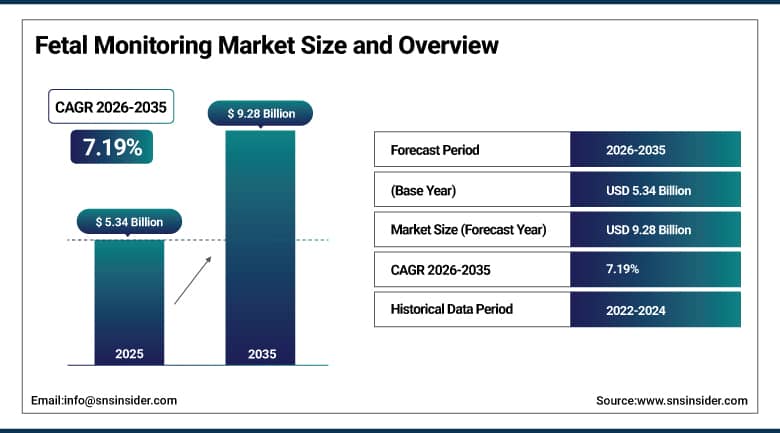
The Fetal Monitoring Market was valued at USD 5.34 Billion in 2025 and is expected to reach USD 9.28 Billion by 2035, growing at a CAGR of 7.19% from 2026–2035.
Pregnancy has gotten riskier in one specific, well-documented way: more women are having children later in life, and more are entering pregnancy with conditions like diabetes or hypertension that require closer watching. That shift alone has been enough to reshape demand across the fetal monitoring market, pushing hospitals and maternity centers toward equipment that can track a baby's heart rate, movement, and overall wellbeing with real precision. What's changed the technology itself is the move toward non-invasive and remote monitoring, tools that let an expectant mother go about her day without being tethered to a hospital bed, paired with AI and IoT integration that flags trouble earlier than a nurse checking in periodically ever could.
There has been a rise of 27% in fetal monitoring technology globally in 2024 because of the use of AI-integrated monitors in almost 60% of city birthing centers. More than 70% of cases of high-risk pregnancies are being monitored constantly or remotely owing to the advancement in prenatal healthcare programs in both the developed and developing nations.
To Get More Information On Fetal Monitoring Market - Request Free Sample Report
Fetal Monitoring Market Trends
-
Wireless and remote fetal monitoring systems are expanding prenatal care through continuous monitoring beyond hospital settings.
-
Non-invasive fetal monitoring technologies are improving maternal comfort and reducing procedure-related complications.
-
AI-powered analytics are enhancing early detection of fetal distress and supporting faster clinical decision-making.
-
Home-based fetal monitoring devices are gaining adoption alongside the growth of telemedicine and remote prenatal care.
-
Connected wearable fetal monitoring solutions are enabling real-time data sharing between expectant mothers and healthcare providers.
The U.S. Fetal Monitoring Market Outlook
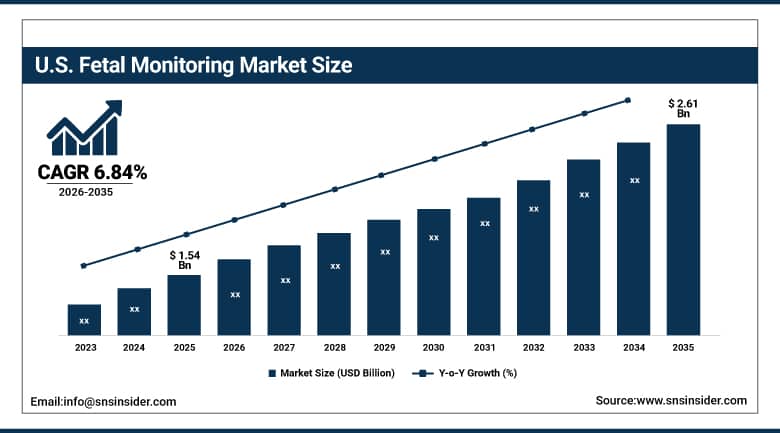
The U.S. Fetal Monitoring Market was valued at approximately USD 1.54 Billion in 2025 and is expected to reach approximately USD 2.61 Billion by 2035, growing at a CAGR of approximately 6.84%.
Rising demand in the U.S. market is associated with growing numbers of high-risk pregnancies, increasing concerns regarding health outcomes of the mother and fetus, and growing implementation of technologically advanced monitoring methods. Prenatal care services and real-time monitoring technologies that are incorporated into hospital routines generate demand for our product line in the country.
Fetal Monitoring Market Segment Analysis
-
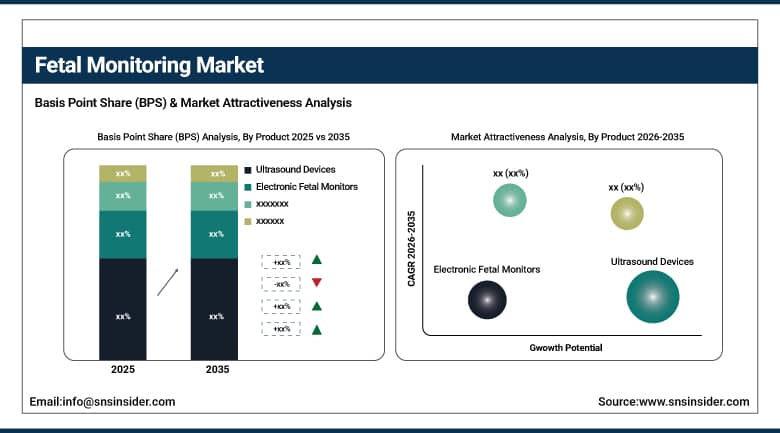
By Product, the ultrasound devices segment dominated the fetal monitoring market with a 38% revenue share in 2025, while the wearable & wireless monitors segment is expected to register the fastest growth.
-
By Portability, the non-portable devices segment dominated the fetal monitoring market with a 60% revenue share in 2025, while the portable devices segment is expected to register the fastest growth.
-
By Method, the non-invasive monitoring segment dominated the fetal monitoring market with a 78% revenue share in 2025, while the invasive monitoring segment is expected to register the fastest growth.
-
By Application, the antepartum monitoring segment dominated the fetal monitoring market with a 55% revenue share in 2025, while the intrapartum monitoring segment is expected to register the fastest growth.
-
By End User, the hospitals segment dominated the fetal monitoring market with a 60% revenue share in 2025, while the homecare settings segment is expected to register the fastest growth.
By Product, ultrasound devices lead, wearable and wireless monitors grow fastest
Ultrasound devices have the highest market share, representing approximately 38%, because of their non-invasive characteristics, high degree of precision, and popularity among clinicians. They provide high-resolution images of the fetus, as well as information regarding the heartbeat and vital parameters of the baby. They have gained acceptance because of their high level of reliability and ease of incorporation into practice.
It is forecasted that wearable and wireless monitoring devices will experience the highest growth rate due to increased demand for remote fetal monitoring, real-time data, and the sheer ease of use of such devices. With telemedicine and mobile healthcare becoming increasingly popular, expecting mothers can effectively monitor the condition of their baby outside a medical facility as well.
By Portability, non-portable devices dominate, portable devices grow fastest
Non-portable products had an estimated market share of 60% during 2025 due to their use by hospitals and clinics for enhanced patient monitoring and alert capabilities of patients in real time. Their accuracy, interoperability with other medical equipment, and ability to monitor more than one patient at a time made them the product of choice for inpatient and high-risk pregnancy monitoring.
Portable devices are anticipated to expand at the fastest rate driven by increased demand for mobility, maternity services in the home environment, and incorporation into telemedicine applications. Portable devices are relatively small, user-friendly, and affordable, making it possible for providers and pregnant women to conduct fetal monitoring out of the hospital premises, while increased awareness and digitization have been driving its adoption.
By Method, non-invasive monitoring dominates, invasive monitoring grows fastest
Monitoring non-invasively made up an estimated 78% of the total market share in 2025 due to the safety and ease of use of this technique along with the high level of acceptance by both patients and healthcare professionals. Doppler ultrasound and External Cardiotocography are among the techniques used, which offer reliable results without posing risks to either the mother or fetus.
The invasive monitoring segment should experience high growth due to the high degree of accuracy involved as well as its importance when dealing with cases of high risk pregnancies and deliveries. Methods of monitoring such as fetal scalp electrode monitoring offer accurate data about heart rate and contractions.
By Application, antepartum monitoring dominates, intrapartum monitoring grows fastest
Antepartum monitoring accounted for about 55% of the market in 2025, owing to its routine use in prenatal care for catching fetal distress, growth abnormalities, and maternal complications early. Frequent hospital visits, standardized monitoring protocols, and a strong clinical emphasis on early detection all continue reinforcing this segment's dominance across maternity care facilities.
Intrapartum monitoring will have the highest growth rate due to the increase in number of deliveries in hospitals, increased number of maternal risks, and the actual requirement of monitoring the fetus throughout the course of delivery. The use of advanced intrapartum monitoring systems enables the provision of necessary alert signals in time, which increases the safety of both the mother and fetus.
By End User, hospitals dominate, homecare settings grow fastest
Hospitals accounted for about 60% of the market in 2025, owing to advanced infrastructure, skilled healthcare professionals, and consistently high patient volumes. The presence of constant monitoring, quick reaction, and linkage to the critical care system makes hospitals the ultimate end-users of the fetal monitors in urban and semi-urban areas.
The fastest-growing market would be the homecare market because of increasing use of telemedicine and wearable fetal monitors and the increase in patient awareness about possibilities beyond the hospital. Homecare solutions offer convenience, continuous tracking, and genuinely personalized monitoring for expectant mothers, and growing preference for remote maternal care combined with earlier intervention strategies continues fueling rapid growth here.
Regional Analysis
|
Region |
Major Country |
Share within Region, 2025 (%) |
|---|---|---|
|
North America |
United States |
82.0% |
|
Europe |
Germany |
25.0% |
|
Asia Pacific |
China |
37.0% |
|
Latin America |
Brazil |
36.0% |
|
Middle East & Africa |
Saudi Arabia |
26.0% |
North America Fetal Monitoring Market Insights
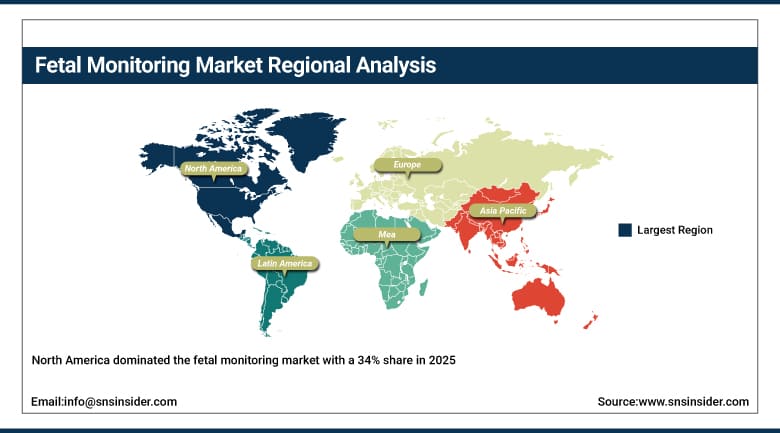
North America dominated the fetal monitoring market with a 34% share in 2025, owing to advanced healthcare infrastructure, high adoption of technologically sophisticated monitoring devices, and a strong presence of leading manufacturers within the region. Rising awareness of maternal and fetal health, favorable reimbursement policy, and increasing numbers of high-risk pregnancies all continue reinforcing the region's market leadership.
The United States provides the lion’s share of regional demand owing to strong hospitals infrastructure and ongoing improvements to monitoring technologies. Canada represents a smaller portion of regional demand but continues to grow due to the healthcare infrastructure of Canada and increasing emphasis on prenatal care.
Get Customized Report as Per Your Business Requirement - Enquiry Now
Europe Fetal Monitoring Market Insights
Europe held a significant share of the fetal monitoring market in 2025, supported by well-established healthcare systems, high adoption of advanced fetal monitoring technology, and strict regulatory standards governing maternal and neonatal care. All of these factors keep on adding to the market's dominance in the region.
The countries that contribute the most to the region are Germany, the UK, and France. The reimbursement environment along with the clinical procedures of prenatal testing is well established in these countries. That combination of regulatory rigor and healthcare system maturity keeps Europe a technically sophisticated, if more measured, growth market relative to Asia Pacific and North America.
Asia Pacific Fetal Monitoring Market Insights
Asia Pacific is expected to grow at the fastest CAGR, at approximately 9.06% from 2026 to 2035, driven by rising maternal healthcare awareness, expanding government initiatives, and growing hospital infrastructure across the region. Rising demand for modern fetal monitoring devices, population growth, and improving access to prenatal care all continue accelerating adoption throughout the region.
China, India, and Japan represent the region's principal growth markets, each contributing meaningfully to overall regional demand as healthcare access continues expanding. That combination of demographic scale and improving infrastructure positions Asia Pacific to keep outpacing every other region in growth rate through the forecast period.
MEA & Latin America Fetal Monitoring Market Insights
The Middle East and Africa and Latin America together showed steady growth in the fetal monitoring market in 2025, driven by increasing investment in maternal healthcare infrastructure, rising awareness of prenatal care, and growing adoption of modern fetal monitoring devices. Expanding hospital networks and government initiatives continue supporting regional market growth across both regions.
Improving access to advanced medical technology continues to shape how quickly both regions can close the gap with more established markets. Brazil, Mexico, Saudi Arabia, and the UAE represent the leading national markets within their respective regions, each benefiting from continued healthcare infrastructure investment.
Market Dynamics
Growth Drivers: Rising high-risk pregnancies and growing maternal age sustain demand
An increase in maternal age, the rate of multiple births, and the frequency of chronic maternal illnesses such as diabetes and high blood pressure have all been identified as factors that make pregnancy become high-risk. In order to monitor these high-risk pregnancies, the most important step taken is for hospitals to acquire improved fetal monitoring equipment such as electronic fetal monitors and ultrasounds.
Growing awareness of maternal and neonatal outcomes, paired with genuine clinical need for precise monitoring, continues driving demand for fetal monitoring solutions across both developed and emerging healthcare markets. In 2024, over 30% of pregnancies worldwide were classified as high-risk, with maternal age of 35 and above rising 22%, a shift that drove a 28% increase in adoption of advanced fetal monitoring systems across maternity care facilities globally.
Restraints: High equipment costs limit adoption in resource-constrained settings
Expensive advanced technologies for fetal monitoring, which include electronic fetal monitors, ultrasound machines, and portable sensors, come at a price that is too high for small health care centers, birthing centers, and hospitals located in developing countries. Limited funding opportunities and the lack of insurance coverage for these advanced technologies prevent their purchase by most facilities, and manual monitoring becomes the only alternative.
It has been found that more than 60% of healthcare providers serving poor areas identified high costs of equipment, typically above USD 20,000 for each piece of equipment, as well as expenses for maintenance, as critical limitations preventing adoption of advanced technology for fetal monitoring in 2024. The additional limitation is the lack of trained personnel able to use these systems.
Opportunities: Home-based monitoring and government prenatal initiatives unlock new growth
Rising awareness of maternal health, combined with the genuine convenience of remote monitoring, is driving strong demand for home-based fetal monitoring solutions. Wearable sensors, mobile applications, and telemedicine platforms allow continuous fetal monitoring while cutting down on hospital visits, and that combination enables timely intervention, better patient comfort, and stronger adherence to prenatal care protocols overall.
There was an increase of 40% in home fetal monitoring in the year 2024, and in cities, 55% of expectant mothers used wearables which are part of telemedicine systems. The use of maternal health care programs that have been adopted nationally in more than 50 nations has experienced an increase in the use of prenatal care with the help of an increase in 30% in the use of fetal monitoring.
Recent Developments:
-
2024: GE Healthcare launched Edison AI Orchestrator, a hospital-wide AI deployment platform integrating third-party and proprietary AI applications into clinical workflows across imaging, cardiology, and critical care, enabling real-time decision support without disrupting existing IT systems.
-
2023: Siemens Healthineers launched Teamplay Copilot, an AI-powered clinical assistant embedded in imaging devices and hospital IT systems that provides real-time guidance during scans, suggests protocols, and auto-generates structured reports, initially available for MRI and CT.
-
2025: Royal Philips introduced the Philips Radiology Operations Command Center, a cloud-based command center using predictive analytics and AI to optimize radiology department workflows, reduce patient wait times, and improve scanner utilization in real time.
Fetal Monitoring Market key players are:
-
GE HealthCare
-
Philips Healthcare
-
Siemens Healthineers
-
Medtronic plc
-
Natus Medical Incorporated
-
Huntleigh Healthcare
-
Spacelabs Healthcare
-
EDAN Instruments
-
CooperSurgical
-
Neoventa Medical AB
-
Bionet Co., Ltd.
-
Mindray Medical International
-
Drägerwerk AG & Co. KGaA
-
Phoenix Medical Systems Pvt. Ltd.
-
Nihon Kohden Corporation
-
Comen Medical Instruments Co., Ltd.
-
Monica Healthcare Ltd.
-
Arjo
-
Clinical Innovations LLC
-
Wallach Surgical Devices
Fetal Monitoring Market Report Scope:
| Report Attributes | Details |
|---|---|
| Market Size in 2025 | USD 5.34 Billion |
| Market Size by 2035 | USD 9.28 Billion |
| CAGR | CAGR of 7.19% From 2026 to 2035 |
| Base Year | 2025 |
| Forecast Period | 2026-2035 |
| Historical Data | 2022-2024 |
| Report Scope & Coverage | Market Size, Segments Analysis, Competitive Landscape, Regional Analysis, DROC & SWOT Analysis, Forecast Outlook |
| Key Segments | • By Product (Ultrasound Devices, Electronic Fetal Monitors, Fetal Dopplers, Uterine Contraction Monitors, Wearable & Wireless Monitors) • By Portability (Portable Devices, Non-Portable Devices) • By Method (Invasive Monitoring, Non-Invasive Monitoring) • By Application (Antepartum Monitoring, Intrapartum Monitoring) • By End User (Hospitals, Clinics, Ambulatory Surgical Centers, Homecare Settings, Maternity Centers) |
| Regional Analysis/Coverage | North America (US, Canada), Europe (Germany, UK, France, Italy, Spain, Russia, Poland, Rest of Europe), Asia Pacific (China, India, Japan, South Korea, Australia, ASEAN Countries, Rest of Asia Pacific), Middle East & Africa (UAE, Saudi Arabia, Qatar, South Africa, Rest of Middle East & Africa), Latin America (Brazil, Argentina, Mexico, Colombia, Rest of Latin America). |
| Company Profiles | GE HealthCare, Philips Healthcare, Siemens Healthineers, Medtronic plc, Natus Medical Incorporated, Huntleigh Healthcare, Spacelabs Healthcare, EDAN Instruments, CooperSurgical, Neoventa Medical AB, Bionet Co., Ltd., Mindray Medical International, Drägerwerk AG & Co. KGaA, Phoenix Medical Systems Pvt. Ltd., Nihon Kohden Corporation, Comen Medical Instruments Co., Ltd., Monica Healthcare Ltd., Arjo, Clinical Innovations LLC, Wallach Surgical Devices |
Frequently Asked Questions
The Fetal Monitoring Market was valued at USD 5.34 Billion in 2025.
Ultrasound Devices dominated with a 38% revenue share in 2025.
