
Fire Control System Market Report Scope & Overview:
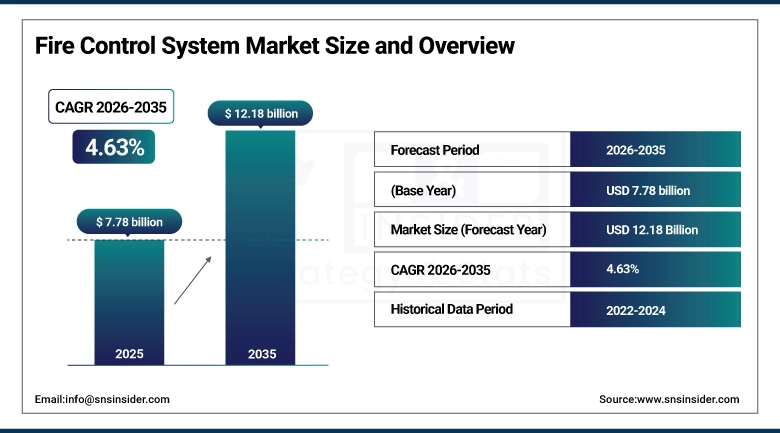
The Fire Control System Market size is valued at USD 7.78 Billion in 2025 and is projected to reach USD 12.18 Billion by 2035, growing at a CAGR of 4.63% during the forecast period 2026–2035.
The Fire Control System Market report encompasses a detailed study of market dynamics, innovations, and the integration of precision targeting systems on defense platforms. The growth of the market is driven by factors such as growing defense modernization initiatives, escalating geopolitical conflicts, surging demand for advanced and AI-driven targeting systems, innovations in sensor fusion technology, and the advent of unmanned and network-centric warfare.
The deployment of fire control systems has surpassed 95,000 units on land, sea, and air platforms in 2025.
Market Size and Forecast:
-
Market Size in 2025: USD 7.78 Billion
-
Market Size by 2035: USD 12.18 Billion
-
CAGR: 4.63% from 2026 to 2035
-
Base Year: 2025
-
Forecast Period: 2026–2035
-
Historical Data: 2022–2024
To Get more information on Fire Control System Market - Request Free Sample Report
Fire Control System Market Trends:
-
Increasing defense modernization programs and rising military expenditures are driving demand for advanced fire control systems across land, naval, and airborne platforms.
-
Growing adoption of AI-enabled targeting, automation, and autonomous weapon systems is significantly enhancing precision, response time, and combat effectiveness.
-
Integration of multi-sensor fusion technologies, including radar, EO/IR, and laser systems, is improving target detection, tracking accuracy, and situational awareness.
-
Rising deployment of unmanned systems (UAVs/UGVs) is accelerating the need for advanced, lightweight, and highly responsive fire control solutions.
-
Strong pipeline of next-generation technologies, including directed energy weapons and network-centric warfare systems, is driving continuous innovation in fire control capabilities.
-
Increasing focus on system upgrades, retrofit programs, and interoperability with command & control networks is boosting adoption across both developed and emerging defense markets.
U.S. Fire Control System Market Insights:
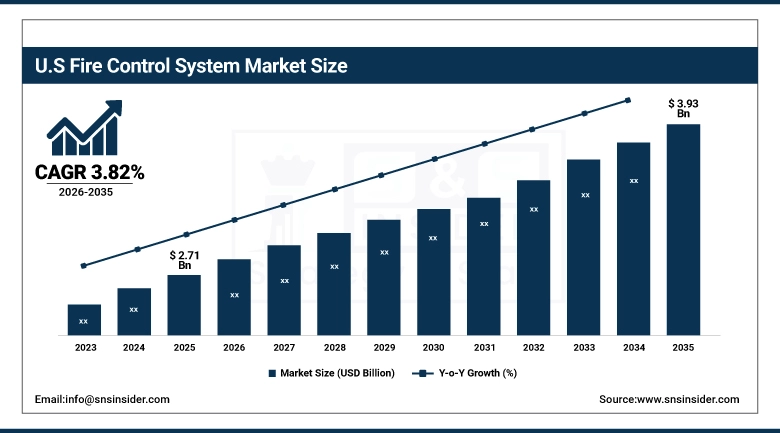
The U.S. Fire Control System Market is projected to grow from USD 2.71 Billion in 2025 to USD 3.93 Billion by 2035, at a CAGR of 3.82%. Factors that will propel growth include rising defense budgets, continuous modernization of military platforms, increasing adoption of AI-enabled and automated targeting systems, strong presence of leading defense contractors, and growing integration of advanced fire control systems across land, naval, and airborne platforms.
Fire Control System Market Growth Drivers:
-
Increasing defense modernization programs and rising adoption of advanced targeting technologies are driving demand for high-precision fire control systems.
The increase in global military spending along with rising geopolitical conflicts are some of the critical factors that are expected to contribute to the growth of the Fire Control System Market. The use of innovative technology, including advanced weapons control, sensors fusion, and AI-based target acquisition for better accuracy during combat operations, is one of the significant factors projected to boost the demand for fire control systems. The development of new generation fire control systems is another major reason for market growth.
More than 68% of modern defense platforms are equipped with multi-sensor and AI-enabled fire control systems in 2025.
Fire Control System Market Restraints:
-
High cost of advanced fire control systems and budget constraints are restraining widespread adoption across defense platforms.
High cost of acquisition and integration associated with advanced fire control systems such as artificial intelligence-based target identification systems, sensor fusion technology, and modern weapon control systems is expected to serve as one of the major factors limiting the Fire Control System Market. High investment needs and costliness associated with the implementation of such technologies make the adoption process difficult for developing countries with limited defense budgets.
Fire Control System Market Opportunities:
-
Expansion of autonomous and network-centric warfare capabilities is creating significant growth opportunities for advanced fire control systems.
Several opportunities have emerged in the Fire Control System Market due to increased spending on autonomous weaponry platforms, real-time communication capabilities during battle, and the establishment of a cohesive command and control ecosystem. The rising inclination toward multi-domain operations and the digitalization of battlefields is making it easier to synchronize sensors, weapons, and decision-making capabilities. These developments allow defense equipment producers to design more adaptive fire control systems with improved interoperability and predictive targeting abilities.
In 2025, network-centric and digitally integrated fire control systems accounted for more than 58% of sales from advanced defense platforms.
Fire Control System Market Segmentation Analysis:
-
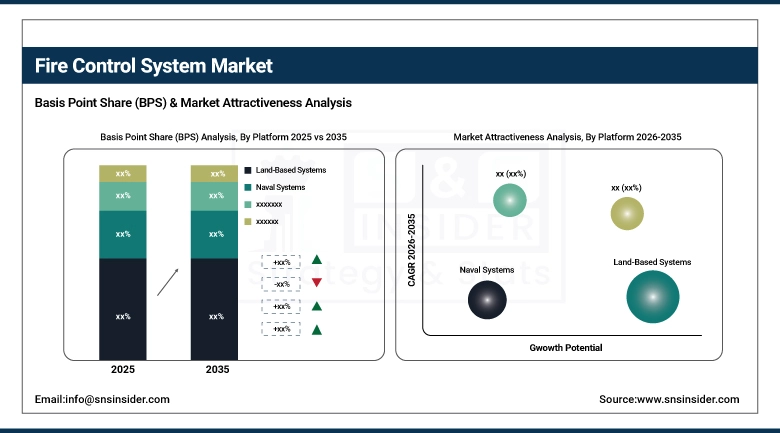
By Platform, Land-Based Systems held the largest market share of 38.03% in 2025, while Unmanned Systems (UAV/UGV) are expected to grow at the fastest CAGR of 7.77% during 2026–2035.
-
By Component, Sensors (Radar, EO/IR, Laser Rangefinders) accounted for the highest market share of 34.05% in 2025, while Software & Ballistic Calculation Systems are projected to grow at the fastest CAGR of 7.95% during the forecast period.
-
By Weapon System, Missile Systems held the largest market share of 30.85% in 2025, while Naval Weapon Systems are expected to grow at a notable CAGR of 5.45% during 2026–2035.
-
By Technology, Electro-Optical / Infrared (EO/IR) Systems accounted for the highest market share of 29.12% in 2025, while AI-Integrated Fire Control Systems are expected to grow at the fastest CAGR of 7.86% during the forecast period.
-
By End User, Army / Land Forces dominated with a 42.23% market share in 2025, whereas Homeland Security is projected to record a steady CAGR of 5.34% through 2026–2035.
By Platform, Land-Based Systems Dominate while Unmanned Systems Grow Rapidly:
Land-Based Systems segment dominated the market owing to widespread use in armored vehicles, artillery systems, and ground defense platforms, coupled with modernization efforts. By 2025, the market was valued at more than 2.9 billion USD, which demonstrates high demand for sophisticated targeting and fire control solutions in land warfare applications.
Unmanned Systems (UAV/UGV) are the fastest-growing segment due to the rising use of automated and remotely operated systems in contemporary warfare conditions. The deployment of unmanned systems is estimated to surpass 1.6 billion USD by 2035, demonstrating fast growth in the industry.
By Component, Sensors Dominate while Software & Ballistic Calculation Systems Grow Rapidly:
Sensor’s segment dominated the market since they played an important role in detection, identification, tracking, and engagement. Radar, electro-optical, and laser range finding are technologies that have found application in many fire control systems. The estimated value of the segment for 2025 reached above 2.9 billion USD.
Software & Ballistic Calculation Systems are the fastest-growing rates due to its focus on automated targeting and analysis. It is expected that the market value will reach more than 2.8 billion USD in 2035.
By Weapon System, Missile Systems Dominate while Naval Weapon Systems Grow Rapidly:
Missile Systems segment dominated the market due to the increasing use of guided missiles and long-range strike capabilities. In 2025, its worth was more than 2.3 billion USD, indicating a high rate of implementation of guidance and fire control of advanced missiles.
Naval Weapon Systems are the fastest-growing segment owing to naval modernization and increased maritime defense capabilities. It is expected that by 2035, the market value will be more than 2.9 billion due to the growing need for fire control systems in naval warfare and surveillance.
By Technology, Radar-Based Systems Dominate While AI-Integrated Fire Control Systems Grow Rapidly:
Radar-Based Systems segment dominated the market due to their critical role in accurate target detection, tracking, and engagement across diverse and complex combat environments. Their reliability and effectiveness in all-weather and long-range operations make them a core component of modern fire control systems.
AI-Integrated Fire Control Systems are the fastest-growing segment, driven by increasing demand for automation, predictive targeting, and faster decision-making capabilities. Growing integration of AI in defense platforms is significantly enhancing operational efficiency and precision.
By End User, Army / Land Forces Dominate While Air Force Expands Rapidly:
Army / Land Forces segment dominated the market, owing to its widespread application in tanks, artillery, and other terrestrial combat systems, and modernization initiatives. Precision targeting in the land war will continue to ensure that this market maintains a high level of demand.
The Air Force segment is among the fastest growing, owing to the rising use of advanced fire control systems in aircraft and drones. Increasing emphasis on precision and targeting in air combat missions will further boost its growth.
Fire Control System Market Regional Analysis:
North America Fire Control System Market Insights:
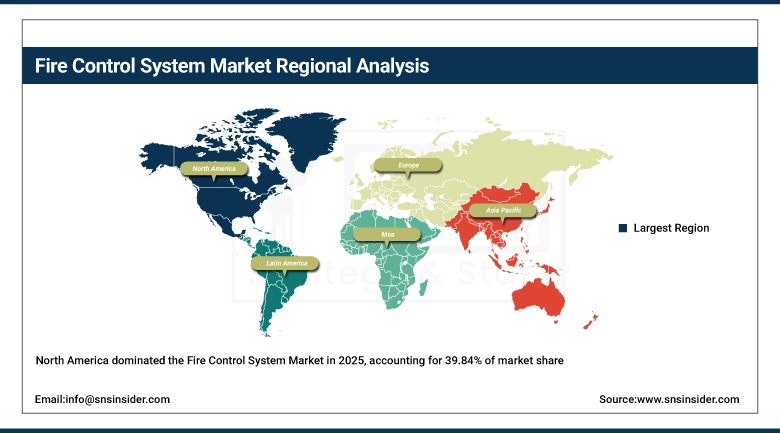
The North America Fire Control System Market is dominant, holding a 39.84% share in 2025, fueled by robust defense budgets and sustained efforts toward military modernization in both the United States and Canada. The sector enjoys the benefit of being home to key defense system manufacturers and high levels of technological prowess, which allows for the swift incorporation of fire control solutions into land-based, maritime, and aerial vehicles. The widespread use of artificial intelligence-based targeting solutions, sensors, and network-centric warfare systems drives market growth even further.
Get Customized Report as per Your Business Requirement - Enquiry Now
U.S. Fire Control System Market Insights:
The U.S. Fire Control System Market is fueled by extensive defense budget allocations, innovative research and development, and early adaptation of the latest technological innovations. The nation enjoys dominance in the deployment of integrated fire control solutions into state-of-the-art combat vehicles, aided by the availability of key defense manufacturers and technological advancements in targeting and weapon guidance systems.
Asia-Pacific Fire Control System Market Insights:
The Asia-Pacific Fire Control System Market is the fastest-growing region, projected to expand at a CAGR of 7.11% during 2026–2035. It is propelled by the rising investments in defense expenditure and swift military modernization in countries such as China, India, Japan, and South Korea. The intensifying geopolitical conflicts and heightened emphasis on securing the borders and seas will accelerate the adoption of innovative fire control systems. Governments around the world are making substantial investments in domestic defense manufacturing and upgrading the current military platforms with sophisticated targeting technologies.
China Fire Control System Market Insights:
The China Fire Control System Market is propelled by the rapid modernization of the armed forces, expansion of defense manufacturing capacity, and government spending on advanced weapons systems. With an increasing emphasis on indigenous production and technology independence, the research and development of next-generation fire control systems on land, sea, and air platforms have gained momentum. The incorporation of artificial intelligence-based targeting and sensor fusion technologies is boosting the combat efficiency of military operations.
Europe Fire Control System Market Insights:
The Europe Fire Control System Market is fueled by effective cooperation among the defense forces of several nations, defense modernization policies, and investments in military technology. Nations such as Germany, France, and the United Kingdom are actively involved in enhancing their capabilities by integrating fire control systems into their current platforms. Joint defense systems, interoperable and precise targeting systems are some factors that have accelerated the adoption of fire control systems. Continuous improvements in technology along with the procurement of newer versions will further solidify Europe's presence in the market.
Germany Fire Control System Market Insights:
Germany is one of the leading countries within Europe due to its extensive defense industry infrastructure and its commitment toward technological advancement. Modernization of tanks, artillery, and air defense systems is carried out in the nation through incorporation of fire control technologies. Investments in research and engineering activities, along with defense partnerships, are expected to drive the market for the coming years.
Latin America Fire Control System Market Insights:
The Latin America Fire Control System Market is growing steadily, supported by increasing defense budgets and modernization of military equipment across countries such as Brazil, Mexico, and Argentina. Governments are focusing on upgrading legacy systems and enhancing surveillance and combat capabilities. Rising investments in border security and defense infrastructure are contributing to adoption of advanced fire control systems. Gradual improvement in local manufacturing and defense partnerships is further supporting regional growth.
Middle East and Africa Fire Control System Market Insights:
The Middle East & Africa Fire Control System Market is expanding due to rising defense procurement and focus on strengthening military capabilities in countries such as Saudi Arabia, the UAE, and South Africa. Increasing investments in advanced weapon systems and modernization of defense platforms are driving demand for fire control systems. Emphasis on air defense, missile systems, and border security is accelerating adoption. Growing defense collaborations and infrastructure development are supporting long-term market expansion across the region.
Fire Control System Market Competitive Landscape:
Lockheed Martin Corporation is a leading defense contractor with a strong presence in the fire control system market, driven by its advanced integrated targeting and weapon control solutions across land, naval, and airborne platforms. The company’s expertise in missile systems, radar integration, and command & control technologies enables highly accurate and reliable fire control capabilities. Its focus on next-generation warfare systems, including multi-domain operations and network-centric combat, strengthens its leadership position.
-
In March 2025, Lockheed Martin continued advancing integrated fire control capabilities through upgrades in missile defense systems and multi-domain command platforms, reinforcing its leadership in precision targeting technologies.
RTX Corporation (Raytheon Technologies) is a major player in the fire control system market, supported by its strong portfolio of radar systems, missile guidance technologies, and advanced targeting solutions. The company leverages deep expertise in sensor fusion, electronic warfare, and integrated air and missile defense systems to deliver high-performance fire control capabilities. Its continuous focus on innovation, digital engineering, and advanced computing strengthens its position in modern combat systems. Expansion of its defense programs and partnerships further reinforces RTX’s role in next-generation fire control system development.
-
In June 2025, RTX advanced next-generation radar and fire control solutions, enhancing integration across air and missile defense platforms and strengthening its position in advanced targeting systems.
Northrop Grumman Corporation is a key innovator in the fire control system market, recognized for its advanced sensor technologies, targeting systems, and integrated battle management solutions. The company focuses on delivering high-precision fire control capabilities through cutting-edge radar, electro-optical systems, and autonomous technologies. Its strong emphasis on digital transformation, AI integration, and multi-domain command systems positions it as a leader in future combat environments. Ongoing investments in advanced defense programs and system integration capabilities support Northrop Grumman’s sustained growth in precision targeting and fire control solutions.
-
In September 2025, Northrop Grumman continued to enhance its integrated fire control and sensor systems through advancements in next-generation radar and battle management technologies, strengthening its presence in modern defense operations.
Fire Control System Market Key Players:
Some of the Fire Control System Market Companies are:
-
Lockheed Martin Corporation
-
RTX Corporation (Raytheon Technologies)
-
Northrop Grumman Corporation
-
BAE Systems plc
-
Thales Group
-
Leonardo S.p.A.
-
Rheinmetall AG
-
Elbit Systems Ltd.
-
Saab AB
-
General Dynamics Corporation
-
L3Harris Technologies Inc.
-
Kongsberg Gruppen ASA
-
Israel Aerospace Industries Ltd. (IAI)
-
ASELSAN A.S.
-
Hanwha Aerospace Co. Ltd.
-
Bharat Electronics Limited (BEL)
-
Safran S.A.
-
HENSOLDT AG
-
Curtiss-Wright Corporation
-
Ultra Electronics Holdings plc
| Report Attributes | Details |
|---|---|
| Market Size in 2025 | USD 7.78 Billion |
| Market Size by 2035 | USD 12.18 Billion |
| CAGR | CAGR of 4.63% From 2026 to 2035 |
| Base Year | 2025 |
| Forecast Period | 2026-2035 |
| Historical Data | 2022-2024 |
| Report Scope & Coverage | Market Size, Segments Analysis, Competitive Landscape, Regional Analysis, DROC & SWOT Analysis, Forecast Outlook |
| Key Segments | • By Platform (Land-Based Systems, Naval Systems, Airborne Systems, Unmanned Systems (UAV/UGV), Others) • By Component (Sensors (Radar, EO/IR, Laser Rangefinders), Fire Control Computers / Processing Units, Weapon Interface Systems, Software & Ballistic Calculation Systems, Others) • By Weapon System (Gun & Cannon Systems, Missile Systems, Artillery Systems, Naval Weapon Systems, Others) • By Technology (Electro-Optical / Infrared (EO/IR) Systems, Radar-Based Systems, Laser-Based Systems, AI-Integrated Fire Control Systems, Others) • By End User (Army / Land Forces, Navy, Air Force, Defense OEMs / Integrators, Others) |
| Regional Analysis/Coverage | North America (US, Canada), Europe (Germany, UK, France, Italy, Spain, Russia, Poland, Rest of Europe), Asia Pacific (China, India, Japan, South Korea, Australia, ASEAN Countries, Rest of Asia Pacific), Middle East & Africa (UAE, Saudi Arabia, Qatar, South Africa, Rest of Middle East & Africa), Latin America (Brazil, Argentina, Mexico, Colombia, Rest of Latin America). |
| Company Profiles | Lockheed Martin Corporation, RTX Corporation (Raytheon Technologies), Northrop Grumman Corporation, BAE Systems plc, Thales Group, Leonardo S.p.A., Rheinmetall AG, Elbit Systems Ltd., Saab AB, General Dynamics Corporation, L3Harris Technologies Inc., Kongsberg Gruppen ASA, Israel Aerospace Industries Ltd. (IAI), ASELSAN A.S., Hanwha Aerospace Co. Ltd., Bharat Electronics Limited (BEL), Safran S.A., HENSOLDT AG, Curtiss-Wright Corporation, Ultra Electronics Holdings plc |
Frequently Asked Questions
North America dominated with a 39.84% share in 2025, while Asia-Pacific is the fastest-growing region, expected to expand at a CAGR of 7.11% during 2026–2035.
Land-Based Systems dominated with a 38.03% share in 2025, while Unmanned Systems (UAV/UGV) are also projected to grow at the fastest CAGR of 7.77% during 2026–2035.
Growth is driven by increasing defense modernization programs, rising adoption of AI-enabled targeting systems, and growing geopolitical tensions.
The market is valued at USD 7.78 Billion in 2025 and is projected to reach USD 12.18 Billion by 2035.
The Fire Control System Market is projected to grow at a CAGR of 4.63% during 2026–2035.
