
Frankincense Oil Market Report Scope & Overview:
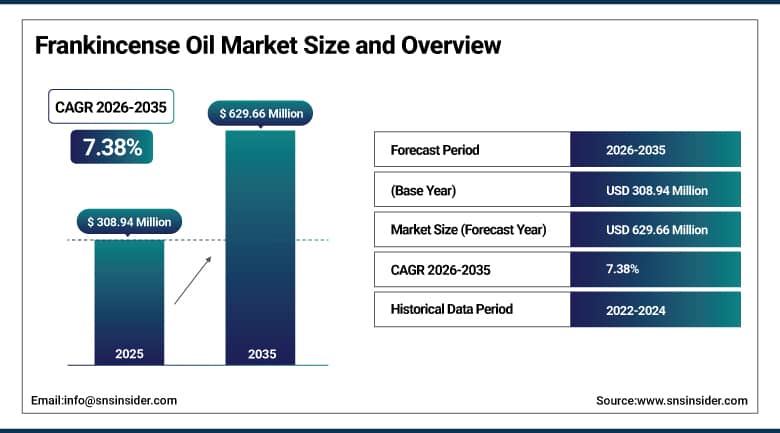
The Frankincense Oil Market was valued at USD 308.94 Million in 2025 and is expected to reach USD 629.66 Million by 2035, growing at a CAGR of 7.38% from 2026-2035.
The growth in the Frankincense Oil Market is being attributed to increased consumer demands for natural ingredients in aromatherapy, personal care, cosmetics, and wellness sectors. Increased consumer preferences towards the use of natural essential oils and fragrance oils is promoting the addition of frankincense oil to skin care products, fragrances, and relaxation products. The conventional use of the oil in wellness practices and increased interests in essential oils in stress management and meditation are further aiding the growth in the demand for the same. Other commercial applications like the use of the oil in premium cosmetics, massage oils, and natural health care products are creating further growth opportunities.
⮞According to the U.S. Department of Agriculture Foreign Agricultural Service, world trade in essential oils reached USD 43.0 billion in 2024, up 25%. The trade base shows the scale of the wider aroma and flavor supply chain that frankincense oil belongs to.
To Get More Information On Frankincense Oil Market - Request Free Sample Report
Frankincense Oil Market Trends:
-
Growing use of frankincense oil in anti-aging and clean-label skin care
-
Rising demand for certified organic and fair-trade oil
-
Sustainable harvesting programs in Oman and the Horn of Africa
-
Wider use in aromatherapy, wellness and nutraceutical products
-
Premium and specialty perfumery using high-grade Boswellia sacra oil
U.S. Frankincense Oil Market Outlook:
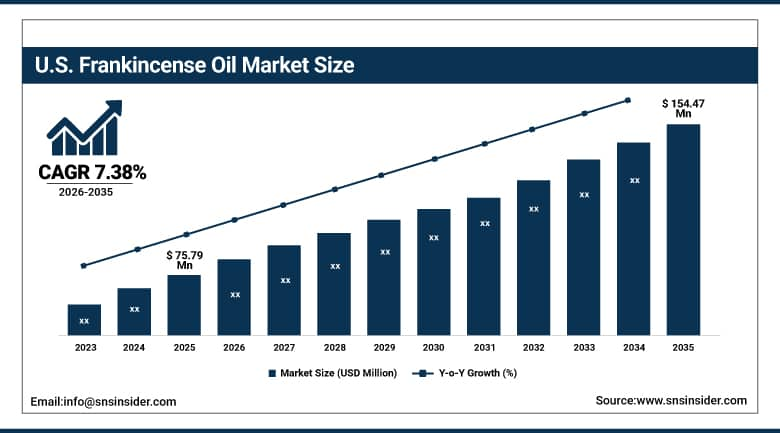
The U.S. Frankincense Oil Market was valued at USD 75.79 Million in 2025 and is expected to reach USD 154.47 Million by 2035, growing at a CAGR of 7.38% from 2026-2035.
The U.S. Frankincense Oil Market is growing due to increasing consumer interest in natural wellness products, aromatherapy, and plant-based personal care ingredients. Rising demand for essential oils in skincare, perfumes, massage products, and relaxation applications is encouraging manufacturers to expand their product offerings. Growing awareness of holistic wellness practices and the use of essential oils for meditation and stress relief are further supporting market demand. Additionally, the popularity of clean-label cosmetics and botanical formulations is creating opportunities for frankincense oil in premium beauty products. Expanding e-commerce platforms and specialty wellness retailers are improving product accessibility.
⮞According to the U.S. Department of Agriculture Foreign Agricultural Service, U.S. essential oil imports were USD 5.6 billion and exports a record USD 2.5 billion. The large import base shows the depth of demand from American flavor, fragrance and wellness buyers.
Frankincense Oil Market Segment Analysis:
-
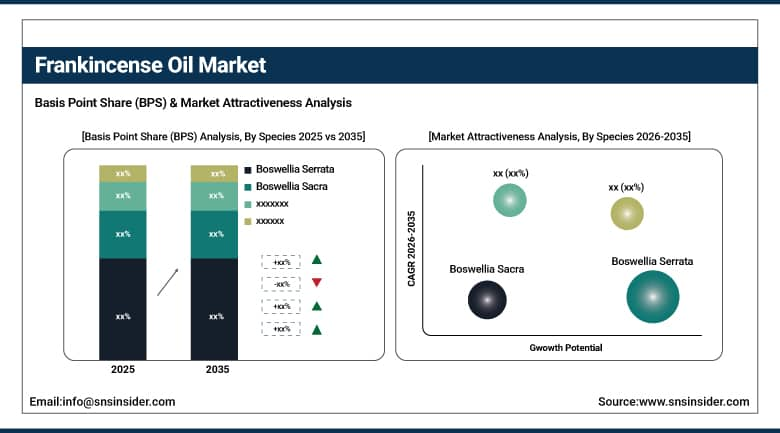
By Species, the Boswellia Serrata segment dominated the Frankincense Oil Market with approximately 32.40% share in 2025, while the Boswellia Sacra segment is the fastest growing with a CAGR of approximately 8.38%.
-
By Nature, the Conventional segment dominated the Frankincense Oil Market with approximately 57.00% share in 2025, while the Organic segment is the fastest growing with a CAGR of approximately 8.58%.
-
By Application, the Cosmetics & Personal Care segment dominated the Frankincense Oil Market with approximately 44.90% share in 2025, while the Pharmaceuticals segment is the fastest growing with a CAGR of approximately 8.48%.
By Species, Boswellia Serrata Dominates the Frankincense Oil Market and Boswellia Sacra Grows Fastest
Boswellia serrata leads because India has a large, organized supply of resin and a strong base of processors that serve cosmetic, pharmaceutical and supplement buyers. The species is widely used in Ayurvedic products, and its oil is priced below Omani and Somali grades, which suits high-volume formulations. Reliable availability and established export channels keep it ahead of rarer species.
Boswellia sacra is the fastest growing species as luxury perfumers and premium skin care brands favor its refined aroma. Oman is investing in managed harvesting and local distillation, which improves traceability and brings more oil to market. Scarcity and certification support higher prices, and collectors of fine fragrance value the origin story. Growth is limited by tree numbers, so supply expands slowly.
⮞According to the International Union for Conservation of Nature, 24 Boswellia species have been assessed, with 5 moved to Endangered and Boswellia nana listed as Critically Endangered. The assessments show why species choice and sourcing are under scrutiny.
By Nature, Conventional Dominates the Frankincense Oil Market and Organic Grows Fastest
Conventional oil leads because most resin is collected from wild trees without formal organic certification, and many buyers prioritize price and consistent supply over labels. Large fragrance, flavor and personal care companies use conventional oil in blends where cost control matters. Established trading channels from Africa and India move large volumes at predictable prices.
Organic oil is the fastest growing as consumers choose clean-label products and brands seek certified ingredients. Retailers in Europe and North America favor suppliers that show organic and fair-trade credentials. Certification adds cost and audit work, but it supports price premiums and wider shelf access. Programs that certify wild harvest areas are enlarging the pool of qualified supply.
⮞In August 2025, the FairWild Foundation announced the first FairWild certification of a frankincense harvest in the Arabian Peninsula, at Wadi Dawkah in Oman. The certification shows growing supply of audited wild-harvested resin.
By Application, Cosmetics & Personal Care Dominates the Frankincense Oil Market and Pharmaceuticals Grows Fastest
Cosmetics and personal care lead because frankincense oil is used in anti-aging creams, serums, soaps, hair care and fragrance. Brands promote the oil as soothing and skin-balancing, and it fits natural and spa positioning. Fine fragrance houses also use it as a base note. The large number of skin care launches and strong online sales keep this application ahead.
Pharmaceuticals are the fastest growing application as research on the anti-inflammatory properties of boswellic acids draws interest from supplement and topical product developers. Traditional medicine in India and the Middle East has long used the resin, which supports acceptance. Regulatory approval and clinical evidence remain necessary for health claims, but pipeline activity is rising.
⮞According to L'Oréal's 2024 annual report, skincare made up 39% of its beauty sales, haircare 21%, make-up 17% and fragrance 13%. The mix shows where beauty ingredient demand is concentrated.
Regional Analysis:
|
Region |
Major Country |
Share within Region, 2025 (%) |
|---|---|---|
|
North America |
U.S. |
75.00 |
|
Europe |
Germany |
29.18 |
|
Asia Pacific |
India |
34.62 |
|
Latin America |
Brazil |
41.58 |
|
Middle East & Africa |
Oman |
27.94 |
North America Frankincense Oil Market Insights
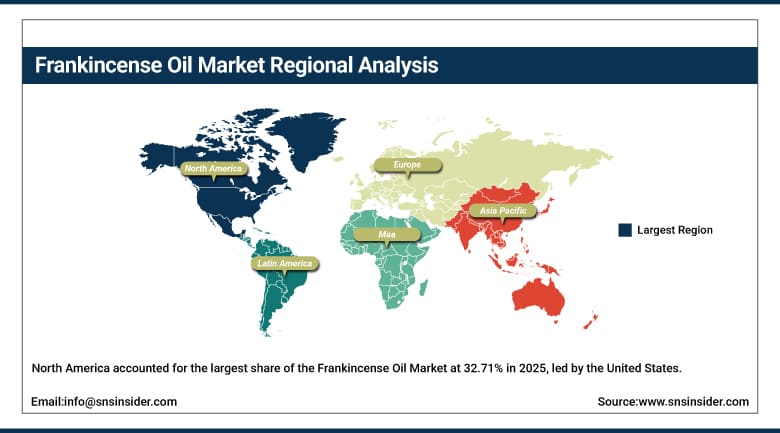
North America accounted for the largest share of the Frankincense Oil Market at 32.71% in 2025, led by the United States. A large wellness sector, strong direct-selling companies and growing online retail create steady demand. Canada adds smaller volumes through natural health products, and Mexico is a minor but growing buyer.
Consumers in the region favor organic and ethically sourced oil, and brands highlight origin and harvest practices. Regulators watch fragrance allergen disclosure and cosmetic safety, which shapes formulations. Nearly all supply is imported, so prices follow harvest conditions in East Africa, Oman and India. Retailers are signing longer contracts with suppliers to stabilize costs.
⮞In March 2026, Health Canada eased cosmetic notification reporting so exact fragrance allergen concentrations are no longer required for most allergens, while label disclosure above 0.001% in leave-on products remains. The change affects how essential oil suppliers document composition.
Get Customized Report as Per Your Business Requirement - Enquiry Now
Europe Frankincense Oil Market Insights
Europe held about 25.83% of the Frankincense Oil Market in 2025 and is led by France, the United Kingdom, Germany, Switzerland and Italy. The region hosts the world's largest fragrance and flavor houses, as well as natural cosmetics brands and aromatherapy producers. Demand for organic and fair-trade oil is especially strong.
Regulation is detailed. New labeling rules require disclosure of more fragrance allergens, which pushes brands to review ingredients and keep better records of oil composition. Buyers ask for traceable sourcing and sustainability certificates, favoring suppliers with FairWild or organic status. European distillers also process imported resin, which adds regional supply.
⮞According to Commission Regulation (EU) 2023/1545, 56 additional fragrance allergens must be listed on labels, with new products compliant by July 2026 and existing products by July 2028. The rule raises documentation needs for essential oil suppliers.
Asia Pacific Frankincense Oil Market Insights
Asia Pacific held about 22.12% of the Frankincense Oil Market in 2025 and is projected to be the fastest growing region. India is the main producer of Boswellia serrata and a large consumer through Ayurveda, incense and personal care. China, Japan, South Korea and Australia are growing buyers of skin care and wellness products.
Rising incomes, a young consumer base and a strong beauty industry are lifting demand. E-commerce platforms make small-batch essential oils easy to reach, and traditional medicine systems support acceptance. Local processors in India are expanding export capacity. Quality consistency and counterfeit oils remain concerns that buyers manage through testing.
⮞According to UN Comtrade data, India exported USD 2.65 billion of essential oils, perfumery and cosmetic products in 2025. The figure shows the size of the regional export base supporting aroma ingredient supply.
MEA & Latin America Frankincense Oil Market Insights
The Middle East and Africa and Latin America together hold about 19.34% of the Frankincense Oil Market. The Middle East and Africa is the source region, with Oman, Yemen, Somalia, Ethiopia and Sudan producing the resin. Gulf countries are also buyers, using frankincense in perfume, incense and traditional wellness.
Harvesting depends on rainfall and security conditions, and tree health is under pressure from over-tapping and drought. Governments and companies are building managed harvest and local distillation programs to capture more value. Latin America is a small but growing market, led by Brazil and Mexico, where natural cosmetics and aromatherapy are expanding.
⮞According to Oman's National Centre for Statistics and Information, frankincense exports totaled about USD 1.22 million (RO 471.4 thousand) in 2025. The figure gives a concrete measure of trade from the leading source country.
Market Dynamics:
Growth Drivers: Natural Beauty and Wellness Demand Drive Growth in the Frankincense Oil Market
Natural beauty and wellness demand is a major driver of the Frankincense Oil Market. Consumers increasingly prefer plant-derived ingredients in skincare, aromatherapy, personal care, and relaxation products. Frankincense oil is incorporated into facial serums, creams, massage oils, perfumes, and diffusers because of its distinctive aroma and traditional association with wellness practices. The expansion of premium cosmetics and natural fragrance products is creating additional commercial opportunities. Growing interest in holistic wellness, meditation, and home aromatherapy is further encouraging essential oil consumption.
Product innovation is also supporting market expansion. Manufacturers are developing organic, traceable, and sustainably sourced oil varieties to meet changing consumer expectations. Improved extraction techniques enable suppliers to offer differentiated ingredients for specialized formulations. Additionally, e-commerce platforms and wellness retailers are improving product accessibility, allowing smaller brands to reach broader audiences. These developments are strengthening demand across personal care, fragrance, and wellness applications.
⮞According to Symrise, its Taste, Nutrition & Health segment grew 4.9% organically in the second quarter of 2026. The growth shows steady demand from natural ingredient buyers.
Restraints: Supply Risk and Regulatory Pressure Restrain Growth in the Frankincense Oil Market
Supply instability is a significant restraint on the Frankincense Oil Market because production depends heavily on resin harvested from Boswellia trees, particularly in arid regions. Drought, changing climatic conditions, excessive tapping, and habitat degradation can reduce resin yields and threaten long-term tree health. Political instability in certain producing regions may also disrupt harvesting, transportation, and international trade. These challenges create fluctuations in raw material availability and procurement costs, making consistent production difficult for manufacturers. Variations in resin quality and the risk of adulteration can further complicate sourcing and weaken buyer confidence.
Regulatory requirements add to these challenges. Sustainability certification, product traceability, quality testing, and ingredient documentation increase compliance costs, particularly for small producers and exporters. Potential changes in international trade controls for threatened Boswellia species could introduce additional permitting requirements and shipment delays. Consequently, supply uncertainty and compliance expenses may restrict market expansion and limit the availability of premium-quality frankincense oil.
⮞According to the Centre for the Promotion of Imports from developing countries, the Convention on International Trade in Endangered Species is assessing Boswellia for listing, with Appendix II the likeliest outcome, while drought in the Horn of Africa has lifted prices. The signals point to tighter supply and higher costs.
Opportunities: Sustainable Harvesting and Local Distillation Create Opportunities in the Frankincense Oil Market
Sustainable harvesting presents an important opportunity for the Frankincense Oil Market by helping secure long-term raw material availability while protecting natural Boswellia populations. Responsible tapping practices, managed harvesting schedules, and community-based conservation programs can improve tree health and support more consistent resin production. Increasing consumer interest in ethical sourcing also creates opportunities for suppliers offering traceable, responsibly harvested, and certified frankincense oil. Cosmetic, fragrance, and wellness brands can use transparent sourcing practices to strengthen product differentiation and appeal to environmentally conscious customers. Long-term procurement agreements can further encourage investment in sustainable production.
Local distillation offers another growth opportunity by enabling producing regions to capture more value from their natural resources. Establishing processing facilities closer to harvesting areas can improve supply-chain transparency, support local employment, and develop technical expertise. Producers can diversify their offerings through specialized extracts, hydrosols, and formulated ingredients for personal care and wellness applications. Partnerships among local communities, governments, and international brands can help finance equipment, training, and sustainable sourcing infrastructure, supporting a more resilient industry.
⮞According to Oman's Ministry of Agriculture, Fisheries Wealth and Water Resources, a partnership with Amouage launched in June 2026 covers a sustainable harvesting project of about 1,500 acres at Wadi Gazelle in Dhofar. The pilot is designed to run for 18 months before wider expansion.
Recent Developments:
-
June 2026, Amouage announced a sustainable frankincense harvesting project with Oman's agriculture ministry at Wadi Gazelle, Dhofar. The company said the resin is to be distilled into essential oil in Oman once its Ayn Dawkah facility opens.
-
July 2024, Dahab Gums and Resins listed itself with FairWild and said it is pursuing certification for Boswellia carterii resin in 2026. The company said certification would support traceable, audited supply for buyers.
Frankincense Oil Market Key Players:
-
doTERRA International, LLC
-
Plant Therapy, Inc.
-
NOW Foods
-
Eden Botanicals
-
Aura Cacia (Frontier Co-op)
-
Mountain Rose Herbs
-
Florame
-
Amouage
-
Neal's Yard Remedies
-
Sheba Nordic Oils
Frankincense Oil Market Report Scope:
| Report Attributes | Details |
|---|---|
| Market Size in 2025 | USD 308.94 Million |
| Market Size by 2035 | USD 629.66 Million |
| CAGR | CAGR of 7.38% From 2026 to 2035 |
| Base Year | 2025 |
| Forecast Period | 2026-2035 |
| Historical Data | 2022-2024 |
| Report Scope & Coverage | Market Size, Segments Analysis, Competitive Landscape, Regional Analysis, DROC & SWOT Analysis, Forecast Outlook |
| Key Segments | • By Species (Boswellia Carterii, Boswellia Serrata, Boswellia Sacra, and Others) • By Nature (Conventional and Organic) • By Application (Cosmetics and Personal Care, Pharmaceuticals, Aromatherapy, Food and Beverages, and Others) |
| Regional Analysis/Coverage | North America (US, Canada), Europe (Germany, UK, France, Italy, Spain, Russia, Poland, Rest of Europe), Asia Pacific (China, India, Japan, South Korea, Australia, ASEAN Countries, Rest of Asia Pacific), Middle East & Africa (UAE, Saudi Arabia, Qatar, South Africa, Rest of Middle East & Africa), Latin America (Brazil, Argentina, Mexico, Colombia, Rest of Latin America). |
| Company Profiles | doTERRA International, LLC, Plant Therapy, Inc., NOW Foods, Eden Botanicals, Aura Cacia (Frontier Co-op), Mountain Rose Herbs, Florame, Amouage, Neal's Yard Remedies, Sheba Nordic Oils |

Frequently Asked Questions
Key players include doTERRA, Plant Therapy, NOW Foods, Eden Botanicals, Aura Cacia, Mountain Rose Herbs, Florame, Neal's Yard Remedies and Sheba Nordic Oils.
Key opportunities include sustainable and certified harvesting, local distillation in source countries, CO2 extracts for supplements and premium organic grades.
Rising demand for natural beauty, wellness and aromatherapy products is the main growth factor.
By Application, the Cosmetics & Personal Care segment dominated the market in 2025 with an estimated 44.90% share, supported by anti-aging skin care and fragrance use.
North America dominated the market with a share of 32.71% in 2025, driven by a large wellness industry and strong online retail.
