
Fusion Vision Computing Chip Market Report Scope & Overview:
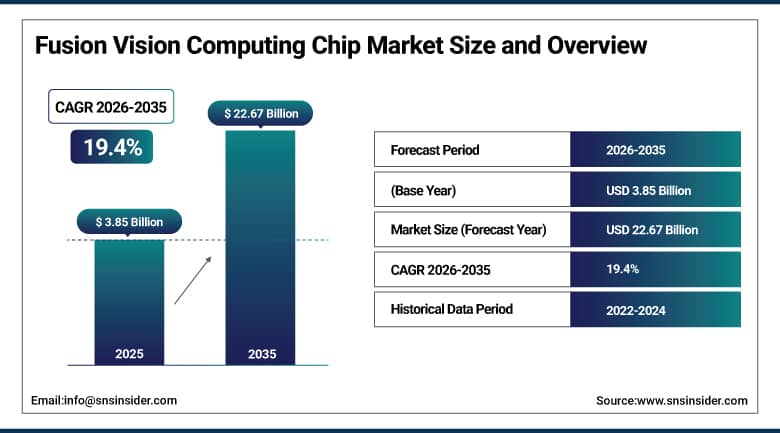
The Fusion Vision Computing Chip Market was valued at USD 3.85 Billion in 2025 and is expected to reach USD 22.67 Billion by 2035, growing at a CAGR of 19.4% from 2026 to 2035.
Rising demand for centralized, real time perception across autonomous vehicles, robotics, and edge artificial intelligence devices continues to push manufacturers toward single platform chips capable of fusing camera, radar, and lidar data at once. Falling costs for advanced packaging and neural processing hardware are widening the range of industries able to afford fusion architecture, while automakers, robotics developers, and industrial automation providers increasingly favor this design because it reduces latency, lowers power consumption, and simplifies overall system architecture compared with discrete, multi-chip alternatives that route data between separate components.
Ambarella Incorporated expanded its CV3-AD family of automotive domain controller chips in early 2024 with the CV3-AD635 and CV3-AD655 models, and by 2025 these processors had been adopted not only by passenger vehicle manufacturers but also by industrial equipment producers and commercial fleet operators. Separately, Horizon Robotics reported a significant increase in shipment volumes of its Journey 5 chip across China during 2025, as domestic automakers sought localized fusion computing solutions capable of handling multi-camera perception under automotive safety standard ASIL-B.
Market Size and Forecast
-
Market Size in 2026E: USD 4.60 Billion
-
Market Size by 2035: USD 22.67 Billion
-
CAGR: 19.4% from 2026 to 2035
-
Fastest Growing Region: Asia Pacific
-
Largest Region: North America
To Get More Information On Fusion Vision Computing Chip Market - Request Free Sample Report
Fusion Vision Computing Chip Market Trends
-
Automakers are integrating fusion vision chips directly into centralized domain controllers to replace multiple discrete electronic control units.
-
Robotics developers are adopting compact fusion chips to give autonomous mobile robots and humanoid platforms faster, lower power real time perception.
-
Event based vision sensors are being paired with fusion processors to reduce data volume while preserving high dynamic range imaging.
-
Consumer electronics companies are embedding vision fusion capability into smartphones and extended reality headsets to improve on device processing.
-
Defense and aerospace programs are funding ruggedized fusion vision chips for autonomous surveillance and unmanned platform applications.
United States Fusion Vision Computing Chip Market Outlook
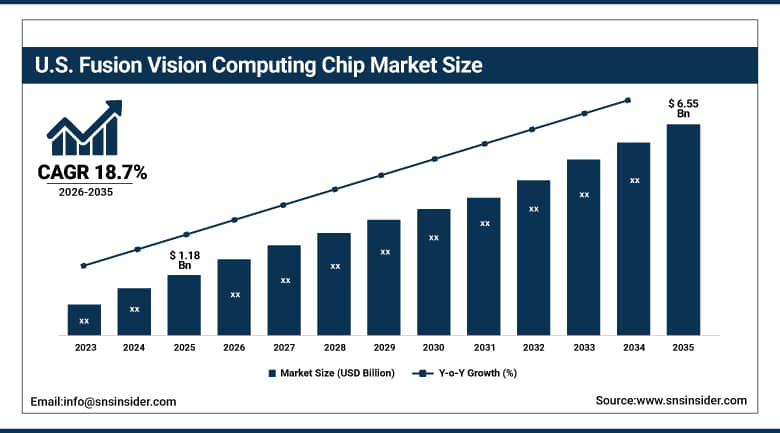
The United States Fusion Vision Computing Chip Market was estimated at approximately USD 1.18 Billion in 2025 and is expected to reach approximately USD 6.55 Billion by 2035, growing at a CAGR of approximately 18.7% from 2026 to 2035.
The United States maintained the largest single national market for fusion vision computing chips in 2025, supported by a concentrated base of semiconductor designers, sustained venture investment in autonomous vehicle and robotics companies, and early enterprise adoption of fusion architecture across multiple industries. Federal research funding directed toward artificial intelligence and autonomous systems, together with a deep pool of engineering talent across California, Texas, and the Pacific Northwest, continued to reinforce the country position as the leading source of fusion vision chip innovation and commercial deployment.
NVIDIA Corporation partnered with Hesai Technology in August 2023 to integrate Hesai lidar sensors with the NVIDIA DRIVE and NVIDIA Omniverse platforms, combining lidar hardware with fusion based artificial intelligence and simulation software for autonomous vehicle development. Continental AG also confirmed an expanded partnership with Ambarella Incorporated to integrate the CV3-AD chip family into its advanced driver assistance system product line, building scalable full stack perception platforms for vehicles ranging from partial automation through full autonomy.
Fusion Vision Computing Chip Market Segment Analysis
-
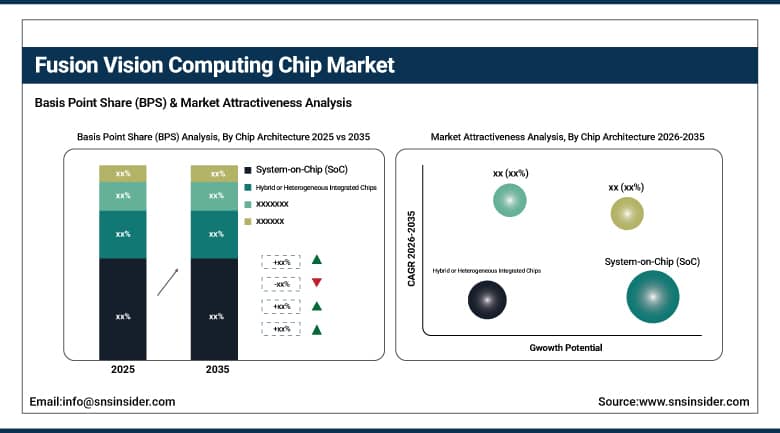
By Chip Architecture, the System-on-Chip segment held approximately 58% share in 2025, while the Hybrid or Heterogeneous Integrated Chips segment was the fastest growing, with a CAGR of approximately 21.8%.
-
By Application, Automotive and Advanced Driver Assistance Systems held approximately 41% share in 2025, while Robotics and Industrial Automation was the fastest growing, with a CAGR of approximately 22.4%.
-
By End User, Automotive Original Equipment Manufacturers and Tier One Suppliers held approximately 45% share in 2025, while Healthcare Providers was the fastest growing, with a CAGR of approximately 23.1%.
By Chip Architecture, System-on-Chip led the market, Hybrid or Heterogeneous Integrated Chips grew fastest
The System-on-Chip segment dominated the Fusion Vision Computing Chip Market in 2025 with approximately 58% market share. Combining image signal processing, neural processing, and memory management onto one die reduced both bill of materials cost and physical footprint compared with multi chip designs. Automotive and consumer electronics manufacturers favored this architecture because it simplified thermal management and shortened design cycles, a combination that kept System-on-Chip designs firmly ahead of alternative architectures across the majority of commercial fusion vision deployments.
The Hybrid or Heterogeneous Integrated Chips segment is projected to grow at the fastest CAGR during the forecast period. This architecture, which combines separately manufactured processing dies within a single package using advanced packaging techniques, allows designers to combine best in class components, an advanced process node neural processing unit paired with a mature process node image signal processor, for example, without waiting for a single monolithic chip to catch up on every function simultaneously, a flexibility that continues to attract manufacturers targeting premium autonomous vehicle and robotics applications.
By Application, Automotive and Advanced Driver Assistance Systems led the market, Robotics and Industrial Automation grew fastest
The Automotive and Advanced Driver Assistance Systems segment dominated the Fusion Vision Computing Chip Market in 2025 with approximately 41% market share. Continued global expansion of driver assistance features and early autonomous driving programs across passenger and commercial vehicles reflected in this leadership position, as regulatory requirements mandating collision avoidance and lane departure warning systems in multiple major markets continued to require centralized, multi sensor perception capability, which kept automotive applications firmly at the center of overall fusion vision chip demand.
The Robotics and Industrial Automation segment is projected to grow at the fastest CAGR during the forecast period. Expanding deployment of autonomous mobile robots, warehouse automation systems, and early humanoid robot platforms across manufacturing and logistics facilities continues to drive this growth. Falling chip costs and improving power efficiency have made fusion vision processing commercially viable for a considerably wider range of robotic applications than had been economically feasible only a few years earlier, a shift that continues to accelerate adoption across this application category.
By End User, Automotive Original Equipment Manufacturers and Tier One Suppliers led the market, Healthcare Providers grew fastest
The Automotive Original Equipment Manufacturers and Tier One Suppliers segment dominated the Fusion Vision Computing Chip Market in 2025 with approximately 45% market share. Large scale procurement of fusion vision chips for both driver assistance and early autonomous driving programs continued to anchor this leadership position. Long standing relationships between vehicle manufacturers and semiconductor suppliers, combined with the multi year design cycles typical of automotive electronics, continued to reinforce this end user category position as the largest single source of fusion vision chip demand.
The Healthcare Providers segment is projected to grow at the fastest CAGR during the forecast period. Rising adoption of fusion vision processing in surgical robotics, endoscopic imaging, and diagnostic equipment requiring simultaneous analysis of multiple visual data streams continues to drive this growth. Growing hospital investment in minimally invasive surgical platforms and portable diagnostic devices continues to widen the addressable market for fusion vision chips within clinical settings, a trend expected to continue through the remainder of the forecast period.
Regional Analysis
|
Region |
Major Country |
Share within Region, 2025 (%) |
|---|---|---|
|
North America |
United States |
83.0% |
|
Europe |
Germany |
27.0% |
|
Asia Pacific |
China |
40.0% |
|
Middle East & Africa |
UAE |
26.0% |
|
Latin America |
Brazil |
38.0% |
North America Fusion Vision Computing Chip Market Insights
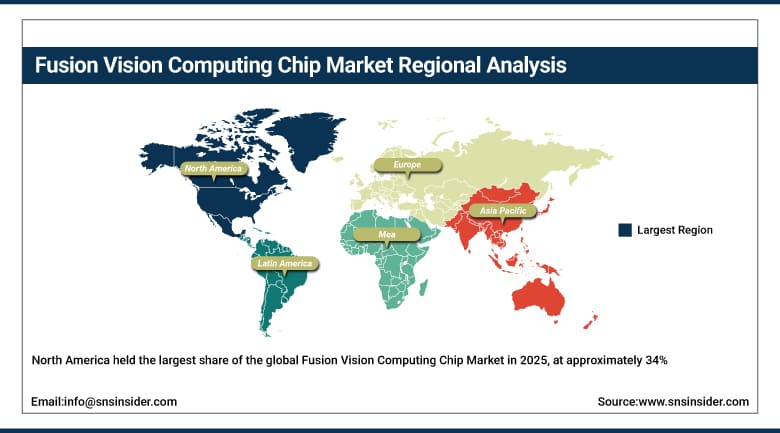
North America held the largest share of the global Fusion Vision Computing Chip Market in 2025, at approximately 34%, supported by a dense concentration of semiconductor designers, sustained venture capital investment in autonomous vehicle and robotics startups, and early enterprise adoption of fusion vision technology across automotive, industrial, and defense sectors. The United States accounted for approximately 83% of regional revenue in 2025, reflecting its outsized concentration of chip design talent and downstream device manufacturers building autonomous vehicles, robots, and extended reality hardware.
Canada contributed a smaller but steadily growing share of regional revenue in 2025, supported by its own artificial intelligence and robotics research ecosystem centered around Toronto and Montreal. That combination of design depth, capital availability, and downstream commercial demand kept North America among the most commercially significant regional markets for fusion vision computing chips throughout the year, a position expected to persist through the near term of the forecast period.
Get Customized Report as Per Your Business Requirement - Enquiry Now
Europe Fusion Vision Computing Chip Market Insights
Europe held a meaningful share of the global Fusion Vision Computing Chip Market in 2025, supported by a strong automotive engineering base, expanding industrial automation investment, and growing government funding directed toward semiconductor and artificial intelligence research across the continent. Germany accounted for approximately 27% of regional revenue in 2025, supported by its concentration of major automotive manufacturers and industrial automation companies that continued integrating fusion vision chips into next generation vehicle and factory systems.
France, the United Kingdom, and Italy followed a broadly similar trajectory in 2025, as European Union level semiconductor investment programs continued extending chip design and manufacturing capability across the continent largest national markets. Continental AG, Robert Bosch GmbH, and other European tier one automotive suppliers continued expanding their own fusion perception platforms during the year, reinforcing the region position as a genuine center of automotive grade fusion vision development.
Asia Pacific Fusion Vision Computing Chip Market Insights
Asia Pacific was the fastest growing region in the global Fusion Vision Computing Chip Market, with a CAGR of approximately 21.5% expected through 2035, driven by rapid automotive production growth, expanding consumer electronics manufacturing, and rising government support for domestic semiconductor development across China, Japan, and South Korea. China accounted for approximately 40% of regional revenue in 2025, supported by aggressive domestic automaker adoption of localized fusion vision chips as part of a broader push toward supply chain independence.
Japan and South Korea contributed significant additional regional demand in 2025 through their own advanced robotics and automotive electronics industries, while India began attracting early stage investment in domestic chip design capability. That combination of manufacturing scale, government policy support, and rapidly maturing domestic design talent continued to reinforce Asia Pacific position as the clear leader in fusion vision computing chip growth throughout the forecast period.
MEA & Latin America Fusion Vision Computing Chip Market Insights
The Middle East and Africa region recorded gradually rising adoption of fusion vision computing chips in 2025, driven by growing smart city investment, expanding industrial automation programs, and rising government interest in autonomous and robotics technology across the Gulf states in particular. The United Arab Emirates accounted for approximately 26% of regional revenue in 2025, supported by national technology diversification strategies and growing enterprise appetite for artificial intelligence enabled hardware across both public and private sector projects.
Latin America expanded at a comparable pace during 2025, led by Brazil at approximately 38% of regional revenue, where growing automotive manufacturing activity and rising industrial automation investment continued to support category growth. Mexico and Argentina followed a similar trajectory as regional electronics manufacturing capacity expanded, and both regions were expected to continue growing steadily as domestic chip design and manufacturing capability slowly matured through the remainder of the forecast period.
Market Dynamics
Growth Drivers: Rising demand for centralized, real time multi sensor perception
The rapid expansion of autonomous vehicles, robotics, and artificial intelligence enabled consumer devices remains the central force behind fusion vision computing chip demand. These applications all require processing of visual and sensor information in real time while operating within tight power and thermal constraints, a combination that fusion chip architecture is uniquely suited to deliver by combining sensing and compute functions onto a single, tightly integrated platform rather than routing data between separate discrete components that introduce latency and consume additional power at every handoff.
Growing enterprise and consumer appetite for artificial intelligence enabled hardware, from smart cameras to extended reality headsets to industrial robots, continues expanding the addressable market for fusion vision chips well beyond their original automotive and industrial roots. As machine vision applications keep multiplying across nearly every major electronics category, chip designers continue racing to deliver increasingly capable, power efficient fusion architectures, and that competitive innovation cycle continues reinforcing demand growth across the broader market.
Restraints: High design complexity and elevated manufacturing costs
Designing fusion vision computing chips requires genuinely sophisticated engineering work, since combining sensing, image processing, and artificial intelligence inference onto a single platform involves considerably more design complexity than building separate discrete components. That complexity translates directly into higher development costs and longer design cycles, a real barrier for smaller chip designers that lack the capital and engineering depth of major semiconductor firms already established in this space.
Advanced fabrication and packaging processes needed to manufacture these highly integrated chips also carry a meaningful cost premium over more conventional chip designs, and that premium makes fusion vision chips a harder sell in cost sensitive application categories where cheaper discrete component solutions remain commercially viable. These combined cost and complexity factors continue to concentrate the competitive landscape among a comparatively small number of well resourced chip designers capable of absorbing the required upfront investment.
Opportunities: Expanding robotics deployment and edge artificial intelligence adoption
The rapid expansion of robotics deployment across industrial, service, and consumer applications opens substantial new opportunity for fusion vision computing chip suppliers positioned to serve this fast growing category. As robots take on more autonomous, less human supervised tasks across manufacturing, logistics, and healthcare settings, demand for compact, power efficient vision processing hardware capable of real time decision making continues to climb, creating a durable growth avenue well beyond the chip market traditional automotive and industrial roots.
Continued advances in edge artificial intelligence capability also open opportunity across healthcare, retail, and smart city applications that have historically relied on cloud based vision processing rather than on device intelligence. As fusion vision chips become more capable and more affordable, device makers across an increasingly wide range of industries gain the ability to embed sophisticated visual artificial intelligence directly into their products, a shift expected to keep expanding the addressable market for fusion vision computing chips through 2035.
Recent Developments:
-
2025: Prophesee collaborated with Sony Semiconductor Solutions to commercialize event based vision sensors under the IMX636 and IMX637 designations. These sensors began shipping in new industrial cameras produced by Lucid Vision Labs and IDS Imaging Development Systems, delivering dynamic range exceeding 120 decibels alongside microsecond level response times, a combination that meaningfully reduced compute and storage requirements for robotics and driver monitoring applications.
-
2025: Pixelworks Incorporated extended its X7 Gen 2 vision processing chip into additional smartphone platforms, following its initial integration into OnePlus devices. The Realme P4 series launched in August 2025 featuring the same processor, enabling refresh rates between 120 and 144 hertz along with super resolution upscaling and low latency frame generation, reinforcing vision processing chips as a genuine differentiator within the competitive premium smartphone segment.
-
2024: Qualcomm Technologies introduced its Snapdragon Ride Vision System as an addition to the broader Snapdragon Ride Platform portfolio, offering an open, modular architecture for automated driving. The system was designed to support driver monitoring, map crowdsourcing, parking assistance, and cellular vehicle to everything connectivity, giving automakers a scalable, customizable foundation for building fusion based advanced driver assistance and automated driving features.
-
2024: CARIAD, the software subsidiary of Volkswagen Group, completed integration of the automotive sensor data fusion division acquired from Intenta GmbH into its broader perception software development team. The completed integration supported Volkswagen strategy of increasing in house software and hardware development capability across critical vehicle perception and fusion processing functions.
Fusion Vision Computing Chip Market key players are:
-
NVIDIA Corporation
-
Qualcomm Technologies, Inc.
-
Intel Corporation
-
Ambarella, Inc.
-
Horizon Robotics
-
Black Sesame Technologies
-
Texas Instruments Incorporated
-
NXP Semiconductors N.V.
-
Renesas Electronics Corporation
-
Samsung Electronics Co., Ltd.
-
ON Semiconductor Corporation
-
Analog Devices, Inc.
-
Sony Semiconductor Solutions Corporation
-
Infineon Technologies AG
-
Microchip Technology Incorporated
-
STMicroelectronics N.V.
-
MediaTek Incorporated
-
Synopsys, Inc.
-
CEVA, Inc.
-
Continental AG
Fusion Vision Computing Chip Market Report Scope:
| Report Attributes | Details |
|---|---|
| Market Size in 2025 | USD 3.85 Billion |
| Market Size by 2035 | USD 22.67 Billion |
| CAGR | CAGR of 19.4% From 2026 to 2035 |
| Base Year | 2025 |
| Forecast Period | 2026-2035 |
| Historical Data | 2022-2024 |
| Report Scope & Coverage | Market Size, Segments Analysis, Competitive Landscape, Regional Analysis, DROC & SWOT Analysis, Forecast Outlook |
| Key Segments | • by Chip Architecture (System-on-Chip and Hybrid or Heterogeneous Integrated Chips) • by Application (Automotive and Advanced Driver Assistance Systems, Robotics and Industrial Automation, Consumer Electronics and Augmented or Virtual Reality, Healthcare and Medical Imaging, Aerospace and Defense) • by End User (Automotive Original Equipment Manufacturers and Tier One Suppliers, Consumer Electronics Manufacturers, Industrial Automation Companies, Healthcare Providers, Defense and Government Agencies) |
| Regional Analysis/Coverage | North America (US, Canada, Mexico), Europe (Eastern Europe [Poland, Romania, Hungary, Turkey, Rest of Eastern Europe] Western Europe] Germany, France, UK, Italy, Spain, Netherlands, Switzerland, Austria, Rest of Western Europe]), Asia Pacific (China, India, Japan, South Korea, Vietnam, Singapore, Australia, Rest of Asia Pacific), Middle East & Africa (Middle East [UAE, Egypt, Saudi Arabia, Qatar, Rest of Middle East], Africa [Nigeria, South Africa, Rest of Africa], Latin America (Brazil, Argentina, Colombia, Rest of Latin America) |
| Company Profiles | NVIDIA Corporation, Qualcomm Technologies, Inc., Intel Corporation, Ambarella, Inc., Horizon Robotics, Black Sesame Technologies, Texas Instruments Incorporated, NXP Semiconductors N.V., Renesas Electronics Corporation, Samsung Electronics Co., Ltd., ON Semiconductor Corporation, Analog Devices, Inc., Sony Semiconductor Solutions Corporation, Infineon Technologies AG, Microchip Technology Incorporated, STMicroelectronics N.V., MediaTek Incorporated, Synopsys, Inc., CEVA, Inc., Continental AG |
Frequently Asked Questions
The Fusion Vision Computing Chip Market is expected to grow at a CAGR of approximately 19.4% from 2026 to 2035.
Independent secondary research places the Fusion Vision Computing Chip Market at approximately USD 3.85 Billion in 2025.
Rising demand for centralized, real time multi sensor perception across autonomous vehicles, robotics, and artificial intelligence enabled consumer devices is the primary growth factor.
The System-on-Chip segment held approximately 58% share of the Fusion Vision Computing Chip Market in 2025.
North America held the largest share of the Fusion Vision Computing Chip Market in 2025, at approximately 34%, while Asia Pacific was the fastest growing region.
